Reviewed by: Aradhana Gambhir
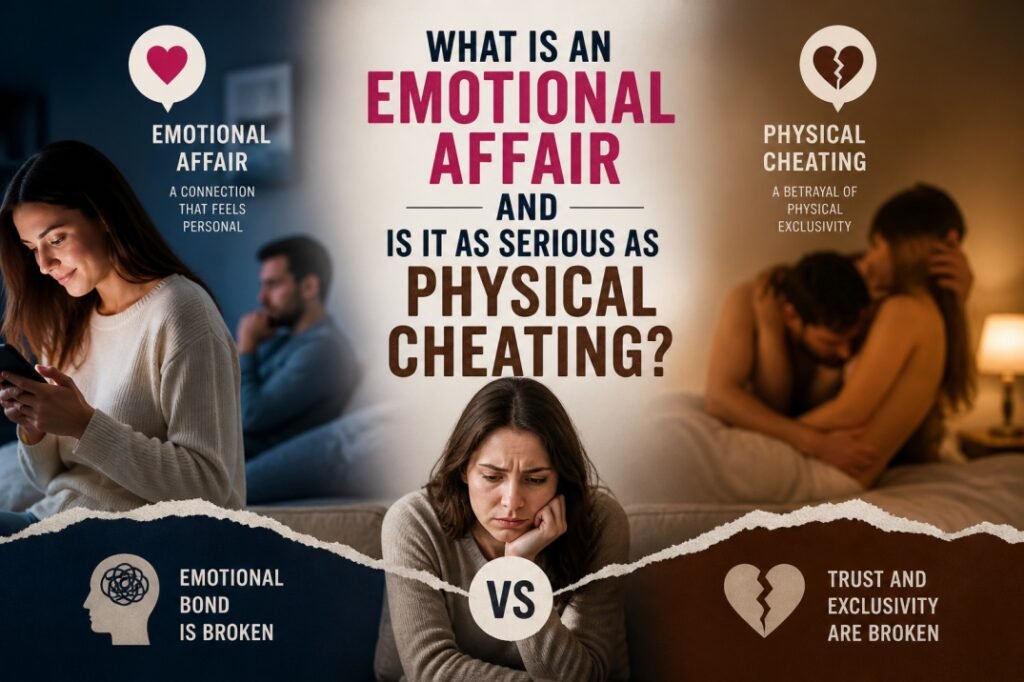
An emotional affair and physical cheating both involve crossing relationship boundaries, but the type of intimacy is different.
An emotional affair involves emotional or romantic closeness with someone outside the relationship, usually combined with secrecy, increasing emotional investment, or behaviour that begins competing with the primary relationship.
Physical cheating involves sexual or physical behaviour with another person that crosses the couple’s agreed boundaries.
Neither is automatically worse. What matters is what happened, what was hidden, which boundaries were broken, and how the betrayal affected the relationship.
What Is an Emotional Affair?
An emotional affair is more than having a close friend.
Close friendships outside a relationship are normal. The concern begins when the connection becomes secretive, romantic, emotionally dependent, or starts replacing intimacy with your partner.
Common signs include:
- regularly sharing private thoughts or relationship problems with one person
- turning to them for emotional support before your partner
- looking forward to their messages or attention
- hiding or deleting conversations
- feeling romantic or sexual attraction
- comparing them with your partner
- becoming less emotionally available at home
Cleveland Clinic notes that emotional cheating becomes different from ordinary friendship when the outside connection begins interfering with the primary relationship or is deliberately concealed.
Emotional Affair vs Physical Cheating
| Emotional Affair | Physical Cheating |
|---|---|
| Emotional or romantic intimacy | Sexual or physical intimacy |
| May involve no physical contact | Involves physical boundary crossing |
| Often grows through repeated communication | May happen once or continue over time |
| Can create a feeling of emotional replacement | Can create sexual betrayal and comparison |
| Often involves secrecy | Often involves secrecy |
| Can later become physical | Can also include emotional attachment |
The category tells you what kind of boundary was crossed. It does not tell you how seriously the betrayed partner should experience it.
When Does a Friendship Become an Emotional Affair?
A friendship usually crosses the line when secrecy, attraction, emotional dependence, or relationship displacement becomes part of it.
Ask yourself:
- Would I hide these conversations from my partner?
- Would I behave differently if my partner were present?
- Am I sharing things with this person that I deliberately avoid discussing at home?
- Do I feel romantic or sexual attraction?
- Has this person become emotionally more important than my partner in some areas?
- Would I be comfortable if my partner had the same relationship with someone else?
One sign alone does not automatically mean there is an affair. The pattern matters.
Signs of an Emotional Affair
Emotional cheating often develops through normal-looking communication.
You may notice:
- frequent texting with the same person
- private or late-night conversations
- deleting messages
- hiding notifications
- becoming defensive about the friendship
- checking repeatedly for their replies
- sharing important news with them before your partner
- thinking about them frequently
- comparing them with your partner
- feeling both excitement and guilt around the connection
- becoming less interested in conversations at home
The clearest warning signs are usually secrecy, increasing emotional investment, attraction, and decreasing intimacy with the partner.
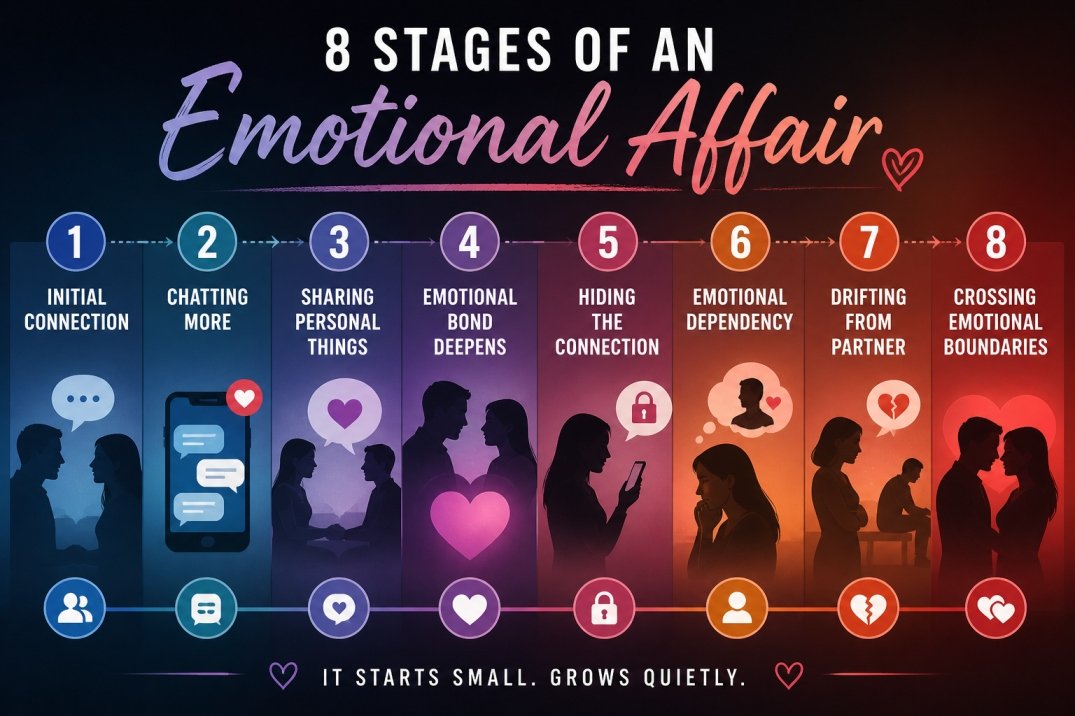
How Emotional Affairs Often Start
They do not always begin with an intention to cheat.
A colleague, ex, friend, or online contact may initially feel completely harmless. Conversations then become more frequent, more personal and eventually emotionally important.
For example, a coworker may become the person you message on WhatsApp after office hours. An old classmate or ex may reconnect through Instagram. A friend may gradually become the person you discuss every argument in your marriage with.
The important shift is not simply talking often. It is when the connection becomes private, emotionally important, and difficult to be open about with your partner.
If the person is a colleague, our guide on becoming emotionally close to a coworker explains where normal workplace friendship can begin crossing relationship boundaries.

Is Emotional Cheating Worse Than Physical Cheating?
There is no universal answer.
Emotional cheating can be especially painful because the betrayed partner may feel emotionally replaced. They may wonder why their partner was sharing thoughts, problems, affection, or attention with someone else.
Physical cheating can hurt differently because sexual exclusivity has been broken. It may lead to sexual comparison, intrusive thoughts about what happened, and questions about physical trust.
One should not be used to minimise the other.
An emotional affair is not automatically worse because feelings were involved, and physical cheating is not automatically less serious because it was “only sex.”
Both can seriously damage trust.
Can an Emotional Affair Become Physical?
Yes, but not all emotional affairs do.
When emotional intimacy, attraction and regular contact are already present, physical boundaries may later be crossed. However, some emotional affairs remain completely non-physical and still cause significant relationship damage.
The absence of sex does not make a secret romantic or emotionally dependent relationship harmless.
Is Texting Someone Else Emotional Cheating?
Not by itself.
Texting becomes more concerning when it is hidden, romantic, unusually intimate, emotionally dependent, or begins replacing communication with the partner.
Online cheating and hidden messaging can also become meaningful infidelity even when two people rarely meet in person.
Smaller secretive behaviours that have not developed into a full affair may fall closer to micro-cheating.
What to Do If You Are Having an Emotional Affair
First, stop calling it “just talking” if you already know you are hiding the relationship or crossing agreed boundaries.
Then:
- reduce or end personal contact with the outside person
- stop deleting or hiding communication
- understand what you were getting from the connection
- decide whether you genuinely want to remain in your primary relationship
- address relationship problems directly rather than through another person
If the person is a coworker or someone you cannot completely avoid, contact may need to become practical, limited and transparent rather than personal.
What to Do If Your Partner Is Emotionally Cheating
Do not focus only on whether sex happened.
Look at what was hidden, how emotionally involved they became, whether romantic feelings existed, and whether your relationship was being pushed aside.
Have one clear conversation about:
- what the relationship involved
- how long it had been happening
- what was hidden
- whether contact is continuing
- what boundaries need to change
Then watch behaviour rather than relying only on promises.
If you remain together, rebuilding trust after cheating requires consistent honesty, clear boundaries and an end to the secretive behaviour.
Can a Relationship Recover After an Emotional Affair?
Yes, recovery is possible.
It usually depends on whether the affair has genuinely ended, whether the person takes responsibility, whether secrecy stops, and whether both partners want to rebuild trust.
Relationship problems can help explain why someone felt lonely or disconnected. They do not make the betrayed partner responsible for the decision to cross boundaries.
When Couples Therapy Can Help
Professional support may help when conversations repeatedly turn into arguments, one partner keeps minimising the affair, trust is not improving, or the couple wants to repair the relationship but does not know how.
Marriage counselling for infidelity can help couples clarify what happened, agree on boundaries and work through the impact of betrayal.
Final Thoughts
The main difference between an emotional affair and physical cheating is the type of intimacy that crosses the relationship boundary.
Emotional affairs involve emotional or romantic closeness outside the relationship, often combined with secrecy. Physical cheating involves sexual or physical behaviour that violates agreed boundaries.
Neither is automatically worse.
What matters is what was hidden, which boundaries were crossed, how trust was affected and what happens next.
FAQs
Is emotional cheating still cheating if there is no physical contact?
Yes. An emotional affair does not require physical contact. It usually involves secrecy, romantic involvement, emotional dependence or a connection that begins competing with the primary relationship.
Is having a close friend emotional cheating?
No. Close friendships are normal. The concern is secrecy, romantic or sexual attraction, hidden communication, emotional dependence or behaviour that violates the couple’s agreed boundaries.
Can you love your partner and still cheat emotionally?
Yes. Someone can remain attached to their partner while crossing emotional boundaries with another person. Love does not prevent poor boundaries, secrecy or attraction to someone else.
Do emotional affairs always become physical?
No. Some emotional affairs later become physical, while others remain entirely emotional or online.
Should you end a relationship after emotional cheating?
That depends on what happened, whether the affair has ended, whether the partner takes responsibility and whether both people genuinely want to rebuild trust.