
Last Updated on July 10, 2026
Reviewed by Bipasha Sharma, Counselling & Developmental Psychologist
We work with many men and women who come in with the same concern:
“My partner is constantly chatting and calling a coworker. I keep seeing them together in office photos, working late on projects. I know this can be normal, but it feels like their attention is shifting.”
There is no clear proof of cheating.
But the pattern feels different.
They talk about this person often. They seem more engaged with them. At the same time, your connection feels slightly off.
You start overthinking. You feel uneasy when they don’t update you. You question yourself, but the feeling doesn’t go away.
The question is not just, “Are they cheating?”
It is: Has something changed in your relationship, and what does it actually mean?
Most People Ask “Are They Cheating with a Coworker?” – That’s the Wrong Question
Many of our clients ask this directly:
“Are they cheating with their coworker?”
It usually comes up when they notice how much time their partner is spending with one specific colleague. They are working late together, attending office parties, sitting next to each other, and sometimes even spending time alone outside regular work hours.
Over time, this starts to feel different. They seem more comfortable, more familiar, sometimes even a little too close. The interaction doesn’t look inappropriate on the surface, but it also doesn’t feel completely normal.
So the mind jumps to one conclusion, cheating.
But this is where clarity is important.
This kind of closeness at work is actually quite common. When people spend long hours together, solve problems, share stress, and talk regularly, a bond naturally forms. Some coworkers become good friends. Some become like siblings. Some become close support systems.
And yes, in some cases, these bonds do cross the line into emotional or physical cheating.
But you cannot label every close coworker relationship as cheating.
Closeness alone does not define what is happening. What matters is how that closeness is developing, and what it is starting to replace in your relationship.
The 3 Stages of a Coworker Relationship
Not every close coworker relationship is a problem. But they don’t all stay the same either.
What usually happens is a gradual shift. Understanding these stages helps you see where your situation actually stands.
Stage 1: Normal Work Friendship
This is common and usually not a concern.
- Interaction is open and transparent
- Your partner is comfortable mentioning them around you
- You are naturally included in conversations or even introduced if appropriate
- Conversations stay work-related or light
- There is no change in your partner’s attention towards you
- No secrecy, no defensiveness
Your partner may work closely with them, joke around, or even spend time in group settings. But your relationship still feels secure, and nothing is being hidden or replaced.
Stage 2: Emotional Drift (Danger Zone)
This is where things start to shift in a noticeable way.
- Conversations become more frequent and personal
- Your partner starts sharing updates, thoughts, or stress with them first
- They respond to them quickly, sometimes even when with you
- You hear about them often, sometimes more than expected
- Subtle prioritisation begins, their time and attention start leaning towards this person
- Slight defensiveness if you question the closeness
Nothing looks clearly inappropriate yet. There is still plausible deniability. But the emotional balance is no longer the same, and you begin to feel it.
This stage is often dismissed, but this is where most emotional affairs begin.
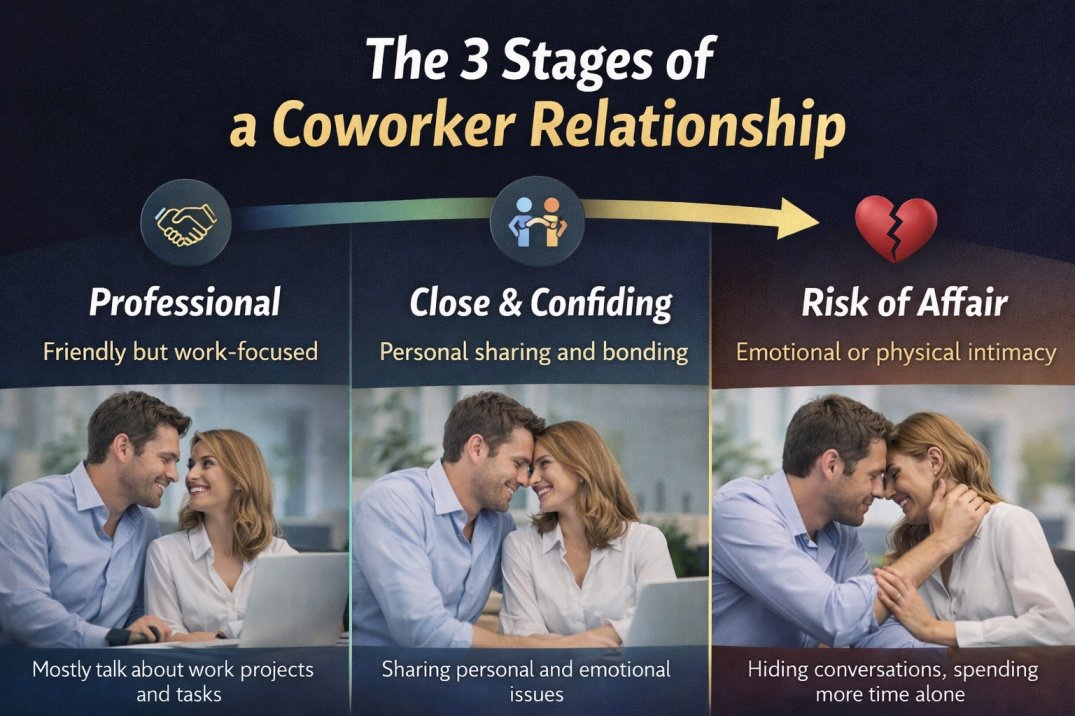
Stage 3: Emotional Affair
At this stage, the line has been crossed, even if there is no physical involvement.
- Communication becomes private, hidden, or deleted
- Your partner shares personal or intimate details with them
- They turn to them for emotional support instead of you
- There is clear prioritisation, they make time for them even at your expense
- You feel excluded, secondary, or replaced
- They may minimise the relationship or call you insecure when questioned
This is no longer just closeness. The emotional space that belongs to your relationship is now being shared or shifted outside of it.
The key is not to label everything as cheating immediately.
The key is to recognise which stage the relationship is in, because that determines how serious it is and what needs to be addressed.
Where Does Your Situation Fall? (Quick Self-Check)
Look at behaviour, not assumptions.
- Who do they share things with first, you or the coworker?
- Where does their attention go during the day?
- How do they react when you bring this up, open or defensive?
- Is anything being hidden, even small things?
- Do you feel included in that part of their life, or pushed out of it?
Now read this clearly:
- If nothing feels hidden and your place in their life hasn’t changed → this is likely normal.
- If attention and emotional sharing are slowly shifting → this is emotional drift.
- If you feel replaced, excluded, or there is secrecy → this is no longer just friendship.
Do not focus on one incident.
Focus on the direction of change.
Why People Often Get Too Close to Coworkers (And Why Office Affairs Are Common)
This happens because the brain shifts attachment based on frequency, reward, and ease. The coworker becomes emotionally relevant through daily interaction, not intention.
- Familiarity effect → seeing and interacting daily increases liking automatically
- Emotional pairing → stress + problem-solving together creates a strong bond quickly
- Immediate reward loop → fast replies and attention release dopamine, making the interaction addictive
- Lower resistance → no responsibilities or conflicts in that space, so it feels easier than the relationship
- Attention shift → they start thinking about, messaging, and sharing with that person first
- Silent comparison → coworker feels engaging, partner feels routine
- Gradual boundary erosion → more time alone, more personal talk, less awareness of limits
- Cognitive justification → “nothing physical” reduces guilt, so behaviour continues
- Secrecy as protection → hiding starts when they know it may look wrong but don’t want to stop
- Emotional displacement → support, validation, and connection move outside the relationship
- Risk perception drops → it no longer feels like “cheating,” it feels like a normal ongoing connection
That’s the mechanism. Not sudden cheating, but a shift in attention, reward, and emotional reliance that lowers resistance over time.
Workplace Affairs Are More Common Than People Think
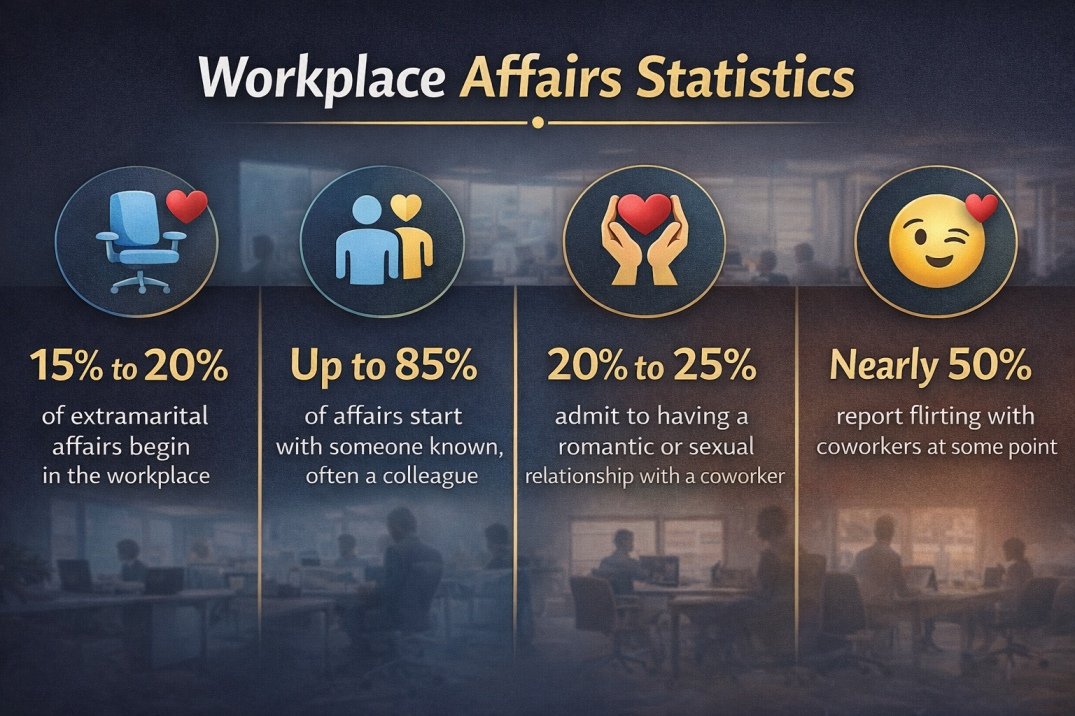
Workplace connections are one of the most common starting points for affairs.
- Over 60% of adults have had a workplace romance at some point
- 40% admit to having cheated on an existing partner with a coworker
- 50% of employees report flirting with coworkers
- 43% have married someone they worked with
Source: Forbes
Clear Signs Your Partner Is Cheating with a Coworker
Watch for patterns like these:
- Work routine changes → frequent late nights, vague meetings, sudden trips
- Phone secrecy → hiding screen, muted notifications, private calls
- One person stands out → constant mention of the same coworker
- Defensive reactions → avoids answers, says “you’re overthinking”
- Appearance shift → extra grooming or effort specifically for work
- Emotional distance → less sharing, less engagement at home
- Priority shift → replies to them quickly, even when with you
- Reduced transparency → no invites, avoids introducing you to them
- Inconsistencies → small gaps, mismatched details, unclear timelines
It’s not one sign; it’s the pattern that matters.
What This Says About Your Relationship (Hard Truth)
This is not just about the coworker. It points to what is happening inside your relationship.
- Unmet emotional needs
Your partner is getting attention, validation, or understanding outside because something is missing or not being expressed clearly at home. - Communication gap
Conversations between you have become limited, surface-level, or avoidant, while they are communicating more openly with someone else. - Emotional disconnection
The bond has weakened. They feel more engaged, heard, or comfortable elsewhere than in the relationship.
This does not justify cheating.
But it explains why the shift happens, and why ignoring it usually makes things worse.
What to Do Without Pushing Them Away
Do not start with accusations. If you go in saying “you’re cheating” or “something is going on,” the conversation will turn defensive immediately, and you will get denial instead of clarity.
Be clear about what is actually bothering you. Focus on specific behaviour you have noticed and how it is affecting you, not assumptions. Keep it grounded.
You can say something simple and direct like:
“I’ve noticed you’ve been spending a lot of time and energy with this person. I’m not accusing you, but it’s making me uncomfortable. I need clarity on what’s going on.”
Then pay attention to how they respond. The goal is not just what they say, but whether they are open, calm, and willing to address it, or defensive and dismissive.
If They Dismiss You or Call You Insecure
If they respond with “you’re overthinking” or “you’re being insecure,” it usually means they are avoiding the issue. It does not confirm cheating, but it shows they are not taking your concern seriously.
In that moment, do not escalate. Stay calm and repeat your point clearly:
“This is not about being insecure. This is about something that is affecting me and our relationship.”
If this pattern continues, especially along with secrecy or behaviour changes, you should take it seriously. Repeated dismissal means the situation is being minimised instead of addressed, and that is where problems tend to grow.
When to Seek a Marriage Counsellor
- Repeated arguments about the same coworker with no resolution
- Your partner dismisses or avoids your concerns
- Ongoing secrecy, defensiveness, or behaviour changes
- You feel increasing anxiety, doubt, or emotional distance
- Communication is breaking down or turning into conflict
If these patterns continue, it is time to involve a neutral third person.
Working with an online marriage counsellor at LeapHope can help you address the issue early, understand what is actually happening, and prevent further damage to the relationship.
The Bottom Line
Not every close coworker relationship is cheating. But it is also not always harmless.
When your partner starts giving more time, attention, and emotional space to someone else, that is where the problem begins.
The issue is not just what they are doing, but what is changing in your relationship because of it.
If there is no secrecy, no shift, and no emotional distance, it is likely normal.
But if you are seeing repeated behaviour, reduced connection, and avoidance when you ask, then something needs to be addressed.
Do not ignore the pattern.
FAQs
How do I know if my partner’s coworker relationship has crossed a line?
Look at direction, not a single moment. If your partner is still open about the friendship, includes you naturally, and nothing feels hidden, it’s likely still normal. The shift to watch for is emotional, when they start sharing things with the coworker first, responding to them faster than they do to you, or getting defensive if you bring it up at all.
Is it wrong to feel jealous of my partner’s coworker?
No, jealousy here isn’t the problem, it’s information. It usually means you’ve noticed a real shift in attention or closeness, even before you can point to specific proof. The goal isn’t to suppress the feeling, it’s to check it against actual behaviour rather than acting on the feeling alone.
What if my partner says I’m just insecure?
That response doesn’t confirm or deny cheating, but it does tell you they’re not taking the concern seriously. Repeating your point calmly, without escalating, matters more here than trying to win the argument in that moment. If the dismissal continues alongside secrecy or continued behaviour changes, that pattern is worth addressing directly rather than absorbing.
Should I ask my partner to stop being friends with the coworker?
Usually not as a first move. Cutting off the friendship outright can feel like control rather than resolution, and it doesn’t address what’s actually shifted in your relationship. A more effective approach is naming what’s changed for you and asking for transparency, rather than demanding the friendship end.
Can a relationship recover if it was an emotional affair, not a physical one?
Yes, emotional affairs are recoverable, but they still need to be treated seriously, not minimised because nothing physical happened. Recovery typically requires the partner to acknowledge the emotional shift honestly, rebuild transparency, and reinvest the attention and openness that had moved elsewhere back into the relationship.