
At LeapHope, couples struggling with money differences often arrive believing their problem is spending. In reality, the conversation quickly becomes much deeper.
- “I feel like I’m the only one thinking about our future.”
- “Why does every purchase turn into an argument?”
- “We can afford it, but my partner still makes me feel guilty for spending money.”
- “How can we build a future together when we have completely different attitudes toward money?”
These conversations are common in saver-spender marriages. One partner finds comfort in saving and planning ahead, while the other believes money should also be used to enjoy life. Neither perspective is necessarily the problem. The challenge begins when these differences create repeated arguments, resentment, criticism, or emotional distance.
In this article, our marriage therapists explain why saver and spender couples often clash, how these differences affect relationships, and what couples can do to create a healthier financial partnership without constantly fighting about money.
What Is a Saver-Spender Marriage?
A saver-spender marriage is a relationship where partners have different attitudes toward money. One partner feels more comfortable saving and planning ahead, while the other prefers spending on experiences, convenience, hobbies, or things that improve everyday life.
These differences may seem small at first, but they often become more noticeable after marriage when couples start making financial decisions together.
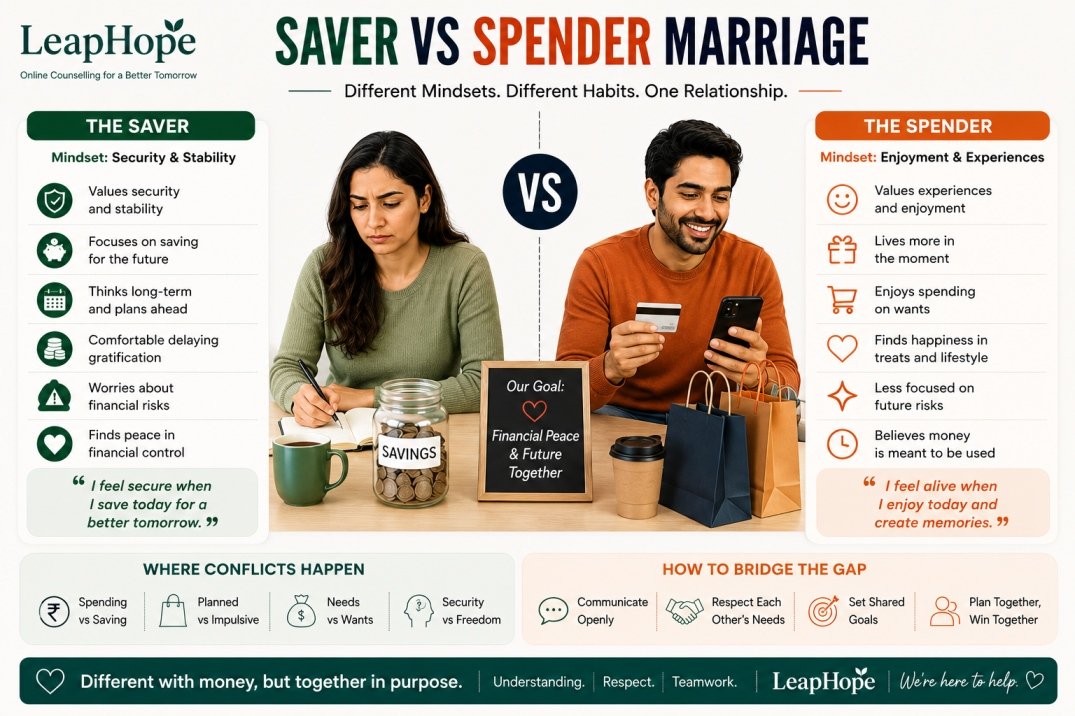
Common Traits of Savers
Savers often:
- plan before spending
- prioritise savings and future goals
- prefer financial security
- track expenses carefully
- feel uneasy about unnecessary purchases
Common Traits of Spenders
Spenders often:
- enjoy using money in the present
- value experiences and quality of life
- make more spontaneous purchases
- prefer flexibility over strict budgets
- believe money should be enjoyed, not just saved
Why Saver and Spender Couples See Money So Differently
The Money Messages You Learned Growing Up
Many of our attitudes toward money are formed long before we enter a relationship. Someone who grew up in a financially uncertain household may feel safer saving and planning ahead, while someone raised in a family that valued experiences and enjoyment may feel more comfortable spending.
Today’s couples are also influenced by social media, lifestyle trends, rising living costs, and different views about what financial success should look like. As a result, one partner may see saving as security, while the other sees spending as a way to enjoy life. These differences can easily create conflict when financial decisions need to be made together.
Opposites Often Attract in Relationships
Many people wonder how a saver and a spender end up together in the first place. The answer is that the qualities which create tension later are often the same qualities that attract people at the beginning of a relationship.
A saver may be drawn to a partner’s spontaneity, generosity, and ability to enjoy life. A spender may admire a partner’s responsibility, stability, and long-term thinking. These differences can create a sense of balance and complement each other’s strengths.
However, once couples start sharing financial responsibilities, the same traits that once felt attractive can become sources of frustration. The spender may begin to see the saver as overly cautious, while the saver may view the spender as financially careless. Without understanding each other’s perspective, these differences can gradually lead to conflict.

How Social Media and Lifestyle Pressure Influence Spending Decisions
Today’s couples are exposed to financial influences that previous generations rarely faced. Social media algorithms constantly promote luxury holidays, expensive restaurants, home upgrades, designer products, and influencers encouraging people to “live in the moment” or “treat yourself because life is short.” Food delivery apps, one-click shopping, and buy-now-pay-later options make spending easier than ever.
For some people, these messages reinforce the idea that money should be used to enjoy life now. Others are more cautious. They recognise that life can change unexpectedly through a job loss, medical emergency, business setback, or other financial challenge. Saving money helps them feel prepared for those realities.
Neither perspective is unusual. However, when one partner is influenced more by present-day enjoyment and the other is focused on future security, disagreements about spending decisions can become increasingly common.
The Real Reason Saver and Spender Couples Fight About Money
Security vs Freedom
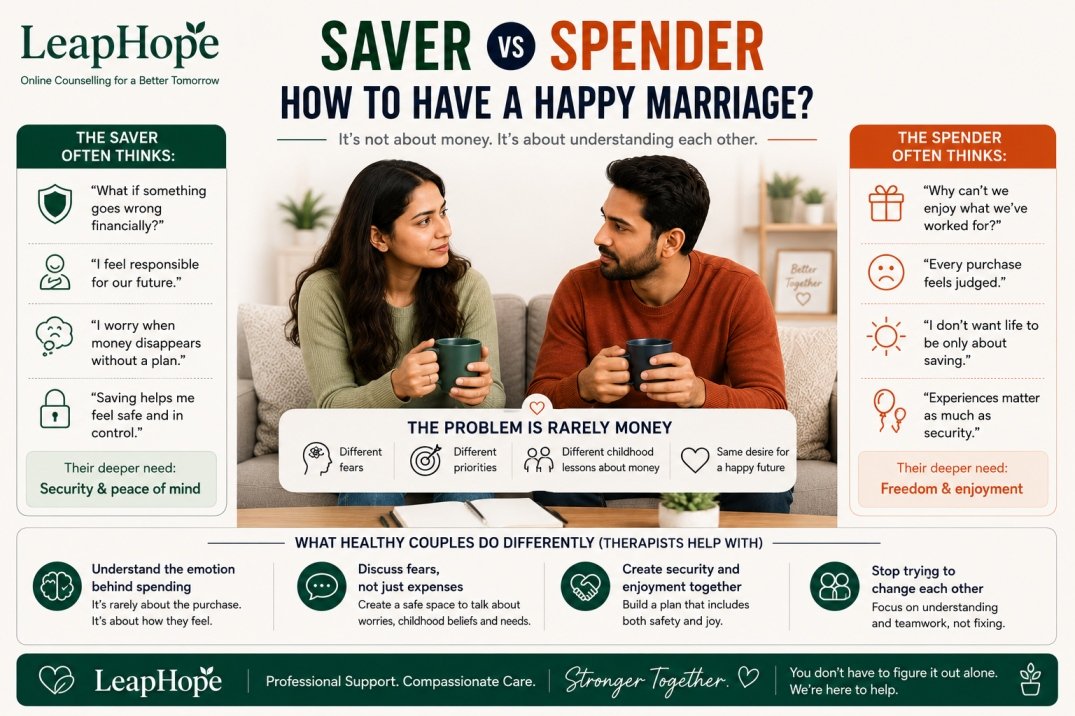
A saver may see an expensive holiday and immediately think:
“What if one of us loses our job next year?”
The spender may look at the same holiday and think:
“We’ve worked hard all year. Why can’t we enjoy our money?”
Neither person is necessarily being unreasonable. They are simply viewing the same decision through completely different lenses. One is focused on protection from future uncertainty, while the other is focused on making life enjoyable today.
Future Planning vs Living in the Present
One partner may be excited about increasing investments, building an emergency fund, or paying off a mortgage early.
The other may wonder:
“What’s the point of earning well if we’re constantly saying no to things we enjoy?”
This tension is common among today’s couples. Many are balancing financial goals with a desire to travel, pursue hobbies, create memories, and enjoy experiences while they are young enough to do so. Problems arise when one partner feels the future is being ignored, while the other feels life is constantly being postponed.
Financial Accountability vs Personal Freedom
One of the most common complaints we hear is:
“Why do I need to justify every purchase?”
At the same time, the other partner may say:
“Why am I always the last person to know money has been spent?”
A saver may view financial discussions as responsible teamwork. A spender may experience the same conversations as criticism or surveillance.
Over time, arguments stop being about the actual amount spent and become arguments about trust, independence, and respect within the relationship.
Anxiety vs Enjoyment
Many savers are not trying to control their partner. They are trying to manage their own fears.
Unexpected expenses, economic uncertainty, layoffs, health issues, and family responsibilities can feel very real to them. Saving money helps reduce those worries.
Many spenders are not trying to be irresponsible. They simply believe life should include enjoyment, comfort, experiences, and moments worth remembering.
This difference is especially visible today. Social media encourages people to travel more, upgrade more, and enjoy more. At the same time, rising living costs and economic uncertainty remind many people how quickly circumstances can change.
As a result, one partner may be asking:
“What if something goes wrong?”
while the other is asking:
“What if we’re so busy preparing for life that we forget to actually live it?”
That’s often the real conflict underneath the money arguments.
Signs Your Saver-Spender Dynamic Is Hurting the Relationship
Occasional disagreements about money are normal. However, the saver-spender dynamic may be affecting your marriage if you notice patterns such as:
- Having the same argument about spending over and over again without reaching a solution.
- Feeling criticised whenever you spend money or frustrated whenever your partner spends money.
- Constantly checking bank accounts, transactions, or purchases because trust is becoming an issue.
- Feeling like you need permission before making even small personal purchases.
- Hiding online orders, purchases, subscriptions, or expenses to avoid conflict.
- Avoiding conversations about money because they almost always end in an argument.
- Keeping score of who spends more or who sacrifices more financially.
- Feeling more like a parent and child than equal partners when discussing finances.
- Growing resentful because you believe your partner does not understand your concerns or priorities.
- Living in the same home and sharing the same financial responsibilities, yet feeling emotionally disconnected from each other.
When these patterns continue for months or years, the issue is no longer just about money. It can begin to affect trust, communication, emotional intimacy, and overall relationship satisfaction.
How Healthy Couples Manage Different Spending Styles: A Psychologist’s Perspective
Discuss Financial Values, Not Just Purchases
Arguments about money often focus on specific transactions.
- a holiday
- a shopping purchase
- an expensive hobby
- an online order
However, these arguments are usually about something deeper.
One partner may be seeking security and predictability. The other may be seeking enjoyment, freedom, or a sense of reward after working hard.
Healthy couples learn to move beyond discussing what was purchased and begin exploring what money represents to each person. When partners feel understood rather than judged, conversations become less defensive and more productive.
Create Shared Financial Goals
Research consistently shows that couples function better when they feel they are working toward common goals rather than competing priorities.
A saver may focus heavily on financial security, while a spender may focus on creating enjoyable experiences and memories. Neither goal is inherently wrong, but problems arise when partners begin protecting their own priorities instead of building a shared vision together.
Healthy couples regularly discuss questions such as:
- What kind of life are we trying to create?
- What matters most to us as a family?
- What are we saving for?
- What experiences do we want to enjoy together?
Shared goals reduce the tendency to see each other as opponents.
Build a Plan That Includes Both Saving and Enjoyment
Many conflicts occur because couples unconsciously believe only one perspective can win.
The saver worries that spending today will create problems tomorrow.
The spender worries that endless saving will prevent them from enjoying life in the present.
Healthy couples avoid this all-or-nothing mindset. Instead of choosing between security and enjoyment, they intentionally make room for both. This reduces feelings of deprivation on one side and anxiety on the other.
Set Personal Spending Boundaries Without Guilt
Many people need a degree of financial autonomy to feel respected within a relationship.
Problems often emerge when every purchase becomes subject to approval, criticism, or justification. Over time, this can create shame, secrecy, and resentment.
Healthy couples establish clear expectations around spending while allowing each partner some freedom to make personal choices. This supports individual independence without undermining shared financial responsibilities.
Schedule Regular Money Conversations
Money conversations often happen at the worst possible moments.
After an unexpected purchase.
During financial stress.
In the middle of an argument.
When emotions are already high.
From a psychological perspective, people process information poorly when they feel threatened, criticised, or defensive. Healthy couples create dedicated times to discuss finances when both partners are calm and emotionally available. These conversations tend to be more collaborative because neither person feels ambushed.
Stop Trying to Change Each Other’s Personality
One of the most powerful shifts in therapy occurs when couples stop viewing their differences as flaws that need fixing.
The goal is not to turn a spender into a saver or a saver into a spender.
Healthy relationships recognise that both perspectives bring value. Savers often contribute planning, stability, and long-term thinking. Spenders often contribute flexibility, enjoyment, and a focus on living in the present.
When couples stop trying to change each other and start learning from each other, money becomes less of a battleground and more of an opportunity for teamwork and growth.
Can a Saver and a Spender Have a Happy Marriage?
Yes, a saver and a spender can have a happy marriage. Different spending habits do not automatically create relationship problems. The real challenge is how couples communicate about money, handle disagreements, and make financial decisions together.
When money arguments become frequent, create resentment, or start affecting trust and emotional connection, professional support can help. LeapHope’s online marriage counseling for financial issues helps couples understand each other’s money mindset, improve communication, and find practical solutions that work for both partners.
When to Consider Marriage Counselling for Money Conflicts
It may be time to seek professional support if:
- You keep having the same money arguments without resolution.
- Financial disagreements are creating resentment or emotional distance.
- One or both partners are hiding purchases or financial decisions.
- Conversations about money regularly end in conflict.
- Money issues are making you question the future of the relationship.
At LeapHope, our online marriage counseling helps couples improve communication, rebuild trust, and develop healthier ways of managing money together. We support couples across India, the USA, the UAE, Australia, Singapore, Italy, the UK, Canada, and worldwide.
Conclusion
Money is rarely the real problem. What couples often struggle with is feeling unheard, misunderstood, or alone in their concerns.
The saver may be trying to create security. The spender may be trying to create a life worth enjoying. Neither intention is wrong.
Problems begin when partners stop listening to each other and start defending their own position. A healthy marriage does not require identical spending habits.
It requires understanding, respect, and the ability to make important decisions together.
When couples learn to see the person behind the financial behaviour, money becomes less of a battleground and more of a conversation about the future they want to build together.