- “My husband has had a hard time finding work and I’ve started to lose respect for him.”
- “My spouse was laid off months ago and I feel like I’m carrying everything by myself.”
- “I work two jobs, manage the children, and handle most of the household responsibilities. I’m exhausted.”
- “I’ve applied for hundreds of jobs and still have nothing to show for it.”
- “My partner says they’re trying, but nothing seems to be changing.”
- “Should I keep supporting my spouse, or is it time to think about leaving?”
At LeapHope, these are some of the concerns we hear from couples after a job loss. While unemployment is often viewed as a financial challenge, many couples discover that it affects much more than income. Confidence can suffer, future plans may be put on hold, communication can become strained, and feelings of frustration, guilt, resentment, or hopelessness may begin affecting the relationship itself.
The good news is that these struggles are more common than many couples realise and do not automatically mean a marriage is failing. Understanding how job loss affects both partners can help couples navigate this difficult period with greater empathy, healthier communication, and a stronger sense of teamwork.
The Types of Couples We Often Meet in Marriage Counselling After a Job Loss
At LeapHope, we meet many couples whose relationships have been affected by unemployment, including:
- Couples trying to adjust after a recent layoff or unexpected job loss
- Couples struggling after months of unsuccessful job searching and growing uncertainty
- Couples where one spouse feels overwhelmed by responsibilities while the other feels discouraged or left behind
- Couples experiencing frustration, resentment, loss of respect, or doubts about the future of the relationship
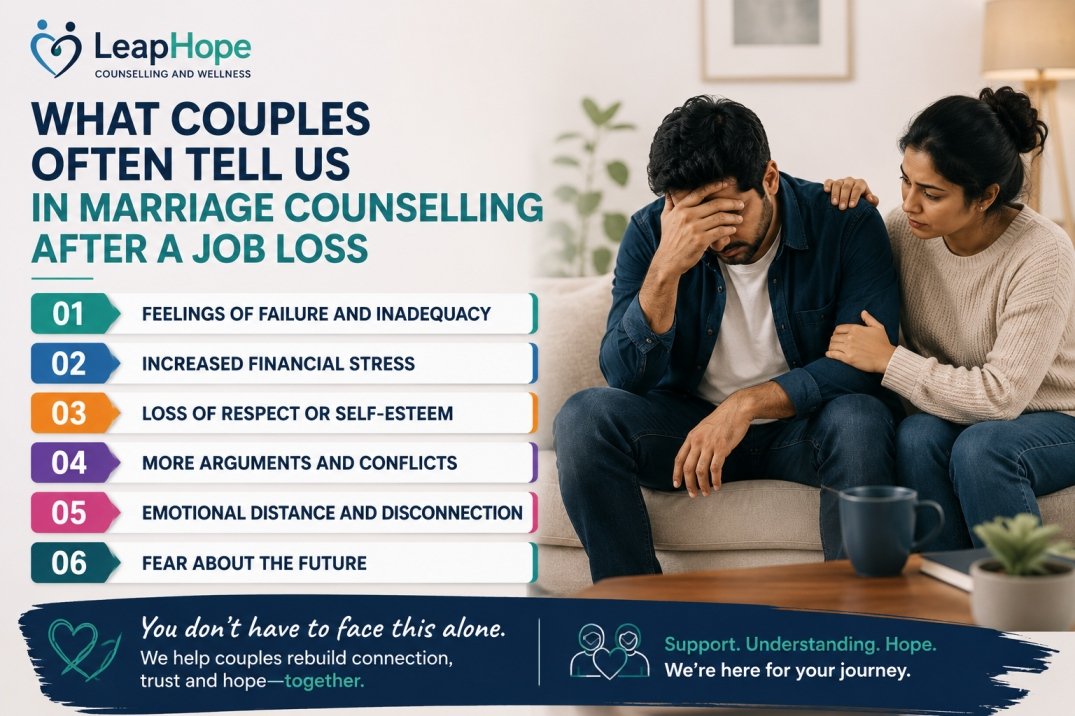
What Couples Often Tell Us in Marriage Counselling After a Job Loss
I Feel Like I’m Carrying Everything By Myself
When one spouse loses their job, the other may end up carrying most of the financial burden. Some take on two jobs, manage the household, care for the children, and worry about paying the bills while their partner keeps saying they are trying, there are no jobs available, or nothing is working out.
This may be manageable for some time. However, when unemployment continues for months or years, many spouses start feeling like they are carrying not only the family’s finances but the entire relationship. Over time, this can create bitterness, resentment, anger, feelings of being used, and emotional exhaustion, deeply affecting the spouse’s emotional and psychological wellbeing.
I Feel Like a Failure
We hear this from both husbands and wives after a job loss.
Many husbands tell us they feel they are failing as providers and letting their family down. Many wives say they feel guilty that they can no longer contribute financially or continue building the career they worked hard for.
Over time, unemployment can damage confidence, create self-doubt, and leave people questioning their value and future. These feelings often spill into the relationship, making communication, emotional connection, and intimacy more difficult.
I Don’t Think My Partner Understands What I’m Going Through
Job loss affects both spouses, but often in very different ways. The unemployed partner may be dealing with rejection, uncertainty, and fear about the future. The working partner may be carrying financial pressure, extra responsibilities, and constant worry about keeping the household stable.
Because their struggles are different, many couples start feeling misunderstood. One spouse may think, “You have no idea how hard this is for me,” while the other feels, “You don’t understand the pressure I’m under either.” Over time, this lack of understanding can create frustration, emotional distance, and repeated arguments.
I Know My Spouse Is Trying, But I’m Exhausted
We hear this from many husbands and wives who have spent months supporting an unemployed spouse. They can see their partner applying for jobs, attending interviews, and dealing with rejection, but they are also living with the reality that the situation is not improving.
Many describe feeling trapped between compassion and exhaustion. They want to be supportive, yet they are tired of carrying the financial pressure, putting plans on hold, and wondering when things will finally change. Over time, this emotional exhaustion can turn into frustration, resentment, and a growing sense of hopelessness about the future.
I’ve Started Losing Respect for My Spouse
Some wives tell us they no longer respect their husbands the way they once did. They feel disappointed watching their husband remain unemployed for months or years while they carry most of the financial responsibility. Some question whether he is trying hard enough, while others feel he has become too comfortable with the situation.
Some husbands share similar concerns about their wives. They may feel frustrated when their spouse gives up on rebuilding a career, stops contributing in meaningful ways, or seems unwilling to move forward.
For many couples, the loss of respect is not caused by the job loss itself. It develops when one spouse begins believing the other is no longer showing the effort, responsibility, determination, or partnership they expect in a marriage. Over time, this can affect attraction, intimacy, communication, and the overall quality of the relationship.
We Never Used to Fight Like This
Many couples tell us they rarely argued before the job loss. As unemployment continues, disagreements about money, household responsibilities, job searching, or future plans can quickly turn into blame, criticism, and defensiveness.
Some couples also struggle with a growing power imbalance. The spouse earning the income may start making most financial decisions, while the unemployed partner may feel dependent, judged, or treated as less of an equal. Over time, these tensions can make conflicts more frequent and harder to resolve.
We Stopped Talking About Our Future
Many couples tell us they stopped talking about buying a home, having children, relocating, retiring, travelling, or other plans they once looked forward to together.
When unemployment continues, the future can start feeling uncertain. Some couples avoid these conversations because they are painful. Others stop making plans altogether because they no longer know what is realistically possible.
Over time, the relationship can become focused on getting through the next week or month rather than building a shared future together.
Should I Stay or Should I Leave?
This is one of the hardest questions some spouses ask after a long period of unemployment.
For many, the issue is no longer the job loss itself. They are questioning whether they can continue living with the resentment, financial pressure, broken promises, repeated instability, or feeling that they are carrying the relationship alone.
Some wonder if their spouse is genuinely struggling and doing their best. Others feel their partner has stopped taking responsibility, stopped trying, or become comfortable with the situation. When these doubts grow over time, some people begin questioning the future of the marriage itself.
You can try LeapHope’s online marriage counselling for financial issues to gain greater clarity, guidance, and confidence before making a decision about the future of your relationship.
How Psychologists Help Couples Deal With Job Loss
Breaking the Blame Cycle
Many couples become trapped in repetitive arguments:
You are not trying hard enough.
You have no idea how much pressure I’m under.
A psychologist helps identify these negative interaction patterns and teaches couples how to discuss concerns without criticism, defensiveness, or personal attacks.
Addressing Shame, Guilt, and Loss of Identity
Many unemployed spouses begin linking their self-worth to their employment status. Therapists often use Cognitive Behavioural Therapy (CBT) techniques to challenge unhelpful beliefs such as:
I’m a failure.
My family would be better off without me.
My spouse no longer respects me.
Rebuilding Respect and Emotional Safety
When resentment or disappointment has developed, therapy focuses on helping partners express concerns honestly without humiliation, contempt, or blame. Couples learn how to discuss effort, responsibility, and expectations in ways that protect respect within the relationship.
Creating Clear Agreements Around Responsibilities
Instead of making assumptions, psychologists help couples have direct conversations about finances, job searching, childcare, household duties, and family responsibilities. Clear agreements often reduce conflict and prevent misunderstandings.
Improving Communication During High-Stress Periods
Many couples stop listening and start reacting. Therapists use communication exercises, active listening techniques, and structured conversations to help partners discuss difficult topics without escalating into arguments.
Strengthening the Sense of Partnership
One of the main goals of therapy is helping couples move away from a provider-versus-dependent dynamic and return to feeling like a team facing the problem together. This often involves rebuilding trust, improving emotional connection, and focusing on shared goals rather than individual frustrations.
Should You Stay or Leave After a Job Loss?
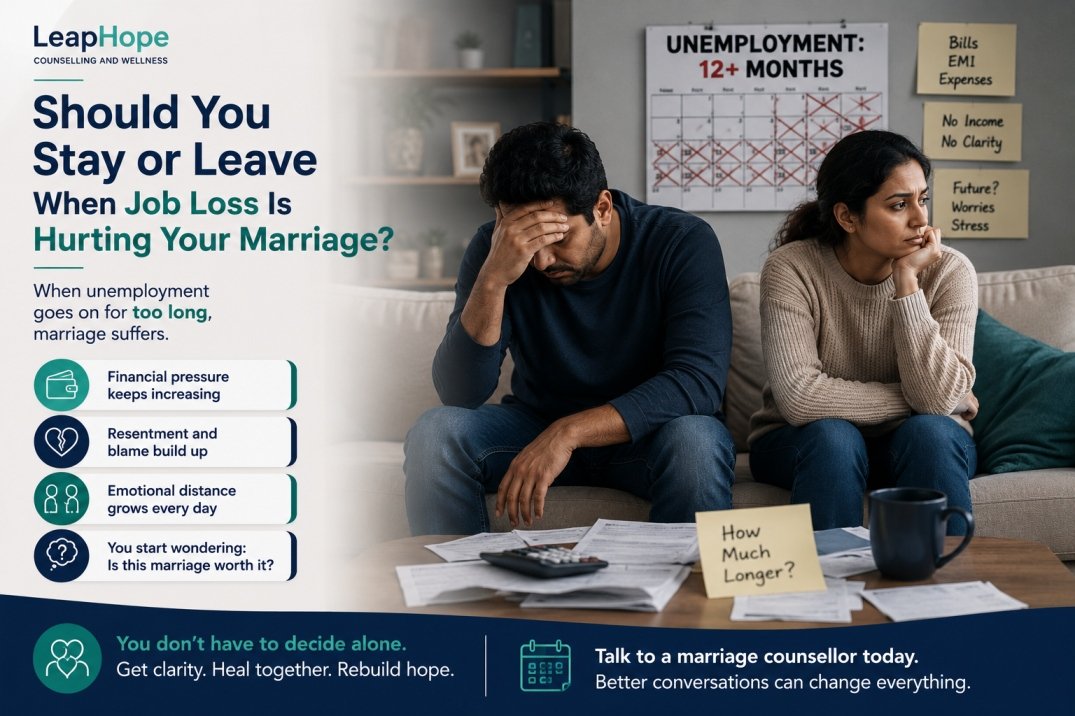
Job loss alone is rarely the reason a marriage ends. Many couples face unemployment, financial uncertainty, and career setbacks and eventually rebuild their lives together.
The more important question is how both partners respond to the situation. Are you supporting each other, communicating honestly, sharing responsibilities, and working toward solutions? Or are resentment, blame, avoidance, broken promises, and loss of respect becoming the norm?
Before making a life-changing decision, give yourself time to separate the stress of unemployment from the overall health of the relationship. If both partners remain willing to work together, seek solutions, and support each other through the uncertainty, many marriages can recover from even difficult circumstances.
At the same time, this is your relationship and your decision. No article, friend, family member, or therapist can decide whether you should stay or leave. What counselling can provide is clarity, helping you understand whether you are dealing with a temporary crisis or deeper relationship issues that need attention.
When Marriage Counselling May Help
Marriage counselling may help if:
- You keep having the same arguments about money, work, or responsibilities.
- Emotional distance, resentment, or loss of respect is growing.
- Job loss is affecting confidence, motivation, or mental health.
- You feel stuck and don’t know how to move forward as a couple.
- Discussions about separation or divorce have started becoming more frequent.
At LeapHope, we provide online marriage counselling for couples dealing with unemployment, career setbacks, financial stress, and relationship difficulties. If job loss has affected your confidence, anxiety levels, or emotional wellbeing, individual online therapy can also provide valuable support during this difficult period.
The Bottom Line
At LeapHope, we are seeing more couples seek help after layoffs, unemployment, and career setbacks across the USA, UK, Canada, Australia, UAE, India, and many other countries. In cities such as Mumbai, Bengaluru, Dubai, Sharjah, and Umm Al Quwain, many families now rely on two incomes, making job loss a relationship challenge as well as a financial one.
While husbands often struggle with feelings of failure, loss of confidence, and pressure to provide, wives frequently describe exhaustion, resentment, and the stress of carrying greater financial and family responsibilities. These reactions are more common than many couples realise.
The good news is that job loss does not have to define a marriage. With the right support, honest communication, and a willingness to face the challenge together, many couples successfully rebuild stability, trust, and hope for the future.