

“My husband keeps making bad financial decisions.”
At LeapHope, our marriage therapists hear this concern from wives across different countries, cultures, and stages of marriage.
Some describe husbands who repeatedly create financial instability despite earning well. Others feel frustrated by impulsive spending, risky decisions, broken promises, or the constant feeling that they are the only person thinking about the family’s future.
What many women eventually discover is that financial irresponsibility affects far more than a bank account.
It can quietly influence trust, emotional security, attraction, family stability, and even the long-term future of a marriage.
In this article, our marriage therapists explain the signs of a financially irresponsible husband, how these behaviours affect wives emotionally, whether meaningful change is possible, and what you can do to protect both your marriage and your peace of mind.
What Does a Financially Irresponsible Husband Look Like?
A financially irresponsible husband is not necessarily someone who struggles to earn money. In many marriages, the husband may have a stable job, a successful career, or even a high income. The problem is often not how much money comes into the household, but how financial decisions are made.
While every situation is different, there are certain patterns that appear repeatedly in marriages affected by financial irresponsibility.
Common Behaviours
- Making large purchases without discussing them with his spouse
- Repeatedly accumulating debt despite previous financial difficulties
- Ignoring financial agreements made as a couple
- Depending on his wife or other family members to fix financial mistakes
- Refusing to discuss money openly or becoming defensive when the topic is raised
- Living as though consequences do not exist until a crisis occurs
- Constantly upgrading his lifestyle despite financial strain
- Relying on future income, promotions, bonuses, or business opportunities to solve today’s problems
- Promising to change but continuing the same behaviours
- Hiding spending, debt, loans, or financial decisions from his spouse
Many wives describe a husband who always seems focused on the next purchase, the next opportunity, or the next lifestyle upgrade, while they are focused on keeping the family financially stable.
Financial Irresponsibility Isn’t Always About Low Income
One of the biggest misconceptions about financial irresponsibility is that it only affects families with limited income.
In reality, some financially irresponsible husbands earn very good money. Yet their families still experience financial stress because spending, poor planning, impulsive decisions, or a lack of accountability consume whatever income comes in.
In today’s world, this problem can become even more complicated. Smartphones, one-click shopping, credit cards, EMIs, Buy Now Pay Later schemes, and social media pressure make it easier than ever to spend money and justify unnecessary purchases.
That is why financial irresponsibility is rarely just a money problem. It is often a pattern of decision-making that affects trust, stability, and the overall health of a marriage.
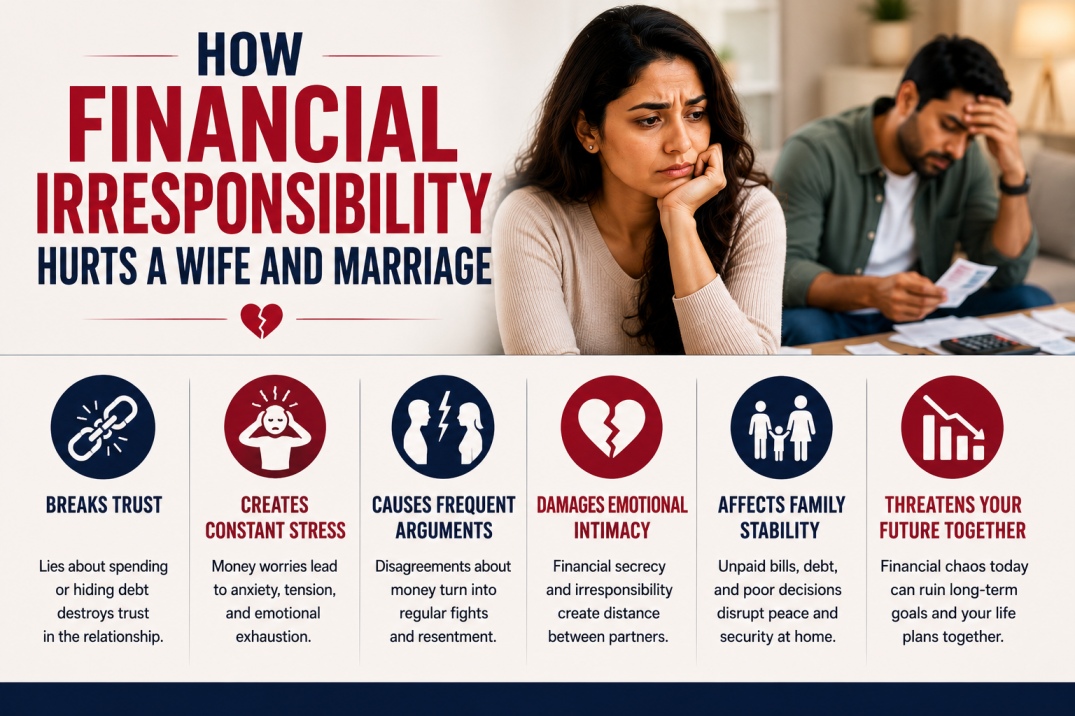
How Financial Irresponsibility Hurts a Wife and Marriage
Chronic Anxiety
One of the most common experiences wives describe is a constant sense of worry.
While their husband may move on from a poor financial decision, they are often left thinking about bills, emergencies, children’s future, retirement, and what could happen if a financial crisis suddenly arises.
Over time, this creates ongoing anxiety. Many wives feel they can never fully relax because they are always preparing for the next financial problem while trying to keep the family’s future secure.
Emotional Exhaustion
Many wives describe feeling emotionally exhausted rather than simply stressed.
When one partner is constantly planning ahead, fixing problems, managing financial crises, and worrying about the future, it becomes difficult to switch off and feel at peace.
Over time, carrying that responsibility alone can lead to burnout, resentment, and the feeling that there is never a chance to truly relax.
Loss of Trust
Trust is not only about faithfulness.
It is also about knowing your partner will make responsible decisions when life becomes difficult.
When a husband repeatedly breaks financial promises, hides spending, ignores agreements, or continues making the same mistakes, trust slowly begins to erode.
Over time, many wives stop asking, “Will he change?” and start wondering, “Can I truly rely on him when my family needs him most?”
Loss of Respect
Many wives continue loving their husbands, but slowly begin losing respect for their judgement and decision-making.
When the same financial mistakes happen repeatedly, promises are broken, and responsibility is avoided, it becomes difficult to view a partner as dependable and mature.
Over time, a wife may start questioning whether her husband can be trusted to protect the family’s future. This loss of respect often creates emotional distance and can gradually affect both connection and intimacy within the marriage.
Feeling More Like a Parent Than a Partner
One of the most common complaints heard in marriage counselling is:
“I feel like I’m raising another child.”
Instead of feeling like an equal partner, many wives find themselves becoming the planner, the reminder, the bill manager, and the person responsible for solving every financial crisis.
When one spouse repeatedly creates problems and the other is left fixing them, the relationship can slowly shift into a parent-child dynamic. Over time, this often leads to frustration, resentment, and emotional distance.
Many wives still love their husbands, but they no longer feel supported by them. As the sense of partnership weakens, attraction and intimacy often begin to suffer as well.
Why Financial Irresponsibility Feels More Dangerous Today
Financial irresponsibility has always created challenges in marriage, but many wives feel the consequences more intensely today than ever before.
Spending Has Never Been Easier
A generation ago, making a large purchase often required planning and saving. Today, a smartphone can provide instant access to online shopping, credit cards, EMIs, and Buy Now Pay Later schemes. Expensive purchases that once felt out of reach can now be made in minutes, often without fully considering the long-term impact.
The Pressure to Keep Up Is Everywhere
Social media constantly exposes people to luxury vacations, new cars, designer lifestyles, expensive gadgets, and picture-perfect success stories. For some husbands, this creates pressure to keep upgrading their lifestyle even when their finances cannot comfortably support it. The result is often spending driven by comparison rather than necessity.
One Emergency Can Change Everything
At the same time, modern life has become increasingly expensive. Rising housing costs, childcare expenses, job uncertainty, and unexpected hospital bills can place enormous pressure on families. A single financial emergency can quickly expose the consequences of years of poor financial decisions.
For many wives, this is why financial irresponsibility feels so frightening. It is not just about today’s spending. It is about whether the family will be protected when life becomes difficult.
How Financial Irresponsibility Affects Family Stability
Financial irresponsibility rarely affects only the couple. Over time, its impact often spreads throughout the entire family.
Children Sometimes Start Carrying Adult Worries
Children notice more than many parents realize. They may hear arguments about money, sense stress at home, or become aware that the family is struggling financially.
Some children stop asking for things they need because they feel guilty. Others become overly responsible at a young age, worrying about family finances when they should be focused on being children. Over time, this can create anxiety and insecurity that affects their emotional wellbeing.
Major Life Goals Keep Getting Delayed
Many couples don’t separate because of one purchase or one bad financial decision.
The real damage often comes from years of postponed goals. Retirement savings never grow, family vacations keep getting cancelled, plans to buy a home are delayed, and long-term dreams are constantly pushed into the future.
Eventually, one partner may begin to feel that they are sacrificing their future because of the other person’s choices.
Couples Often Begin Avoiding Emotional and Physical Intimacy
Financial stress rarely stays confined to bank accounts.
As resentment, frustration, and disappointment build, many couples begin withdrawing from each other emotionally. Conversations become shorter, conflicts become more frequent, and affection often decreases.
When a spouse no longer feels supported, understood, or secure, emotional and physical intimacy can gradually suffer, creating even more distance within the marriage.
Can a Financially Irresponsible Husband Change?

Many wives eventually reach a point where they start asking a difficult question:
“Should I keep fighting for this marriage, or is it time to walk away?”
The answer often depends less on the financial mistakes themselves and more on how your husband responds to them.
Signs He Is Ready to Change
- Accepts responsibility for his actions
- Stops making excuses or blaming others
- Becomes transparent about finances
- Follows through on promises consistently
- Understands the emotional impact his behaviour has had on the family
- Takes steps to rebuild trust without being forced
Signs the Pattern Is Unlikely to Change
- Blames everyone else for financial problems
- Hides spending, debt, or financial decisions
- Makes promises without meaningful action
- Becomes angry or defensive whenever money is discussed
- Expects others to repeatedly rescue him from the consequences of his choices
- Shows little concern about the stress his behaviour places on his spouse and family
Many marriages survive financial difficulties. What they struggle to survive is repeated irresponsibility without accountability.
If your husband is genuinely taking responsibility and making consistent efforts to change, the relationship may still have a strong foundation to rebuild. However, if the same harmful patterns continue year after year despite conversations, boundaries, and support, it may be time to seriously evaluate what is healthiest for you and your family.
How to Deal With a Financially Irresponsible Husband
Trying to control every purchase, monitor every expense, or repeatedly lecture your husband rarely creates lasting change. In many cases, it simply creates more arguments and resentment.
Instead, focus on addressing the underlying relationship issues that financial irresponsibility often creates.
Talk About Impact, Not Numbers
Many financial conversations become arguments because couples focus only on the money.
Instead of saying:
“You wasted ₹50,000.”
Try saying:
“When this happens, I feel unsafe and alone carrying the responsibility for our future.”
People are often more willing to hear the emotional impact of their actions than another lecture about spending.
Focus on Patterns
One purchase, one mistake, or one poor decision may not be the real issue.
The bigger concern is repeated behaviour that continues despite conversations, promises, and consequences.
Addressing the pattern helps keep the discussion focused on the actual problem rather than the latest argument.
Create Shared Financial Values
The goal is not to control your husband or win every financial disagreement.
The goal is to create a shared understanding of what matters most to both of you, whether that is security, stability, children’s future, retirement, or reducing stress within the marriage.
When couples work toward shared values instead of arguing over individual purchases, financial decisions often become easier to navigate together.
When to Seek Marriage Counselling
Consider seeking marriage counselling if:
- The same money arguments keep repeating
- Trust has been damaged
- Resentment continues growing
- Financial conflicts affect intimacy
- Children are being affected
- Separation or divorce is being discussed
Money is rarely the only issue. In many marriages, financial conflicts reflect deeper problems involving trust, communication, responsibility, and emotional safety.
At LeapHope, our online marriage counsellors help couples rebuild trust, improve communication, and address the relationship issues behind ongoing financial conflict.
Final Thoughts
A financially irresponsible husband creates more than money problems.
Over time, repeated poor financial decisions can lead to anxiety, resentment, loss of trust, and emotional distance within a marriage.
The good news is that many couples are able to rebuild trust and create healthier patterns when both partners are willing to take responsibility and work toward shared goals.
Money is rarely just about money. It is often connected to trust, security, respect, and emotional safety.
If financial conflicts are affecting your relationship, LeapHope’s online marriage counsellors can help. We support couples across India, including Delhi, Gurgaon, Noida, Mumbai, Bangalore, Hyderabad, and Pune, as well as Dubai, Abu Dhabi, Sharjah, the UAE, Singapore, Australia, the UK, Canada, the USA, and worldwide.