

Many couples come to us with the same concern:
“My partner is talking to their ex again, and it’s making me insecure.”
Sometimes it’s a married couple where one partner says, “We’re just friends,” but there are hidden chats, delayed disclosures, or things you only find out by accident. Other times, it’s someone in a newer relationship who suddenly notices their partner reconnecting with an ex, and something doesn’t feel right.
What starts as a small detail quickly turns into anxiety, overthinking, and constant questions:
- Why didn’t they tell me?
- Why now?
- Am I overreacting, or is this actually a problem?
The confusion is real. Because on the surface, talking to an ex can seem harmless. But in reality, it often sits in a grey area between “normal” and “not okay,” especially when emotional history, secrecy, or discomfort are involved.
This article will help you understand what this situation actually means, when it’s a genuine red flag, and what you should do next.
Is Talking to an Ex Always a Red Flag?
No, talking to an ex is not always a red flag.
It can be acceptable when:
- The contact is rare
- There is no secrecy
- The reason is practical or unavoidable (work, shared responsibilities, logistics)
- There is no emotional involvement
In these cases, the interaction stays limited and does not affect the relationship.
However, it stops being neutral the moment:
- It becomes frequent
- It is hidden or delayed
- Emotional support or closeness is involved
So the issue is not just whether they are talking, but how, why, and how much space that connection is taking in your relationship.
Why Does My Partner Talking to Their Ex Make Me Feel Uncomfortable?
Even if you trust your partner, this situation can still feel unsettling. That’s because your reaction isn’t only about what your partner is doing, it’s about what your mind and body are interpreting from it.
You Know How Easily Exes Can Cross Boundaries
This isn’t a new person. It’s someone your partner has already been emotionally and physically close to. There is no “getting to know each other” phase. The familiarity is already there, which means the connection can deepen quickly without much effort. Your mind recognises this risk, even if nothing inappropriate has happened yet.
Your Attachment System Gets Activated
When something feels uncertain in a relationship, your attachment system responds. Even if you generally trust your partner, this kind of situation introduces unpredictability, and your brain starts scanning for possible threats. That’s why you may feel more alert, sensitive, or reactive than usual.
Past Experiences Start Influencing the Present
If you’ve ever felt replaced, ignored, or lied to in the past, those experiences don’t just disappear. They sit in the background and get activated in similar situations. This doesn’t mean you’re overreacting, it means your brain is trying to protect you based on what it has learned before.
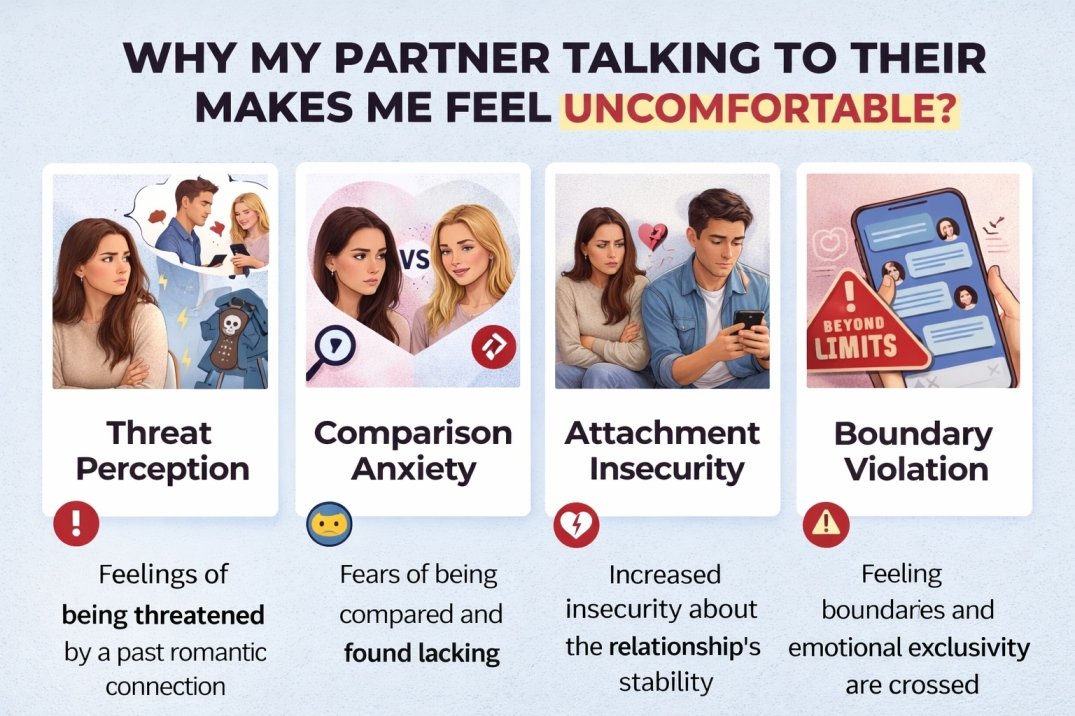
Fear of Loss and Emotional Investment Comes Up
You’ve invested time, emotions, and trust into this relationship. When an ex reappears, it can feel like that investment is at risk. The discomfort often comes from thoughts like:
- “What if I’m not enough?”
- “What if they reconnect on a deeper level?”
This is less about jealousy and more about fear of losing something important.
Your Logic and Emotions Start Conflicting
You might find yourself thinking:
- “I trust my partner, so why do I feel like this?”
At the same time, your emotions are telling a different story. This creates an internal conflict, where you try to stay rational, but still feel anxious or unsettled.
Constant Access Increases Uncertainty
In today’s environment, communication is instant and private. Messages, calls, and social media interactions can happen anytime. Even if nothing is happening, the possibility that it could happen without your knowledge increases mental stress.
This is why the discomfort feels real, even when you trust your partner.
It’s not just about their behaviour, it’s about how your internal system is responding to a situation that carries emotional history, uncertainty, and potential risk.
When Talking to an Ex Is Acceptable
First, your partner should never lie about or hide contact with their ex. If they know it makes you uncomfortable, they should either clearly close that connection or keep it strictly limited. It should not be something you discover on your own or have to question repeatedly. Now here are the situations where it can be acceptable:
- Practical reasons only (children, work, shared circles)
- Contact is limited, not frequent
- No secrecy, no hiding, no delayed disclosure
- You are aware without having to ask
- No defensive behaviour when discussed
- Clear boundaries (no personal or emotional sharing)
- No late-night or private conversations
- No revisiting past relationship or intimacy
- No emotional reliance or support from the ex
- The current relationship is the priority at all times
👉 If even one of these starts slipping, it’s no longer neutral or acceptable.
When Talking to an Ex Becomes a Red Flag
This is where it stops being about “just talking” and starts affecting the relationship in a real way. It’s not one message or one call, it’s the pattern, the shift in behaviour, and how it makes you feel over time.
Behavioural Signs
- You don’t find out directly, you notice things or discover them later
- Messages are hidden, deleted, or quickly closed
- Contact becomes more frequent without a clear reason
- They reconnect or check on the ex without telling you
- Simple questions lead to irritation, defensiveness, or avoidance
👉 It starts feeling like information is being managed, not shared
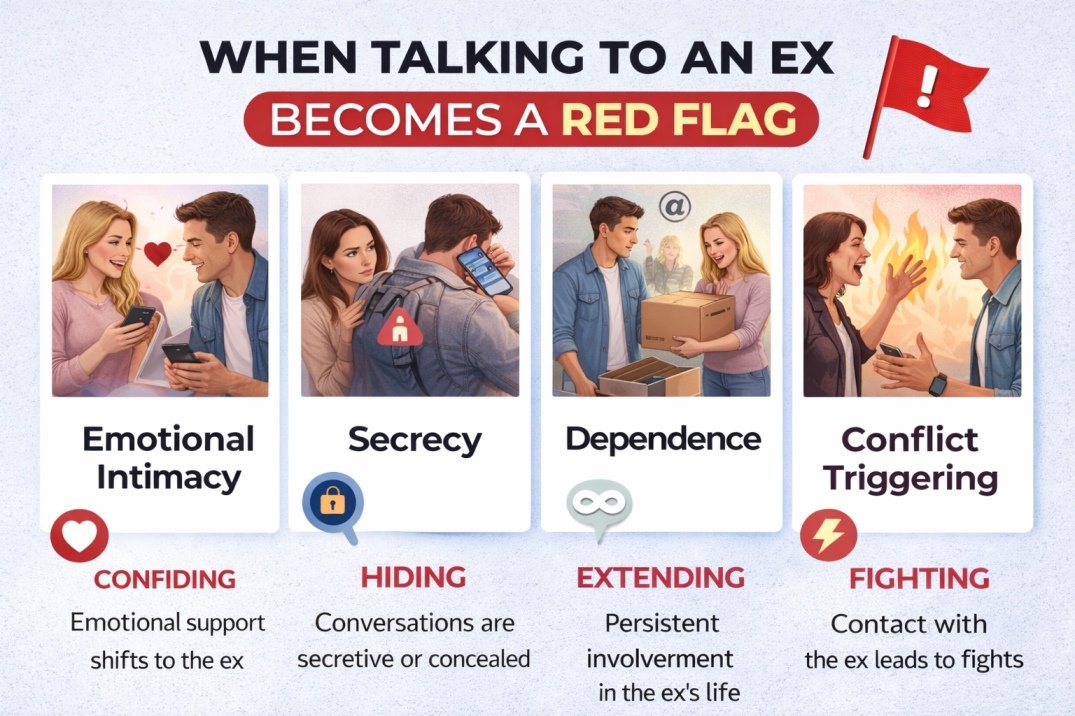
Emotional Signs
- They share things with their ex that they don’t share with you
- The ex becomes someone they turn to during stress or emotional lows
- Conversations go beyond casual and start becoming personal again
- There is a sense of emotional familiarity rebuilding
- They seem more concerned about not hurting the ex than about your discomfort
👉 The connection slowly shifts from casual contact to emotional involvement
Impact on Your Relationship
- You start overthinking things you normally wouldn’t question
- You feel anxious even when nothing is “proven”
- You hesitate to bring it up because you don’t want to seem insecure
- Communication with your partner feels reduced or less open
- You begin to feel like you’re competing with someone from their past
- You feel like you are adjusting more than they are
👉 It doesn’t feel like a partnership anymore, it feels like you’re managing a situation
👉 Core truth:
It becomes a red flag the moment the ex starts taking emotional space that should belong to your relationship.
Why Your Partner Is Talking to Their Ex Again

This is rarely just about “checking in.” There is usually a psychological reason behind it, even if your partner doesn’t fully recognise it.
- They still feel emotionally connected
The relationship may have ended, but the emotional bond didn’t fully close. This doesn’t always mean they want the ex back, but there is still attachment, care, or lingering feelings. - Their attachment pattern pulls them back
Some people struggle to fully detach. They stay connected because distance feels uncomfortable, or they find it hard to let go of people they once depended on emotionally. - There was no proper closure
If things ended abruptly or without resolution, the mind keeps that loop open. Staying in contact becomes a way to feel some sense of completion or understanding. - They feel responsible for their ex
Sometimes they carry guilt, especially if they hurt the ex or left them. They stay in touch to “make sure they’re okay” or to ease that internal responsibility. - They deeply understand their ex’s pain
Because of shared history, they may feel like they are the only one who truly understands the other person. This can create a pull to stay emotionally available, even from a distance. - There may be regret or ‘what if’ thoughts
They might not want to go back, but there can still be curiosity about how things could have turned out differently.
👉 This is why it’s complicated.
It’s not always about love in the present, but about unresolved emotional ties from the past that haven’t fully let go.
Is Talking to an Ex Considered Cheating?
No, talking to an ex is not automatically cheating.
But it often brings unnecessary risk into your current relationship.
This is not really about cheating. It’s about what this connection does to the relationship.
You may already have stress, responsibilities, and things to manage in life. Now this added connection, someone from the past who is no longer part of your present, starts affecting your relationship without adding any real value.
Even if nothing inappropriate is happening, it can still:
- Create comparison (“Am I enough?”)
- Trigger insecurity or fear of replacement
- Increase anxiety and overthinking
- Make your partner feel second or uncertain
And the truth is, most people are not genuinely comfortable with their partner staying connected to an ex, even if they don’t say it openly.
So the real question is not:
“Is this cheating?”
It is:
“Why risk something important for a connection that belongs to the past?”
If a connection is no longer relevant to your present life, it’s okay to set a clear boundary around it.
You both chose to move on from that relationship. Reopening it, even casually, can disturb what you are trying to build now.
What to Do If Your Partner Is Talking to Their Ex
Handle this clearly, not emotionally.
- Don’t react to one message, look at the pattern
Check how often they talk, whether it’s hidden, and if it’s affecting your relationship. - Have one direct conversation, not repeated arguments
Say it clearly:- “This makes me uncomfortable”
- “I need clarity on what this connection is”
One clear conversation works better than bringing it up again and again
- Ask straight questions, not indirect hints
- “Why are you still in contact?”
- “What role does this person have in your life now?”
- “Would you be okay if I did the same?”
- Be clear about what you are okay with and what you are not
Don’t stay vague. Say what feels acceptable and what doesn’t. - Watch what changes after the conversation
If behaviour stays the same, that tells you more than any explanation.
👉 Don’t stay stuck in overthinking.
Clarity comes from what they do after you address it.
When to Seek Professional Help
- The issue keeps repeating and nothing changes
- Your partner continues contact despite your clear discomfort
- There is secrecy, lying, or defensive behaviour
- You feel anxious, insecure, or constantly overthinking
- You feel second priority in the relationship
- Conversations turn into arguments instead of solutions
👉 At this point, this is not just about the ex. It’s about trust, boundaries, and emotional safety.
- If you are struggling with anxiety, overthinking, or emotional triggers → talk to an online clinical psychologist
- If this is affecting your relationship, communication, or trust → take online marriage counselling at LeapHope
👉 Don’t wait for things to get worse. Fix the pattern early.
Bottom Line
Talking to an ex is not always wrong, but it is rarely neutral. This isn’t just about “trust me.” Even in stable relationships, boundaries slip, and with an ex, that slip can turn into something bigger very quickly because the emotional history is already there. One moment is enough to disturb what you both have built, and the person who isn’t even part of your present ends up affecting your relationship.
If this situation is making you anxious, overthink, or feel like you come second, it matters. Don’t ignore that just because someone says it’s “normal.” And don’t let social media or influencers convince you to accept something that doesn’t feel right in your relationship.
At the end, a relationship should feel secure, not something you have to constantly adjust around.
FAQs
Is it normal for a partner to talk to their ex occasionally?
It is normal for a partner to talk to their ex occasionally if the contact is limited and transparent. However, psychologically, even occasional contact can activate threat perception and comparison anxiety, because your mind recognises the past emotional and physical bond.
Does talking to an ex mean they still have feelings?
Talking to an ex does not always mean they still have romantic feelings, but it often indicates some level of residual emotional attachment. This can show up as emotional familiarity, attachment carryover, or unresolved bonding.
Should I be worried if my partner hides messages with their ex?
You should be worried if your partner hides messages with their ex because secrecy activates uncertainty anxiety and disrupts relational transparency. This often leads to cognitive distrust, where your mind fills in gaps with worst-case assumptions.
Is talking to an ex considered cheating?
Talking to an ex is not considered cheating by default, but it can become emotional infidelity if there is emotional intimacy transfer, where support, validation, or vulnerability shifts outside the relationship.
Why does my partner keep helping or supporting their ex?
Your partner may keep helping or supporting their ex due to guilt-driven attachment, caretaker patterns, or a sense of emotional responsibility formed during the relationship.
Should I ask my partner to stop talking to their ex?
You can ask your partner to stop talking to their ex if the situation is affecting your emotional safety. This is about setting relational boundaries, not control.
Can someone talk to their ex and still be loyal?
Someone can talk to their ex and still be loyal if the interaction remains emotionally neutral and within boundaries. Loyalty includes emotional exclusivity, not just behaviour.
What should I do if my partner talks to their ex every day?
If your partner talks to their ex every day, it often indicates emotional dependency, habit bonding, or attachment reinforcement, which can shift emotional energy away from the relationship.