Structured support for family relationships

Online Family Counselling and Therapy for India and NRIs

Repeated arguments, emotional distance, parent-adult child tension, sibling conflict or problems involving in-laws can affect the whole family. LeapHope provides private online family counselling with qualified psychologists for families in India and those living abroad.

Sessions explore each person’s perspective, family roles, cultural expectations and the interaction patterns keeping the same conflict active before deciding whether joint, individual, couple or parent-focused sessions may be most helpful.

  • Qualified psychologists
  • One or more family members
  • Join from different locations
  • India and global time zones

LeapHope provides scheduled psychological counselling and is not an emergency, legal mediation or crisis service.

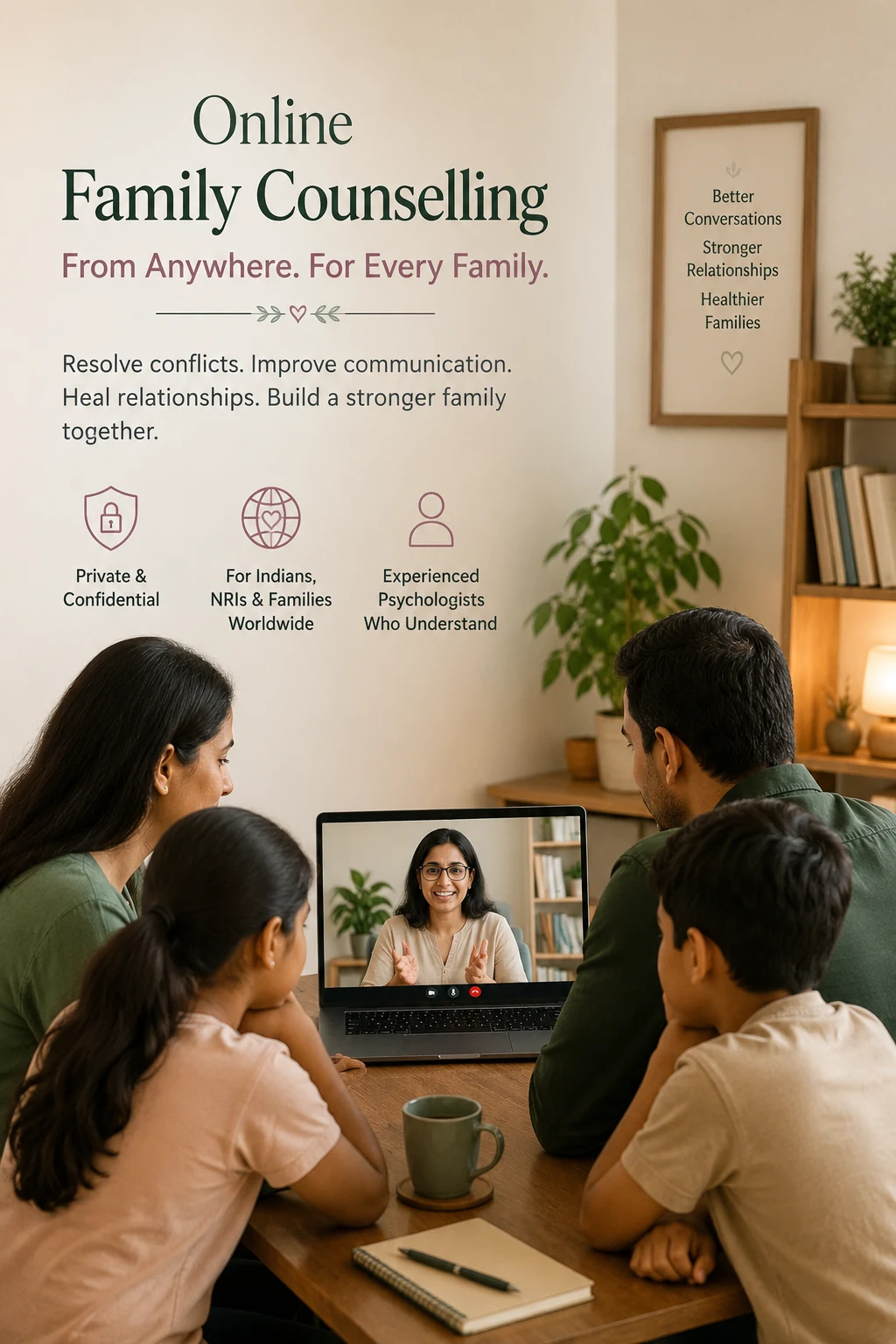
Indian family attending online family counselling with a psychologist
Join from different locations Private online sessions across cities and countries

Experienced Family Counsellors & Psychologists

Choose a Therapist for Online Family Counselling

Compare professional experience, qualifications, counselling approach, languages and session fees before choosing a family counsellor. One person can begin individually, or other family members can join when appropriate.

View All Therapists
Mamta Mehrotra senior family counsellor at LeapHope Senior Family Counsellor

Mamta Mehrotra

MSW, University of Delhi · B.A. Psychology (Honours) · 35+ Years Experience

Languages: English & Hindi

50 min

Mamta brings more than 35 years of counselling experience across generations. Her depth of work with adults, children, parents and families gives her a strong understanding of how relationships, roles and recurring patterns influence the wider family system. Her counselling is structured, person-centred and culturally aware.

Person-Centred Humanistic CBT-Informed Psychoeducation
Aradhana Gambhir senior psychologist and family counsellor at LeapHope Senior Psychologist & Family Counsellor

Aradhana Gambhir

M.A. Psychology · PG Diploma in Guidance & Counselling · 25+ Years Experience

Languages: English & Hindi

50 min

Aradhana brings more than 25 years of psychological and counselling experience to family work. Her background across children, adults, couples and parents allows her to understand concerns from different family members' perspectives while keeping sessions structured, practical and culturally sensitive.

CBT REBT SFBT Mindfulness Integrative Counselling
Mansi More Nopany RCI registered clinical psychologist providing online family counselling Clinical Psychologist

Mansi More Nopany

RCI-Registered Clinical Psychologist · M.Phil. Clinical Psychology · PhD Scholar · 10+ Years Experience

Languages: English & Hindi

50 min

Mansi uses a structured clinical approach to understand how individual emotional patterns, communication and family interactions influence one another. Her work can combine individual understanding with relationship-focused interventions as the wider family dynamics become clearer.

CBT DBT Family Therapy Emotion-Focused Therapy Gottman-Informed
K S Veena mental health counsellor providing multilingual family counselling Mental Health Counsellor

K. S. Veena

RCI-Registered Mental Health Counsellor · 5+ Years Experience

Languages: English, Tamil, Kannada, Telugu & Hindi

50 min

Veena uses practical counselling, psychoeducation and structured problem-solving within family work. Her multilingual practice can be especially useful where family members are more comfortable discussing personal concerns in familiar Indian languages.

CBT-Informed Psychoeducation Structured Counselling Parent Guidance

Not every family member needs to attend the first session. One person can begin by explaining the situation. The counsellor can then discuss whether later sessions should include other family members or continue individually.

Compare All LeapHope Therapists

Client Experiences

What Families Say After Starting Counselling

Experiences shared by individuals and families who received private online support for conflict, communication difficulties and strained family relationships.

Every disagreement in our family used to return to the same old issues. Counselling helped us recognise the pattern and discuss the actual concern without blaming one person for everything.
R. S. Online family counselling client
My parents and I could not discuss my personal decisions without the conversation becoming emotional. The sessions helped us set clearer boundaries while still respecting our relationship.
A. M. Parent and adult-child counselling
My brother and I had stopped speaking because of disagreements about our parents’ care. Therapy gave both of us space to explain what we were carrying and divide responsibilities more fairly.
N. K. Sibling counselling client
We live in three different countries, and misunderstandings kept growing through messages and short calls. Online family sessions helped us have one structured conversation together.
P. D. NRI family counselling client
I felt caught between my spouse and my parents. Counselling helped me understand my role in the conflict and communicate boundaries without making either side feel rejected.
S. R. Extended-family counselling client
I started counselling alone because the rest of my family was not ready. Even changing the way I responded reduced several arguments, and another family member later joined a session.
K. T. Individual family-support client
Grief affected each of us differently, and we started judging one another’s reactions. Our psychologist helped us understand those differences and communicate with more patience.
M. A. Family grief counselling client
After remarriage, everyone had different expectations about roles and rules. Counselling helped us discuss those expectations openly instead of expecting the children to simply adjust.
D. P. Blended-family counselling client
The therapist did not decide who was right. She helped each of us explain what happened from our perspective and showed us how our reactions were keeping the conflict active.
V. N. Online family therapy client
Private online family sessions
Join from different cities or countries
Continue with the same psychologist

Family concerns in real-life words

Do Any of These Family Problems Feel Familiar?

Family problems often develop through repeated arguments, silence, changing roles, cultural expectations, unresolved hurt or difficult responsibilities involving parents, adult children, siblings, in-laws and extended family members.

How people often describe what is happening

Every conversation eventually becomes an argument.
We keep fighting about the same old issues.
One person is blamed whenever anything goes wrong.
We say hurtful things and regret them later.
Small disagreements quickly become personal attacks.
No one feels heard during family discussions.
Some family members shout while others completely withdraw.
We communicate through another family member.
Apologies happen, but nothing actually changes.
Family gatherings have become tense and uncomfortable.
We avoid important topics to prevent another fight.
Everyone remembers the same event differently.
My parents still try to control my adult decisions.
My adult child no longer shares anything with me.
Career decisions have created distance in our family.
Marriage choices have caused conflict with my parents.
My parents use guilt when I set a boundary.
My adult child thinks every concern is interference.
Privacy and independence cause constant arguments.
I feel responsible for keeping my parents happy.
My parents do not accept my partner or spouse.
Financial expectations are damaging our relationship.
I feel judged whenever I make a different life choice.
We love each other but cannot speak without defensiveness.
My sibling and I have carried resentment for years.
Our parents treated us differently growing up.
One sibling is expected to handle every responsibility.
We disagree about caring for our ageing parents.
Money and inheritance have divided our family.
My sibling’s spouse has changed our relationship.
We only speak when there is a family emergency.
Old childhood comparisons still affect us as adults.
I feel taken for granted by my siblings.
My sibling avoids every difficult family conversation.
We compete for our parents’ approval and attention.
I want to reconnect but do not know how to begin.
I feel caught between my spouse and my parents.
Our relatives interfere with private family decisions.
There is no privacy in our joint-family home.
Setting boundaries is treated as disrespect.
My in-laws compare me with other family members.
Household responsibilities are divided unfairly.
Our parenting decisions are challenged by relatives.
Family expectations are affecting our marriage.
Every boundary creates guilt, pressure or criticism.
Important decisions require approval from the whole family.
I am expected to keep everyone in the family happy.
Our relatives take sides during disagreements.
My parents in India feel I abandoned them.
Living abroad has changed how I view family boundaries.
We live in different countries and misunderstandings keep growing.
Short calls often turn into complaints or guilt.
My family thinks I have forgotten our culture.
We disagree about financial support across countries.
I feel guilty because I cannot visit often enough.
My spouse and parents have different cultural expectations.
My children are growing up with different family values.
We disagree about who should care for ageing parents.
Returning to India has created unexpected family conflict.
Time zones make serious family conversations difficult.
Illness has changed every role in our family.
One person is carrying most of the caregiving burden.
We disagree about treatment and care decisions.
Grief has made us emotionally distant from one another.
Everyone is grieving differently and judging each other.
Caregiving pressure has created anger and resentment.
Money and medical responsibilities are causing conflict.
Our family does not know how to discuss a diagnosis.
I feel guilty when I cannot do more for my family.
Separation has divided our extended family.
Children feel caught between different adults.
Our blended family has different rules and expectations.
My stepchild does not accept my role in the family.
Children feel disloyal when they connect with a stepparent.
Former and current partners affect every family decision.
Relatives have not accepted our remarriage.
We need help creating a new family structure.
Different parenting histories cause repeated conflict.


Online family counselling can begin with one willing family member. Depending on the concern, the psychologist may later recommend joint, individual, couple, parent-focused or wider family sessions. Standard joint sessions may not be appropriate where there is ongoing violence, intimidation or immediate safety risk.

Psychological approaches

Therapies Used in Online Family Counselling

The psychologist may combine different approaches according to the family’s concerns, relationships and therapy goals.

Family-Pattern Work

Identifies repeated roles, reactions and relationship patterns keeping conflict active.

Cognitive Behavioural Therapy

Examines thoughts and reactions that increase family tension and misunderstanding.

Communication Work

Helps family members speak clearly, listen and manage difficult conversations.

Mindfulness Approaches

Supports calmer responses during emotionally intense family situations.

Behavioural Strategies

Builds clearer routines, responsibilities, boundaries and practical changes at home.

Integrative Therapy

Combines suitable methods according to each family member’s needs and progress.

The approach and session format may change during therapy. Sessions can involve one person, selected family members or the wider family.

Indian family members joining an online family counselling session with a LeapHope psychologist
Family members can join privately from different locations

Culture-aware family support across countries

Online Family Counselling for India, NRIs and Families Worldwide

Family relationships are shaped by culture, childhood experiences, responsibilities, expectations and changing roles. LeapHope provides online family counselling that considers these influences rather than treating one person as the entire problem.

Families living in India

Counselling may address repeated conflict, parent-adult child tension, sibling concerns, joint-family pressure, in-law involvement and disagreements about family responsibilities.

Indian and NRI families across countries

Parents in India, adult children abroad and siblings living in different countries can join the same structured online family therapy session.

Intercultural and international families

Therapy can explore different expectations around boundaries, marriage, parenting, independence, caregiving, finances and extended-family involvement.

  • Qualified psychologists for family concerns
  • Choose your psychologist before booking
  • One family member can begin alone
  • Selected family members can attend together
  • Private 50–60 minute online sessions
  • Continue with the same psychologist
  • English and Indian-language options
  • Appointments across international time zones

LeapHope supports families in India and those living in the USA, Canada, UK, Ireland, Australia, New Zealand, UAE, Singapore and other countries. Session participation and format are planned according to the family concern, privacy, safety and psychologist availability.

Psychology-led support for family relationships

Why Families Choose LeapHope for Online Family Counselling

LeapHope provides more than general relationship advice. Sessions examine family roles, emotional reactions, communication patterns, cultural expectations and the concerns keeping conflict active.

01

Understanding the Whole Family Pattern

Sessions examine how different reactions, expectations and roles contribute to recurring tension rather than treating one person as the entire problem.

02

Structured Work Around Real Conflicts

Families can discuss specific arguments, communication breakdowns, boundary concerns, caregiving pressure and difficult decisions that occur between sessions.

03

Indian and Cultural Context Is Considered

Psychologists consider joint-family structures, in-law involvement, respect, independence, marriage expectations and responsibilities across generations.

04

Choose Your Psychologist Before Booking

Compare qualifications, experience, therapy approaches, languages, session fees and availability before selecting a psychologist.

What families can expect
  1. 1
    A clearer understanding recognise why the same family problems keep returning
  2. 2
    Practical relationship changes improve communication, boundaries and emotional responses
  3. 3
    Consistent online support continue with the same psychologist across sessions

Sessions may include family-pattern work, CBT-informed methods, communication training, emotional regulation, behavioural strategies and integrative therapy according to the family’s needs.

Questions About Family Therapy

Online Family Counselling Frequently Asked Questions

Clear answers about who can attend, what happens during sessions, confidentiality, online participation and choosing a psychologist.

What is online family counselling?

Online family counselling is psychological therapy focused on relationships and interaction patterns within a family. Sessions may explore repeated arguments, communication breakdowns, emotional distance, family roles, unresolved hurt, cultural expectations and difficult responsibilities.

Who can attend a family counselling session?

Sessions may involve parents, adult children, siblings, couples, in-laws, caregivers or selected members of an extended family. The psychologist decides who should attend according to the concern, willingness to participate, privacy and emotional safety.

Can I begin if other family members refuse counselling?

Yes. One family member can begin alone. Individual sessions can help you understand the family pattern, manage your responses, communicate more clearly and decide whether inviting another family member may be useful later.

What happens during the first family counselling session?

The psychologist asks what has been happening, who is involved, how long the concern has continued and what each person hopes will change. The therapist may also discuss family history, communication patterns, responsibilities, boundaries and the most suitable format for future sessions.

Is family counselling different from marriage counselling?

Marriage counselling mainly focuses on the relationship between partners. Family counselling may include parents, children, siblings, in-laws or caregivers and examines how the wider family system affects the concern. Some situations may require a combination of family, couple and individual sessions.

Can family members join from different cities or countries?

Yes. Family members can join the same online session from different locations when suitable appointment times and private spaces are available. This can be helpful for NRI families, siblings living abroad and parents and adult children living in different countries.

Are family counselling sessions confidential?

Family counselling is private, but confidentiality works differently when several people attend. The psychologist should explain how information from shared and individual conversations will be handled. Confidentiality may be limited where there is a serious safety concern or legal safeguarding requirement.

How many family counselling sessions are needed?

The number of sessions depends on the duration and complexity of the concern, the number of people involved, attendance and willingness to practise changes outside therapy. The psychologist can review progress and discuss frequency after understanding the family situation.

Is joint family counselling suitable when there is abuse or intimidation?

Joint sessions may not be appropriate when there is ongoing violence, coercion, intimidation, serious manipulation or an immediate safety risk. The psychologist may recommend individual support, specialised domestic-abuse services or urgent local assistance before considering shared sessions.

What should I check before choosing a family psychologist online?

Review the psychologist’s qualifications, professional registration where applicable, experience with family concerns, therapeutic approaches, languages, session fee and availability. Also check whether the psychologist is comfortable working with the specific relationships and cultural concerns involved.

Scroll to Top