
Last Updated on August 27, 2026
Choosing a life partner gets difficult when there is no obvious reason to leave, but you still do not feel fully sure.
You may love them and still worry about how they handle anger, money, responsibility, family, sex, commitment or conflict. You may also be asking yourself whether the problems you see now are normal differences—or signs that marriage will make life harder later.
The right life partner is not simply someone who is kind, successful or attractive. Look at how they behave when they are stressed, disappointed, told no, expected to take responsibility or asked to consider your needs. Those repeated patterns tell you far more about long-term compatibility than promises or chemistry.
This article will help you judge those patterns clearly before you make a long-term decision.
What Should You Look for in a Life Partner?
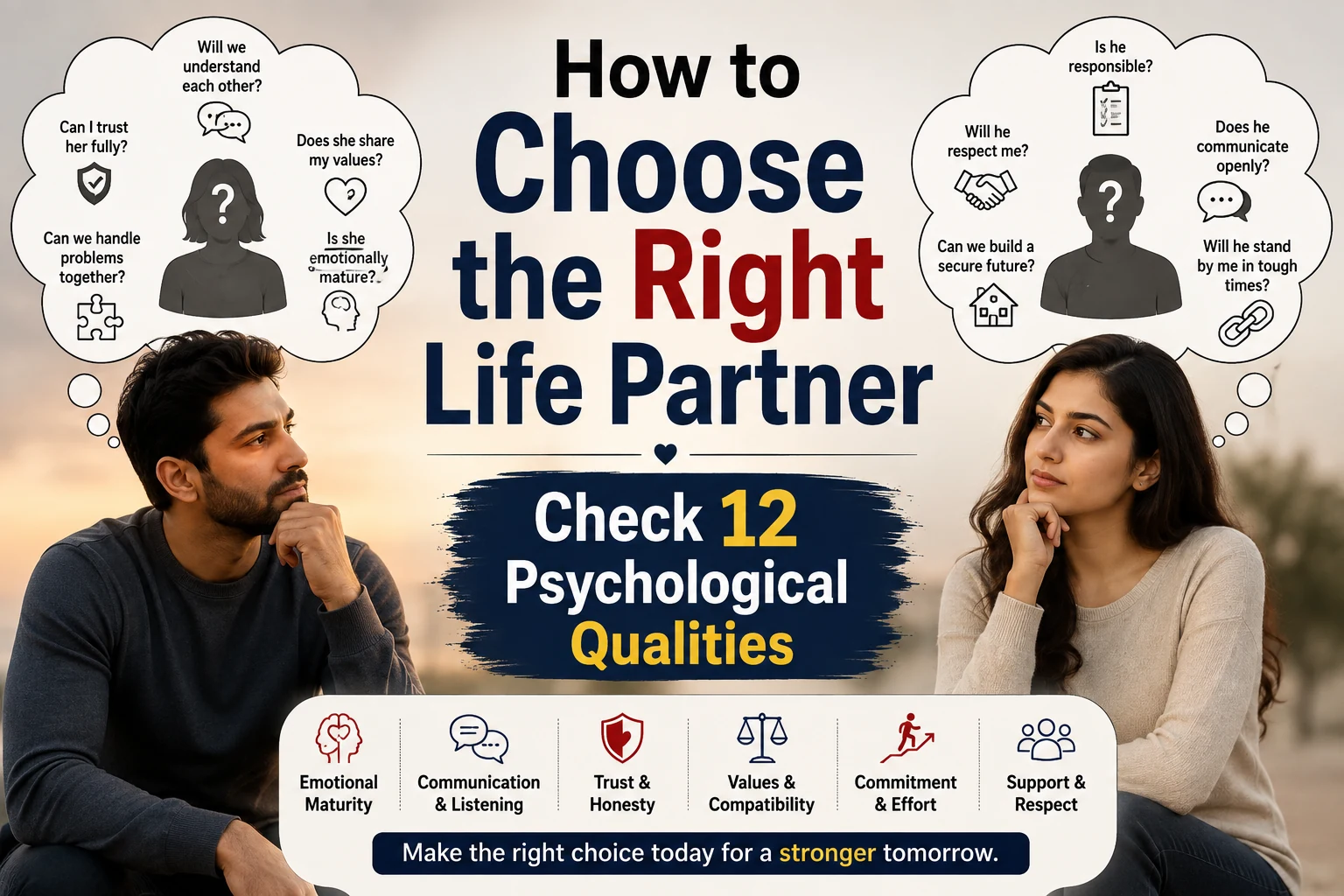
Look for emotional maturity, consistency, accountability, responsiveness, respect for boundaries, healthy conflict behaviour, commitment, self-awareness and the ability to grow with you.
You are not looking for someone who never becomes angry, insecure, stressed or difficult.
You are looking for someone who can experience those emotions without repeatedly damaging the relationship.
Here are the psychological qualities worth paying attention to.
1. They Can Handle Their Emotions Without Making Them Your Responsibility
Emotional maturity does not mean your partner stays calm every minute.
Watch what they do when emotions become uncomfortable.
When they are angry, do they insult you?
When they feel insecure, do they accuse you?
When they are disappointed, do they punish you with silence?
When they are stressed, does everyone around them have to walk carefully?
A healthy life partner can say, “I am angry,” “That hurt me,” or “I need some time,” without turning the emotion into intimidation, humiliation or control.
You will experience stressful periods together. The important question is not whether your partner has strong emotions.
It is whether you remain emotionally safe when they do.
2. They Respond When Something Matters to You
You tell them you had a difficult day.
Do they listen, or immediately start looking at their phone?
You tell them something they said hurt you.
Do they become curious about your experience, or spend the next twenty minutes proving you should not feel hurt?
Emotional responsiveness means your inner world matters to your partner even when they do not experience the situation exactly as you do.
You should not have to turn every feeling into a courtroom argument before it deserves attention.
Over a lifetime, feeling understood and cared about matters far more than having a partner who simply knows the right romantic words.
3. Their Words and Behaviour Match
Anyone can say:
“I will always be there.”
“You can trust me.”
“I want a future with you.”
“I’ll change.”
Look at what happens afterward.
Do they keep plans?
Do they follow through on promises?
Does their behaviour remain consistent when the relationship feels secure and they no longer need to impress you?
Do they tell you important things voluntarily, or only after you discover them?
Trust grows when your experience repeatedly matches what your partner tells you.
When words and behaviour constantly disagree, believe the pattern rather than the promise.
4. They Can Take Responsibility Without Turning It Back on You
You will both make mistakes.
That is not what separates healthy relationships from unhealthy ones.
Watch what happens after the mistake.
A partner capable of accountability can acknowledge:
“I handled that badly.”
“I understand why that upset you.”
“I should not have spoken to you like that.”
They do not immediately add:
“But you started it.”
“But you made me angry.”
“But you’re too sensitive.”
“But look at everything you do.”
An apology that exists only after you accept half the blame is not meaningful accountability.
Choose someone who can examine their own behaviour without needing you to become the villain first.
5. Watch How They Fight, Not Whether You Fight
You will disagree with your life partner.
You will disagree about money, family, time, household responsibilities, priorities, sex, work, children and hundreds of smaller things nobody thinks about while dating.
So “we never fight” is not the goal.
Watch how conflict works.
Can your partner disagree without insulting your intelligence or character?
Can either of you ask for a break and return to the discussion later?
Can your partner hear a complaint without immediately becoming defensive?
Can you repair after a bad argument?
If every disagreement becomes shouting, threats, contempt, days of silence or talk of ending the relationship, take that pattern seriously.
If conflict is already becoming repetitive, LeapHope’s article on how to stop arguing in a relationship goes deeper into what keeps the same fights returning.
6. You Are Allowed to Have Boundaries
Pay close attention to what happens when you say no.
Not when you agree.
Not when you’re affectionate.
Not when you’re doing what your partner wants.
Say no to something.
Disagree.
Spend time with a friend.
Ask for privacy.
Choose something independently.
A healthy partner does not treat your independence as betrayal.
You should be able to remain a separate person while building a close relationship.
Love does not require surrendering your friendships, privacy, opinions, career, interests or ability to make decisions.
If setting normal boundaries repeatedly leads to guilt, accusations, monitoring or punishment, you are not dealing with a small difference in personality.
You are learning how power works in the relationship.
7. Their Commitment Is Visible
Commitment is more than saying, “Of course I’m serious about you.”
Look at their decisions.
Are you included when they think about their future?
Can they make plans beyond the next weekend?
When the relationship becomes difficult, do they work on the problem or immediately question whether the relationship should exist?
Do they behave as though they are building something with you, or do you constantly feel that you are auditioning to remain in their life?
You should not need daily reassurance that your partner still wants the relationship.
Commitment becomes believable when their decisions repeatedly include it.
8. They Appreciate You Instead of Constantly Evaluating You
Notice how you feel after spending time with your partner.
Do you generally feel accepted?
Or do you feel as though you are constantly being reviewed?
Your appearance could be better.
Your career could be bigger.
You should be more social.
Less emotional.
More ambitious.
More affectionate.
Less independent.
A partner can raise concerns without making you feel permanently inadequate.
You also need appreciation.
Do they notice your effort?
Do they recognise what you contribute?
Do they speak respectfully about you when other people are around?
A relationship becomes exhausting when one person spends years trying to finally become good enough for the other.
9. Watch Who They Become Under Stress
A romantic dinner tells you very little about how someone handles real pressure.
Watch them when the flight is cancelled.
When work goes badly.
When they are exhausted.
When money becomes tight.
When they have to wait.
When they are embarrassed.
When someone disagrees with them.
When a family problem takes over the week.
Stress reduces people’s ability to maintain their polished dating behaviour.
That makes stressful moments useful information.
You are not looking for perfection under pressure.
You are checking whether basic respect survives it.
If every difficult week turns your partner cruel, reckless, controlling or completely unavailable, do not tell yourself marriage will automatically make that pattern easier.
10. Look at Their Everyday Habits
Choosing a life partner is also choosing who you will share thousands of ordinary days with.
Pay attention to ordinary behaviour.
How do they manage money?
How much time disappears into their phone?
How do they use alcohol?
Do they arrive when they say they will?
How do they treat their home?
Do they take responsibility without needing another adult to repeatedly remind them?
Can they balance work with the rest of life?
Do they constantly create emergencies through poor planning?
You do not need identical routines.
But habits matter because marriage does not happen mainly on holidays and anniversaries.
It happens on tired Wednesday evenings when bills need paying, someone needs groceries and both of you have had a long day.
11. They Can Be Emotionally and Physically Close
A long-term relationship requires more than companionship.
Can your partner talk about fear, disappointment, affection and insecurity?
Can they let you know them beyond the confident or socially acceptable parts?
Can you discuss physical affection, sex, rejection, desire and boundaries without ridicule or pressure?
Can they receive comfort as well as give it?
Emotional distance often becomes easier to notice once a relationship becomes serious.
If closeness repeatedly causes withdrawal, discomfort or fear, understanding why intimacy feels difficult in relationships can help you separate ordinary vulnerability from a recurring intimacy pattern.
You do not need constant emotional intensity.
You need enough safety for both of you to become known.
12. They Can See Their Own Patterns and Grow
Listen carefully to how your partner talks about previous relationships and current problems.
If every ex was “crazy,” every boss was unfair, every friendship ended because the other person was jealous and every current disagreement is your fault, there is very little room for self-reflection.
Compare that with:
“I become defensive when I feel criticised.”
“I know I withdraw during conflict.”
“I handled that relationship badly.”
“I need to work on how I react when I feel rejected.”
Self-awareness does not mean someone has solved every issue in their life.
It means they can see themselves clearly enough to change.
That matters because you are not choosing a finished human being.
You are choosing someone you will both have to grow alongside.
Do Not Confuse Chemistry With Compatibility
Strong chemistry can make a relationship feel unquestionably right.
You miss them constantly.
Sexual attraction is strong.
Conversation lasts all night.
The relationship feels intense.
None of that tells you how the two of you will manage money, conflict, commitment, family, responsibility or everyday life.
Chemistry answers:
“Do I strongly want this person?”
Compatibility asks:
“Can we actually build a life that works?”
You need attraction and connection. But intensity should not persuade you to dismiss behaviour you would immediately recognise as unhealthy in someone else’s relationship.
The person who excites you most is not automatically the person with whom you can build the healthiest life.
Look at Patterns, Not One Good or Bad Moment
Do not choose your life partner based on their best week.
Do not reject them because of one imperfect evening either.
Look for patterns.
One forgotten plan is human.
Being unreliable every week is a pattern.
One angry argument happens.
Regular humiliation during conflict is a pattern.
One insecure question is understandable.
Checking your phone and controlling your friendships is a pattern.
This principle protects you from two common mistakes: excusing repeated problems because your partner is wonderful at other times, and expecting a real person to behave perfectly every day.
Repeated behaviour tells you far more than isolated incidents.
Do Not Choose the Person You Hope They Will Become
This is where many difficult decisions become clearer.
Ask yourself:
Would I still choose this person if their current behaviour never changed?
Not:
“They’ll become more responsible after marriage.”
“They’ll eventually want children.”
“They’ll stop drinking so much.”
“They’ll become more affectionate once we live together.”
“They’ll learn to manage their anger.”
“They’ll stop messaging that person once we’re engaged.”
People grow. Relationships change.
But choosing a life partner based on expected future transformation places your future on a promise nobody can guarantee.
Choose the person who exists now.
Then decide whether the growth both of you still need feels realistic rather than essential for the relationship to survive.
A Good Person Can Still Be the Wrong Life Partner for You
This is one of the hardest truths to accept.
Your partner does not need to be toxic, abusive or dishonest for you to decide the relationship is wrong for you.
They can be genuinely kind and still want children when you do not.
They can be loyal and still want a lifestyle you would hate.
They can be emotionally mature and still have completely different expectations around religion, money, sex, family or where to live.
You are not searching for the universally best life partner.
There is no such person.
You are choosing whether this person’s way of loving, living and imagining the future can work alongside yours.
Compatibility does not mean being identical.
It means your important differences can exist without requiring one person to give up a life they actually want.
What If You Cannot Tell Whether the Problem Is Them or Your Own Fear?
This question becomes especially difficult when the relationship is serious.
You think:
What if I leave a healthy relationship because I am scared of commitment?
Then five minutes later:
What if I marry the wrong person because I keep telling myself this is just anxiety?
Do not automatically trust every anxious thought.
Do not automatically dismiss every doubt as anxiety either.
Look at evidence.
Does this uncertainty appear every time a relationship becomes serious?
Or are there clear behaviours in this relationship that repeatedly make you hesitate?
Are you afraid of closeness itself?
Or do you feel unsafe, controlled, ignored or fundamentally incompatible with this particular partner?
LeapHope’s relationship anxiety and attachment guide looks specifically at the difference between recurring internal fears and concerns that are connected to what is actually happening in your relationship.
If you repeatedly pull away whenever a good relationship becomes close, it is also worth understanding whether self-sabotaging relationship patterns are affecting how you make decisions. The LeapHope article describes patterns such as overthinking, pushing a partner away, perfectionistic expectations and avoiding important conversations.
Questions to Ask Yourself Before Choosing Your Life Partner
Before making a long-term commitment, answer these honestly:
- Can I disagree with this person without being afraid of their reaction?
- Can I be myself around them rather than constantly managing their opinion of me?
- Do I trust their repeated behaviour, not only their words?
- What happens between us after a serious disagreement?
- Do I respect the person they are today?
- Can our everyday lifestyles realistically work together?
- Can we talk honestly about money, sex, family, children and future plans?
- Do I feel appreciated as well as loved?
- Are the problems I am worried about occasional incidents or repeating patterns?
- Am I choosing this person, or the future version of them I hope will appear?
- If nothing important changed after marriage, would I still want this relationship?
Do not answer these according to what you think a successful relationship should look like.
Answer them according to the relationship you actually have.
When Premarital Counselling Can Help
You do not need to wait until the relationship is failing to talk with a marriage therapist.
When marriage is becoming serious, premarital counselling can help you discuss areas couples often avoid until after commitment: conflict, finances, family involvement, intimacy, children, responsibilities, lifestyle and future expectations.
A counsellor should not decide whether this is the “right person” for you.
The useful work is helping both of you understand the relationship clearly enough to make your own decision with fewer assumptions.
Final Thoughts
Choosing the right life partner is not about finding someone with the longest list of impressive qualities.
You are choosing the person who will be beside you when life is repetitive, stressful, unfair, exciting, exhausting and changing.
Watch how they respond when you need them.
Watch how they behave when they are angry.
Watch whether apologies become changed behaviour.
Watch whether you can say no.
Watch whether you feel respected when nobody is trying to impress anybody.
Watch whether the future you each want can genuinely fit together.
And most importantly, stop asking only:
“Is this person good enough?”
Ask:
“Does the relationship we create together feel healthy enough to build a life inside?”
That question will tell you far more about choosing the right life partner than any list of perfect qualities.
FAQs About Choosing the Right Life Partner
How Do I Choose the Right Life Partner?
Choose the right life partner by looking at repeated behaviour rather than promises or first impressions. Pay attention to emotional maturity, accountability, conflict, commitment, boundaries, everyday habits and whether your important future goals can work together.
What Qualities Should I Look for in a Life Partner?
Look for emotional maturity, consistency, responsiveness, responsibility, respect, self-awareness and willingness to repair problems. The strongest qualities are the ones you can repeatedly see in your partner’s behaviour.
How Do I Know If Someone Is the Right Partner for Marriage?
The right partner for marriage is someone with whom you can handle disagreement, responsibility, intimacy and future decisions without losing respect or emotional safety. You should also be able to discuss money, family, children, lifestyle and expectations honestly before committing.
Is There Such a Thing as a Perfect Life Partner?
No. A perfect life partner does not exist. A healthy partner will still have flaws and differences; what matters is whether those differences are workable and whether the relationship consistently includes respect, trust, responsibility and repair.
How Do I Find a Good Life Partner?
Finding a good life partner requires looking beyond appearance, status and early chemistry. Spend enough time observing how the person communicates, handles stress, treats boundaries, follows through on commitments and behaves once the relationship becomes comfortable.
Should I Choose Chemistry or Compatibility?
You need attraction, but chemistry alone is not enough for a lasting relationship. Compatibility becomes visible in how your values, lifestyle, conflict style, emotional needs, responsibilities and future plans work together.
How Long Should I Know Someone Before Choosing Them as a Life Partner?
There is no psychological number that guarantees you know someone well enough to marry them. What matters is whether you have seen each other across ordinary life, disagreement, stress, responsibility and important conversations rather than only during the most exciting stage of the relationship.
What If I Keep Doubting Whether My Partner Is Right for Me?
Do not treat every doubt as proof that the relationship is wrong, and do not dismiss repeated concerns as overthinking. Look at whether the doubt follows a recurring anxiety pattern or whether specific behaviours, incompatibilities or unresolved problems keep giving you genuine reasons to hesitate.