Last Updated on August 26, 2026
Clinical Review: Aradhana Gambhir — Senior Psychologist with 25+ years of counselling experience.
You may already know how the fight is going to go before it really starts.
You say something because you are frustrated. Your partner does not hear the concern behind it; they hear criticism. They defend themselves. You try harder to explain, which sounds even more critical to them.
Then one of you wants space while the other wants the problem solved now.
Twenty minutes later, you are no longer arguing about what started it.
If you are trying to understand how to stop fighting with your partner, the goal is not to remove every disagreement. Couples can disagree and still have a healthy relationship.
The real work is learning where a normal conversation turns into the same damaging fight.
Why Do We Keep Having the Same Fight?
Couples often come into counselling describing many different arguments.
Money. Phones. In-laws. Housework. Work hours. Sex. Parenting. Social media. Who said what.
But once those fights are unpacked, the emotional issue underneath them is often much smaller.
It may be about respect.
Or reassurance.
Or fairness.
Or freedom.
Or loyalty.
Or transparency.
Or simply wanting to feel heard.
In LeapHope counselling sessions, these deeper concerns often matter more than the topic that starts the argument.
A fight about a phone may actually mean:
“I do not feel important when we are together.”
A fight about in-laws may mean:
“I need to know that you will stand with me.”
A fight about money may mean:
“I do not feel secure when decisions are made without me.”
This is why couples can solve one surface problem and still have another fight a few days later.
The topic changed.
The emotional need did not.
Relationship counselling often focuses on identifying these repeating patterns rather than treating every argument as a separate problem.
Sometimes the Fight Starts Before Either Person Says Anything
Many arguments begin when one or both partners are already emotionally exhausted.
You come home after a difficult day at work.
Your partner has been dealing with family pressure.
There are bills to think about, children needing attention, messages waiting, and very little patience left.
Then someone chooses the wrong words.
A sentence that might have been manageable on another day suddenly feels disrespectful.
Instead of:
“I need more help with this.”
it comes out as:
“You never do anything.”
Instead of:
“I felt uncomfortable about what happened online.”
it becomes:
“You cannot be trusted.”
The person speaking is reacting from their mood.
The person listening reacts to how those words land.
That is how an ordinary concern can become a personal attack within seconds.
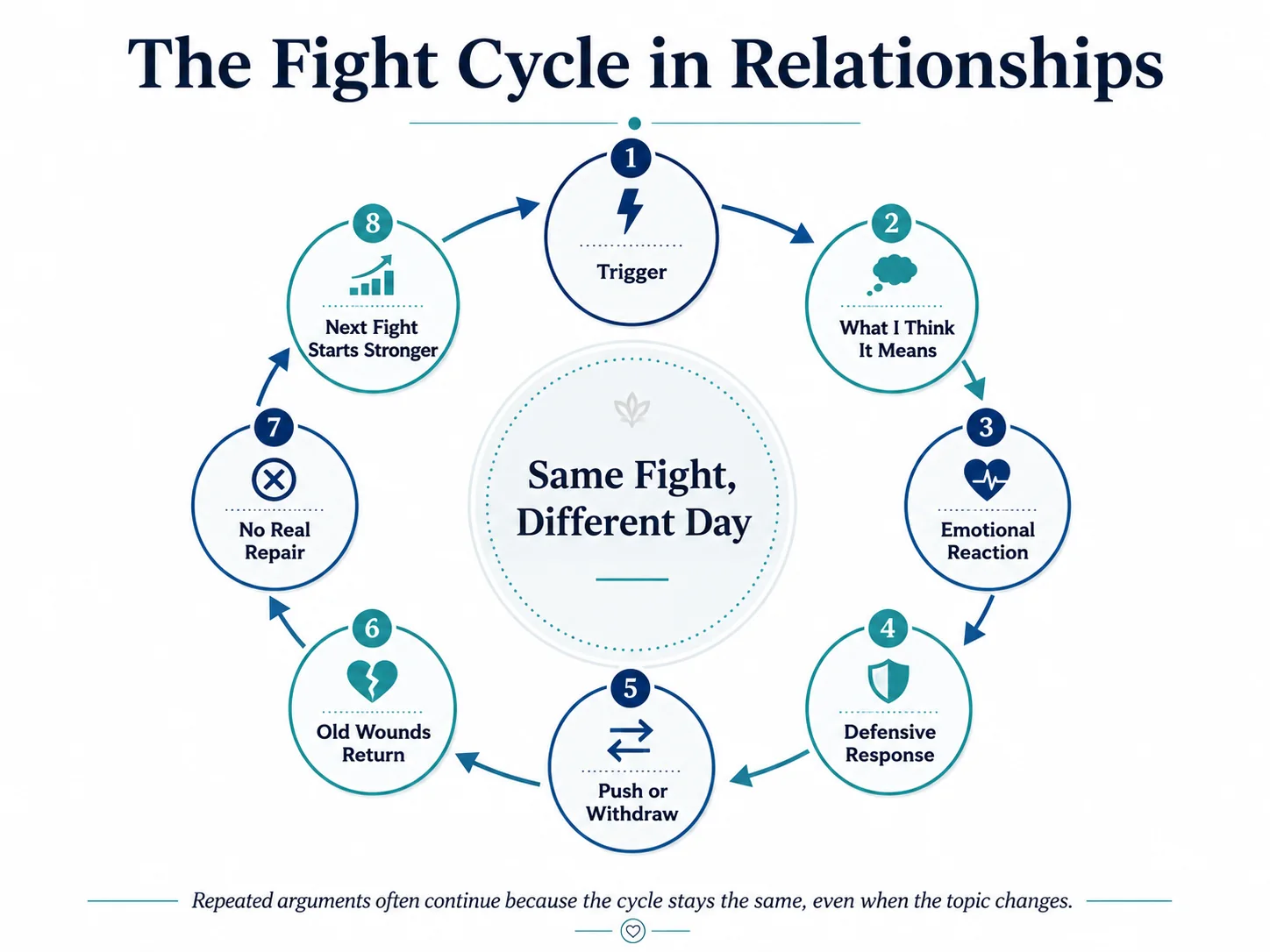
How a Conversation Turns Into an Argument
Imagine one partner says:
“You are always on your phone.”
The other person hears:
“You think I am a bad partner.”
So they respond:
“I am not always on my phone. You complain about everything.”
Now the first partner feels even less heard.
They become louder.
The second partner feels attacked and pulls away.
The first partner sees the withdrawal as avoidance and pushes harder.
Soon, an argument about the phone includes something that happened six months ago.
Neither person is discussing the original problem anymore.
The cycle has become:
a trigger → an interpretation → an emotional reaction → defence → pressure or withdrawal → escalation → old wounds → no real repair.
The next fight then starts with more resentment already waiting in the background.
Learning how anger develops inside relationships can help couples notice this cycle earlier, before both people are too reactive to listen.
How to Stop the Argument Before It Gets Worse
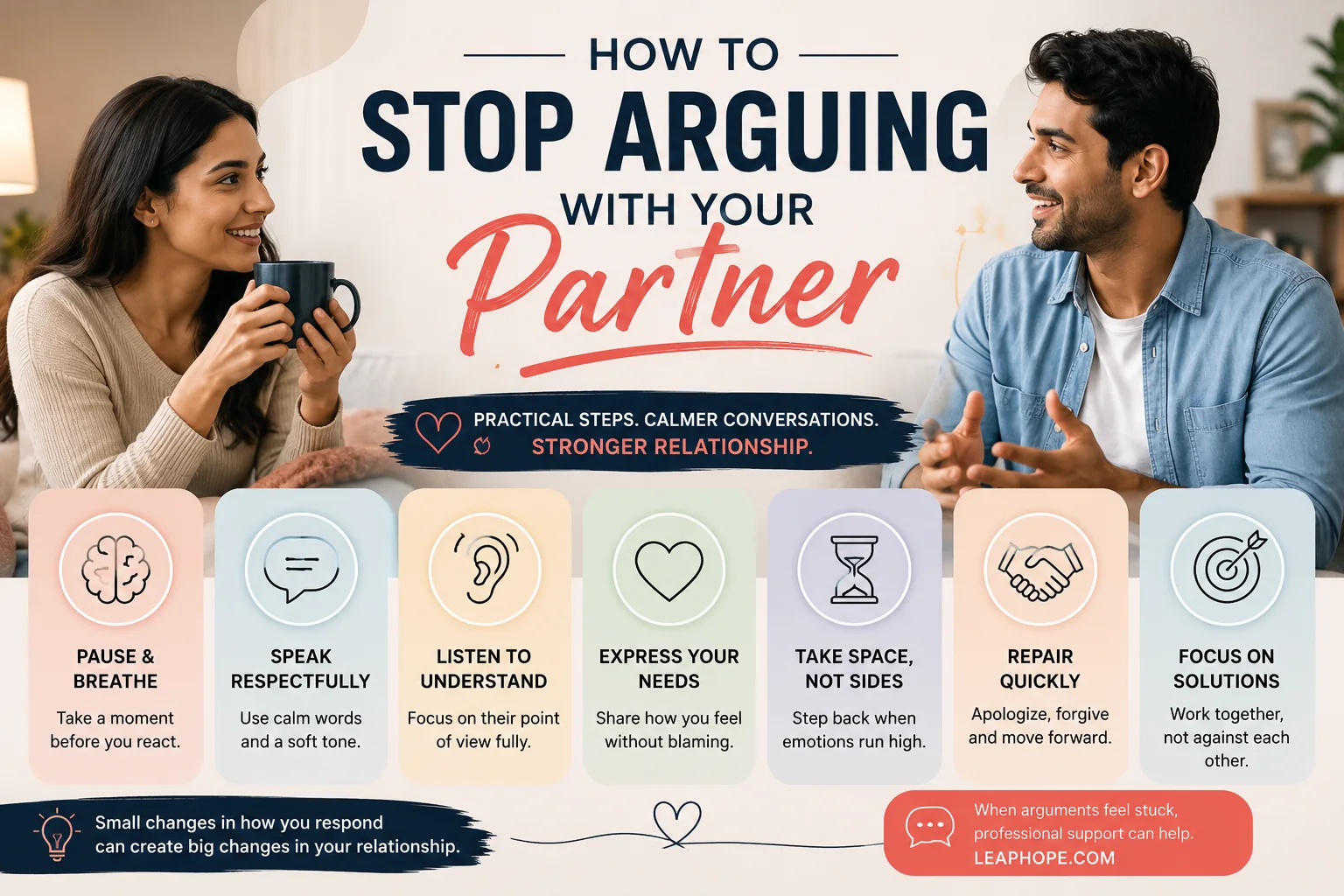
The first change is often not learning what to say during a huge fight.
It is noticing the fight earlier.
If you are already tired, irritated, or under pressure, ask whether this is really the right moment for an important conversation.
You can say:
“I do want to talk about this. I just do not think I will talk properly right now. Can we discuss it later tonight?”
That is not avoidance.
It is choosing a better moment.
The opening sentence matters too.
“You never listen to me” makes the other person defend themselves.
“I need you to hear me for a few minutes before responding” gives the conversation somewhere to go.
In Hindi, it can be as simple as:
“Main upset hoon, lekin main ladna nahi chahta/chahti. Aaram se baat karte hain.”
Or:
“Abhi gussa aa raha hai. Thoda shaant hokar baat karte hain.”
The goal is not to sound like a therapist.
It is to say what is wrong without attacking who your partner is.
When One Partner Wants Space and the Other Wants Answers
This is one of the most common conflict cycles.
One partner knows:
“If I keep talking now, I will say something I regret.”
So they want space.
The other partner thinks:
“If you walk away now, you do not care enough to solve this.”
So they follow, keep asking questions, or demand an answer.
The person asking for space feels trapped.
The person asking for answers feels rejected.
Both reactions then make the other person’s fear worse.
Taking space can help, but only when the other person knows the conversation is not being abandoned.
Instead of disappearing, say:
“I need 30 minutes because I am too angry to talk properly. I am not avoiding this. Let us talk again at 8.”
That one sentence changes the meaning of the break.
It is no longer:
“I am leaving you with this problem.”
It becomes:
“I need to calm down so we can continue.”
The Gottman Institute also describes how physiological flooding during conflict can reduce a person’s ability to listen and problem-solve, which is why a structured pause can be useful before continuing. Read more about cognitive overload during conflict.
The important part is returning.
Space can regulate an argument.
Silent treatment usually extends it.
Stop Fighting About the Surface Problem
If you keep arguing over small things, ask yourself:
“What does this issue actually mean to me?”
Phone use may be about attention.
Online behaviour may be about transparency.
Housework may be about feeling valued.
Money may be about security, fairness, or control.
In-laws may be about loyalty and boundaries.
Sex may be about rejection or closeness.
Freedom may be about autonomy rather than permission.
Once that deeper issue is spoken clearly, the conversation becomes different.
Instead of:
“Why did you spend that money?”
you may really need to say:
“I feel anxious when financial decisions happen without me.”
If money repeatedly becomes the trigger, these ways to reduce financial stress in marriage can help separate the financial problem from the emotional conflict around it.
What Should You Do With Old Wounds?
Bringing up the past is not always manipulation.
Sometimes the past keeps returning because it never stopped hurting.
That is very different from using an old mistake to win today’s argument.
If the wound is still active, say it directly:
“I know this happened before, but I have not rebuilt trust around it yet. I need us to work on that.”
That gives the old issue its own place.
Repeating:
“You did this three years ago, so you have no right to say anything”
during every unrelated disagreement usually does not help either person heal.
The past cannot be changed.
But its effect on the relationship can still be worked on.
If this pattern keeps repeating, understanding why a partner keeps bringing up past mistakes may help you separate unresolved hurt from using the past as ammunition.
Who Should Apologise First?
After some fights, neither partner speaks because both are waiting.
Who will message first?
Who will come back first?
Who will apologise first?
Who cares more?
Repair quietly turns into another power struggle.
Coming back first does not mean you lost.
You can say:
“I do not think either of us handled that well. Can we talk again?”
You can also apologise for your part without taking responsibility for everything.
For example:
“My tone was disrespectful. I should not have spoken to you like that.”
That is accountability.
“Fine. Sorry. Happy now?”
is usually only an attempt to make the conflict disappear.
The difference matters because peace without repair often lasts only until the next trigger.
End the Fight With Something That Changes
Many couples apologise and then return to exactly the same behaviour.
Before ending the conversation, ask:
“What will we do differently next time?”
If one person needs space, agree on how they will ask for it.
If phones keep causing arguments, agree on times when they stay away.
If family boundaries are the issue, decide what each partner will communicate.
If disrespect starts when voices rise, agree that either person can pause the conversation at that point.
An apology repairs the emotional moment.
A behavioural change reduces the chance of repeating it.

When Fighting Is No Longer Just a Communication Problem
Not every relationship problem can be solved by choosing nicer words.
Repeated fights may be pointing to something deeper when there is ongoing contempt, betrayal, emotional disengagement, controlling behaviour, serious loss of trust, or resentment that neither partner is willing to address.
Outside pressure can also become relationship conflict.
Work stress, money problems, family demands, poor sleep, and parenting can leave people with very little emotional capacity. This is one reason fighting after having a baby can increase even in couples who previously handled disagreements well.
Sometimes the useful question is not:
“Why is my partner annoying me?”
It is:
“How much patience do I have left today?”
That does not excuse shouting or disrespect.
It explains why emotional regulation matters as much as communication.
If repeated conflict continues despite genuine effort, it may also be worth looking at the signs a relationship may be beyond repair rather than assuming another communication technique will solve everything.
When Couples Therapy Can Help
Couples therapy can help when both people know the arguments are damaging the relationship but cannot see where the pattern keeps restarting.
A psychologist may look at what triggers the fight, what each partner thinks the other person’s behaviour means, how both react when they feel threatened or unheard, and what happens once the argument ends.
The work is rarely just:
“communicate better.”
It may involve timing conversations differently, regulating anger, learning when to pause, rebuilding trust, taking accountability, or recognising the need underneath the complaint.
It can also help couples separate advice that sounds useful from marriage strategies that actually create change.
The goal is not a relationship with no conflict.
It is a relationship where conflict does not keep creating the same damage.
FAQs
How do I stop arguments in marriage?
To stop arguments in marriage, notice when the conversation starts escalating, discuss one issue at a time, take a clear break when emotions become too intense, and end the discussion with one specific behaviour both partners will change.
How do I stop arguing with my partner over small things?
To stop arguing with your partner over small things, identify what the small issue represents emotionally. Repeated fights about phones, money, family, or housework often involve deeper concerns about respect, attention, trust, fairness, or control.
How do I stop being argumentative in a relationship?
To stop being argumentative in a relationship, pay attention to your timing, tone, assumptions, and emotional state. Pause when you become defensive, listen before responding, and explain what you need without attacking your partner’s intention or character.
Final Thoughts
If you keep fighting with your partner, look beyond what the last argument was about.
Think about what happened before it.
Were you already exhausted?
How did the conversation begin?
What did each of you think the other person’s words meant?
Who pushed?
Who withdrew?
Did an old wound enter the fight?
And most importantly, did anything actually change afterward?
For many couples, repeated arguments begin to reduce when four things improve: tone, emotional regulation, knowing when to pause, and taking accountability.
You do not need to agree about everything.
You need a safer way to handle the moments when you do not.