

Clinically reviewed by Aradhana Gambhir, Senior Psychologist & Marriage Counsellor · 25+ years of experience
You may start an argument about something happening today, and within a few minutes your wife is talking about something you did months or even years ago.
You may have already apologised. You may believe you have changed. Yet the same mistake appears whenever you disagree, leaving you wondering, “Why does my wife keep bringing up the past when I am trying to move forward?”
There is no single explanation. Sometimes the old hurt was never fully repaired. Sometimes your wife sees your present behaviour as another version of the same problem. And sometimes the original issue has been addressed, but the past has gradually become a way to blame, shame or gain an advantage in current arguments.
Those situations may look similar from your side, but psychologically they are very different.
The first step is not telling her to forget the past. It is working out why the past still feels relevant in your marriage today.
Why Does My Wife Keep Bringing Up My Past Mistakes?
When your wife brings up an old mistake during a new argument, she may not experience the two events as completely separate.
Suppose years ago you repeatedly dismissed her concerns during a difficult period. Today, you interrupt her or make a decision without discussing it first. To you, today’s disagreement may be small and unrelated. To her, it may immediately create the same feeling she had before: what I say does not matter to him.
That is why the better question is not simply, “Why is she talking about something old?”
Ask:
What does today’s situation remind her of?
Sometimes that answer explains why one old mistake appears in many apparently different arguments.
What May Be Happening in Her Mind When the Past Comes Up
A present disagreement can reactivate the emotional meaning of an older experience surprisingly quickly.
This does not necessarily mean your wife consciously decides to use history against you. Her mind may recognise a familiar pattern before either of you has fully understood what triggered it.
The present situation feels similar to the old hurt
People often remember emotionally significant events through their meaning rather than only through factual details.
You may remember an incident as, “I lied about something once.”
She may remember it as, “That was when I realised I could not completely trust what he told me.”
If something happens today that creates even a small doubt about honesty, the old event may suddenly feel relevant again.
To you, she is connecting two unrelated incidents.
To her, both incidents may belong to the same question: Can I rely on him?
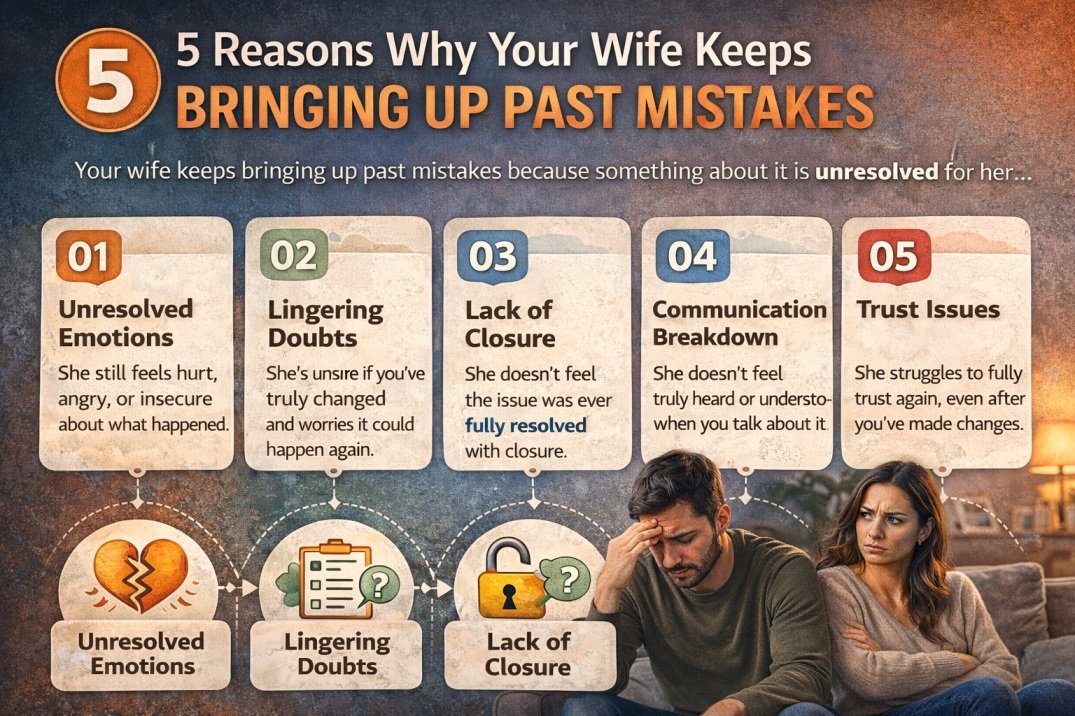
She may be trying to prevent the same hurt happening again
After someone has been deeply hurt, they can become more sensitive to signs that resemble the original problem.
If your past mistake involved cheating, secrecy, financial dishonesty, abandonment during a difficult period or repeatedly choosing someone else over her, she may watch more closely for signs that it could happen again.
That can look like criticism or repeated accusations from your side.
From her side, it may feel like protection: I ignored signs once. I don’t want to ignore them again.
This does not mean every suspicion she has is correct. It explains why seemingly small events can sometimes create a much larger reaction.
She may be looking for understanding, not another apology
You may have apologised several times and feel confused about what else she expects.
Sometimes the missing piece is not another “sorry.”
It is the feeling that you genuinely understand what the experience changed for her.
There is a difference between saying, “I know I made a mistake,” and understanding, “I see why what I did made it harder for you to trust me afterward.”
If she repeatedly feels that you understand the event but not its impact, she may keep returning to it hoping the conversation will finally reach that deeper level.
The unresolved issue may be the meaning, not the facts
Couples sometimes agree completely about what happened and still remain stuck.
For example, you both agree that you failed to support her when her family was going through a crisis.
You may understand it as one poor decision during a stressful period.
She may understand it as the moment she learned that when she really needed you, she was on her own.
Until couples discuss what the event came to mean, repeating the factual timeline often achieves very little.
That is one reason our guide to miscommunication traps in marriage focuses on the difference between explaining your intentions and actually understanding your partner’s experience.
Is the Past Unresolved, or Is the Same Problem Still Happening?
This is one of the most important distinctions in the entire situation.
Sometimes a husband says, “She keeps bringing up an old mistake,” but from the wife’s perspective, the problem is not actually old.
Perhaps the original issue was that you hid things from her. You no longer repeat the same major lie, but you still avoid difficult conversations until she discovers something herself.
Perhaps you once failed to stand up for her with your family. You apologised, but when a similar conflict happens today, you still stay silent.
Perhaps the old complaint was that she felt ignored. Years later, she still feels that you dismiss her concerns whenever you disagree.
In those situations, she may not simply be stuck in the past.
She may believe the pattern never completely stopped.
Before asking her to move on, ask yourself honestly whether anything happening today supports her interpretation.
The Past May Still Be Unresolved Even If You Said Sorry
An apology is important, but an apology does not automatically repair an injury.
There is a difference between acknowledging what you did, repairing the consequences and rebuilding trust afterward.
If your mistake involved something serious, such as cheating, repeated lying, hidden finances or breaking an important promise, your wife may need more than verbal reassurance before the relationship feels secure again.
Research examining forgiveness and conflict resolution in marriage has found connections between forgiveness-related responses and how couples manage marital conflict. That does not mean repeated complaints always prove someone has “not forgiven.” It does show why unresolved responses to an injury can continue influencing later conflict.
The useful question is therefore not:
“Why hasn’t she forgotten?”
It is:
“What part of what happened still feels unfinished?”
What If I Have Apologised and Actually Changed?
This is where the situation becomes more complicated.
Perhaps you accepted responsibility without blaming her. You changed your behaviour and have maintained that change for months or years.
Yet your wife keeps bringing up old mistakes whenever you disagree.
If that is happening, do not keep giving the same apology every time.
Have a separate conversation outside the argument and ask something more specific:
- What about what happened still feels unresolved?
- Is something I do today reminding you of it?
- Is there something you needed from me afterward that you never received?
- What would make you feel that we had genuinely dealt with this?
- Do you believe there can eventually be a point where this mistake is no longer brought into unrelated arguments?
That final question matters.
A relationship cannot repair if one partner has no idea what repair would ever look like.
When Bringing Up the Past Becomes Unfair
Understanding your wife’s psychology does not mean every use of the past is healthy.
There is a clear difference between saying, “This situation is bringing back what happened before,” and using an old mistake to shut down every concern you raise today.
The pattern becomes destructive when the past is repeatedly used to:
- humiliate you;
- make you feel permanently guilty;
- end unrelated disagreements;
- avoid responsibility for her own behaviour;
- prove that your needs or concerns no longer matter;
- justify current disrespect;
- or keep you permanently in the role of the person who is wrong.
Suppose you raise a reasonable concern about money today and the response is, “You lied to me three years ago, so you don’t get to question me.”
That does not resolve the old injury or the current problem.
It simply makes productive disagreement almost impossible.
A Past Mistake Should Not Become Permanent Power in the Marriage
If you hurt your partner, accountability matters.
But accountability and permanent punishment are not the same thing.
A relationship cannot function well if one person becomes permanently morally superior because the other once made a serious mistake.
You should be able to take responsibility for what you did while still being allowed to have boundaries, concerns and feelings of your own.
If every current problem ends with you being reminded why you are the “bad one,” resentment will eventually grow on your side too.
Healthy repair requires movement from both partners.
The person who caused the hurt needs to demonstrate change.
The hurt partner eventually has to decide whether that change can be recognised.
Why Old Mistakes Come Up More During Arguments
When people become emotionally overwhelmed, conversations rarely stay neatly organised.
A current disagreement can pull in several previous experiences that carried the same emotion.
So an argument that began because you were late might suddenly include a holiday from two years ago, something your mother said and another time your wife felt unsupported.
The connection may not be logical chronologically, but emotionally those situations may all represent the same theme to her.
That does not mean you should resolve five years of history during one argument.
It means you should notice the common theme.
If every argument becomes about “You don’t prioritise me,” “I can’t trust you,” “You never defend me,” or “You don’t listen to me,” that repeated message may tell you more than the individual examples.
Why Defending Yourself Too Quickly Can Make the Past Come Up More
When you feel accused, your natural reaction may be to explain.
You may say:
“That isn’t what happened.”
“You’re leaving out what you did.”
“I already apologised.”
“That has nothing to do with this.”
Some of those statements may even be factually correct.
But if your wife is trying to communicate hurt, immediate defence can make her feel that you are once again missing the point.
She then gives more examples.
You defend yourself against those examples.
She brings up another event.
Soon the conversation contains half the history of your marriage.
This is one of the ways a couple ends up having the same argument over and over even when the original topic changes.
Our guide on how to resolve conflict in marriage without escalating or damaging trust looks more closely at this pattern.
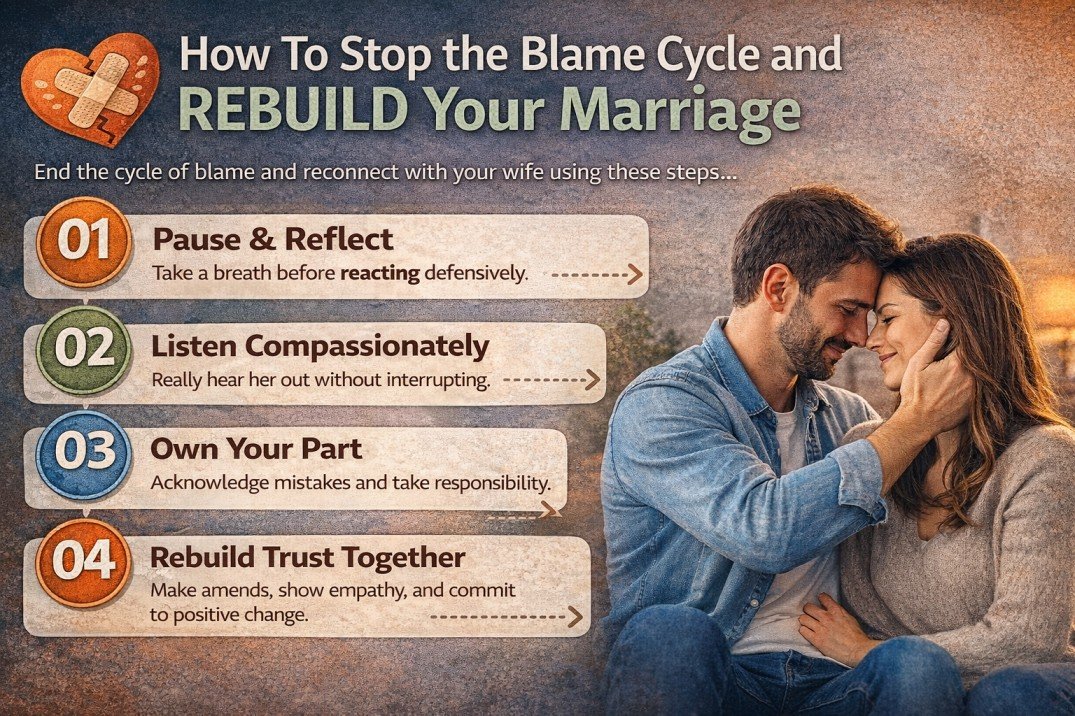
Do Not Respond by Bringing Up Her Mistakes
If she says, “You did this before,” it can be tempting to respond with something she did.
Sometimes her behaviour genuinely does need to be discussed.
But using her mistake to neutralise yours usually turns the conversation into emotional accounting.
You hurt me.
You hurt me more.
You did it first.
What about what you did?
Now neither problem gets resolved.
If you have a legitimate concern about her behaviour, discuss it as its own issue rather than using it to cancel her complaint.
Do Not Tell Her to “Just Move On”
Time alone does not repair every injury.
Saying, “That happened three years ago,” may be true, but it does not answer why it still has emotional power today.
Instead, ask what keeps the issue active.
Her answer may show that something is genuinely unresolved.
It may show that you are still repeating part of the pattern.
Or it may reveal that the relationship has reached a point where the old mistake is being used unfairly.
All three are more useful discoveries than arguing about how long someone should remain upset.
You Can Understand Her Hurt and Still Set a Boundary
Empathy does not require accepting every argument becoming about your past.
You can acknowledge that what happened still hurts her while also asking that unrelated issues be discussed separately.
The boundary should not be:
“You can never mention this again.”
A better boundary is:
“I am willing to talk properly about what is still unresolved. But I don’t think bringing this into every unrelated argument is helping either of us.”
That keeps space for her hurt without allowing the old mistake to control the entire marriage.
Have One Proper Conversation About What Is Still Unfinished
Trying to resolve this in the middle of another fight rarely works.
Choose a calmer time.
Talk specifically about the recurring pattern.
Ask what the original event means to her now, what she still fears, what she believes has changed and what she believes has not changed.
Share what the repeated accusations are beginning to do to you too.
The goal is not to decide who has suffered more.
It is to answer:
What would genuine resolution look like for both of us?
If neither person can answer that, the marriage may remain trapped in an undefined process where one partner keeps apologising and the other keeps waiting to feel different.
If the Mistake Involved Betrayal, the Psychology Is Different
Some injuries create a much larger disruption in trust than others.
If your past mistake involved an affair, major deception, hidden money or another serious betrayal, your wife may not simply be remembering what happened.
She may be using the past to assess whether she is safe from it happening again.
A delayed reply, private phone behaviour or unexplained change of plan may carry much more meaning after betrayal than it would have before.
In these cases, the aim is not simply getting her to stop mentioning the past.
The deeper goal is rebuilding enough consistency that the past gradually stops feeling necessary for predicting the future.
Our guide to rebuilding trust after betrayal in a relationship explains this process in more detail.
What If She Says She Forgives Me but Keeps Bringing It Up?
Forgiveness is not the same as forgetting.
Someone may genuinely want the relationship to continue while still having emotional reactions to what happened.
But forgiveness also becomes confusing if the old event is repeatedly used as punishment during unrelated conflicts.
Instead of debating whether she has “really forgiven you,” focus on what happens when the issue returns.
Is she asking for reassurance?
Is she afraid it will happen again?
Is something similar still happening?
Or is the old mistake simply being used to gain the upper hand?
Those questions are much more useful than arguing over the definition of forgiveness.
What If Nothing I Do Ever Seems Enough?
This feeling can eventually damage your side of the relationship too.
If you have consistently changed but believe every positive change is ignored while every mistake is remembered, you may become resentful, emotionally withdrawn or stop trying.
That reaction is understandable, but silently giving up usually makes the marriage worse.
Tell your wife what the pattern is doing to you.
You can take responsibility for your history and still say that you need your current behaviour to be judged fairly.
Repair requires accountability, but it also requires the possibility that people can change.
How to Tell Which Problem You Actually Have
When your wife brings up the past in arguments, try to identify which of these three patterns best describes your marriage.
1. The wound is still unresolved
She can explain what still hurts, the issue is related to the original injury, and conversations improve when she feels understood.
The work here is repair.
2. The same behaviour is still happening
You believe the mistake is finished, but some version of the original pattern continues in the present.
The work here is behaviour change.
3. The past has become a weapon
The old issue appears in unrelated arguments, prevents her from taking responsibility and is repeatedly used to shame or silence you despite sustained change.
The work here is boundaries and changing the conflict pattern.
Some marriages contain more than one of these at the same time.
That is why simply telling your wife to stop bringing up the past rarely solves anything.
When Marriage Counselling Can Help
Consider professional support when the same issue has been discussed dozens of times but nothing seems to settle.
Counselling can be especially useful when:
- your wife keeps bringing up past mistakes in most arguments;
- she says she still does not feel understood;
- you believe you have changed but feel permanently judged;
- you disagree about whether the original problem is actually over;
- both of you become defensive quickly;
- the past involved betrayal or serious loss of trust;
- resentment is increasing on both sides;
- or you keep having the same argument without understanding why.
Online marriage counselling can help both of you separate the original injury from the current conflict and understand what is actually keeping the cycle alive.
A counsellor should not simply tell your wife to forgive you or tell you to tolerate repeated blame.
The useful work is figuring out whether the marriage needs repair, present-day behaviour change, stronger boundaries—or some combination of all three.
Final Thoughts
If your wife keeps bringing up the past, there is usually more happening than an old memory appearing during an argument.
The past may still carry unresolved hurt. Something happening today may feel like the same pattern. Or the old mistake may have become part of an unhealthy way the two of you now handle conflict.
Do not immediately assume she is refusing to forgive.
But do not assume you must spend the rest of your marriage paying for one mistake either.
Try to understand what the old event means to her today, check honestly whether any part of the original pattern is still happening and pay attention to how the past is being used during current disagreements.
A marriage needs room for accountability.
It also needs room for repair, boundaries and genuine change.
The goal is not to erase your history. It is to reach a point where your history no longer has to decide every argument you have today.