Last Updated on September 10, 2026
Clinically Reviewed by Aradhana Gambhir – Senior Psychologist & Marriage Counsellor, 25+ Years of Experience
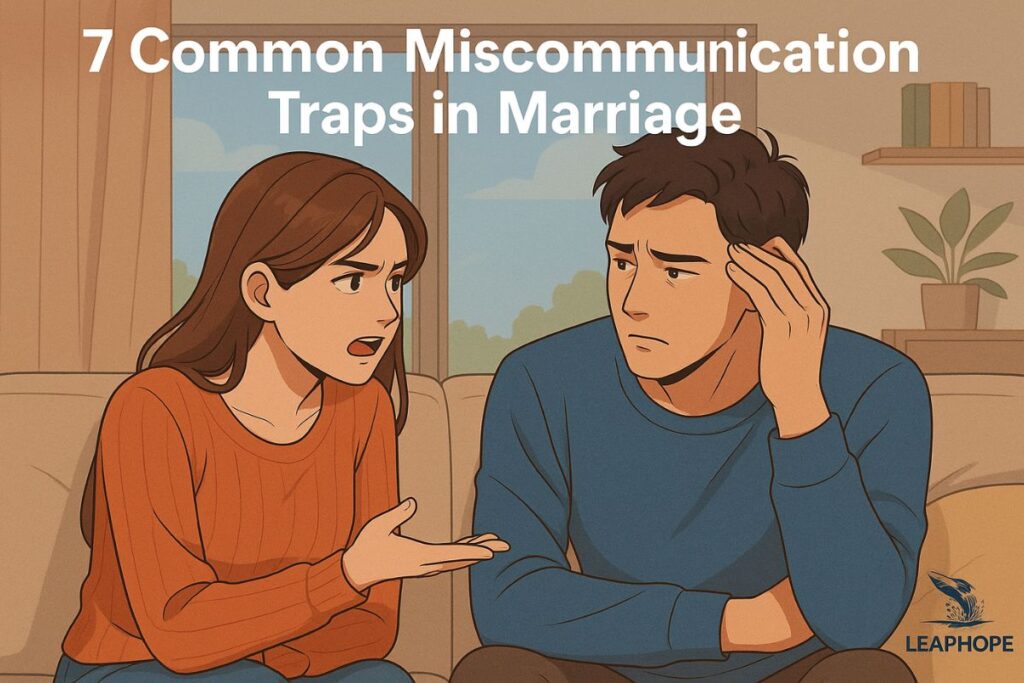
Miscommunication in marriage often starts during completely normal conversations.
You ask a question. Your partner hears criticism. They reply quickly. You hear attitude. Five minutes later, both of you are arguing about something neither person meant to discuss.
Couples can love each other, talk every day, and still keep misunderstanding each other.
Here are seven common miscommunication traps that can turn small moments into bigger arguments.
Common Miscommunication Traps in Marriage
Trap 1: Listening While Preparing Your Reply
Your partner is still talking, but you already know what you want to say.
You are correcting details in your head, thinking about what they did last week, or waiting for the right moment to explain why they have misunderstood you.
Then comes:
“That’s not what happened.”
“You’re missing the point.”
“Let me explain.”
The conversation continues, but neither person feels heard.
This is especially common when the topic feels personal. You start protecting yourself before you have fully understood what your partner is trying to say.
If this happens regularly, notice whether you are hearing your partner without really listening to them.
Sometimes letting them finish, then asking one question before replying, is enough to change the direction of the conversation.
Trap 2: Assuming You Know What They Meant
A short reply sounds rude.
A pause feels dismissive.
Your partner says, “Do whatever you want,” and you spend the next hour deciding what they really meant.
Assumptions create a lot of miscommunication in marriage because we rarely react only to words. We react to tone, timing, facial expressions, previous arguments, and what we already fear the other person might be thinking.
You may say:
“I know what you’re trying to say.”
“You obviously don’t care.”
“I can tell you’re angry.”
Sometimes you are right.
Sometimes your partner was simply tired.
Before reacting to the meaning you have created, ask.
“Did you mean that the way it sounded?”
“Are you upset with me?”
That small check can prevent many everyday misunderstandings between married couples.
Trap 3: Choosing the Worst Time for an Important Conversation
You have been thinking about money all afternoon.
Your spouse walks through the door after a terrible workday.
You start:
“We need to talk about our expenses.”
The topic may be completely reasonable. The timing makes it harder.
The same happens when couples bring up family problems while getting ready for work, start discussing travel plans at midnight, or ask a serious relationship question while the other person is distracted by something else.
Try asking:
“Can we talk about something tonight?”
or:
“Is now a bad time?”
You do not need to schedule every conversation.
But subjects involving money, sex, family, trust, or another ongoing disagreement usually go better when both people have enough attention to stay in the room mentally.
Trap 4: Using “Always” and “Never”
One forgotten call becomes:
“You never think about me.”
One messy kitchen becomes:
“You always leave everything for me.”
Your partner immediately starts proving the statement wrong.
“I cleaned yesterday.”
“I called you three times this week.”
Now the original issue has disappeared.
“Always” and “never” often show up when the feeling is bigger than the event. Maybe you have felt ignored several times. Maybe the chore imbalance has bothered you for months.
Say the thing underneath it.
“I’ve been feeling like I have to remind you a lot lately.”
“I felt forgotten when you didn’t call.”
That gives your partner something they can actually respond to.
When small disagreements repeatedly become the same argument, it may be worth looking at why some married couples keep fighting about the same issues.

Trap 5: Bringing Five Old Arguments Into One New Argument
You start by talking about being late.
Then somebody mentions last weekend.
Then the holiday with your parents.
Then something said six months ago.
Eventually neither of you remembers what started the conversation.
Old issues often return because they never felt settled to one person.
Maybe you stopped arguing about it, but nobody really discussed what happened.
This can make miscommunication in marriage feel much heavier than the original problem. Your spouse thinks you are fighting about today. You are reacting to today plus four other times you felt the same way.
If an old concern keeps coming back, give it its own conversation.
Do not wait until another unrelated argument gives you an opening.
Trap 6: Trying to Win With Logic
You remember exactly what happened.
You have dates.
Messages.
Examples.
A perfectly reasonable explanation.
Your partner is still upset.
This often happens when one person is explaining facts while the other is trying to explain how something felt.
You may be saying:
“But that isn’t what I meant.”
They may be saying:
“But that is how it affected me.”
Both things can be true in the same conversation.
The Gottman Institute describes criticism, contempt, defensiveness, and stonewalling as communication patterns that can become damaging in relationships.
Before adding another explanation, try:
“I can understand why that upset you.”
You can discuss the facts after your partner knows you have understood their side.
Trap 7: Reading Too Much Into Text Messages
“Okay.”
“Fine.”
“K.”
Three ordinary messages can somehow create three completely different arguments.
Texting removes facial expression, voice, and context. That leaves plenty of room for assumptions.
Maybe your partner took two hours to reply because they were busy.
You read it as avoidance.
They send a short answer because they are rushing.
You read it as anger.
By the time they get home, you have already had half the argument in your head.
Digital communication is useful for plans and quick updates.
When a conversation starts feeling emotional, call each other or wait until you can talk properly.
Some communication problems in marriage grow simply because couples keep trying to solve an emotional issue through increasingly irritated WhatsApp messages.
Why Does Miscommunication Happen in Marriage?
Miscommunication in marriage usually has more than one cause.
Stress, previous arguments, expectations, personality, family pressure, money problems, and different ways of handling emotion can all affect what you hear in a conversation.
Stress Makes People Less Patient
You may communicate very differently on Sunday morning than after a twelve-hour workday.
When you are tired, hungry, worried, or already frustrated, it takes less to feel criticised.
A harmless question suddenly sounds demanding.
A joke feels insulting.
A slow reply feels deliberate.
Outside pressure can make this worse. Ongoing family tension can spill into the marriage, while financial stress between partners can make ordinary spending conversations surprisingly sensitive.
Past Arguments Change How You Hear New Ones
Your spouse may be talking about today.
You are remembering last month.
If the same issue has hurt you several times, your mind becomes quicker to notice anything that resembles it.
That is why reactions sometimes look much bigger than the current situation.
The present conversation has picked up emotional weight from older ones.
Couples Communicate Differently
One person wants to talk immediately.
The other needs time.
One explains everything in detail.
The other gives short answers.
One wants reassurance first.
The other wants to solve the problem.
Different styles can create misunderstandings without either person intending to be difficult.
The important part is learning what happens between the two of you when those styles collide.
Talking Every Day Does Not Guarantee Good Communication
Couples can talk constantly and still avoid the conversations that matter.
You may discuss work, bills, children, shopping, family plans, and dinner every day.
But do you talk about resentment?
Feeling ignored?
Sex?
Money worries?
Something your partner keeps doing that bothers you?
Repeated miscommunication can eventually turn into a broader lack of communication within the marriage, where important subjects start being avoided altogether.
When Does Miscommunication Become a Bigger Marriage Problem?
One misunderstanding is usually just one misunderstanding.
Pay more attention when you begin recognising a pattern.
The same argument happens every week.
One person constantly feels criticised.
The other constantly feels misunderstood.
Small issues regularly turn into old arguments.
You spend more time defending what you meant than discussing what happened.
Conversations end in shouting, withdrawal, sarcasm, or several hours of silence.
At that point, changing a few phrases may not be enough. You may need to understand why the same interaction keeps happening.
Marriage counselling can help couples slow the conversation down and see the pattern underneath it. LeapHope’s couples and marriage support works with concerns around communication, recurring conflict, trust, family pressure, intimacy, and expectations.
Final Thoughts
Miscommunication in marriage can start with something tiny.
A tone.
A badly timed question.
An assumption.
A text message.
An old issue appearing in a new argument.
Instead of trying to become a perfect communicator, notice which pattern keeps showing up between you.
Maybe you interrupt.
Maybe your spouse assumes what you mean.
Maybe serious conversations always happen when one of you is exhausted.
That gives you somewhere practical to start.
LeapHope also works with couples across different family and cultural settings. Couples in Delhi, Gurgaon, and Bangalore can access support online, while couples living outside India can explore options designed around NRI relationships and cross-cultural marriage concerns.
Sometimes the useful question after an argument is simply:
“What did you hear me saying?”
The answer may explain why the conversation went wrong.
FAQs About Miscommunication in Marriage
What is miscommunication in marriage?
Miscommunication in marriage is when one partner says something but the other understands a different meaning. Tone, assumptions, timing, stress, previous arguments, and emotional reactions can all change how words are interpreted.
Why does miscommunication happen in marriage?
Miscommunication happens in marriage because couples bring stress, expectations, past experiences, and different communication styles into conversations. A partner may react to what they think was meant rather than the words that were actually said.
What are common examples of miscommunication in marriage?
Common examples of miscommunication in marriage include assuming a partner’s tone is angry, interrupting before they finish, using “always” or “never,” discussing serious issues at bad times, and misreading short text messages.
Can miscommunication cause problems in a marriage?
Yes. Miscommunication can cause problems in a marriage when misunderstandings keep repeating. Partners may begin feeling criticised, ignored, blamed, or emotionally distant even though the original conversations started over relatively small issues.
How can couples reduce miscommunication in marriage?
Couples can reduce miscommunication in marriage by checking assumptions, choosing better times for serious conversations, listening before replying, staying with one issue, and asking what their partner understood before continuing an argument.
When should couples seek help for communication problems in marriage?
Couples should seek help for communication problems in marriage when the same arguments keep returning, conversations regularly become hostile or silent, one partner feels consistently unheard, or attempts to resolve misunderstandings are no longer working.