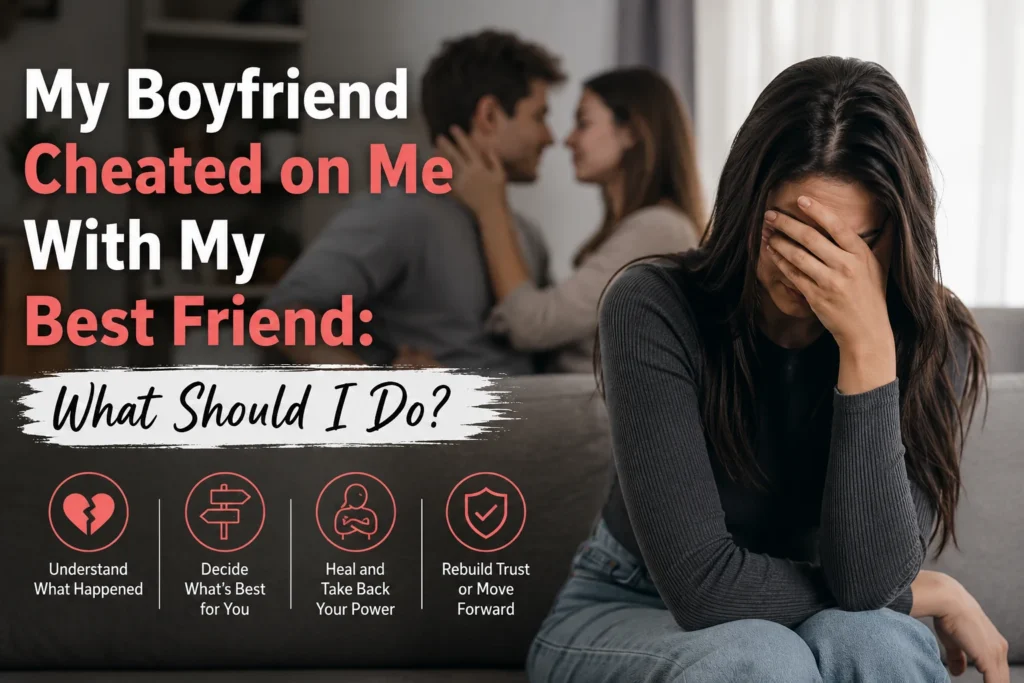

In counselling sessions at LeapHope, a recurring presentation is infidelity after having children.
Clients report:
“My partner cheated after we had kids.”
“We have children, and this still happened.”
“I don’t understand why they did this.”
“What was missing?”
“What changed after becoming parents?”
The timing varies. In some cases, it happens soon after childbirth. In others, it comes up a few years into parenting or later.
What remains consistent is the question of why the cheating happened after having children, what was lacking, and what changed after becoming parents.
This article examines the changes that can occur in a relationship and within individuals after having children, and how those changes can lead to infidelity.
Cheating After Kids Doesn’t Always Happen the Same Way
Cheating after childbirth is often linked to multiple changes happening at the same time in the relationship and within each partner. The shift into parenting can reduce emotional attention between partners, change intimacy patterns, and alter how each person experiences themselves in the relationship.
Common factors include emotional neglect, where one partner feels secondary or limited to responsibilities, identity disruption after becoming a parent, and a growing need for validation. At the same time, physical recovery, hormonal changes, and reduced intimacy can add further strain, while some individuals use external attention as a way to escape pressure or feel a sense of control again.
These factors do not justify cheating, but they help explain why it can occur during this phase.
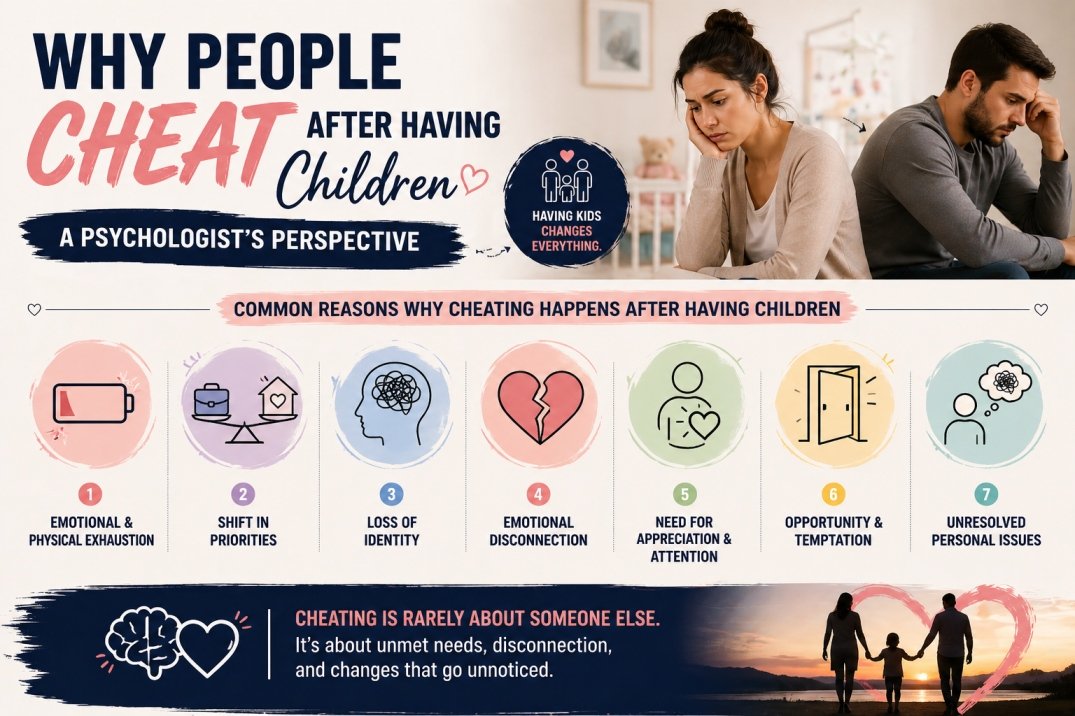
Why People Cheat After Having Children – A Psychologist’s Perspective
Emotional Disconnection and Feeling Unseen
After having children, emotional attention often shifts toward responsibilities. Interactions become task-focused, and one or both partners may start feeling less noticed or understood, even without conflict.
Men often experience this as reduced attention or closeness, while women often experience it as lack of emotional support. The experience is the same, being present, but not feeling seen.
This can happen quickly after childbirth due to exhaustion, or build gradually over the years as routine replaces connection. If it continues, even small external attention can feel more significant, increasing the risk of crossing boundaries.
Identity Loss After Becoming a Parent
After having children, many people experience a shift from being an individual to being defined mainly by their role as a parent. Personal identity, interests, and self-expression often get reduced, especially in the early years of caregiving.
This can happen quickly after childbirth, particularly for the primary caregiver, or develop over time as routines take over and personal space becomes limited. In later years, it may show up as a stronger awareness of what feels missing beyond parenting.
When this sense of self is not maintained, external attention or connection can feel like a way to reconnect with a part of oneself that feels lost, increasing the likelihood of crossing boundaries.
Sexual Disconnection or Mismatch
After having children, physical intimacy often changes. Frequency may reduce, desire may not align, and the emotional meaning of intimacy can shift. This creates a mismatch where one partner wants closeness and the other may feel unavailable.
In the early phase after childbirth, this is often linked to recovery, fatigue, and hormonal changes. In later years, it can continue due to routine, unresolved patterns, or reduced effort toward intimacy.
When this gap persists, it can be experienced as rejection or distance. Over time, some individuals respond by seeking physical or emotional closeness outside the relationship, especially when the issue is not openly addressed.
Routine, Boredom, and Lack of Novelty
After having children, daily life often becomes structured around routines, responsibilities, and predictability. While this brings stability, it can also reduce spontaneity and new experiences within the relationship.
In the early phase, routine is driven by caregiving demands. In later years, it becomes a fixed pattern where days start to feel repetitive. Over time, this can create a sense of monotony or emotional flatness.
When novelty is low for a prolonged period, external interactions can feel more stimulating or engaging. This contrast can increase the pull toward something outside the relationship, especially when the routine is not actively balanced with shared experiences.
External Validation and Feeling Desired
After having children, the amount of attention, appreciation, and desire expressed within the relationship can reduce. This is not always intentional, but it changes how valued or attractive a person feels over time.
In the early phase, this may be affected by physical recovery, exhaustion, and reduced focus on the relationship. In later years, it can continue if validation is not actively expressed, and partners begin to take each other for granted.
When someone else shows interest, appreciation, or attraction, it can feel stronger than expected. This is often less about the other person and more about meeting a need that has not been felt within the relationship, which can increase the risk of crossing boundaries.
Avoidance of Difficult Conversations
After having children, many couples prioritise stability and avoid conversations that may create tension. Concerns about distance, intimacy, or dissatisfaction are often delayed or softened instead of addressed directly.
In the early phase, this happens due to exhaustion and lack of time. In later years, it becomes a pattern where issues are known but not discussed. This prevents small problems from being resolved.
When communication is avoided, gaps remain. Over time, some individuals turn outward instead of addressing what is missing within the relationship, increasing the risk of crossing boundaries.
Unequal Emotional Load and Growing Resentment
After having children, responsibilities are not always shared equally. One partner may take on more of the mental and emotional load, planning, caregiving, and day-to-day management, while the other may feel pushed out or limited to specific roles.
In the early phase, this can develop quickly due to caregiving demands. In later years, it can become a fixed pattern. The partner carrying more may feel overwhelmed and unsupported, while the other may feel unappreciated or disconnected.
Over time, this imbalance can lead to resentment on both sides. When these feelings are not addressed, emotional distance increases, and external attention or connection can start to feel more appealing.
Opportunity Combined With Weak Boundaries
After having children, routines expand beyond the relationship, work, social media, and day-to-day interactions increase exposure to others. Opportunity by itself does not lead to cheating, but weak boundaries can.
In the early phase, boundaries may be less defined due to stress and shifting priorities. In later years, casual interactions can gradually become more personal if limits are not clear or maintained.
When emotional or personal gaps already exist, these situations can progress more easily. Without clear boundaries, what starts as normal interaction can move toward inappropriate connection.
These Patterns Often Build Slowly After the Early Parenting Phase
While some changes begin soon after childbirth, they often become more visible over time. The early phase is focused on adjustment and recovery, so many shifts are not fully noticed or addressed.
As life settles into routine, these patterns, disconnection, reduced intimacy, unaddressed concerns can continue without clear intervention. Because there is no single breaking point, they tend to build gradually.
Over time, this slow build increases distance within the relationship, making external attention or connection more likely to feel significant.
When Cheating Happens at Different Parenting Stages
Cheating After Childbirth and Early Parenthood
After childbirth, intimacy often reduces sharply due to recovery, exhaustion, and constant caregiving. Attention shifts to the child, and the couple’s connection becomes limited.
For some, this leads to a sense of rejection or loss of importance, especially when the change is sudden and not discussed. At the same time, communication around needs remains low.
In this situation, some individuals seek attention, validation, or physical connection outside the relationship instead of addressing the shift within it.
👉 Check this too: My Partner Cheated During Pregnancy
After Life Settles (2–6 Years)
In this phase, life becomes structured around work, routines, and parenting. Relationship issues often remain in the background, conversations are mostly practical, emotional check-ins reduce, and unresolved concerns are not actively addressed.
Parenting demands, unequal responsibilities, and ongoing stress can create friction or quiet distance. Emotional disconnection builds gradually, and intimacy may reduce or become infrequent, sometimes turning into a sexless or routine pattern.
Because these changes develop slowly, they are often normalised. Over time, this creates a gap where external attention or connection can feel more engaging, increasing the risk of crossing boundaries.
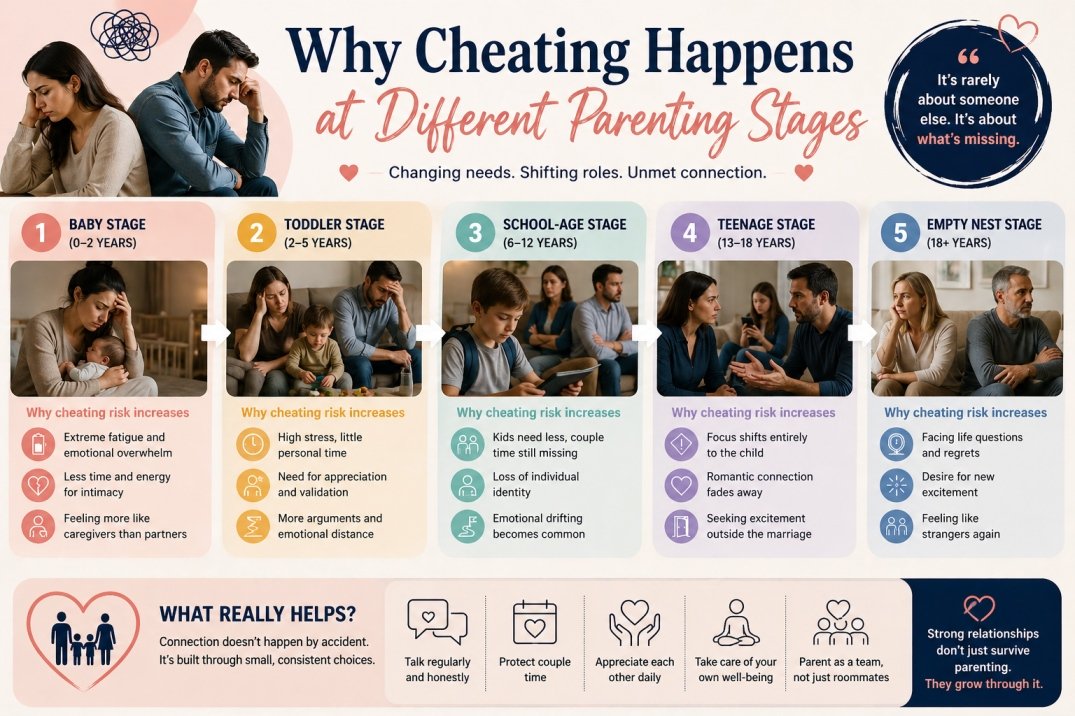
When Kids Are Older or Teenagers
At this stage, the intensity of daily parenting reduces, and attention shifts back to the relationship. Long-term patterns become more visible, especially emotional distance that may have built over years.
Some individuals begin to question their identity, role, and satisfaction with life and the relationship. If emotional connection and intimacy were not rebuilt earlier, the gap feels more established rather than temporary.
In this phase, cheating is often linked to long-standing disconnection or a need to experience something different, rather than a recent change.
Is It Worth Staying After Cheating When You Have Kids?
There is no clear yes or no answer to this. The decision depends on your partner, your relationship, and what is actually happening after the cheating.
What matters is not just the betrayal, but how your partner responds to it. Are they taking responsibility, being transparent, and making consistent effort to rebuild trust? Or are they minimising it, avoiding it, or repeating the same patterns?
At the same time, it depends on the condition of the relationship now. Is there respect, communication, and willingness to work through the issues, or is there ongoing tension, distance, or emotional harm?
Having children makes the decision more complex, but it should not be based only on staying together for them. The focus should be on whether the relationship can become stable, respectful, and workable in a real sense.
Ultimately, you are in the best position to assess this, based on what you see, not what is promised.
When To Seek Professional Help
Professional help is useful when the situation is not improving or feels difficult to manage.
- Issues keep repeating despite discussions
- Trust is not rebuilding
- Communication leads to arguments or avoidance
- You feel emotionally overwhelmed or stuck
- You are unsure whether to stay or leave
In such cases, structured support can help. At LeapHope, online therapy supports individual psychological concerns, while online marriage counselling focuses on rebuilding trust, communication, and understanding in the relationship.
Final Thoughts
Your partner, whether husband or wife, did not cheat because of one moment alone.
It usually develops over time, through changes in the relationship that were not clearly seen or addressed.
Before deciding what to do next, it is important to understand what actually changed in the relationship and in your partner’s behaviour.
Because your decision should be based on what is real and consistent now, not just the shock of the cheating.