
Last Updated on July 10, 2026
Reviewed by Mansi More Nopany, Sex Therapist
When a partner cheats, it hurts. But when it happens in a marriage that was already sexless, it becomes more confusing.
We often hear this from men and women in therapy:
“We weren’t having sex for a long time… did that lead to this?”
“Does a sexless marriage justify cheating?”
Maybe the distance had already been there. Intimacy stopped, conversations around it became uncomfortable, and over time, it just faded out.
Now that cheating has happened, one question keeps coming back:
“Did this happen because we stopped having sex?”
It’s a difficult place to be. You can understand that sexual needs matter, but at the same time, being cheated on still feels like a clear breach of trust.
This situation is not as simple as it looks. A sexless marriage can create frustration and distance, but it doesn’t automatically lead to cheating.
In this article, we’ll break down what role a sexless marriage actually plays, why cheating can still happen in this situation, and how to understand it without blaming yourself or ignoring what went wrong.
Did the Sexless Marriage Actually Cause the Cheating?
No. A sexless marriage can create frustration, distance, and unmet needs, but it does not cause someone to cheat.
For both men and women, the experience can feel different:
- some feel rejected or undesired
- some feel disconnected or emotionally distant
But the pattern is the same, something important is missing.
What differs is the response.
Some people try to address it.
Some withdraw.
Some choose to cheat.
So the lack of sex may explain the strain, but cheating is still a choice.
What a Sexless Marriage Really Feels Like (Beyond “No Sex”)
A sexless marriage is not just about the absence of sex. It changes how both partners experience the relationship.
For the partner with higher desire, it often feels like rejection. Over time, this can turn into frustration, self-doubt, and a sense of being unwanted.
For the partner with lower desire or avoidance, it can feel like pressure. Sex becomes something to avoid, which can lead to guilt, discomfort, and further withdrawal.
Between both partners, emotional distance starts to grow. Conversations around intimacy become tense or stop completely. What was once connection slowly turns into silence.
It’s not just “no sex” – it’s a gradual loss of closeness that affects how both people feel in the marriage.
Why Sex Stops Between Partners in a Marriage
Emotional disconnection and unresolved issues
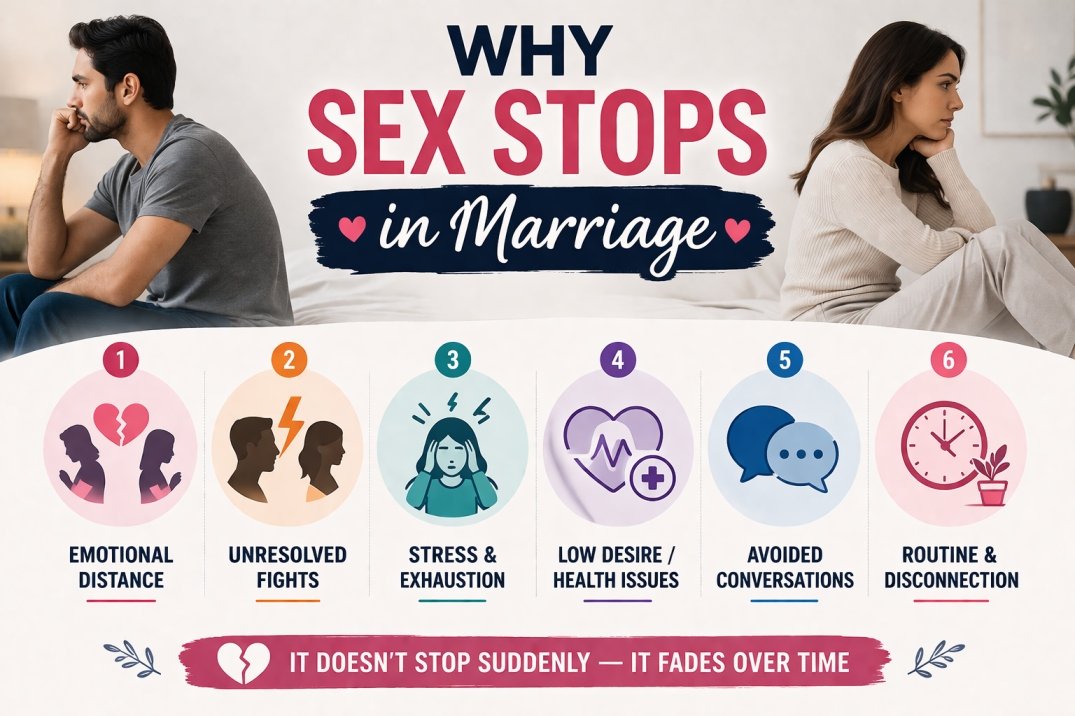
It often doesn’t start with sex. It starts with small things, feeling unheard, dismissed, or taken for granted. Arguments don’t get resolved, they just stop being discussed. Over time, you stop opening up. And when that emotional connection fades, physical intimacy usually follows.
Rejection and withdrawal cycles
One partner keeps trying, the other keeps saying no. After a point, the one initiating feels rejected and stops trying. The other feels relieved the pressure is gone. On the surface, things look calmer but intimacy has already started shutting down.
Stress, exhaustion, and mental overload
By the end of the day, both are tired but in different ways. One may still want closeness, the other just wants rest. Work, responsibilities, and mental load take over. Intimacy starts feeling like another task instead of something natural.
Painful sex, trauma, or health concerns
Sometimes sex stops because it becomes physically or emotionally uncomfortable. Pain, low libido, erectile issues, or past experiences can make one partner avoid it. Instead of addressing it openly, it gets pushed aside, and silence grows around it.
Body image and insecurity
Feeling unattractive, changed after children, or simply not confident in your body can make you pull away from physical closeness. This often isn’t spoken about, but it shows in avoidance and hesitation.
Life changes (children, aging, routine)
Life gets full. Kids, routine, responsibilities, everything else starts taking priority. Without conscious effort, intimacy slowly disappears. It’s not a decision; it just stops being part of the relationship.
Why a Partner Chooses to Cheat in a Sexless Marriage
They no longer feel desired in the marriage
When sexual intimacy is absent for a long time, it often affects a person’s sense of desirability and sexual self-esteem. Even if the reason is stress, health, or life changes, the experience can still feel personal.
- In men, this is often felt as sexual rejection, which can affect how desirable or confident they feel.
- In women, it often feels like not being seen or valued, both emotionally and physically.
Over time, this creates a gap in validation. The need is not just for sex, but for feeling wanted. When that need is not met in the relationship, attention from someone else can start to feel meaningful.
This shift usually happens slowly, especially when the need to feel desired is not talked about or addressed.
Emotional disconnection is never addressed
Over time, repeated arguments and unresolved issues can lead to emotional disconnection. Respect and emotional safety start to weaken, and intimacy naturally declines.
- One partner may feel criticised or rejected
- The other may feel unheard or drained
Instead of resolving it, both begin to withdraw. The relationship becomes functional, not emotionally connected.
In this state, a new connection can feel easier, lighter, and more positive. That contrast can create excitement and lower boundaries, which can lead to cheating.
Conversations about sex and intimacy are avoided
In many marriages, issues like ED, low libido, or painful sex are not openly discussed. The topic becomes uncomfortable, so it’s avoided.
Over time, sex can start to feel like a routine or obligation, which leads to more avoidance and eventually a sexless pattern.
- One partner stops asking to avoid rejection
- The other avoids it to escape pressure or discomfort
In contrast, a new connection can feel easier and more open, where expression feels natural and understood. That difference can lower boundaries and lead to cheating.
Stress and exhaustion lower self-control and boundaries
When someone is under constant stress or mental load, their ability to self-regulate reduces. They are more focused on immediate relief than long-term consequences.
- Work pressure, responsibilities, and daily fatigue drain emotional energy
- Intimacy starts to feel like effort, not connection
In this state, judgment can shift. Opportunities that would normally be avoided may feel easier to engage with.
Cheating in this context is less about planning and more about reduced impulse control under prolonged stress.
They seek validation outside instead of repairing the relationship
When someone feels unwanted or disconnected for a long time, the need shifts from sex to validation.
Instead of trying to fix what feels stuck or difficult in the relationship, external attention feels easier.
- Being noticed, appreciated, or desired again fills that gap quickly
- There is no history, conflict, or pressure to deal with
This creates a pattern of external validation seeking, where the person relies on someone else to feel better rather than addressing the issue within the marriage.
Over time, this can lead to crossing boundaries.
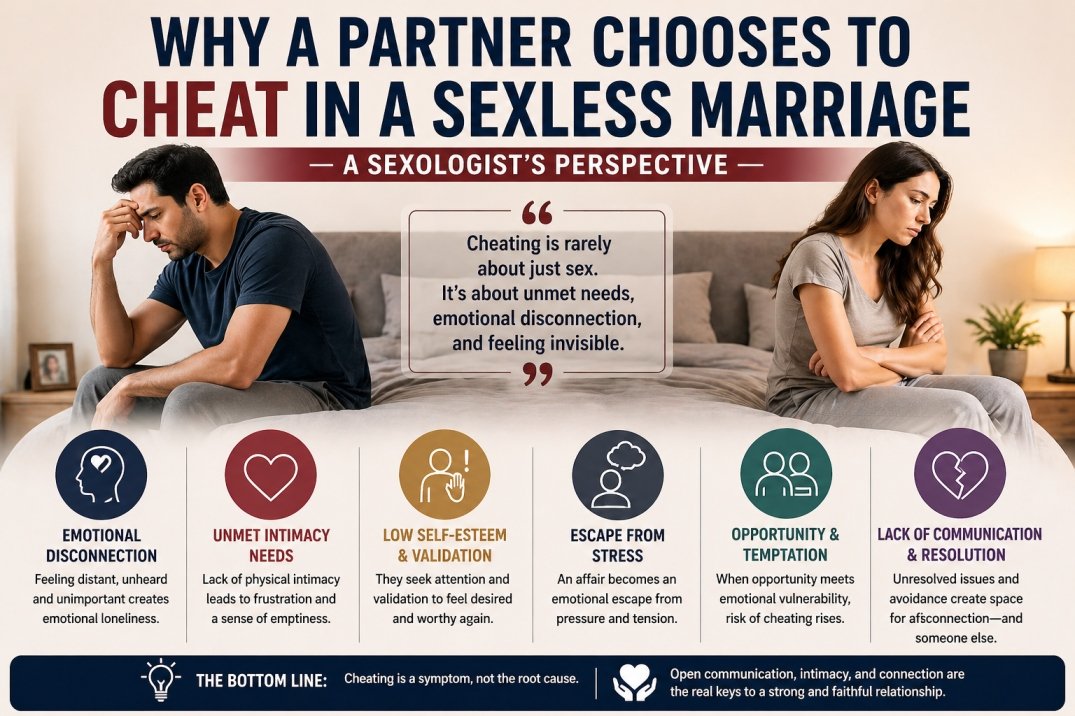
Personal boundaries and behaviour patterns are weak
Not everyone in a sexless marriage cheats. This is where individual differences matter.
Some people have weaker relationship boundaries or struggle with impulse control and accountability. When they face frustration or unmet needs, they are more likely to act on opportunity rather than pause and reflect.
- They may not clearly define limits with others
- They may allow emotional or physical closeness to cross lines gradually
This is less about the marriage itself and more about how the individual handles difficult situations.
Stronger boundaries usually lead to communication or change. Weaker boundaries make it easier to cross into cheating.
They justify the behaviour instead of questioning it
In a sexless marriage, the thinking can shift from “Is this right?” to “Why this is understandable.”
It often sounds like:
- “My needs aren’t being met, I have to deal with it somehow”
- “This is because of the situation, not really my fault”
This is rationalisation, a way of creating permission and reducing guilt.
It may make the behaviour feel easier to accept, but it shifts responsibility away from the decision.
A sexless marriage can explain the frustration, but it does not justify infidelity.
What Should You Do After Discovering Cheating in a Sexless Marriage?
Don’t react impulsively
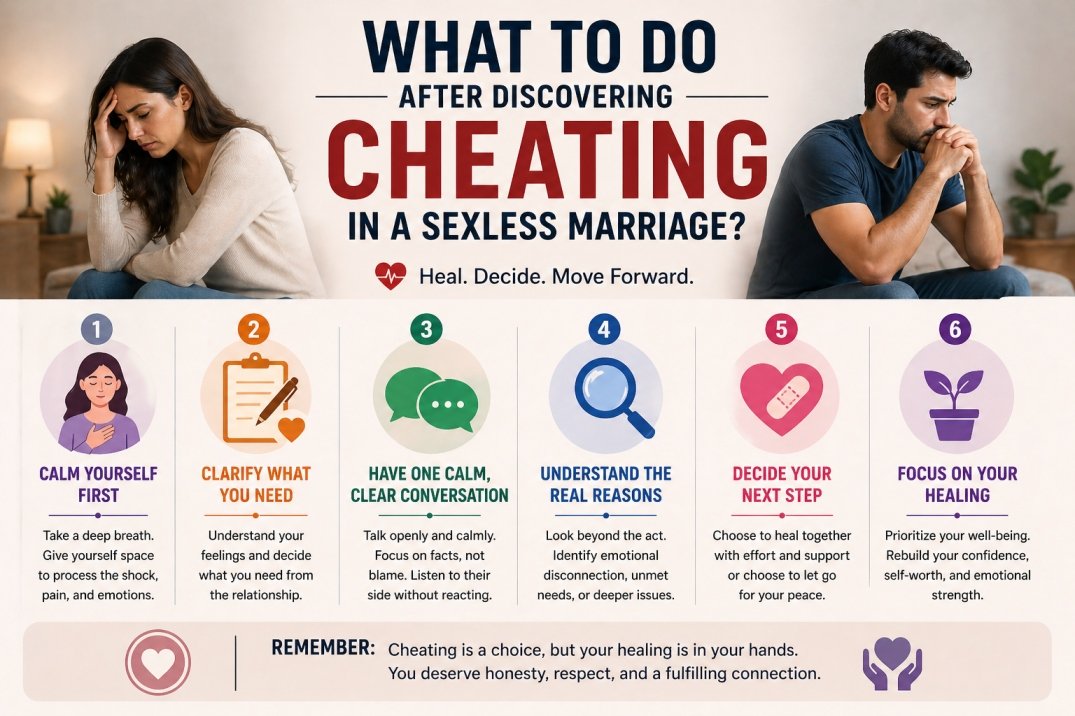
The shock can push you toward immediate decisions, confronting aggressively, threatening to leave, or trying to control the situation. These are emotion-driven reactions, not decisions.
Take a pause. Your nervous system is dysregulated right now, and clarity is low. Acting in this state often escalates conflict rather than giving you answers.
Get clarity before confrontation
Before confronting your partner after cheating, be clear on what you already know and what you actually need to understand.
- Are you trying to confirm facts, or understand patterns?
- Do you want honesty, or a reaction?
A scattered, emotional confrontation often leads to defensiveness or partial truth. A calm, structured conversation increases the chances of real clarity.
Separate emotion from decision
Right now, you may feel anger, betrayal, guilt, or even self-blame. These are valid, but they are not a reliable basis for decision-making.
You need to separate:
- emotional reaction → how you feel right now
- relational decision → what you want going forward
This shift allows you to think in terms of repair vs exit, rather than reacting to pain.
Look at patterns, not just promises
After cheating is exposed, most people apologise. The question is not what they say, it’s what pattern you’re seeing.
Look for:
- accountability vs blame-shifting
- willingness to address both cheating and intimacy issues
- consistency over time, not immediate reassurance
Cheating in a sexless marriage is rarely an isolated event. It usually reflects ongoing patterns of avoidance, disconnection, or boundary issues.
Your decision should be based on whether those patterns are likely to change, not just on what is promised in the moment.
Can a Sexless Marriage Survive Cheating?
Yes, it can, but only if both people are willing to deal with it honestly.
- the partner who cheated takes full responsibility, without blaming the situation
- both partners are willing to put in effort
- both issues are addressed:
- the cheating
- the loss of intimacy
If this doesn’t happen, the relationship usually does not recover.
A sexless marriage itself can also be worked on and improved over time. If you need structured support, you can consider sexless marriage counselling at LeapHope.
It’s possible, but not guaranteed.
When to Seek Professional Help
- conversations keep failing or turning into conflict
- intimacy has been missing for a long time
- sexual issues like ED, PE, low libido, or painful sex are present
- emotional distance keeps increasing
- cheating has happened and you’re unsure what to do next
In these cases:
- online sex therapy can help with ED, PE, low libido, painful sex, and other psychological sexual concerns
- online marriage counselling can help with communication issues, emotional disconnection, and trust after cheating
Final Truth Most People Avoid
A sexless marriage didn’t cause the cheating.
It created strain and distance, but the decision to cheat was still a separate choice.
At the same time, the lack of intimacy is not something to ignore. It often points to deeper issues in the relationship that were already there but not addressed.
If you only focus on the cheating, the underlying problem remains.
If you only focus on the sexless marriage, the breach of trust remains.
Both need to be looked at separately and dealt with directly.
FAQ
Is cheating justified in a sexless marriage?
No, and the distinction matters here. A sexless marriage explains the frustration and distance a partner may have felt, but it doesn’t explain the decision to cheat, those are two separate things. Plenty of people go through long periods without intimacy and choose to address it, withdraw, or leave, rather than cheat. The lack of sex creates the conditions for temptation; it doesn’t remove the choice.
Can a marriage recover after no intimacy and infidelity?
It can, but only if both issues get addressed separately rather than one being used to explain away the other. Recovery typically requires the partner who cheated to take full responsibility without leaning on the sexless marriage as justification, and both partners being willing to work on what caused the intimacy to fade in the first place. Skipping either piece usually stalls the recovery.
How long do sexless marriages last?
There’s no fixed timeline, some couples sustain a sexless period for years without it destabilising the relationship, especially where emotional connection stays strong. What matters more than duration is whether the topic can still be discussed openly. Once conversations about intimacy stop happening at all, that silence tends to do more damage than the absence of sex itself.
What if I don’t want sex but my partner does?
A mismatch in desire isn’t unusual, and neither partner is obligated to want sex on the other’s timeline. What causes damage isn’t the mismatch itself, it’s leaving it undiscussed. Naming the difference openly, and working out what closeness looks like for both of you, prevents the resentment and distance that often follow when it’s left unaddressed.