We hear this question in therapy more often than you might expect, whether it’s about a husband, wife, boyfriend, or girlfriend:
“They cheated on me, but I still love them… why?”
You expected the love to disappear the moment you found out.
Instead, you feel broken, confused, and somehow still emotionally attached.
Some people say:
“I caught my boyfriend cheating, and instead of wanting to leave, I feel even more drawn to him.”
Or,
“My partner hurt me deeply, but my feelings haven’t changed.”
That contradiction can make you question yourself, and even wonder, “Why do I still love my partner after they cheated?”
In this article, our therapists draw on real experiences from working with couples and individuals to explain what’s actually happening psychologically, and why your feelings haven’t switched off, even after betrayal.
And more importantly, it doesn’t mean something is wrong with you.
Why You Still Love Your Partner After They Cheated (Psychologist’s Explanation)
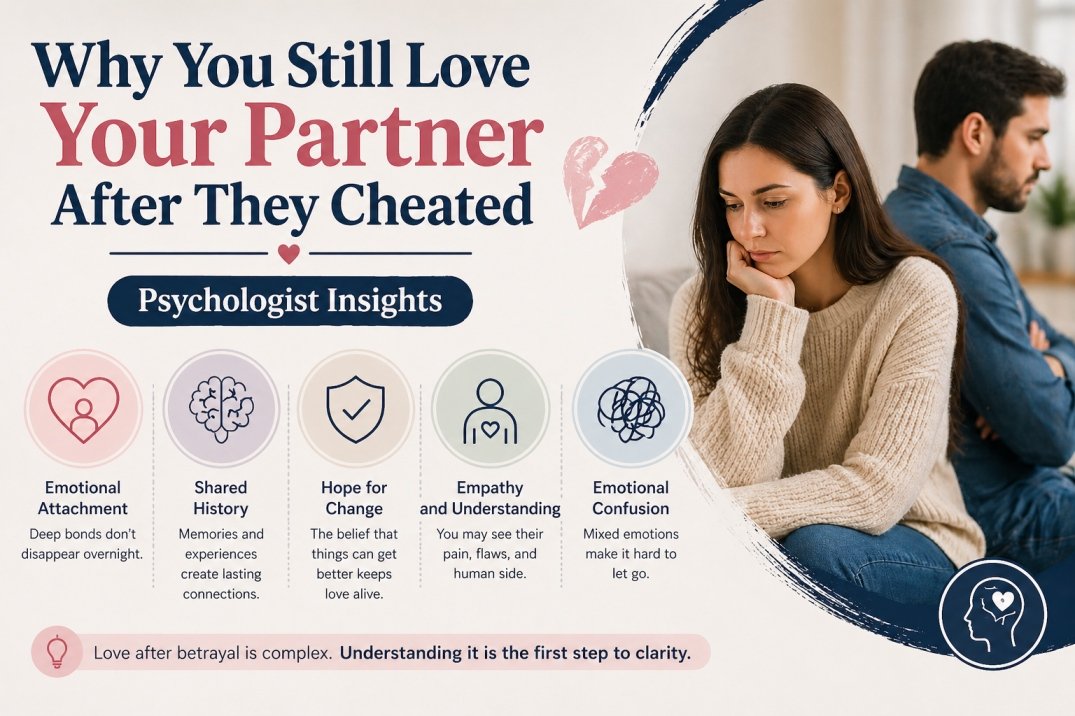
Loving someone after betrayal can feel deeply confusing. You were hurt, cheated on, and part of you fully understands how serious that is. But at the same time, another part of you keeps bringing your feelings for them back, despite the pain.
Below, our licensed therapists with over 10 years of experience in couples therapy explain the real psychological reasons behind this.
Your Attachment System Still Sees Them as Your Safe Person
Over time, your brain learns to treat your partner as a primary attachment figure, someone linked to safety, comfort, and emotional regulation. This happens at an automatic, deeper level. So when betrayal occurs, your logical mind may recognise the hurt, but your attachment system is still wired to seek closeness with them.
Your attachment style shapes how this shows up. If you lean anxious, the pull can feel stronger, driven by fear of losing the relationship. If you’re more avoidant, you might feel numb or distant at first, only for the attachment to surface later. Even with a secure style, the bond doesn’t disappear instantly, it takes time for your system to adjust.
This is why you can feel drawn toward the same person who hurt you. That pull can feel like love, but often it’s your attachment system trying to return to familiarity and emotional safety, even when that safety has been disrupted.
Your Emotional Memory and Daily Habits Are Still Built Around Them
Your brain doesn’t just remember your partner emotionally, it encodes them through associative memory and conditioning. Over time, routines, conversations, and shared moments become automatic patterns your mind expects.
Even after betrayal, these neural associations stay active. Small cues like a place, time, or habit can trigger emotional recall and implicit memory, bringing back feelings without conscious effort.
Social media can intensify this. Photos, chats, or algorithm-driven reminders repeatedly reactivate those memory pathways, creating a reinforcement loop.
So what feels like love is often your brain responding to disrupted patterns and familiarity, not just a current emotional connection.
Your Identity Was Tied to the Relationship
Over time, your sense of self can shift from “me” to “we,” a process known as identity fusion. For many people, especially in long-term relationships or marriage, their partner becomes central to how they make decisions, plan their future, and define their role in life.
You may have shared your relationship openly on social media, involved family and friends, and started prioritising your partner in most aspects of life. Many of your choices, routines, and even goals may have been shaped with them in mind.
When betrayal happens, it doesn’t just feel like losing a person, it disrupts your self-concept and the life you had built around them. That’s why the pull you feel can seem like love, when in reality, part of it is your mind trying to hold onto that identity and restore a sense of stability.
Your Mind Is Stuck Between “They Hurt Me” and “I Love Them”
What you’re experiencing is cognitive dissonance, when your mind is trying to hold two conflicting truths at the same time: they hurt me and I still care about them.
This creates psychological tension, so your brain tries to reduce it by making sense of the situation. That’s why you may find yourself overthinking, replaying events, or looking for explanations that make both realities fit.
In that process, it’s common to start justifying, minimising, or reinterpreting their behaviour, not because you’re ignoring what happened, but because your mind is trying to restore internal consistency.
Your Emotions Are Fluctuating Because Your System Is Dysregulated
Betrayal creates a nervous system shock, activating your stress response. The same person your brain linked with safety is now also perceived as a threat, creating a mixed signal at a physiological level.
This can lead to emotional dysregulation, where you swing between anger, longing, numbness, or moments of closeness. In some cases, the distress is so intense that it can even show up as physical pain, tightness in the chest, heaviness in the body, or a sinking feeling in the stomach. This happens because emotional pain and physical pain share overlapping neural pathways.
The intensity you feel can seem like deeper love, but often it reflects instability and unresolved emotional activation, not clarity about the relationship.
Part of You May Be Minimising or Blocking the Reality
To cope with the shock, your mind can use defence mechanisms like denial and minimisation to reduce emotional overwhelm. Instead of fully absorbing the betrayal, it softens the impact.
This can show up as creating explanations that make the situation feel less threatening, like thinking “maybe they were drunk,” “maybe they didn’t mean it,” or “maybe they were pressured.” These kinds of interpretations help your mind hold onto the relationship without fully confronting the pain.
This is sometimes referred to as betrayal blindness, where the mind partially blocks or reshapes reality to stay emotionally stable. It can help in the short term, but over time, it can delay clarity and make it harder to fully process what actually happened.
You’re Mourning the Person You Thought They Were
What you’re feeling isn’t just about the betrayal, it’s about grief. You’re grieving the version of them you trusted, the relationship you believed in, and the future you had imagined together.
This kind of loss is often called ambiguous loss, where the person is still physically present, but emotionally feels different or unfamiliar. That makes it harder to process than a clear breakup.
You may remember how they protected you, showed up for you when you were sick or struggling, supported you in difficult moments, or were there in emergencies when no one else was. You may think about the romantic gestures, the late-night conversations, and the time you spent building something meaningful together.
Because of this, you’re not just missing a person, you’re missing everything they represented in your life. In many cases, the love you feel is directed toward that version of them, not the reality of who they are right now.
Hope for Change Is Keeping the Bond Alive
After betrayal, apologies, promises, or moments of closeness can quickly reactivate hope. Your mind shifts toward what could be, not just what happened, as a way to reduce emotional pain.
You may find yourself thinking, “maybe it was a mistake,” or “maybe they’ll change.” This kind of future-focused thinking keeps the attachment active, because it offers relief from the present hurt.
Hope can feel very similar to love, but it’s often based on possibility rather than current reality. It keeps you emotionally connected to what you want the relationship to become, not necessarily what it is right now.
Intermittent Reinforcement Is Strengthening Attachment
When hurt is followed by affection, your brain gets pulled into a strong intermittent reinforcement loop. The shift from pain to closeness makes those moments feel more intense than steady, consistent connection.
Because the reward is unpredictable, your mind keeps seeking it out more. This creates a pattern of emotional dependency, where you hold on, hoping for the next moment of reassurance or closeness.
Over time, this leads to emotional highs and lows that feel powerful. It can feel like deep love, but often it’s the intensity created by this reinforcement pattern, not the health of the relationship.
You May Be Idealising the Relationship
After betrayal, your mind can shift into idealisation, where it focuses more on the good memories and downplays the negative patterns. This is a form of selective recall, where your brain highlights what felt safe and meaningful before.
You may find yourself comparing the present pain to a past “better version” of the relationship, holding onto how things used to feel rather than how they are now. You might also think, “people make mistakes,” or “this happens in other relationships too,” as a way to make sense of what happened.
This can distort your perception and make the relationship seem more valuable or acceptable than it actually is, keeping you emotionally attached.
Fear of Loss and Uncertainty Is Holding You Back
After betrayal, it’s not just the person you’re afraid of losing, it’s the life structure built around them. Your brain tends to prefer familiar pain over uncertain outcomes, a bias known as loss aversion.
You may fear being alone, starting over, or losing the time, effort, and emotional investment you’ve already put in. This is also linked to the sunk cost fallacy, where past investment makes it harder to let go.
Because the unknown feels more threatening than what you already know, your mind may hold onto the relationship. That fear can keep emotional attachment active, even when part of you knows you’ve been hurt.
You May Be Questioning Your Own Worth or Role
After betrayal, it’s common to turn inward and ask, “Was I not enough?” This is a form of self-attribution bias, where you start linking their behaviour to your own value.
You may begin internalising their actions, even though the choice to cheat was theirs. This can create a need to “fix” the relationship as a way to restore your sense of worth.
Over time, your feelings can become mixed, where what feels like love is partly a need for validation and reassurance, not just genuine emotional connection.
You’re Still Processing What Happened and Looking for Closure
After betrayal, your mind enters an ongoing processing loop, trying to make sense of what happened. This often shows up as rumination, where your brain keeps replaying events to find clarity or answers.
You may feel a strong need for explanation, meaning, or closure, something that helps the situation “make sense.” Until that happens, your mind keeps the emotional connection active.
Because the experience feels unresolved, your feelings don’t shut down instantly. What feels like love can persist simply because your brain hasn’t fully processed or closed that chapter yet.
You’re not feeling just one emotion; you’re experiencing multiple internal processes at once.
- Part of you is still attached (attachment system)
- Part of you is grieving (loss response)
- Part of you is trying to make sense of it (cognitive processing / rumination)
- Part of you may be afraid of losing everything (fear response / loss aversion)
- And yes, part of you may still genuinely love them
That’s why it feels so confusing.
Because it’s not just love.
It’s love mixed with attachment, fear, memory, and emotional conditioning, all activating at the same time, and they haven’t fully aligned yet.
So no, this doesn’t mean your love is fake.
But it also doesn’t mean everything you’re feeling is love.
Understanding that difference is what brings clarity.
Feeling Love For Cheating Partner Doesn’t Always Mean the Same Thing
Loving your partner after cheating is common because deep emotional bonds, shared history, and attachment don’t disappear instantly, even when trust is broken. You may be holding onto who they were, or the hope of who they could be.
But not all of what you’re feeling means the same thing.
Some of it is genuine care and emotional connection.
And some of it is everything built around that love, familiarity, fear of loss, and the need to make sense of what happened.
That’s why it’s important not to rush decisions right now. Acting out of confusion, whether leaving suddenly or getting pulled into repeated arguments, can make things more complicated.
In long-term relationships or marriage, there may also be family, finances, children, or a shared home involved, which makes thoughtful clarity even more important.
Give yourself time to understand what you’re feeling before deciding what to do.
When to Seek Professional Help
If this situation is starting to affect your mental health, don’t ignore it. You may need support if you’re experiencing:
- You feel stuck and can’t decide whether to stay or leave
- Your mind keeps overthinking the same things again and again
- You feel anxious, restless, or emotionally overwhelmed most of the time
- You keep blaming yourself or questioning your worth
- You feel drained, low, or mentally exhausted
- You’re avoiding people or don’t feel like talking to anyone
- You don’t feel emotionally safe or able to trust anymore
If this feels like you, you don’t have to handle it alone.
For relationship repair, consider online marriage counseling at LeapHope to rebuild trust and gain clarity.
For individual support, you can also work with an online clinical psychologist, available for international clients.
The Bottom Line
Loving your partner after they cheated doesn’t make you weak, it makes you human. Emotional bonds, memories, and attachment don’t switch off instantly just because something painful happened.
But what you’re feeling is not just love. It’s a mix of attachment, fear, habit, hope, and real emotional connection, all happening at the same time.
The goal isn’t to force yourself to stop loving them.
The goal is to understand what your feelings actually mean before you decide what to do next.
Give yourself time. Clarity comes before decisions.
Related Questions People Ask
Why do I still love my husband after he cheated?
Loving your husband after cheating is common because attachment, shared history, and emotional bonding don’t disappear instantly. You may still feel connected even though you’re hurt, which creates that inner conflict.
Can someone cheat and still love you?
Yes, someone can still feel love and cheat at the same time. But love alone doesn’t mean respect, commitment, or healthy behaviour are present in the relationship.
Why is it so hard to leave someone who cheated?
It’s hard to leave because of emotional attachment, fear of starting over, and the life you built together. Your mind often holds onto familiarity, even when it’s painful.
Why do I miss someone who hurt me?
You miss them because your brain is used to their presence in your daily life. You’re not just missing the person, but the routines, connection, and emotional familiarity.
Should I stay if I still love them after cheating?
Love alone is not enough to decide whether to stay. It’s important to look at trust, behaviour, accountability, and whether the relationship can realistically improve.
Why do I feel confused about leaving my wife after she cheated?
The confusion comes from holding two truths at once, she hurt you, but you still care. This creates mental conflict, making it hard to feel clear about your decision.
Why can’t I stop thinking about my boyfriend after he cheated?
Your mind keeps replaying the situation to understand it. This is a form of overthinking or rumination, where you’re trying to find meaning or closure.
Why do I feel more attached to my girlfriend after she cheated?
Sometimes attachment increases after betrayal due to emotional intensity and fear of loss. This can make the bond feel stronger, even if the situation is painful.