
We work with men and women who come into counselling with this exact question: “Should I stay, or should I leave after my partner cheated?”
Some people tell us, “I still love them. I care about this relationship. But I don’t feel the same anymore. I can’t trust them, I feel insecure around them, and even being in the same space feels frustrating or uncomfortable.”
Others say, “If I leave, I’m not just leaving a person. I’m losing years of history, everything we’ve built, our home, our routines, sometimes our children’s stability, and facing financial and social complications.”
That’s the reality of this decision. It’s not just emotional; it affects your day-to-day life, your sense of safety, and your future.
You’re not choosing between “right” and “wrong.” You’re choosing between two difficult paths: staying and trying to rebuild, or leaving and starting over.
In this article, our marriage therapists will help you understand how to look at your situation clearly, so you can make a decision based on what is actually happening in your relationship, not just what you feel in the moment or hope might change.
Questions You’re Asking Yourself After Your Partner Cheated
- Is this relationship even worth saving anymore?
- Can I realistically trust them again, or will I always doubt them?
- Am I reacting to the pain, or seeing the situation clearly?
- If I stay, will things actually improve or stay the same?
- If I leave, will I regret giving up on this relationship?
- Am I holding on because I love them, or because I’m afraid to let go?
Can A Marriage Survive After Infidelity?
Yes, some marriages do recover. But it depends on what happens after the cheating.

A marriage is more likely to survive when the affair is fully over. That means no contact at all. The partner who cheated needs to be honest and not hide things. They need to take responsibility and not blame you. You should be able to ask questions and talk about what happened. Over time, you need to see real change in their behaviour, not just words.
Healing also does not happen in a straight line. At first, you may feel shocked. Then angry. You may keep checking things or thinking about it again and again. Sometimes you may try to fix everything. Other times, you may feel sad or distant. These feelings can come and go.
A marriage can survive only if things truly change and stay that way over time.
When It No Longer Makes Sense To Stay After Your Partner Cheated
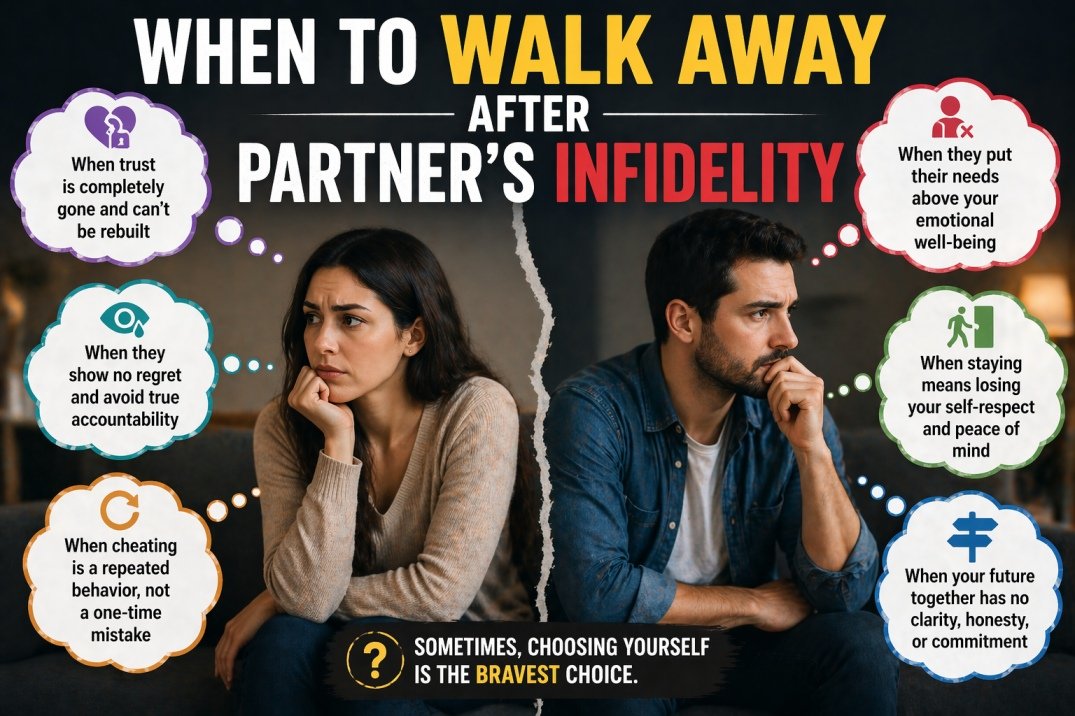
Your Partner Doesn’t Take Responsibility Or Show Genuine Remorse
If your partner responds with excuses, minimises what happened, or turns the focus back on you, it usually means they are trying to protect themselves rather than repair the relationship. Real remorse looks like staying present with your pain, even when it’s uncomfortable, and not rushing you to “move on.”
Your Partner Keeps Lying, Even About Small Things
When the lying continues, even in small ways, it often means they are still managing what you know instead of being fully open. That keeps you in a state of doubt, where you’re constantly trying to piece things together. In that environment, trust doesn’t rebuild; it stays unstable.
The Affair Is Still Ongoing In Some Form
An affair doesn’t have to be physical to continue. Ongoing contact, hidden communication, or even emotional attachment that hasn’t been let go can keep the breach active. If any part of that connection is still being protected, the relationship doesn’t get a real chance to heal.
Your Partner Avoids Or Shuts Down Important Conversations
If every attempt to talk about what happened leads to defensiveness, silence, or withdrawal, it leaves you carrying the impact alone. Over time, this creates distance, because your experience isn’t being acknowledged or worked through together.

Your Partner Doesn’t Make Real Effort To Repair The Relationship
In the early stage, many people say the right things. What matters is whether anything changes over time. Repair shows up in consistency, how they respond when you’re triggered, how they handle transparency, how they stay engaged even when it’s difficult. Without that, things tend to return to the same pattern.
You No Longer Respect Your Partner
After betrayal, respect can shift. If you find that you no longer see your partner in the same way, or you feel disconnected from who they are, that can be hard to rebuild. Respect isn’t something you can force; it either returns through change, or it doesn’t.
You Feel Emotionally Drained Or Unsafe In The Relationship
If being in the relationship keeps you in a constant state of anxiety, hyper-awareness, or emotional exhaustion, it’s important to take that seriously. A relationship that is trying to heal should, over time, start to feel more stable, not more draining.
The Relationship Has Been Unhealthy For A Long Time
Sometimes the affair isn’t the only issue. If there were ongoing problems before disconnection, repeated conflict, or lack of trust, this may be part of a larger pattern. In those cases, you’re not just repairing one event, but the foundation of the relationship.
There Is Any Form Of Abuse In The Relationship
If there is emotional, physical, or psychological abuse, the focus shifts from saving the relationship to protecting yourself. In those situations, the question is no longer “Can this work?” but “Is this safe for me to stay in?”
Reasons Some People Choose Not To Divorce After A Partner’s Cheating
Here are some facts that may help put things in perspective:
- Infidelity affects about 1 in every 2.7 couples, and many couples (around 65–70%) choose to stay together.
- Many people who cheat still want to continue the relationship.
- Some relationships do become stronger over time, but only when real change and repair happen.
They’re Thinking About Stability, Finances, And The Life They’ve Built Together
For many people, this is not just about love. It’s about the life they have built over time. There may be a shared home, money, routines, and plans for the future.
Leaving can feel like losing all of that at once. Staying can feel safer in a practical way. But it’s important to notice this: stability only helps if the relationship also feels emotionally safe.
If not, you may be keeping the structure but losing your peace.

They’re Considering How Separation Might Affect Their Children
Children often play a big role in this decision. Some people worry that separation will disrupt their child’s life. Others worry that staying in a tense or distant relationship may also affect them.
Children are sensitive to the emotional environment around them. What matters is not just whether parents stay together, but what the home feels like day to day, calm and respectful, or tense and uncomfortable.
They’re Weighing Their Long-Term Happiness And Emotional Well-Being
After some time, the question becomes less about the affair and more about the future. People start asking, “Will I feel okay here over time?”
Staying can work if trust slowly rebuilds and the relationship changes. But if the same hurt, doubt, or stress continues, it can affect your mental health.
Leaving can also feel hard and uncertain at first. So the real question becomes, which path gives you a better chance at a stable and healthy life over time.
What Needs To Happen To Rebuild The Relationship After Your Partner Cheated
Your Partner Is Completely Honest, No More Lies Or Half-Truths
Rebuilding doesn’t work if the truth comes out in pieces. If you’re still finding new details later, it usually means your partner is managing what you know, not being fully open.
Real honesty means you don’t have to keep investigating or guessing. You may not like what you hear, but it helps you understand reality clearly. Without that, your mind stays stuck in doubt.
The Affair Is Fully Over, Both Online And In Person
This isn’t just about saying “it’s over.” It means no contact, no checking in, no hidden connection, even in small ways like social media.
If any part of that connection is still active, your body will keep sensing it, even if you can’t prove it. That’s why you may feel uneasy or suspicious. Healing doesn’t begin until the connection is fully cut off.
You Both Have Clear Boundaries And Real Transparency
After cheating, the old boundaries usually don’t work anymore. Things like late-night chats, unclear friendships, or private interactions that once felt normal may now feel unsafe.
Clear boundaries mean both of you know what is okay and what is not. Transparency helps reduce guessing. It’s not about control; it’s about removing the situations that create doubt.
You’re Able To Ask Questions And Talk About The Hurt
You will have questions, and they won’t come up just once. If your partner gets defensive, shuts down, or avoids these conversations, you’re left holding the impact alone.
Talking about it doesn’t mean staying stuck in the past. It means making sense of what happened so your mind can settle. Without that, the same thoughts keep repeating.
Your Partner Works To Understand Why It Happened
If the explanation stays at “it just happened” or “it was a mistake,” nothing really changes.
Understanding means your partner looks at their own patterns, where boundaries failed, where they needed validation, or where they avoided responsibility. Without that, the behaviour can repeat in a different form.

You Begin To Feel Emotionally And Sexually Safe Again
At the start, it’s normal to feel anxious, tense, or disconnected. But over time, something should shift. You should feel less on edge and more able to relax in the relationship.
If you still feel uncomfortable, guarded, or distant even after time has passed, it’s a sign that safety hasn’t been rebuilt yet.
Your Partner Is Actively Rebuilding Trust Through Consistent Behaviour
Trust doesn’t come back because someone promises it will. It comes back when their behaviour becomes predictable and consistent over time.
You notice it in small things, they do what they say, they don’t hide, and they stay steady even when things are difficult. If the effort comes and goes, trust stays unstable.
You And Your Partner Are Open To Therapy
If you or your partner are open to it, getting support can help. Individual therapy can address the emotional and psychological impact of the betrayal, things like anxiety, overthinking, anger, or loss of self-confidence.
At the same time, online marriage counselling can help both of you work on the relationship itself, improving communication, rebuilding trust, and understanding what led to the situation.
Therapy doesn’t fix the relationship on its own, but it gives you clarity about what is actually happening, not just the cheating, but how both of you are responding to it. That clarity often makes the next step easier to see.
How To Decide Whether To Stay Or Leave After Your Partner Cheated
Look At Your Relationship Honestly, Not Just What You Hope It Could Be
Before you look at your partner, start here. This is about the relationship itself, what it actually feels like to be in it right now.
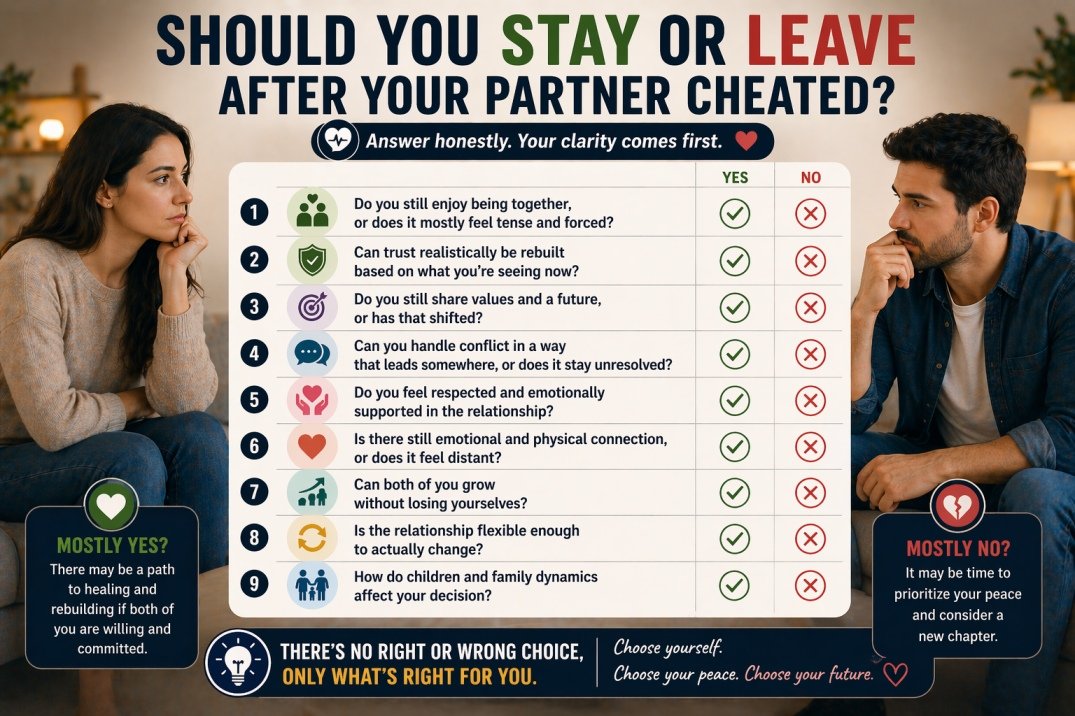
- Do you still enjoy being together, or does it mostly feel tense and forced?
- Can trust realistically be rebuilt based on what you’re seeing now?
- Do you still share values and a future, or has that shifted?
- Can you handle conflict in a way that leads somewhere, or does it stay unresolved?
- Do you feel respected and emotionally supported in the relationship?
- Is there still emotional and physical connection, or does it feel distant?
- Can both of you grow without losing yourselves?
- Is the relationship flexible enough to actually change?
- How do children and family dynamics affect your decision?
As you go through these, try to answer based on your current reality, not on what you hope things will become. It’s common to hold on to how things used to feel, but this decision depends on what is true now.
Then Look At Your Partner’s Actions, Not Just Their Words
Once you’ve looked at the relationship, shift your focus to your partner’s behaviour. This is where things often become clearer.
- Is this a pattern, or does it truly seem like a one-time situation?
- Is there real honesty now, or do you still feel things are hidden?
- Do they show genuine remorse, or mainly regret being caught?
- Are they taking full responsibility, or still explaining it away?
- Are they willing to rebuild trust over time, even when it’s uncomfortable?
- Do they understand why it happened, or are they dismissing it?
After something like this, words can sound convincing. What matters is whether their actions stay consistent over time. Pay attention to what keeps repeating; that usually tells you more than what they say.
Be Honest With Yourself About What Your Answers Mean
This is the part most people avoid, because it can be uncomfortable.
You may already have a sense of the answer, but it doesn’t always feel easy to accept. If your answers depend mostly on hope, waiting, giving more chances, or expecting change without clear evidence, it usually means you don’t feel secure yet.
If your answers reflect real effort, honesty, and a gradual return of safety, there may be something to work with.
You don’t need a perfect answer. But you do need an honest one.
What Should NOT Drive Your Decision
Before you decide whether to stay or leave, it helps to notice what might be pushing you in the wrong direction. Some reasons feel strong in the moment, but don’t lead to a healthy outcome long-term.
- Fear of being alone
It’s normal to worry about starting over. But staying only to avoid loneliness often keeps you in a situation that doesn’t feel right. Over time, that fear can turn into emotional exhaustion. - Financial or practical pressure
Money, housing, and daily life responsibilities are real concerns. But making a decision only based on convenience can leave the emotional side of the relationship unresolved. Both sides matter. - Staying only because of children
Children are important, but they also pick up on tension, distance, and conflict. Staying in an unhealthy environment can affect them in ways that are not always obvious at first. - Obsessing over details of the affair
Trying to know every detail can feel like it will give you control or clarity. But often, it keeps you stuck in the event instead of helping you decide what to do next.
These factors can influence your thinking, but they shouldn’t be the only reasons you stay or leave. The decision needs to be based on whether the relationship can actually become stable, respectful, and safe again.
The Three Choices You Have Right Now
At this stage, your situation usually comes down to three clear options. Each one depends on what is actually happening in your relationship, not what you hope will happen.
Leave Now
Choose this if there is no real change. That includes ongoing lying, lack of responsibility, no effort to repair, or the affair not being fully over.
In these situations, staying usually leads to continued stress, doubt, and emotional strain. Leaving creates distance from the problem, but also involves loss and adjustment.
Take Time Before Deciding
Choose this if you don’t have enough clarity yet.
Use this time to observe your partner’s behaviour and your own emotional state. Look for consistency, whether honesty improves, effort continues, and communication becomes easier.
This option only works if something is actually changing. If nothing changes, delaying the decision keeps you stuck.
Stay And Commit To Rebuilding
Choose this only if the required conditions are present: honesty, no contact with the affair partner, accountability, and consistent effort over time.
Rebuilding takes time and involves ongoing conversations, emotional discomfort, and gradual trust-building.
If both people are engaged in the process, recovery is possible. If not, the same issues tend to repeat.
Each option has a cost. The decision should be based on what is already happening, not what you expect to happen later.
Final Reality Check
Answer each with a clear Yes / No:
- Are you staying out of love or fear?
- Can you realistically see a healthy future here based on what is happening now?
- Are you trying to fix something that isn’t fixable?
- Are you repeating a pattern you’ve had in past relationships?
- Would outside support help you gain clarity?
- Can you support yourself financially if you leave?
- Are you prepared to handle legal and practical challenges if separation happens?
- Will you be able to take care of your children or manage co-parenting?
- Can you see yourself being physically close or sharing a bed with them again?
- Are they showing genuine remorse and actively working to repair the relationship?
The Bottom Line
There isn’t a single right answer to whether you should stay or leave after your partner cheated. The right decision depends on what is actually happening in your relationship now, not what you hope will change.
If there is honesty, accountability, no ongoing contact, and consistent effort over time, rebuilding can be possible. But if the same issues continue, lying, avoidance, lack of responsibility, staying usually leads to more stress and doubt.
This decision is less about the past and more about the future you can realistically have from here.
You don’t need to rush it, but you do need to be honest with yourself about what you’re seeing.