In our work as marriage therapists, we often see people come to us after their partner’s infidelity, and one thing stands out immediately, it doesn’t affect everyone the same way.
Some feel anger. Some feel deep sadness. But many say something they didn’t expect at all:
“I feel so ashamed… even embarrassed, and I don’t understand why.”
We hear this from both men and women who are quietly carrying this feeling. They haven’t told anyone. They’re hiding what happened. And over time, this starts to isolate them, pulling them away from others and making everyday life feel heavier.
The betrayal itself is already painful. But feeling ashamed and embarrassed on top of that can make it even harder to process what you’re going through.
So why does this happen?
Why do you feel ashamed after being cheated on, when you were the one who got hurt?
In this article, our marriage therapists explain why you feel ashamed after being cheated on, and why you feel the need to hide it.
Why Shame Feels So Strong After Being Cheated On
After your partner cheats, you don’t just feel one emotion. You feel a mix of things all at once.
- Pain is about what was done to you
- Anger is about what your partner chose to do
- Shame is about what you start believing about yourself because of it
That’s what makes shame so confusing.
Even though your partner’s infidelity is not your fault, your mind can turn the situation inward, making it feel like this says something about you.
And that’s why shame can feel so strong; it makes something that happened to you feel like something that is about you.
The Real Psychological Reasons You Feel Ashamed After Your Partner Cheated
1. You Start Believing This Reflects on You
After your partner’s infidelity, a common thought is:
“What does this say about me?”
You don’t just choose a partner, you attach your judgment, trust, and identity to that choice.
So when they cheat, your mind doesn’t process it as just their behaviour; it starts linking it to your decision.
This creates a subtle shift:
- from “they did this”
- to “what does this mean about me?”
Psychologically, your brain is trying to make sense of the shock by turning it inward.
It questions your judgment, your awareness, even your sense of self.
And that’s where shame begins, when something that happened to you starts to feel like something that defines you.
2. You Feel Like You Failed in the Relationship
After your partner’s infidelity, thoughts like:
“Did I do something wrong?”
“Was I not enough as a partner?”
can start to surface.
Even though the decision to cheat was theirs, your mind looks for a reason and often turns inward to find it.
Psychologically, we’re wired to see relationships as something we help create and maintain.
So when something breaks, it can feel like a personal failure.
That’s why it starts to feel like:
- you could have done something differently
- you missed something
- you weren’t enough in some way
And this is where shame deepens, when your partner’s actions start to feel like your responsibility.
3. You Feel Like You Weren’t Enough
After your partner’s infidelity, a painful thought can take hold:
“If I was enough, this wouldn’t have happened.”
Even though their behaviour was their choice, your mind turns it into a reflection of your worth.
This isn’t just about the present moment.
For many people, it connects to much older beliefs formed earlier in life, around being “enough,” being chosen, or being valued.
So the situation doesn’t just hurt, it activates a deeper fear:
- “Maybe I’m not enough”
- “Maybe I’m replaceable”
And that’s why it hits so strongly because it’s not just about the cheating, it feels like a direct attack on your self-worth.
4. You Compare Yourself to the Person They Cheated With
After your partner’s infidelity, a common thought is:
“What did they have that I didn’t?”
Your mind tries to make sense of what happened by looking for differences.
It starts scanning for what the other person might have had, looks, personality, attention, something you think you lacked.
This isn’t a conscious choice. It’s your brain trying to find a reason for the betrayal.
But instead of giving clarity, it creates:
- feelings of inferiority
- self-doubt
- a distorted view of your own worth
And over time, this comparison makes it feel like you came up short, even though their decision to cheat wasn’t about you being “less.”
5. You Feel Like You Should Have Seen It Coming
After your partner’s infidelity, a common thought is:
“How did I not realise?”
Your mind goes back over everything, looking for missed signs or moments you should have questioned.
Psychologically, this is your brain trying to regain a sense of control.
If you believe you should have known, it creates the illusion that you could have prevented it.
But that often turns into self-blame:
- I ignored something
- I should have been more aware
- I let this happen
And that’s where the shame deepens, when you hold yourself responsible for something you never had full control over.
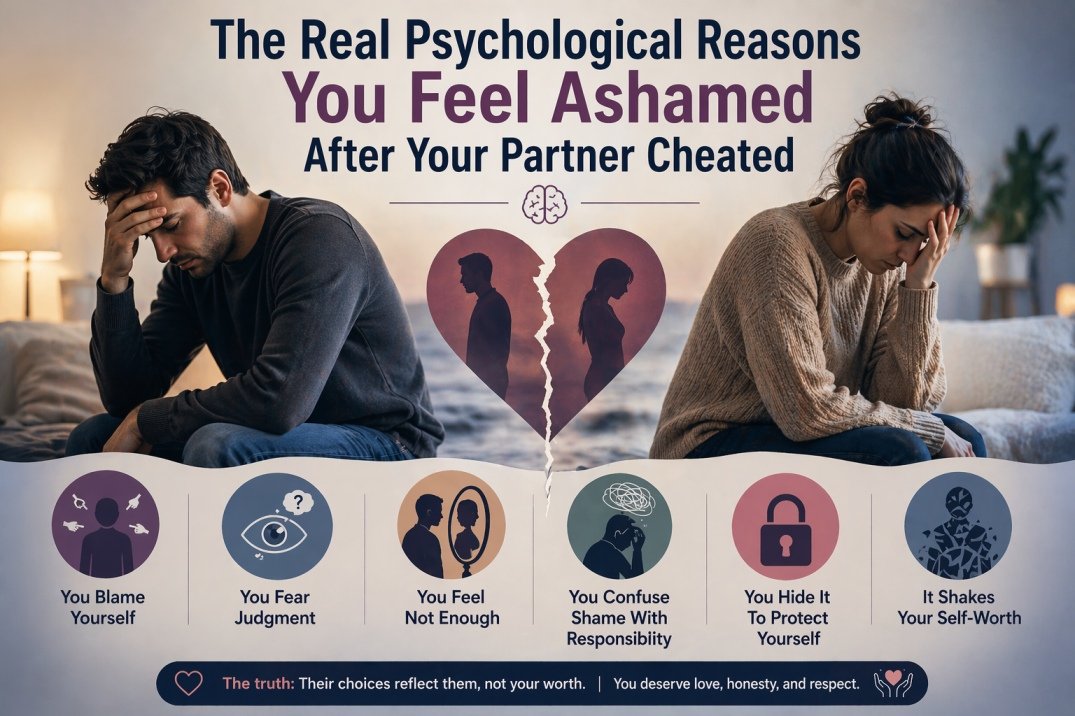
6. You Internalise What They Did
After your partner’s infidelity, you may start taking on feelings that don’t actually belong to you.
Instead of seeing their behaviour as separate, your mind begins to absorb it.
You might find yourself:
- taking emotional responsibility for what they did
- questioning your role in their choices
- carrying guilt or shame that isn’t yours
Psychologically, this happens because your brain tries to make sense of the betrayal by pulling it inward.
But in doing that, you end up carrying something that was never yours to begin with.
7. You Fear What Others Might Think About You
After your partner’s infidelity, a common thought is:
“People will think something is wrong with me.”
We all carry a sense of how we’re seen by others, our image, our choices, the life we’ve built.
For some, there’s pride in that. For others, there are deeper fears of being judged or not being enough.
When your partner cheats, it can hit that directly.
Your mind starts imagining:
- how others might interpret it
- what it might say about you
- whether you will be seen differently
Even if no one actually knows, this perceived judgment is enough.
Because the brain treats imagined social judgment almost as strongly as real judgment.
And that’s why the shame deepens, it feels like you’re not just hurt, but being silently evaluated.
8. Your Self-Image as a Partner Takes a Hit
After your partner’s infidelity, you may start to question how you see yourself in the relationship.
You might think:
- “Was I not a good partner?”
- “Did I miss something about myself?”
Psychologically, when a relationship breaks in this way, it doesn’t just affect trust, it affects identity.
Your sense of who you are as a partner can feel shaken, and with that, your confidence takes a hit.
And that’s where shame grows, when your self-image starts to feel uncertain because of something you didn’t cause.
Why You Feel the Need to Hide Your Partner’s Infidelity
After your partner’s infidelity, many people feel a strong urge to keep it hidden, even from close friends or family.
It’s not just about privacy. There are deeper reasons behind it.
- Talking about it makes the shame feel more real
- You don’t want to be seen differently
- You don’t want pity or judgment
- You don’t want to explain what happened
- You want to protect how others see you
- You want to protect how you see yourself
- You want to avoid outside opinions or pressure
- You want to keep a sense of control
At its core, hiding isn’t about weakness.
It’s your mind’s way of protecting you from more emotional exposure.
But over time, it can also lead to isolation, making the experience feel heavier than it already is.
Is It Normal to Feel Ashamed and Embarrassed After Being Cheated On?
Yes, it is.
Feeling ashamed and embarrassed after your partner’s infidelity is a common psychological response.
Even though you were the one who was hurt, your mind can interpret the betrayal as something that reflects on you.
Shame makes it feel personal.
Embarrassment makes it feel visible.
So even when it’s not your fault, it can still feel like something about you is being exposed or judged.
How to Start Letting Go of Shame and Embarrassment After Being Cheated On
Letting go of shame and embarrassment after your partner’s infidelity doesn’t happen overnight.
But it begins when you slowly change how you see yourself in what happened.
Separate Their Actions From Your Identity
Your partner’s cheating reflects their choices, their boundaries, and their behaviour, not your worth as a person or a partner.
This is simple to say, but it takes time for your mind to truly accept.
Notice How Your Mind Is Turning It Against You
Shame often shows up as thoughts like:
- “I wasn’t enough”
- “I should have known”
These thoughts feel real, but they are your mind trying to make sense of something painful, not the truth.
Stop Measuring Yourself Against the Other Person
Comparison is one of the fastest ways to deepen shame.
It creates a false idea that someone else had something you lacked.
In reality, infidelity is rarely about “who is better”, it’s about poor choices and unmet boundaries.
Allow Yourself to Feel Without Judging It
You may feel ashamed, embarrassed, angry, confused, all at once.
That doesn’t mean something is wrong with you.
These are natural responses to betrayal, not signs of weakness.
Be Careful About Who You Open Up To
You don’t need to explain your situation to everyone.
Sharing with the wrong people can increase shame.
Choose people who:
- listen without judgment
- don’t rush you into decisions
- allow you to process at your own pace
Reconnect With Yourself Outside the Relationship
Infidelity can make your identity feel tied to what happened.
Start rebuilding that by reconnecting with:
- things you enjoy
- people who value you
- parts of yourself that have nothing to do with the relationship
Consider Professional Support if It Feels Heavy
Sometimes, the shame and embarrassment go deeper than the situation itself.
Working with a therapist can help you:
- separate your identity from the betrayal
- process the emotional impact
- rebuild your sense of self in a healthier way
A Simple Truth to Hold On To
You were hurt, but you are not defined by what happened.
Letting go of shame is not about forcing yourself to “move on”,
it’s about slowly realising that this was never yours to carry.
When to Seek Professional Help
If the shame and embarrassment after your partner’s infidelity are not easing with time, and are starting to affect how you think, feel, or function daily, it may be time to seek professional help.
You may need support if:
- you feel stuck in shame, self-blame, or overthinking
- you’re withdrawing from people or avoiding conversations
- your self-worth and confidence feel significantly affected
- you feel confused about what to do in the relationship
In such cases, online therapy can help you work through the emotional and psychological impact, understand your thoughts, and separate your identity from what happened.
If your concern is also about the future of your relationship, online marriage counselling can help you and your partner process the situation, communicate better, and gain clarity on whether and how to move forward.
The Bottom Line
You’re not ashamed because you did something wrong.
You feel ashamed because it feels like your partner’s cheating says something about you, your worth, your choices, your identity.
But it doesn’t.
Their actions reflect their decisions, their boundaries, and their behaviour, not your value as a person.
It may take time to fully believe that.
But this was never yours to carry.