
In our counselling work with married couples and those in dating relationships, one concern comes up again and again.
People say:
- “I chose to stay, but I can’t trust my partner anymore.”
- “I keep scanning everything they do, their tone, their behaviour, even small changes.”
- “They are trying, but I still keep doubting them after they cheated.”
This is not limited to one age group. Men and women in their 20s, 30s, 40s and beyond come with the same experience. The situation may differ, but the internal struggle feels almost identical.
What confuses most people is this:
Even when the relationship continues, and even when the partner is making efforts, trust does not return in the same way. Instead, the mind becomes more alert, more questioning, and more focused on finding certainty.
Many want to understand what is happening within them. Not just emotionally, but psychologically. Why does the doubt persist? Why does checking behaviour increase? Why does trust feel so difficult to rebuild, even when there is a desire to move forward?
In this article, our marriage therapists explain the psychological and emotional impact of cheating on trust, and why it becomes difficult to rely on your partner in the same way again.
What Does Trust Mean in a Relationship
Trust in a relationship is a psychological expectation that your partner is honest and transparent. It allows you to believe what they say without needing constant proof or reassurance.
It is built on the alignment between words and actions. When what your partner says consistently matches what they do, the mind accepts their behaviour as reliable.
Trust also creates emotional safety. You feel secure in the relationship even when your partner is not around, without needing to monitor or question their actions.
At its core, trust allows you to feel certain without needing to check. It allows you to rely on your partner naturally, without scanning, checking, or trying to verify everything they say or do.
Psychological Reasons Why You Struggle To Trust Your Cheating Partner Again
Violation of Core Beliefs About Your Partner
In a relationship, trust is built on core beliefs about your partner’s honesty and loyalty. These beliefs shape how you see them and interpret their actions.
When cheating occurs, these beliefs are directly contradicted by their behaviour. The image you held of your partner no longer fits reality.
As a result, you no longer perceive them through the same psychological framework. This shift makes it difficult to trust them in the same way again.
Cognitive Dissonance (Conflicting Realities in Your Mind)
Trust relies on a stable and consistent understanding of your partner. You form a mental picture of who they are based on their behaviour over time.
When cheating occurs, there is a clear discrepancy between the reality you believed and the reality that existed. The version of your partner you trusted does not fully match their actions.
This creates cognitive dissonance, where the mind struggles to hold two opposing versions of the same person at once. This internal conflict leads to ongoing doubt and mental discomfort.
Loss of Predictability in Their Behaviour
Trust relies on behavioural consistency over time. When a partner’s actions follow a stable and understandable pattern, it allows the mind to feel certain about what to expect.
Infidelity disrupts this consistency. Behaviour that once felt predictable is now seen as potentially uncertain or misleading.
As a result, your brain no longer feels confident in anticipating their actions. This loss of predictability makes it difficult to rely on their behaviour in the same way, leading to increased doubt and vigilance.
Disruption of Reality and Perception
In a relationship, trust allows your perception of your partner to feel stable and real. You rely on your experiences as an accurate reflection of what is happening.
When cheating occurs, the experienced relationship no longer aligns with factual reality. What you believed was happening and what was actually happening are not the same.
This mismatch disrupts your sense of reality. It creates ongoing uncertainty about what is accurate, making it difficult to rely on your perception in the same way again.
Heightened Threat Awareness After Betrayal
Trust normally allows your mind to stay at ease within the relationship, without constantly looking for problems. It assumes safety rather than risk.
After betrayal, the brain increases sensitivity to potential relational threats. It becomes more alert to anything that could indicate dishonesty or inconsistency.
As a result, attention shifts from maintaining connection to detecting risk. This heightened awareness keeps the mind focused on possible threats, making it difficult to feel secure or relaxed in the relationship.
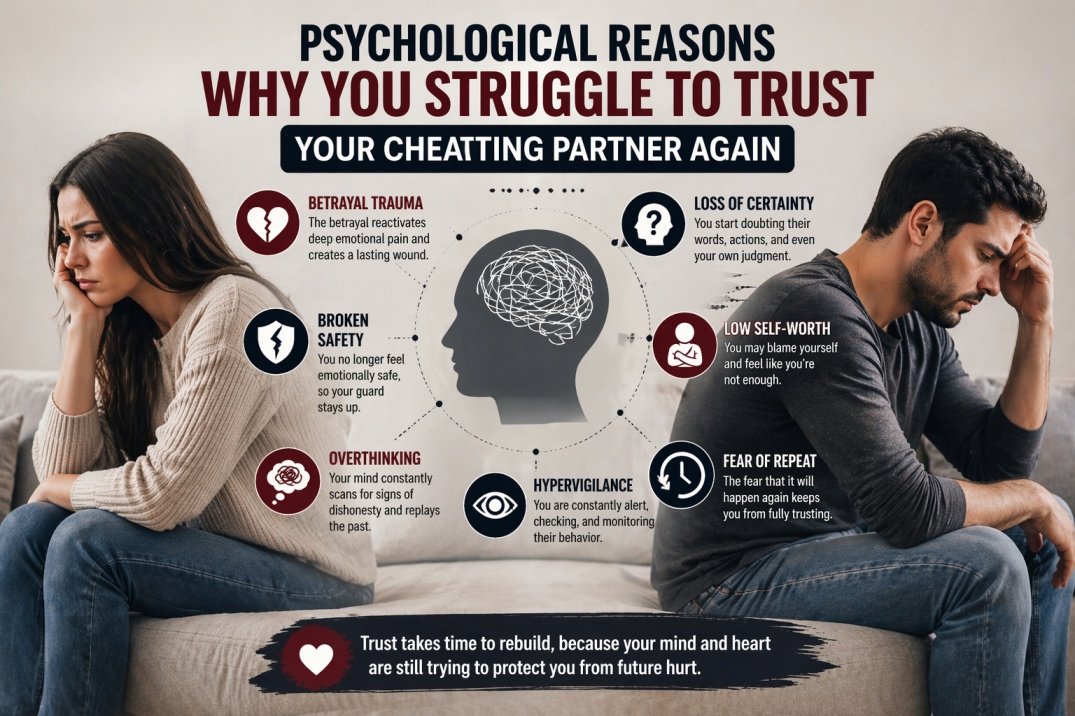
Reinforcement of Betrayal Through Memory
Trust normally allows past experiences to feel stable and consistent. Memories support the belief that the relationship has been honest and reliable.
After betrayal, the event becomes a dominant cognitive reference point. It stands out in memory and begins to shape how other experiences are understood.
Past interactions may then be reinterpreted in light of this new information. Moments that once felt normal can start to feel questionable, reinforcing ongoing doubt and weakening trust further.
Loss of Trust in Your Own Judgement
Trust after betrayal does not only affect the relationship, it disrupts your internal judgement system. You relied on your ability to understand your partner and feel certain about what was happening. That confidence is now shaken.
After cheating, you may question why you trusted, whether you ignored signs, or how something went unnoticed. The doubt shifts from your partner to your own perception.
This often extends into your sense of self. You may begin to question your judgement, awareness, and whether you can be misled.
As a result, you rely less on instinct and more on checking and analysis, not just to understand your partner, but to regain trust in your own judgement.
Why You Keep Scanning and Checking Everything After Your Partner’s Betrayal
In counselling, many people ask why they keep scanning, doubting, and checking everything after betrayal. They know it is exhausting and affecting the relationship, yet the urge feels hard to control.
This happens because trust has been replaced by uncertainty. Your mind no longer accepts things at face value, so it shifts to monitoring instead of believing.
You begin analysing tone, behaviour, and small changes because words no longer feel reliable. The brain looks for proof through actions, patterns, and consistency.
Checking phones, tracking time, and noticing routines becomes a way to reduce uncertainty. It gives temporary relief, even if nothing is found.
At the same time, your mind is trying to avoid being caught off guard again. It scans more to make sure nothing is missed.
Over time, this creates a pattern where checking feels necessary to feel certain, even though it becomes mentally exhausting.
How To Rebuild Trust After Your Partner Cheated
Trust from your side returns when your mind starts to feel predictability again. After betrayal, your brain moves from belief to verification, so the goal is not to force trust, but to let repeated, consistent behaviour reduce doubt over time.
You are not trying to “be less suspicious”, you are trying to observe whether reality is stable enough to trust again.
- Track patterns, not moments – one good or bad incident is not proof, look at behaviour over weeks, not days
- Match words with actions – only treat something as reliable when it is repeatedly followed through
- Reduce impulse checking – pause before checking phone or details, ask: “am I seeking proof or reacting to fear?”
- Ask directly instead of assuming – replace silent doubt with clear, specific questions
- Notice consistency in ordinary situations – reliability shows more in daily behaviour than in big promises
- Differentiate past vs present – stay aware of what happened, but assess current behaviour separately
- Allow doubt without acting on every urge – feeling suspicious does not mean you need to verify immediately
- Rebuild self-trust alongside partner trust – pay attention to your judgement improving through observation, not fear
Rebuilding trust after infidelity does not come back by effort alone. It returns when your experience starts to feel consistent enough that your mind no longer needs to keep checking.
When To Seek Help
If trust does not begin to stabilise over time, it may indicate that the impact of betrayal is not resolving on its own. When doubt remains constant despite consistent behaviour, it can start to affect both your mental health and the relationship.
- Trust has not improved even after a significant period
- You feel the need to constantly check, monitor, or verify
- Small situations trigger strong doubt or anxiety
- You find it difficult to feel calm or secure
- Checking and overthinking are affecting daily life
- Conversations about trust lead to repeated conflict or exhaustion
In such cases, professional support can help you understand and manage these patterns. Online therapy can address the psychological impact of betrayal, while online marriage counselling at LeapHope can help couples work through trust issues and rebuild stability in the relationship.
The Bottom Line
Cheating does not just break trust in your partner, it affects how you understand the relationship and how you trust your own judgement.
What once felt certain now feels unclear. Words, actions, and even normal situations can start to feel doubtful.
Because of this, constant thinking, checking, and staying alert become common. These are not random reactions, but a natural response to broken trust and loss of certainty.