
Last Updated on July 10, 2026
Reviewed by Bipasha Sharma, Counselling & Developmental Psychologist
“I keep thinking… maybe I wasn’t enough.”
This is one of the most common things clients say after being cheated on. The same questions keep repeating: What did they have that I don’t? Why wasn’t I enough?
Along with that, something shifts inside. Confidence drops. Self-esteem takes a hit. You start overthinking, comparing, and sometimes pulling away from others. Many people describe feeling not good enough, worthless, or even a sense of disgust toward themselves or the situation.
These feelings are strong, and they feel real.
But they are not a direct reflection of your worth. They are your mind reacting to betrayal.
As psychologists, we see this pattern often. What you’re experiencing is not random; there are specific psychological reasons behind it.
In the next section, we’ll break down exactly why you feel this way after being cheated on.
Why People Feel “Not Good Enough” and Worthless After Being Cheated On
People feel “not good enough” and worthless after being cheated on because the brain immediately turns the betrayal into a personal judgment. It internalises the event, assuming “this must be about me,” which is a self-blame response. At the same time, it creates an illusion of control, where believing “I could have been better” feels easier than accepting that you couldn’t control your partner’s actions.
Cheating is also processed emotionally as a verdict, as if a comparison happened and you were not chosen. This triggers automatic comparison with the other person, often based on imagined or incomplete information, which makes you feel inferior. The shock of betrayal causes a rapid drop in self-esteem, while also activating deeper insecurities that may already exist.
On a deeper level, infidelity violates core values like trust and loyalty, creating a moral injury, and can trigger a disgust response, where the situation feels wrong or unsafe. At the same time, it activates a fear of abandonment, making you feel unchosen and replaceable.
These combined psychological responses make it feel like your worth has been affected, even though the betrayal reflects your partner’s choices, not your value.
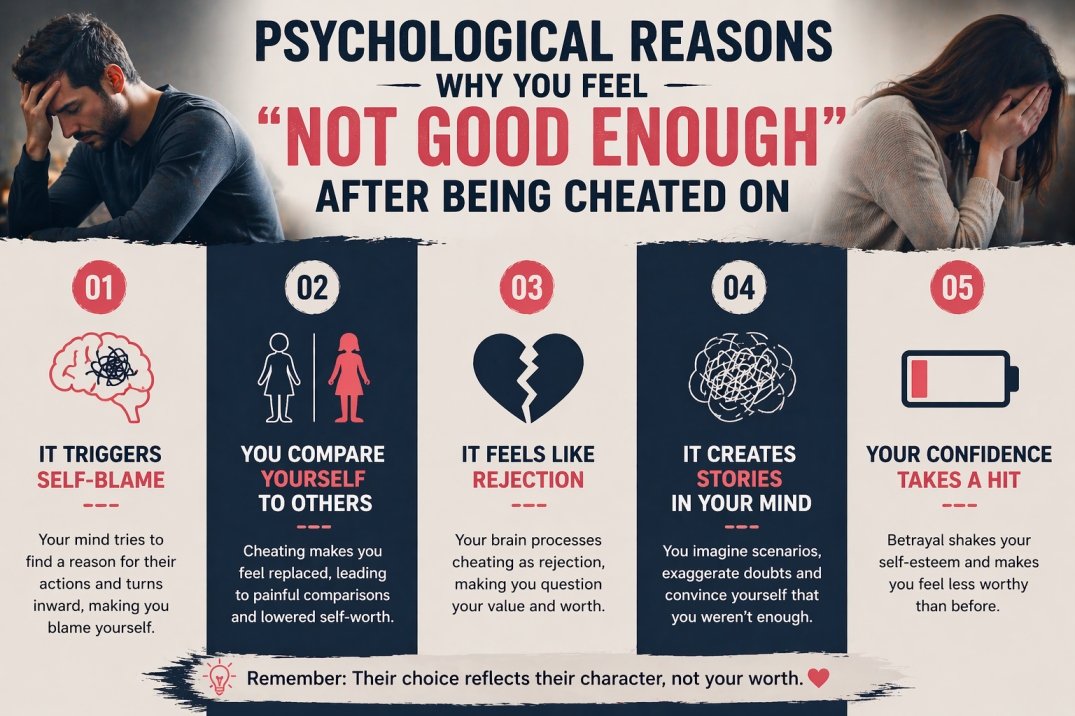
Why You Feel “Not Good Enough” After Being Cheated On (Psychological Reasons)
Self-referential thinking (internal attribution)
After infidelity, the mind looks for a cause and turns inward: they chose someone else, they didn’t choose me, so something must be lacking in me. This is a form of internal attribution, where your brain explains their behaviour as a reflection of your worth, and that explanation becomes the story you carry forward.
Men often interpret this as not being enough in performance or desirability, while women more often experience it as not being enough to be loved or chosen.
Illusion of control
After infidelity, the mind tries to reduce uncertainty by creating a sense of control. It shifts into thinking: if I had been better or done something differently, this wouldn’t have happened.
This is known as the illusion of control, where your brain assumes responsibility over something that was not fully in your control. By doing this, it makes the outcome feel like something you caused, when it wasn’t yours to control.
The affair feels like a verdict
The brain processes infidelity as a social evaluation, not just an event. It reads the situation as: they chose someone else, which means I was not chosen. This is evaluative processing, where your mind treats their decision as a judgment of your worth.
That’s why it doesn’t just feel like betrayal. It feels like a verdict on your worth, when it was never a trial to begin with.
Blame-shifting gets internalised
When responsibility is deflected, even subtly, the mind absorbs it as truth. Statements like something was missing or things weren’t right get translated inward as: this happened because of me. This is internalisation, where external behaviour is turned into a personal cause.
Over time, this shifts from a situation to identity. It stops being about what happened and becomes about who you are, turning a single event into a story about your identity.
Uncertainty creates self-doubt
After infidelity, the mind is left without clear answers. To reduce this uncertainty, it fills the gaps with self-referential explanations: they must have had something I lacked. This is a form of cognitive closure, where the brain prefers a quick, personal explanation over not knowing.
This process turns uncertainty into comparison and doubt. Instead of accepting the lack of clarity, the mind creates a story that places you at a disadvantage, and the mind fills that gap with doubt instead of fact.
Comparison + imagined rival
After infidelity, the mind automatically compares you with the other person. Because you don’t have full information, it fills in the gaps and constructs an idealised version of them, often amplifying their strengths and ignoring their flaws.
This creates a distorted comparison. You are measuring your full, real self against an imagined, edited version of someone else, leaving you inferior to someone who was never real to begin with.
Unfair comparison (fantasy vs reality)
After infidelity, the comparison your mind makes is structurally unfair. You are comparing your full, real self, including flaws, history, and everyday realities, to a limited and filtered version of the other person.
This is a form of cognitive distortion where the brain overlooks context and treats both sides as equal. Because the comparison is incomplete, the conclusion that you fall short was rigged before it even started.
Choice = value distortion
After infidelity, the mind equates choice with value. It simplifies the situation into: they chose someone else, which means that person is better than me. This is a cognitive distortion where a decision is interpreted as a measure of worth.
This shortcut ignores context and reduces everything to comparison, mistaking someone’s decision for a verdict on your value.
Pre-existing “not enough” beliefs get activated
Infidelity activates underlying beliefs about yourself that may already exist, such as feeling not good enough or replaceable. These beliefs may not always be visible, but they are part of your internal self-schema.
When the betrayal happens, the mind uses it as confirmation. Instead of seeing it as a separate event, it gives old fears a new, false confirmation.
Self-esteem collapse
After infidelity, your core sense of worth takes a direct hit. The mind draws a harsh conclusion: if I wasn’t worth loyalty, what am I worth? This is a global self-evaluation, where one event is used to define overall value.
Instead of seeing the betrayal as their behaviour, the brain generalises it into a statement about you, turning one painful moment into a verdict on your entire worth.
Identity disruption
After infidelity, the sense of who you are in the relationship gets shaken. The roles you held, as a partner, as someone valued and chosen, no longer feel stable. This creates a disruption in identity, where your self-image no longer feels secure.
As a result, you begin to question your value, attractiveness, and even your place in the relationship. The uncertainty about what you mean to them turns into uncertainty about who you are.
Internalisation of rejection
After infidelity, the mind shifts the focus from what happened to what it means about you. Instead of holding it as “they betrayed me,” it becomes “I wasn’t enough to be chosen.” This is internalisation, where external behaviour is absorbed as a personal truth.
This shift turns rejection into identity. The experience is no longer just about their actions, so their action becomes, wrongly, your identity.
Moral injury + disgust response
Infidelity violates core values like trust and loyalty, creating what is known as a moral injury. The mind registers the act as deeply wrong, not just painful, which shifts the reaction from hurt to internal rejection.
This can also trigger a disgust response, where the situation feels unsafe or contaminated at an emotional level. When this reaction turns inward, that reaction gets misdirected at yourself instead of the betrayal.
Abandonment + self-disgust response
Infidelity triggers a deep fear of abandonment, where the mind reads the event as: I was not chosen, I can be replaced. This activates a survival-level response, making the experience feel more threatening and personal than it actually is.
At the same time, this rejection can turn inward. You may start questioning yourself, your decisions, or why you stayed or trusted, compounding hurt with self-doubt that was never warranted.
Is It Your Fault?
No. Being cheated on is not your fault.
After infidelity, the mind tries to find a reason and often turns inward, making it feel like you were not enough. But cheating is a choice, not a measure of your worth. Even if the relationship had problems, they do not justify betrayal.
What happened reflects your partner’s decisions and boundaries, not your values.
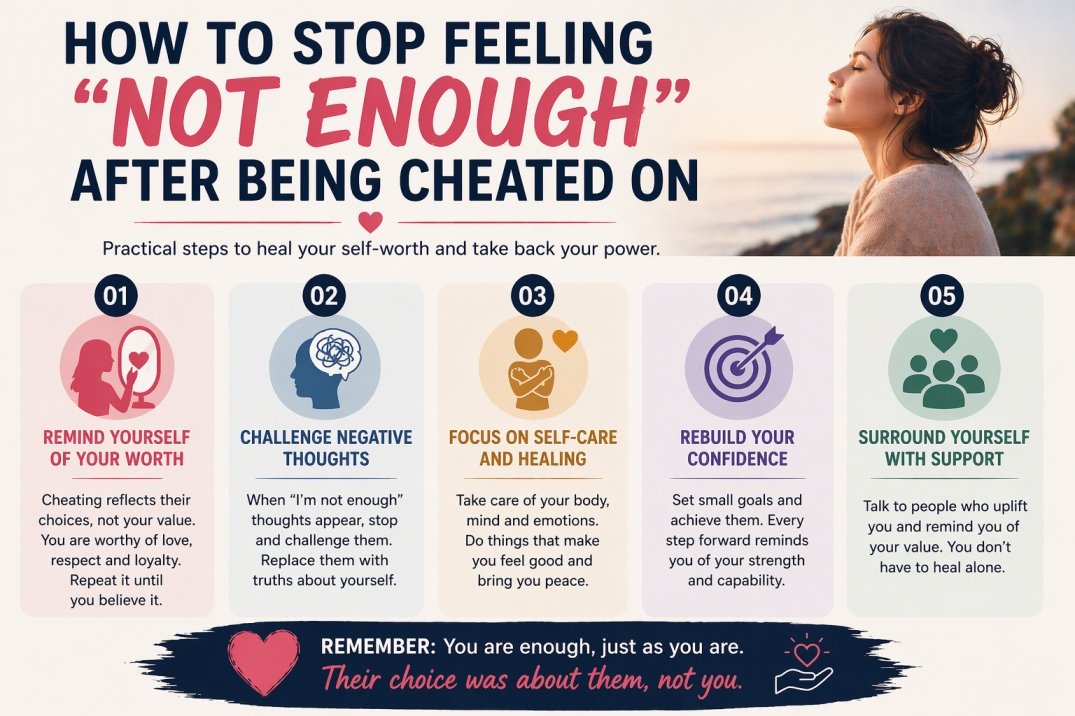
How to Stop Feeling “Not Enough” After Being Cheated On
Break the comparison loop in real time
When your mind goes to “they were better”, don’t just notice it, interrupt it. Say to yourself: I don’t have full information, this comparison is incomplete. Then shift your focus to something concrete, a task, a call, a routine. The goal is not to win the comparison, but to stop feeding it.
Separate their decision from your identity
Write this clearly once: They cheated → their choice. It does not equal my value.
Your mind will keep linking the two, so you have to repeatedly separate them. Every time the thought comes back, bring it to this line. This is how you weaken the connection over time.
Catch and correct the thought, not just notice it
When you think “I wasn’t enough,” don’t leave it there. Complete it:
“I feel like I wasn’t enough because I was hurt, not because it’s true.”
This keeps the emotion valid but stops it from becoming a fact.
Rebuild self-trust through small decisions
Start making small, clear decisions for yourself, what to eat, where to go, what to say no to. Follow through on them. Self-trust doesn’t come back from thinking, it comes from repeated actions where you rely on yourself again.
Remove triggers that keep you stuck
If you’re checking their social media, comparing yourself, or revisiting details of the affair, you’re keeping the loop active. Reduce exposure. Distance is not avoidance here, it’s how you give your mind space to reset.
Reconnect with parts of you outside the relationship
Do something that has nothing to do with them, a hobby, work goal, fitness routine, or social circle. This helps your mind rebuild identity beyond the role of “partner who was cheated on.”
Get support before the thoughts become your baseline
If the feeling of being “not enough” is constant or affecting your daily life, talk to someone or a therapist who can challenge it with you. Left alone, these thoughts tend to become your default belief.
When to Seek Help
If the feeling of not being enough after being cheated on is not settling on its own, it’s a sign you may need support.
- When your self-worth stays low for days or weeks
- When thoughts like “I’m not enough” keep repeating or feel uncontrollable
- When it starts affecting your sleep, work, or daily decisions
- When you feel stuck and unable to move forward despite trying
You don’t have to process this alone. Talking to a professional can help you break these thought patterns and rebuild your sense of self.
If this is affecting your relationship as well, online marriage counseling at LeapHope can help you understand both the emotional impact and the relationship dynamics in a structured way.
Final Thoughts
Feeling not good enough after being cheated on is real. It doesn’t come out of nowhere, your mind is trying to process something painful and confusing.
But what you feel is not the same as what is true. The thought that you were not enough is a conclusion your mind formed, not a fact about your worth.
Their decision reflects their choices, not your value.
Their decision is not your definition.
FAQs
Is it normal to feel not good enough after being cheated on?
Yes, it’s one of the most consistent reactions therapists see after infidelity. The brain doesn’t process betrayal as a neutral event, it processes it as a personal verdict, comparing you to someone it barely has information about. That’s why the feeling arrives so fast and feels so convincing, even though it’s not an accurate measure of your worth.
How long does this feeling usually last?
It typically peaks in the first few weeks, while the mind is still trying to make sense of what happened, and gradually loosens as the brain stops treating the betrayal as proof of inadequacy. There’s no fixed timeline, healing isn’t linear, but if it’s still constant or getting worse after a few months rather than easing, that usually means the self-blame has hardened into a belief, and outside support helps at that point.
Does this mean something is wrong with me, or with the relationship?
Neither, directly, those are two separate questions your mind is collapsing into one. The feeling is a reaction to betrayal, not a diagnosis. Whether the relationship has real issues worth addressing is a separate evaluation, best made once the self-blame has quieted down, not while it’s still driving the conclusion.
Can it come back even after I’ve healed?
Yes, usually around specific triggers, an anniversary, starting a new relationship, or an unanswered question resurfacing. That doesn’t mean the healing didn’t work or that you’re back at the beginning. A brief return is a normal response to a reminder, not a relapse, what changes afterward is how quickly you recognise it and how much power it holds.
How do I rebuild my confidence after infidelity?
Less by thinking your way back to feeling good, more by separating your partner’s decision from your own identity, reducing the automatic comparison with the other person, and rebuilding self-trust through small, consistent choices you actually follow through on. Confidence returns as a result of that pattern, not as a precondition for starting it.