Last Updated on October 23, 2026
Clinically Reviewed by Mohit Yadav, RCI-Registered Clinical Psychologist (CRR A100623)
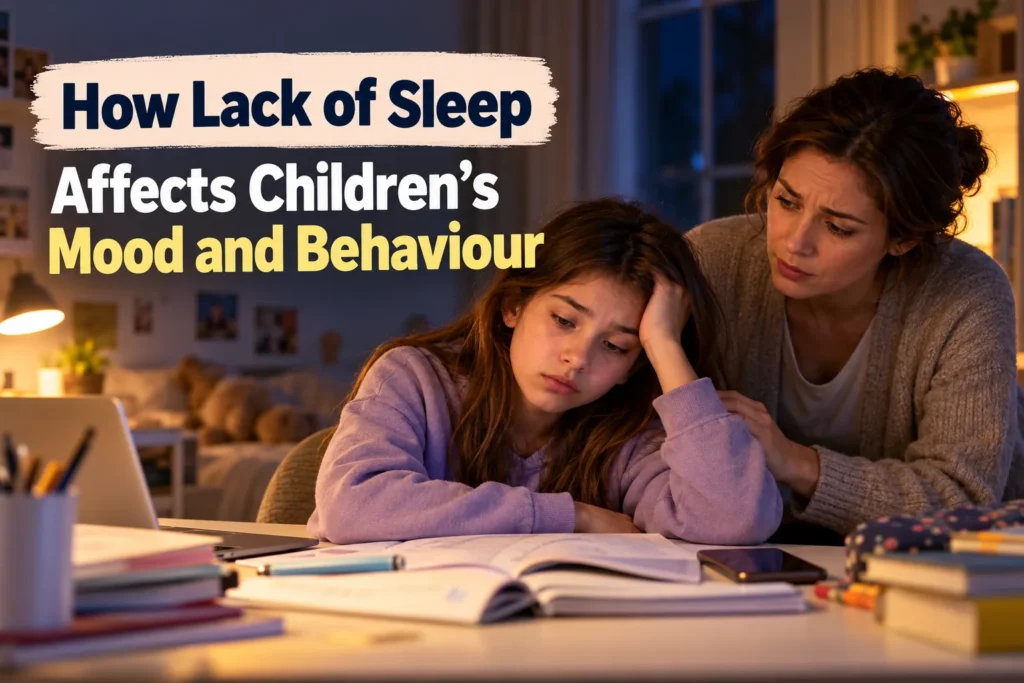
You’ve noticed your child or teenager has started sleeping late. Some nights they’re finishing homework, preparing for exams or attending tuition. Other nights they’re watching videos, playing games or chatting with friends. But school still starts early, leaving them with fewer hours of sleep.
Naturally, you’re concerned. How is this lack of sleep affecting your child? Could it explain their changing mood, difficulty concentrating, falling grades or behaviour at home? And could regularly sleeping too little affect their mental health?
Sleep does much more than help children feel energetic the next morning. It supports learning, memory, attention and emotional regulation. When children consistently miss the sleep they need, the effects may become visible in their schoolwork, relationships and everyday behaviour.
Here’s what research tells us about those effects, what parents should look for and how to respond.
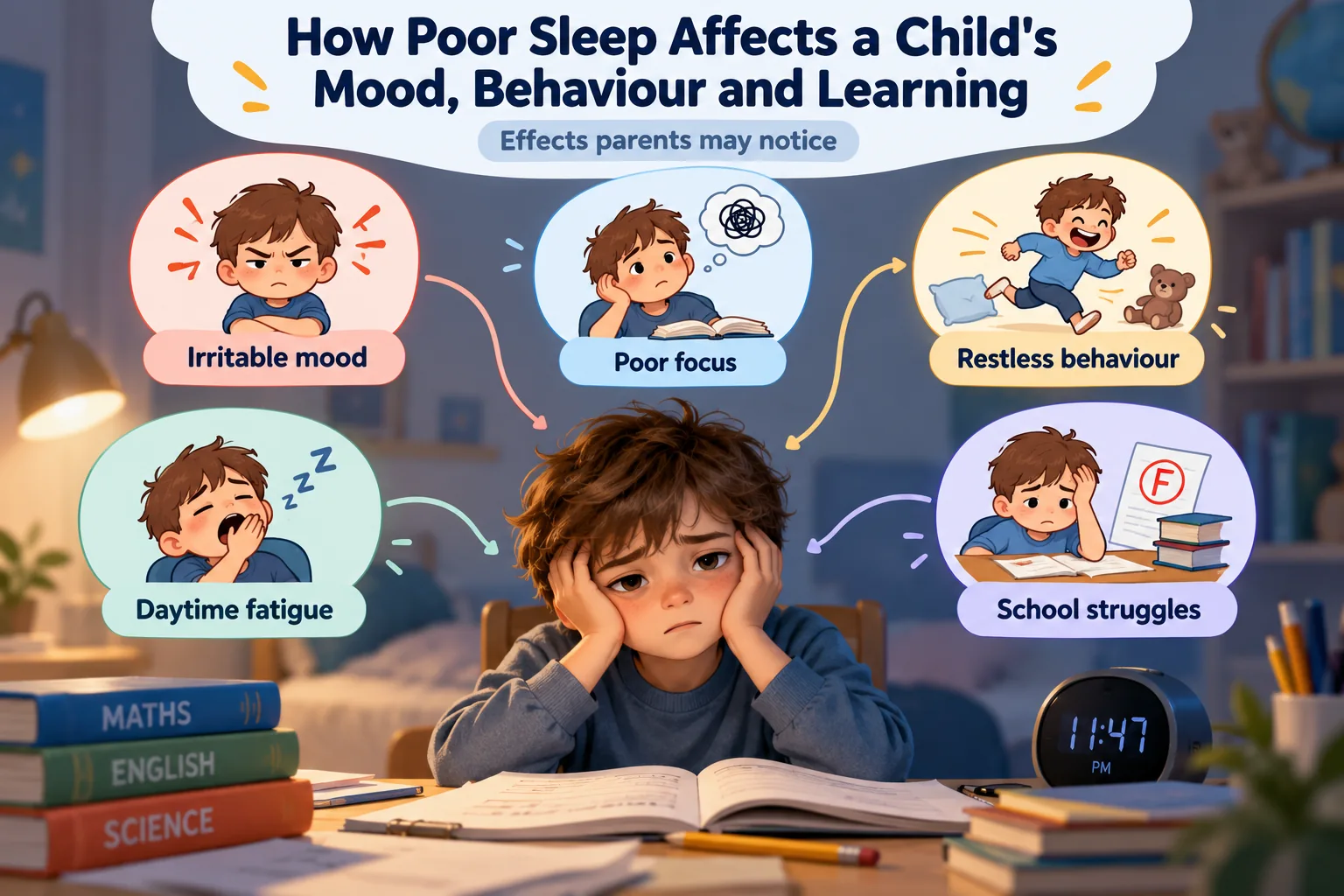
How Poor Sleep Affects a Child’s Mood, Behaviour and Learning
1. Irritability, Anger and Emotional Outbursts
Your child comes home from school, and you ask them to finish their homework. They immediately become irritated. Later, a sibling touches their belongings, and they start shouting.
On another day, neither situation might have bothered them much.
When children haven’t slept enough, dealing with frustration can become harder. They may react more strongly to disappointment, criticism or ordinary instructions, and take longer to calm down afterwards.
In a controlled study published in Pediatrics, researchers adjusted sleep duration in 34 children aged 7–11. During the restricted-sleep condition, teachers reported greater emotional lability and restless or impulsive behaviour.
Parents may notice:
- Getting upset over minor problems.
- Crying more easily after disappointment.
- Becoming unusually sensitive to criticism.
- Taking longer to recover from frustration.
The important question is whether these reactions represent a change from your child’s usual behaviour, particularly after nights when they’ve slept less than normal.
If the emotional outbursts are frequent regardless of sleep, other factors may be involved. LeapHope’s article on why children throw tantrums over little things explores those possibilities.
2. Difficulty Concentrating, Remembering Lessons and Performing at School
Your child spends an hour studying but cannot remember what they’ve just read. Homework that normally takes 30 minutes now takes twice as long. A teacher mentions that they’re frequently distracted during lessons.
Parents may interpret this as laziness, poor motivation or excessive phone use. Sometimes, however, insufficient sleep is part of the problem.
Sleep plays an important role in consolidating memories, while adequate rest supports attention and alertness during the day.
When children regularly sleep too little, they may struggle to:
- Follow classroom explanations and instructions.
- Remember information learned the previous day.
- Complete assignments without repeated distractions.
- Stay alert during early lessons or tuition.
- Perform consistently in tests despite preparing for them.
Lower grades are not inevitable. Some children continue performing well academically while becoming increasingly exhausted.
Consider a teenager who studies until midnight and wakes at 6 AM. They’re spending extra time preparing for examinations but leaving only six hours for sleep.
For teenagers aged 13–18, the recommended amount is generally 8–10 hours per 24 hours. Studying longer at the expense of adequate rest may undermine the learning they’re trying to improve.
If academic expectations are becoming overwhelming, LeapHope’s guide to school stress in children explores the emotional effects of school pressure.
3. Restlessness and Impulsive Behaviour
Not every tired child looks exhausted.
Some become unusually active, talk excessively, interrupt others or struggle to remain seated. This can confuse parents who expect their child to become quiet when they’re sleepy.
Inadequate sleep can interfere with attention and behavioural regulation, particularly in school-age children.
For example, a child may know they’re supposed to wait their turn but respond before thinking. Another may leave tasks unfinished because they keep moving between activities.
However, these behaviours are not specific to sleep deprivation.
ADHD and other developmental or emotional concerns can produce similar difficulties, and children with ADHD may also experience sleep problems.
Poor sleep should be considered during an assessment, but it should not automatically be used to explain away persistent attention or behavioural difficulties.
If your child’s reactions are becoming difficult to manage, LeapHope’s child behaviour counselling page explains the types of concerns a psychologist can help assess and address.
4. Daytime Fatigue and Reduced Participation
Some children show tiredness in a quieter way.
Your child may stop joining outdoor games, complain that activities feel exhausting or want to rest immediately after school.
Before assuming they’ve lost interest in physical activity, look at what their day involves.
A child who wakes at 6 AM, spends several hours at school, attends tuition and completes homework late in the evening may have limited energy left for anything else.
Daytime fatigue may appear as:
- Struggling to wake despite repeated alarms.
- Feeling sleepy during lessons or travel.
- Needing more rest after normal activities.
- Avoiding physically demanding activities because they’re tired.
One distinction matters here: a child who has too little time available for sleep is different from a child who sleeps for an age-appropriate duration but remains excessively tired.
The second situation may require medical assessment for poor sleep quality, an underlying sleep disorder or another health concern.
Similarly, persistent withdrawal or loss of enjoyment should not automatically be attributed to fatigue. Changes in emotional wellbeing may also need attention.
5. Emotional and Mental-Health Difficulties in Teenagers
Teenagers face a combination of biological sleep changes, academic expectations and social pressures.
During puberty, the body’s natural sleep timing generally shifts later. This can make it harder for teenagers to fall asleep early, even when they know they must wake up for school.
Examinations, social media, friendships and late-night conversations may further reduce their sleep opportunities.
In a controlled study involving 50 adolescents aged 14–17, sleep restriction increased anger, tension and fatigue. Teenagers and their parents also reported more irritability and difficulties with emotional regulation.
Sleep and mental health can also affect one another.
A teenager experiencing anxiety may lie awake thinking about examinations, friendships or family expectations. Missing sleep may then make it harder to handle those worries the following day.
Depression can involve changes in sleep, energy, motivation and mood as well.
But poor sleep alone does not mean a teenager has anxiety or depression, and a few late nights should not be treated as evidence of a mental-health disorder.
Parents should pay closer attention when emotional changes persist, particularly if a teenager withdraws from relationships, stops enjoying usual activities or has significant difficulties at school.
LeapHope’s article on teen mood swings or emotional distress explains when these changes deserve attention. Our guide to teenage sleep deprivation covers the reasons adolescents often struggle to get adequate rest.
What Parents Can Do When Their Child Isn’t Getting Enough Sleep
The most useful first step is not introducing another bedtime rule. It’s identifying where your child’s sleep time is being lost.
A child who stays awake completing homework needs a different solution from one who spends hours gaming or lies in bed unable to fall asleep.
1. Calculate How Much Sleep Your Child Can Actually Get
Start with their normal school-day wake-up time.
Suppose your 14-year-old needs to wake at 6 AM and usually falls asleep around 11:30 PM.
That leaves approximately 6½ hours of sleep, at least 1½ hours below the recommended minimum of eight hours for their age.
According to the American Academy of Sleep Medicine:
| Age | Recommended sleep per 24 hours |
|---|---|
| 3–5 years | 10–13 hours, including naps |
| 6–12 years | 9–12 hours |
| 13–18 years | 8–10 hours |
Remember that going to bed at 10 PM doesn’t necessarily mean your child falls asleep at 10 PM.
2. Identify What’s Actually Pushing Bedtime Later
For three ordinary school days, note when your child finishes tuition, homework, dinner and recreational screen use.
Don’t begin by changing everything. Look for the biggest obstacle.
For example:
- School finishes: 3:00 PM
- Tuition ends: 7:00 PM
- Homework finishes: 10:15 PM
- Usual waking time: 6:00 AM
In this situation, insisting on a 9:30 PM bedtime without adjusting the workload is unlikely to work.
Parents may need to discuss recurring homework difficulties with teachers, reduce optional commitments or review whether the current coaching schedule is manageable.
The aim is to create a routine that actually allows sufficient sleep, rather than one that only looks sensible on paper.
3. Work Out Why Your Child Uses Their Phone Late at Night
Not every child stays online for the same reason.
A younger child may repeatedly watch another video because autoplay makes stopping difficult. A teenager may feel uncomfortable leaving friendship-group messages unanswered. Another child may use their phone because they’re worried, bored or unable to fall asleep.
Match your response to the situation:
- Endless videos: Disable autoplay and agree on a stopping point.
- Gaming: Avoid beginning long multiplayer sessions close to bedtime.
- Group chats: Discuss expectations around late-night replies and consider muting nonessential notifications.
- Difficulty sleeping: Explore what is keeping your child awake rather than assuming the phone is the original problem.
Charging devices outside the bedroom may also help when notifications repeatedly interrupt sleep.
With teenagers, explain why boundaries matter and involve them in creating a workable arrangement.
4. Recognise When Earlier Bedtime Won’t Solve the Problem
There’s an important difference between not having enough time to sleep and being unable to sleep despite having enough time.
A child who is still doing homework at midnight has an obvious scheduling problem.
But a child who goes to bed at 9:30 PM and remains awake until midnight may be experiencing worry, delayed sleep timing or another sleep difficulty.
Moving bedtime earlier without understanding the reason may lead to more frustration.
If your child is regularly anxious at bedtime, our guide to bedtime anxiety in children explains possible reasons. Parents who notice worry extending beyond bedtime may also find our article on signs of anxiety in children helpful.
5. Check Whether More Sleep Makes a Meaningful Difference
After addressing the main obstacle, observe your child’s sleep and daytime functioning for approximately one to two weeks.
You don’t need to monitor every disagreement.
Choose two or three things that were already causing concern, such as morning waking, alertness at school, homework completion or emotional outbursts.
If your child begins getting sufficient sleep but difficulties remain significant, don’t continue assuming tiredness explains them.
For persistent sleep difficulties, our guide to sleep problems in children explains warning signs parents shouldn’t overlook.
When Should Parents Seek a Child Psychologist?
An occasional late night or difficult morning doesn’t mean your child needs counselling.
However, psychological support may be helpful when sleep difficulties occur alongside emotional or behavioural concerns, or when parents are struggling to understand what their child needs.
Consider speaking with a child psychologist when:
- Anxiety is interfering with sleep: Your child frequently lies awake worrying about school, friendships or other concerns.
- Emotional difficulties continue: Irritability, distress or withdrawal persists even when there is sufficient opportunity for sleep.
- Behaviour is affecting daily life: Ongoing outbursts, attention difficulties or family conflict interfere with school, friendships or relationships at home.
- Sleep has become a recurring family struggle: Attempts to change the routine repeatedly lead to conflict without improving the situation.
- You’re unsure what’s normal: You want professional guidance on whether the changes are related to sleep, emotional development or something that warrants further assessment.
A psychologist can help parents understand the pattern, identify possible emotional or behavioural concerns and decide what support, if any, would be useful.
When to see a paediatrician: Loud habitual snoring, breathing pauses during sleep, unexplained excessive daytime sleepiness or persistent physical symptoms call for medical assessment. Some children may benefit from both medical and psychological care.
If your child expresses thoughts of suicide or self-harm, seek urgent professional or emergency assistance.
LeapHope offers online child and teen counselling for families who would like professional guidance. Counselling may be relevant for concerns involving child anxiety, emotional wellbeing or behaviour.
Families can access LeapHope’s country-specific counselling services in India, the USA, the UK, Canada and Australia.
Recap: Should Parents Be Worried About Their Child’s Sleep?
Not every late night, difficult morning or change in mood is a reason to worry.
Children’s routines change as they grow. Schoolwork becomes more demanding, friendships become more important and teenagers naturally develop later sleep preferences. An occasional late night or a temporary period of tiredness doesn’t automatically suggest a psychological problem.
In many cases, small, realistic lifestyle changes can help. Adjusting an overloaded evening schedule, setting workable phone boundaries and making enough time for rest may be all that’s needed.
What matters is whether your child is regularly missing sleep and whether it’s affecting their wellbeing, school life or relationships.
And if you’re concerned or simply unsure, there’s nothing wrong with talking to a qualified child psychologist. You don’t have to wait until a problem becomes severe. Sometimes a professional conversation provides useful guidance, reassurance or a clearer understanding of what your child needs.
Clinical References
- Gruber R, et al. Impact of Sleep Extension and Restriction on Children’s Emotional Lability and Impulsivity. Pediatrics. 2012.
- Baum KT, et al. Sleep Restriction Worsens Mood and Emotion Regulation in Adolescents. Journal of Child Psychology and Psychiatry. 2014.
- Paruthi S, et al. Recommended Amount of Sleep for Pediatric Populations: A Consensus Statement of the American Academy of Sleep Medicine. Journal of Clinical Sleep Medicine. 2016.
This article is intended for educational purposes and does not replace individual medical or psychological assessment.