Last Updated on October 4, 2026
A child with anxiety does not always look frightened or nervous.
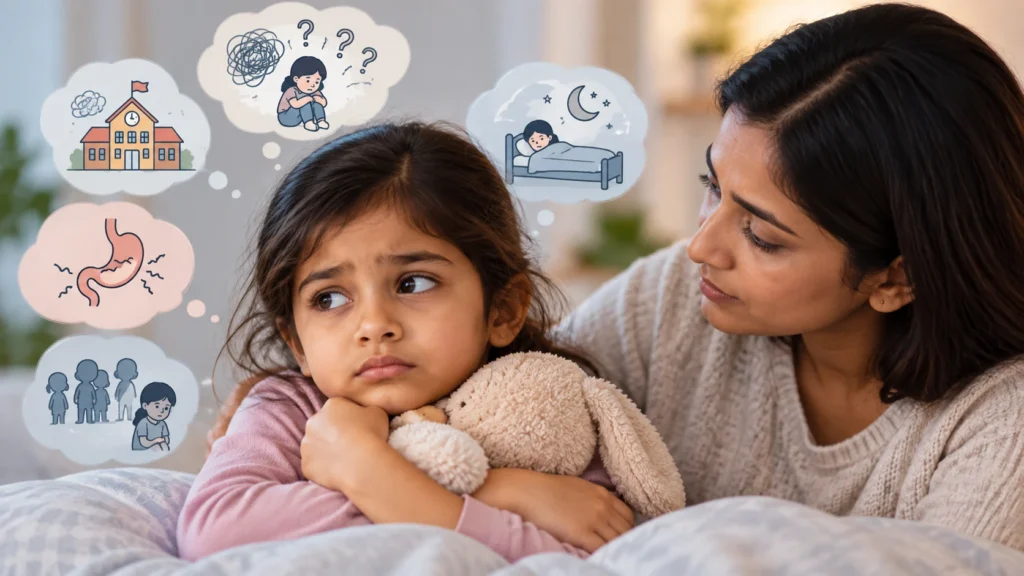
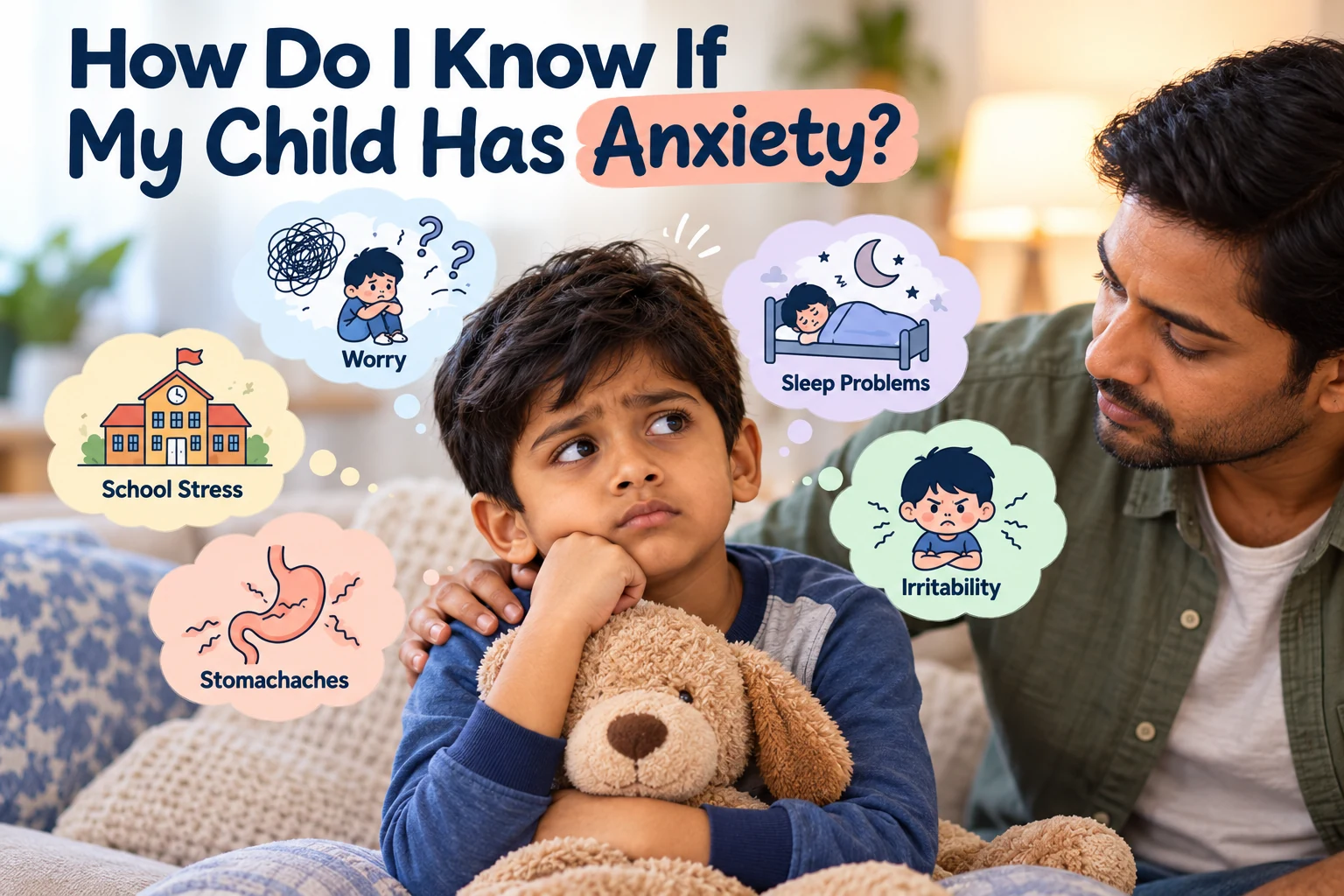
Some children worry openly. Others become irritable, avoid certain situations, repeatedly ask whether everything will be okay, complain about feeling unwell before school, or appear confident until they face something they find difficult.
That can make anxiety surprisingly easy to miss.
One behaviour alone cannot tell you whether your child has anxiety. What matters more is the pattern: what keeps happening, what triggers it, what your child is beginning to avoid, and whether worry is changing what they can comfortably do in everyday life.
What Does Anxiety Look Like in a Child?
Anxiety can affect a child’s thoughts, behaviour, body, sleep and ability to participate normally at school or socially. Two anxious children may therefore look quite different.
Worry and Anxious Thinking
Some children tell their parents exactly what they are worried about. Others reveal their anxiety through the questions they keep asking.
You might notice:
- repeated “what if?” questions
- expecting something to go wrong
- worrying far in advance about ordinary events
- excessive fear of making mistakes
- worrying about parents becoming ill or getting hurt
- repeatedly checking whether something is safe
- asking for reassurance even after receiving an answer
Worry itself is not abnormal. Children are expected to worry sometimes.
The concern becomes greater when worry is unusually persistent, difficult for the child to control or much stronger than the situation would normally require.
Avoidance and Refusal
Sometimes anxiety becomes easier to recognise by looking at what the child has stopped doing.
A child may begin avoiding:
- school
- extracurricular activities
- parties or social situations
- unfamiliar places
- answering questions in class
- sleeping alone
- separating from a parent
- performances or competitions
- situations where they might make a mistake
Avoidance can make a child feel better immediately because the uncomfortable situation disappears.
That short-term relief can also make the child more likely to avoid the same situation again. Over time, anxiety can begin deciding where the child goes, what they attempt and what they believe they can handle.
That is clinically more important than a child simply saying, “I don’t want to.”
Anger and Irritability
Anxiety does not always look like fear.
A child who feels overwhelmed, uncertain or unable to control what is happening may become irritable instead.
Parents sometimes notice:
- snapping over small requests
- becoming unusually upset when plans change
- angry reactions before school or homework
- arguments around particular activities
- strong emotional reactions when something feels uncertain
This does not mean that an angry child necessarily has anxiety.
The useful question is whether the anger repeatedly appears around situations involving worry, uncertainty, embarrassment, separation, performance or avoidance.
If irritability itself is a new change in your child’s behaviour, read Why Is My Child Suddenly So Angry All the Time?.
Physical Symptoms
Children can experience anxiety strongly through their bodies.
Possible complaints include:
- stomachaches
- headaches
- nausea
- feeling shaky
- sweating
- racing heartbeat
- unusual tiredness
Timing can sometimes provide useful clues.
A child may repeatedly feel sick on school mornings but improve later in the day. Another may develop headaches before tests, performances or situations they have been worrying about.
However, recurrent physical symptoms should not automatically be labelled anxiety. Medical causes need to be considered when symptoms are persistent, severe, new or otherwise concerning.
We look more closely at this distinction in Unexplained Physical Complaints in Children With Emotional Causes.
Sleep Changes
Anxiety can become particularly noticeable when a child is trying to settle at night.
You may notice:
- difficulty falling asleep
- worrying once they get into bed
- needing a parent nearby
- repeated waking
- nightmares
- lying awake thinking about the following day
An occasional difficult night is common.
A repeated pattern matters more, particularly if poor sleep begins affecting the child’s mood, concentration or ability to function the next day.
School and Social Changes
Some anxious children continue going to school and never describe themselves as frightened.
Instead, the change appears in how they participate.
A child may:
- become excessively afraid of getting answers wrong
- freeze despite knowing the answer
- avoid putting their hand up
- spend too long trying to make work perfect
- withdraw from friends
- avoid unfamiliar children
- become intensely worried about embarrassment
- lose confidence only in particular settings
Behaviour can also differ significantly between environments.
A child who appears regulated at school may behave very differently later at home. That difference does not by itself establish anxiety, but it can provide useful information about demands, triggers and context. See Why Is My Child Well Behaved at School but Not at Home? for a closer look at that pattern.
What Anxiety Can Look Like in Indian Children
The underlying features of anxiety are not fundamentally different in Indian children. However, culture, education, family expectations and the language children use to describe emotional distress can influence what parents notice.
Research with Indian adolescents has found that words such as “tension” and “stress” are commonly used when describing emotional distress. A child may therefore never use the word “anxiety” themselves.
Context can also matter:
- board exams, school marks and competitive entrance examinations can become major sources of pressure
- fear of disappointing parents may intensify worry about academic performance
- older teenagers may become preoccupied with streams, university admissions, entrance examinations or career decisions
- children may continue attending school and performing adequately while experiencing considerable internal pressure
- study resistance may sometimes involve fear of failure or overwhelm rather than simply lack of discipline
- comparison with classmates, siblings or expected achievement can influence how a child interprets mistakes and performance
None of these situations automatically means a child has an anxiety disorder.
They simply help explain what the child’s worry may be attached to.
When Does Normal Worry Become Anxiety?
Fear and worry are normal parts of development.
A preschool child may struggle with separation. A school-age child may worry before a test. A teenager may feel nervous before giving a presentation or entering a new social situation.
Age matters because the same fear can have a different meaning at different developmental stages.
The American Academy of Child and Adolescent Psychiatry explains that childhood fears become more concerning when they persist beyond what is developmentally expected or become severe enough to interfere with everyday functioning. AACAP guidance on anxiety in children
Instead of asking whether your child worries at all, look at five things.
Frequency: How often is the worry occurring?
Duration: Does it settle when the situation passes, or continue for long periods?
Intensity: Is the reaction much stronger than the situation would normally suggest?
Avoidance: Is your child beginning to stop doing things because of the anxiety?
Impact: Is it interfering with school, independence, relationships, sleep or ordinary family life?
For example, asking for reassurance before an important examination is very different from needing repeated reassurance every day across many ordinary situations.
The pattern matters more than a single symptom.
Different Anxiety Problems Can Look Different
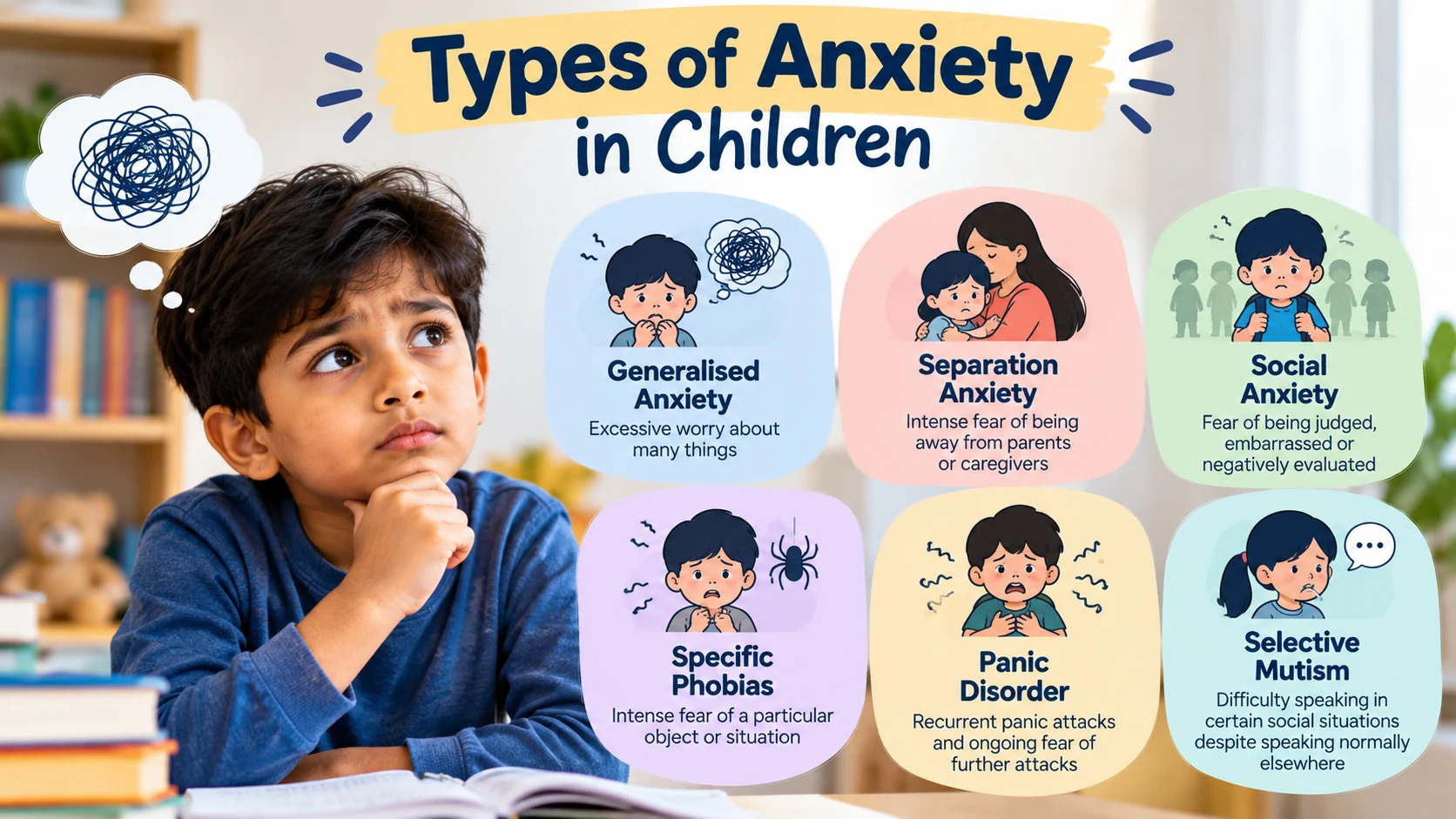
Childhood anxiety is not one single presentation.
Generalised anxiety involves excessive and difficult-to-control worry across several areas of life.
Separation anxiety centres on excessive distress about being away from parents or other important caregivers.
Social anxiety involves strong fear of embarrassment, judgment or negative evaluation by other people.
Specific phobias involve intense fear associated with a particular object or situation.
Panic disorder involves recurrent unexpected panic attacks together with continuing concern about further attacks or their consequences.
Selective mutism is an anxiety disorder in which a child who can speak normally in some situations consistently cannot speak in certain social environments, such as school.
OCD can also involve severe anxiety, intrusive thoughts and avoidance, but it is classified separately under obsessive-compulsive and related disorders rather than simply being another anxiety disorder.
These distinctions matter because children who all appear “anxious” may actually be struggling with very different patterns.
Could Something Else Look Like Anxiety?
Yes.
Many difficulties in childhood overlap.
Poor sleep can produce irritability and poor concentration. ADHD may involve restlessness, emotional reactions and difficulty managing demands. Low mood may cause withdrawal. School stress can create worry without an anxiety disorder. Trauma can affect a child’s behaviour and sense of safety.
Physical health problems can also produce sensations that resemble anxiety.
This is why symptom lists are useful for noticing a possible pattern but poor tools for deciding what is actually causing it.
A clinician needs to understand the child behind the symptoms.
When Is a Professional Assessment Worth Considering?
Parents do not need to wait until anxiety becomes extreme before asking for professional help.
Assessment becomes particularly useful when:
- avoidance keeps spreading into more parts of the child’s life
- the child is struggling to attend or participate in school
- distress keeps returning despite support
- anxiety is restricting age-appropriate independence
- friendships or family relationships are deteriorating
- the child feels unable to control their worries
- several emotional, behavioural or physical difficulties are appearing together
- parents cannot work out what is driving the change
- it is unclear whether anxiety or another difficulty better explains the behaviour
The purpose of assessment should not simply be to attach an anxiety label.
It should help answer a more useful question:
What is happening for this child, and what is maintaining the difficulty?
What Happens During a Child Anxiety Assessment?
A good child anxiety assessment goes beyond counting symptoms.
A psychologist may explore:
- when the difficulty began
- the child’s developmental stage
- situations that trigger anxiety
- what the child avoids
- how long distress lasts
- school functioning
- friendships and social participation
- sleep
- physical complaints
- recent changes or stressors
- developmental history
- the child’s own explanation of what happens
- what parents observe
Information from school or teachers may also be useful when appropriate.
That matters because children, parents and teachers do not always observe the same behaviour. Anxiety may be obvious in one environment and difficult to see in another.
Structured measures such as child and parent anxiety questionnaires can support this process. They are tools, not stand-alone diagnoses.
A psychologist may also consider how the family has adapted around the anxiety.
Parents understandably try to reduce their child’s distress. They may provide repeated reassurance, speak for the child, allow them to avoid something frightening or change family routines around the anxiety.
Sometimes that support is necessary. But when accommodation becomes extensive, it can unintentionally make avoidance easier to continue.
Understanding that pattern is not about blaming parents. It helps identify what may be keeping the anxiety going.
How LeapHope Supports Children With Anxiety
LeapHope’s child anxiety support begins by understanding the child’s individual pattern rather than treating every anxious child the same way.
Depending on the child’s age, difficulties and clinical needs, support may include structured assessment, CBT-based work, emotional regulation, parent guidance and age-appropriate psychological strategies.
CBT for anxiety may also involve gradually helping a child approach situations they have been avoiding, where clinically appropriate, rather than organising more and more of life around avoiding discomfort.
Parents looking specifically for anxiety support can learn more about LeapHope’s Child Anxiety Counselling.
If it is not yet clear whether anxiety is the main problem, Online Child & Teen Counselling provides a broader starting point for understanding emotional and behavioural concerns.
Final Thoughts
A child does not need to look frightened for anxiety to be present.
Instead of asking whether your child matches a list of anxiety symptoms, look at what worry is beginning to change.
Is it changing where they go, what they attempt, how independently they function or what they feel capable of doing?
When worry increasingly starts making those decisions for the child, it is worth looking more closely at what is happening.