
Last Updated on October 11, 2026
Reviewed by: Mohit Yadav, RCI-Registered Clinical Psychologist (CRR A100623)
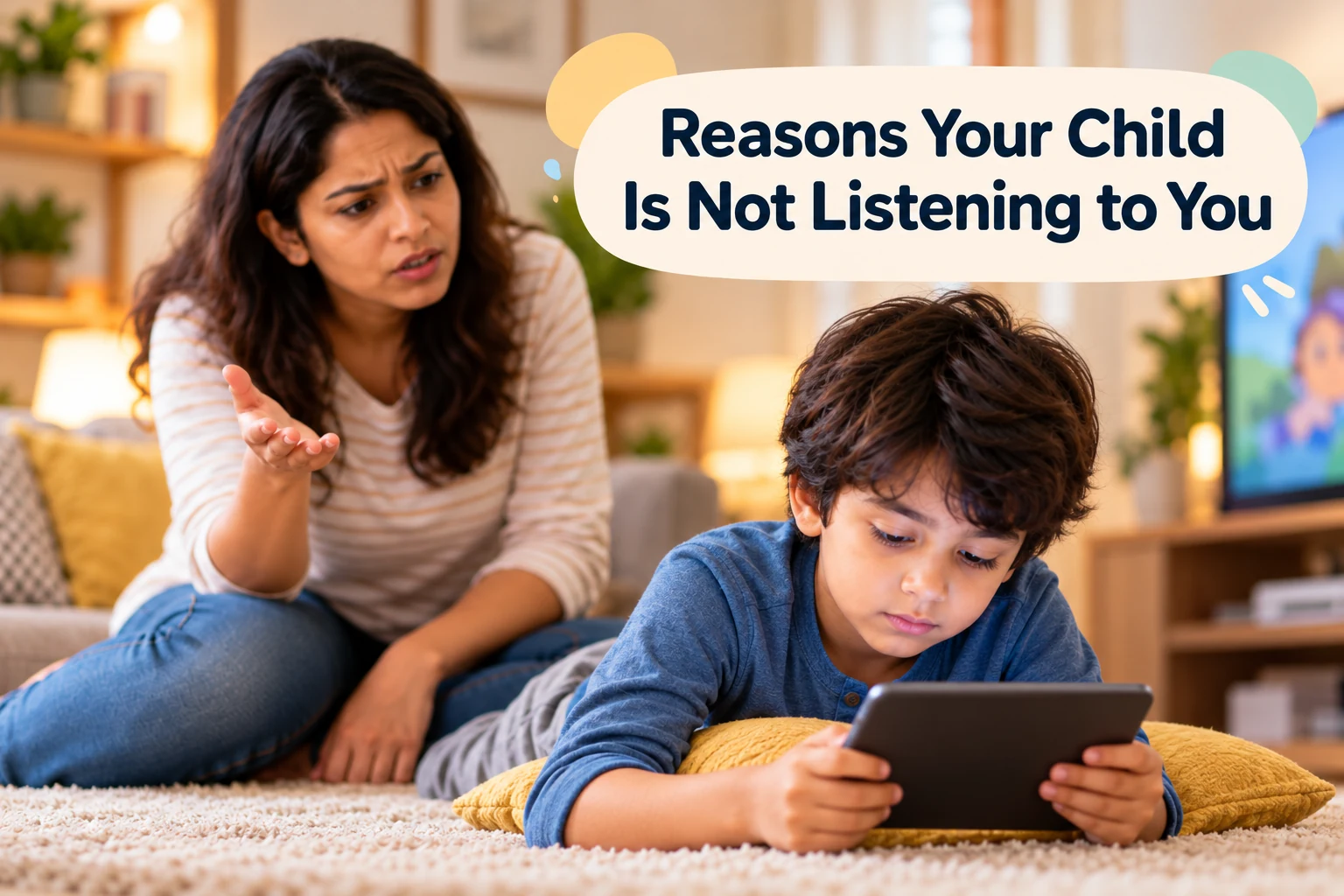
You call your child once. Then again. Sometimes they are watching TV, playing a game or using a phone and barely react. Other times they look at you, say “okay,” and a few minutes later nothing has changed.
It is easy to read this as ignoring, stubbornness or disrespect. But children can fail to follow an instruction for very different reasons. They may be distracted, struggle to shift attention, forget what you asked, feel overwhelmed, misunderstand the instruction or simply decide they do not want to do it.
That difference matters. Before trying to make a child “listen better,” it helps to understand what is actually getting in the way.
Reasons Your Child Is Not Listening to You
Some reasons are part of normal child behaviour, while others relate to attention, memory, emotional regulation, transitions or the way instructions are given. The patterns below can help you understand what may be behind your child’s response.
They Are Focused on Something Else
When a child is deeply involved in drawing, building something, playing, reading or another activity, they may hear your voice without fully shifting their attention to what you are saying. This can look like ignoring even when the instruction has not been properly processed yet.
Notice what happens when you move closer, get their attention and then ask. If they respond much better, switching attention may be the main difficulty.
If they continue to ignore a clear instruction after their attention is already on you, another reason is more likely.
They Heard You but Got Distracted
Some children hear the instruction, understand it and even say “okay,” but lose track of it before they act.
Their attention may move somewhere else, or they may have difficulty keeping several steps in mind at once. You may notice them starting a task and getting sidetracked halfway through, forgetting what they were asked to bring, or needing frequent reminders to finish simple routines.
In these situations, shorter instructions and one step at a time can help you see whether attention and memory are part of the problem.
The Instruction Is Too Long or Unclear
“Get ready for school” may sound like one instruction to an adult. For a young child, it can mean getting dressed, brushing their teeth, packing their bag, putting on shoes and remembering what comes next.
Long, vague or multi-step instructions are easier to lose track of, especially when they are called from another room or given while the child is already busy.
Clear wording makes a difference. Instead of “go and get ready,” a younger child may respond better to “please put your shoes on,” followed by the next step once that is done.
They Do Not Want to Stop What They Are Doing
A lot of “not listening” happens when children are asked to stop something they enjoy and move to something less appealing:
- TV to homework
- play to bath
- park to home
- getting ready for school
- bedtime
The difficulty may be less about the instruction itself and more about the transition. Stopping a preferred activity requires a child to shift attention, control the urge to continue and accept that something enjoyable is ending.
If the problem mainly appears during transitions, a short warning before the change and a predictable routine can work better than repeating the same instruction several times.
They Are Testing Independence
Sometimes there is no attention or memory problem. Your child heard you, understood what you asked and simply does not want to do it.
This often happens when the instruction limits something they want: leaving the park, turning off a game, taking a bath, getting dressed or going to bed.
Some resistance is a normal part of developing independence, particularly in younger children. Allowing a child to have preferences does not mean removing reasonable boundaries. They can disagree with an instruction while still learning that some limits need to be followed.
They Have Learned That the First Request Is Not the Final Request
If the normal pattern is ask → repeat → negotiate → repeat again → shout, your child can gradually learn that the first request does not really require action.
They may begin responding only when your voice changes or a consequence appears. If your child only listens when you shout, the raised voice may have become the signal that the request is finally serious.
This can also help explain why a child seems to listen immediately to a teacher or one parent but needs repeated reminders from another. It does not necessarily mean they respect one person more. The routines, expectations and follow-through may simply be different.
Giving a clear instruction and following through consistently can help break this pattern without turning every request into an argument.
They Are Tired, Stressed or Emotionally Overloaded
Listening and cooperating can become harder when a child is tired, hungry, worried, overstimulated or emotionally drained.
This is one reason a child may manage well throughout the school day but become irritable or resistant once they get home. Their ability to cope with another request may simply be lower at that point.
If the problem is noticeably worse after school, late in the evening or during stressful periods, look at your child’s physical and emotional state as well as the behaviour itself.
Attention or Executive-Function Difficulties May Be Involved
Some children genuinely find it harder to hold an instruction in mind, stop what they are doing, organise the next step and stay with a task until it is finished.
You may notice that your child forgets everyday requests, gets sidetracked midway through simple tasks or needs much more prompting than other children of a similar age.
When this happens regularly across different situations, it is worth looking beyond simple disobedience.
Why Does My Child Ignore Me When Watching TV or Using a Phone?
Some parents complain that their child seems to ignore them completely when watching TV, gaming or using a phone. They may call several times and get no response, which can easily feel like stubbornness or disrespect.
Highly engaging screen content can make shifting attention back to a parent harder. The useful comparison is whether your child responds normally once the screen is paused or when you move closer and get their attention first.
If the same problem also happens during ordinary conversations, routines and schoolwork, it is worth looking at the pattern more broadly rather than blaming the screen alone. If screen use itself has become difficult to limit and is regularly affecting routines, sleep, studies or behaviour, support for problematic mobile and screen use may be worth considering.
What Can Parents Do When a Child Doesn’t Listen?
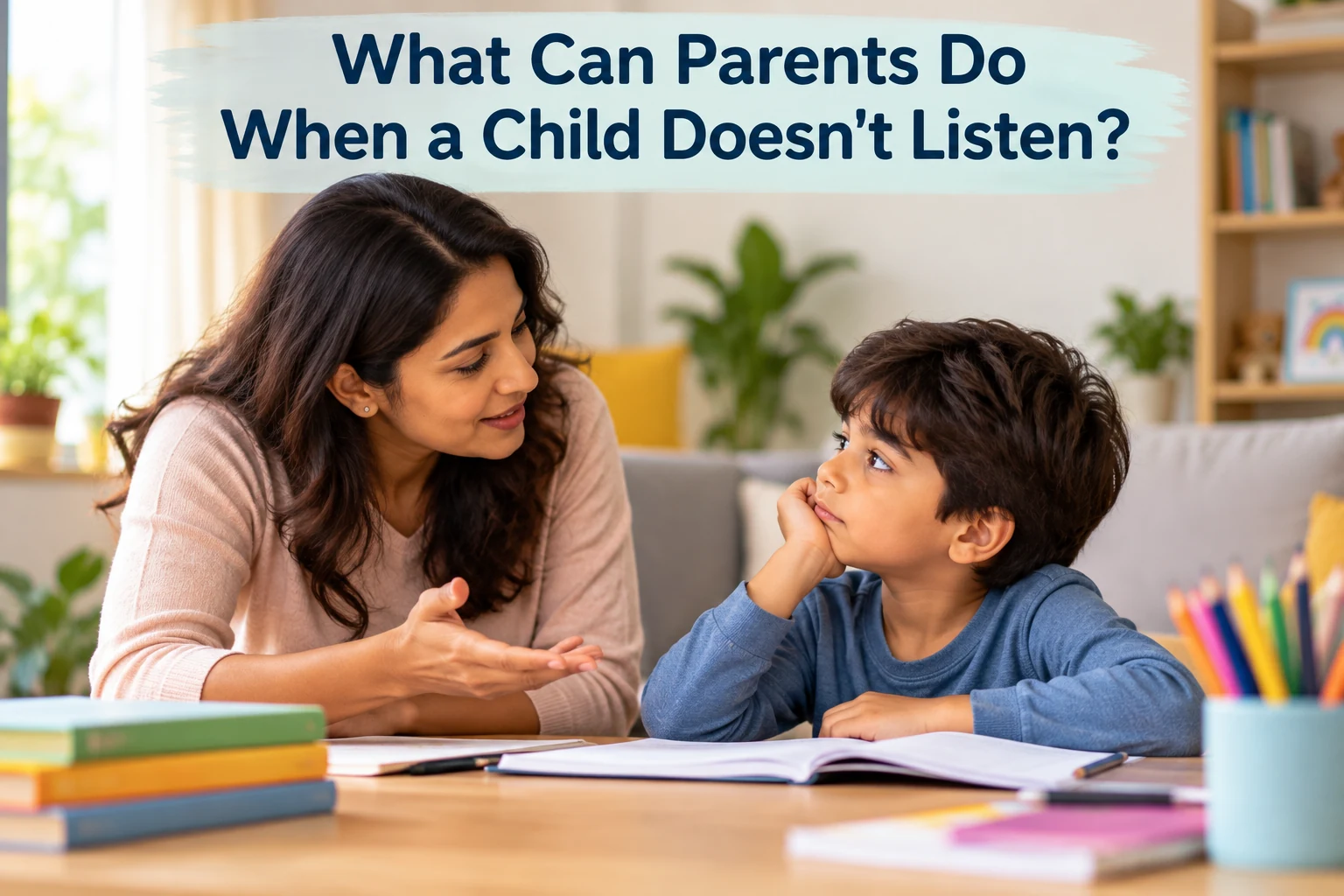
Once you have a better idea of what may be getting in the way, your response can be more specific. Avoid hitting, shouting or harsh punishment when your child does not listen. A child who forgot an instruction needs a different response from a child who understood it and deliberately refused.
- Get their attention first. Move closer, use their name and make sure they have shifted attention before giving an important instruction.
- Keep instructions short. If your child struggles with several steps, give one clear instruction first and then the next.
- Do not repeat the same request five times. Too many reminders can teach a child that the first request does not really require action.
- Give warning before transitions. If TV, play or gaming is about to end, tell them a few minutes before the change.
- Keep routines predictable. Morning, homework and bedtime routines become easier when your child already knows what usually comes next.
- Follow through calmly. Avoid turning every refusal into a long negotiation or increasing your volume with each reminder.
- Notice cooperation too. A simple “thank you for doing that when I asked” acknowledges the behaviour you want to see more often.
- Look for a pattern. Is the problem mainly around screens, homework, after school, with one parent, or in almost every setting?
Research also supports the importance of how instructions are delivered. A systematic review covering 42 studies found evidence for strategies including effective instruction delivery when improving children’s compliance with adult requests. Read the PubMed review
The goal is not instant obedience. It is to understand what is getting in the way, make reasonable instructions easier to follow and reduce repeated conflict.
If instructions and discipline have become a regular source of conflict between you and your child, parenting counselling can also help parents examine the pattern rather than simply increasing consequences.
When Could Not Listening Point to ADHD or Another Difficulty?
Not listening alone does not mean your child has ADHD or another condition.
It is worth looking deeper when attention problems are persistent and appear alongside frequent forgetfulness, difficulty completing tasks, poor organisation, impulsivity or similar concerns in more than one setting, such as both home and school. You can read more about how LeapHope approaches ADHD support for children without assuming that one behaviour confirms ADHD.
If your child genuinely seems not to hear properly or repeatedly needs things to be said again, hearing should also be considered. If they regularly misunderstand even simple verbal instructions, language or comprehension difficulties may need to be ruled out.
If several concerns are appearing together, ask for a proper clinical assessment. Avoid trying to diagnose your child from videos, online checklists or self-help content.
Is It Normal for My Child Not to Listen Sometimes?
Yes. Occasional distraction, resistance and testing limits are common, especially in younger children.
A 3- or 4-year-old may understand what you are asking but still struggle to stop an activity, control an impulse or shift quickly to the next task.
What matters more is your child’s age, how often it happens, how intense it is, where it happens and whether it is affecting daily life.
A four-year-old needing extra reminders at bedtime is very different from an older child who regularly cannot follow simple instructions at home, school and other settings.
When Should Parents Speak to a Child Psychologist?
Consider speaking to a child psychologist when not listening is persistent, happens across different settings, or starts affecting school, routines or relationships.
It is especially worth looking deeper if:
- teachers notice the same problem
- simple instructions are consistently hard to follow
- attention difficulties affect schoolwork
- routines regularly turn into major conflict
- there are strong emotional or behavioural reactions
- the behaviour has changed suddenly
- consistent changes at home are not improving the pattern
A child psychologist will usually look at attention, executive functioning, emotional state, developmental level, behaviour patterns, family interaction and school functioning before deciding what may be contributing.
For persistent behaviour concerns, LeapHope’s child behaviour counselling focuses on understanding what is maintaining the behaviour and what changes may help at home. Families looking for a psychologist can also view LeapHope’s child psychology support in India or the USA. For families elsewhere, the main child and teen counselling service covers international support.
The purpose of an assessment is not to attach a diagnosis to every child who does not listen. It is to understand why the behaviour keeps happening and whether the child or family needs additional support.
Final Thought
A child who seems not to listen may be distracted, forgetful, overwhelmed, struggling with transitions or simply resisting what you asked. Before assuming disrespect or a disorder, notice when it happens, what was going on just before it, and whether the same difficulty appears at home, school and in other situations.