Last Updated on October 4, 2026
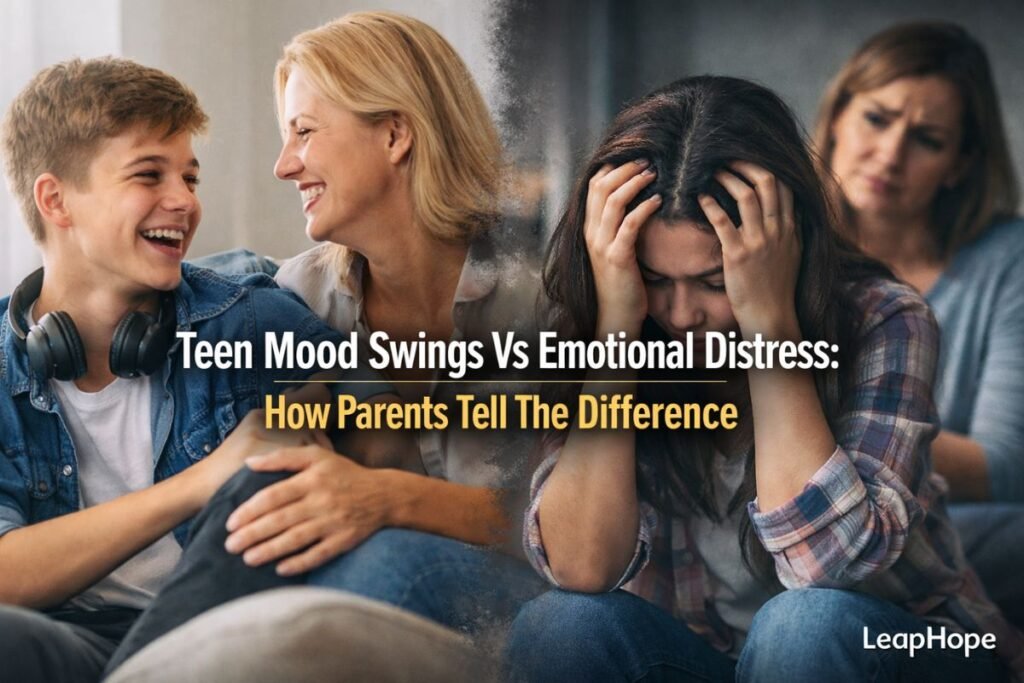
Your teenager is laughing with friends at night, barely speaking to you the next morning, and furious over something small by dinner.
It is easy to blame hormones.
It is also easy to wonder whether something more serious is happening.
Some increase in emotional ups and downs is normal during adolescence. Teenagers are dealing with puberty, changing friendships, school pressure, greater independence, sleep changes and a brain that is still developing.
But “teenagers are moody” should not become an explanation for every major emotional change.
What matters more is the pattern.
Has your teenager changed from how they usually are? How long has it lasted? Does the mood pass, or does it keep returning? And most importantly, is it beginning to affect school, friendships, sleep, interests or everyday life?
What Can Normal Teenage Mood Swings Look Like?
Teenagers can experience emotions more intensely than adults expect.
They may become upset quickly, argue about boundaries, want more privacy or seem completely different depending on the situation.
A teenager might:
- be irritated with parents but relaxed with friends
- become emotional after a disagreement and recover later
- want more time alone without withdrawing from everyone
- complain about school but continue attending and functioning
- become more sensitive to criticism
- argue more about phones, clothes, friends or independence
- have stronger emotional reactions during periods of stress
Research shows that emotional variability can increase during adolescence, particularly in the earlier teenage years.
But normal teenage moodiness usually does not steadily take over the teenager’s life.
They may be difficult to talk to one evening and still enjoy football the next day.
They may argue with you and then laugh with friends.
They may want more privacy while still remaining connected to people and activities that matter to them.
That distinction is important.
Do Hormones Cause Teenage Mood Swings?
Puberty can contribute to changes in mood, but hormones are only one part of the picture.
During adolescence, several things are happening at once.
The brain is continuing to develop. Sleep patterns change. Social relationships become more important. Academic expectations often increase. Teenagers become more aware of how others see them and begin making bigger decisions about identity, relationships and the future.
That means a change in mood can come from many places.
Sometimes it is ordinary adolescent development.
Sometimes the teenager is exhausted.
Sometimes something is happening at school or with friends.
And sometimes persistent irritability or withdrawal is part of anxiety, depression or another psychological difficulty.
So “it’s just hormones” can sometimes prevent parents from looking more closely when something genuinely has changed.
Irritability Matters, but It Does Not Tell You the Diagnosis
Parents often describe teenagers as:
“moody”
“angry”
“snappy”
“rude”
“short-tempered”
or simply:
“not themselves.”
Psychologists often pay close attention to irritability.
Irritability is important because it appears across many different difficulties, including anxiety, depression, ADHD, sleep problems and behavioural problems.
But irritability itself is not a diagnosis.
A teenager who becomes angry easily is not automatically depressed.
They are not automatically bipolar.
And they are not automatically going through a normal phase either.
The useful questions are:
How often does it happen?
How long does it last?
How easily is it triggered?
How different is it from this teenager’s usual behaviour?
What effect is it having on their life?
Those questions tell us much more than simply asking whether a teenager is “moody.”
Has Your Teenager Changed From How They Usually Are?
One of the most useful things parents can watch for is change from baseline.
Think about what your teenager was normally like three or six months ago.
A teenager who has always been outspoken, emotional and easily frustrated is different from a teenager who was previously relaxed and suddenly becomes persistently angry or withdrawn.
Pay attention to changes such as:
- becoming much quieter than usual
- becoming unusually irritable
- spending far more time alone
- losing interest in friends
- stopping hobbies or sport
- struggling to get out of bed
- sleeping dramatically more or less
- falling behind at school
- appearing exhausted most of the time
- no longer caring about things that previously mattered
A sudden or sustained change tells us more than comparing your teenager with somebody else’s child.
The question is not:
“Are teenagers supposed to behave like this?”
It is:
“Is this different from my teenager?”
Depression in Teenagers Does Not Always Look Like Sadness
Parents often expect depression to look like crying, obvious sadness or a teenager saying:
“I feel depressed.”
Sometimes it does.
But teenagers experiencing depression can also become irritable, frustrated, angry or emotionally flat.
Other changes can include:
- losing interest in activities
- avoiding friends
- feeling tired most of the time
- sleeping much more or less
- struggling to concentrate
- declining grades
- changes in appetite
- feeling hopeless or worthless
This is why anger alone should not be used to decide whether a teenager is depressed.
Instead, look at what else is changing.
One particularly useful question is:
What has my teenager stopped enjoying?
A teenager who argues with you about curfew but still enjoys friends, sport, music and weekend plans may be experiencing something very different from a teenager who has stopped caring about all of those things.
Loss of interest can sometimes tell us more than moodiness itself.
The National Institute of Mental Health also includes irritability, withdrawal, sleep changes and loss of interest among possible signs of depression in teenagers.
Withdrawal From Parents Is Not the Same as Withdrawal From Everyone
Many teenagers naturally want more privacy.
They may spend more time in their room.
They may tell friends things they no longer tell parents.
They may stop wanting to join every family activity.
That can be part of growing independence.
But the picture changes when withdrawal spreads into other parts of life.
For example:
A teenager who talks less to parents but still meets friends, attends school and enjoys activities may simply be becoming more independent.
A teenager who stops talking to parents and friends, quits hobbies, refuses invitations and spends most of their time isolated deserves closer attention.
We explored this distinction in more depth in why teenagers withdraw emotionally but say nothing is wrong.
The important question is not simply:
“Does my teenager spend more time alone?”
It is:
“Are they becoming disconnected from the people and activities that normally matter to them?”
Sleep Can Make a Teenager Look Much More “Moody”
Sleep is easy to overlook.
Teenagers naturally experience changes in their body clock, while school schedules, homework, social media, gaming and late-night phone use can reduce how much sleep they actually get.
Poor sleep can increase:
- irritability
- frustration
- emotional reactivity
- difficulty concentrating
- low energy
- conflict with parents
Research following young people’s sleep and emotions in everyday life has found that shorter sleep can be followed by greater irritability the next morning.
The relationship can also work both ways.
A distressed or angry teenager may sleep badly, which can make the next day’s mood even harder.
That is why psychologists usually ask about sleep before assuming every emotional change reflects a psychiatric disorder.
Are Mood Swings a Sign of Bipolar Disorder?
Usually, mood swings by themselves are not enough to suggest bipolar disorder.
A teenager going from happy to angry to upset during the same evening is not automatically experiencing a bipolar episode.
Bipolar disorder involves clearer episodes of significant changes in mood together with changes in areas such as:
- energy
- activity
- sleep
- speech
- thinking
- impulsivity
- behaviour
For example, a manic episode may involve an unusually elevated or intensely irritable mood together with very high energy, racing thoughts, much less need for sleep and behaviour that is clearly different from the teenager’s normal functioning.
If a teenager simply becomes irritable, argumentative or emotionally changeable, that is not enough to diagnose bipolar disorder.
A proper assessment looks at the entire pattern.
When Should You Worry About a Teenager’s Mood Swings?
An occasional bad mood, argument or emotional evening is usually less important than a change that keeps happening and starts affecting the teenager’s life.
Pay closer attention when several of these are happening together:
- Their mood has clearly changed from how they normally are.
- Irritability, sadness or anger is present most days.
- The change continues for weeks rather than passing after a difficult situation.
- They have stopped enjoying things they previously cared about.
- They are withdrawing from friends as well as family.
- School attendance or grades have noticeably changed.
- Their sleep has changed significantly.
- Eating or everyday self-care has deteriorated.
- They frequently appear hopeless, worthless or unusually guilty.
- Anger is much easier to trigger or much harder to recover from.
- They are taking unusual risks or behaving very differently from their normal personality.
One useful question is:
What has my teenager stopped doing because of how they feel?
A teenager can argue with parents, want more independence and still be functioning well.
That is very different from a teenager whose world is gradually becoming smaller.
Do Not Wait When Safety Is Involved
Some changes need more immediate attention.
Seek urgent professional help if a teenager:
- talks about wanting to die or not wanting to be alive
- talks about or engages in self-harm
- threatens serious harm to another person
- becomes dangerously aggressive
- appears disconnected from reality
- hears or sees things others do not
- becomes severely confused
- goes for unusually long periods with very little sleep while becoming extremely energetic, impulsive or unlike themselves
- cannot eat, sleep, attend school or manage basic daily functioning because of their mental state
Parents do not need to work out whether the problem is depression, anxiety, bipolar disorder, stress or hormones before seeking help.
A major change in functioning or a safety concern is enough reason for an assessment.
Parents May Not See Everything Their Teenager Is Feeling
Parents usually see behaviour.
Teenagers experience the thoughts behind it.
That difference matters.
Research consistently finds that parents and teenagers do not always agree when reporting depressive or emotional symptoms.
A parent may see:
“She’s becoming lazy.”
The teenager may experience:
“I can’t concentrate and everything feels exhausting.”
A parent may see:
“He doesn’t want to talk to us anymore.”
The teenager may be thinking:
“I don’t want them to worry about me.”
A parent may see anger.
The teenager may be experiencing anxiety, shame, rejection or hopelessness.
This is why an assessment should not consist only of parents describing their teenager.
The teenager needs an opportunity to speak privately and honestly too.
What Does a Psychologist Look At?
A psychologist should not diagnose a teenager simply because a parent reports mood swings.
Assessment usually looks at the broader pattern.
That may include:
What changed?
Was there a clear change from their usual personality or behaviour?
When did it start?
Was there a school problem, friendship breakdown, relationship issue, family change, bullying, examination pressure or another event?
How often does it happen?
Occasional episodes are different from persistent irritability.
How long does the mood last?
Minutes? Hours? Most of the day? Weeks?
Where does it happen?
Only at home? At school too? With friends?
How quickly do they recover?
What has changed in everyday functioning?
School, friendships, hobbies, sleep, eating, hygiene and responsibilities all matter.
What else is happening emotionally?
Anxiety, hopelessness, loss of interest, low confidence, fear or guilt may provide important clues.
Is there a safety concern?
The goal is not to attach a label as quickly as possible.
The goal is to understand why this teenager has changed and what is maintaining the problem.
How LeapHope Supports Teenagers and Parents
At LeapHope, support begins by understanding the teenager as an individual rather than assuming that every emotional change is “normal teenage behaviour.”
Depending on the concern, assessment may explore mood, anxiety, school stress, friendships, family relationships, sleep, emotional regulation and changes in everyday functioning.
Teenagers should also have space to speak without feeling that therapy is simply another place where adults will criticise or correct them.
Where appropriate, psychological support may include CBT-based work, emotional regulation, communication work, parent guidance and strategies matched to the teenager’s needs.
Parents can learn more about online child and teen counselling or speak with one of LeapHope’s online child psychologists in India.
If anger is the main change you have noticed, our guide on why a previously calm child may suddenly become angry may also help you understand the pattern more clearly.
Final Thoughts
Teenagers are allowed to have bad moods.
They are allowed to be frustrated with their parents, want more privacy and react emotionally while learning how to handle increasingly complicated lives.
The question is not whether your teenager ever becomes moody.
Look instead at the direction things are moving.
Are they still enjoying life?
Are they staying connected to friends?
Are they managing school?
Are they sleeping reasonably?
Do they recover after difficult moments?
Or are they gradually withdrawing, losing interest, struggling to function or becoming very different from the teenager you knew a few months ago?
Change, persistence and impact matter more than moodiness alone.
If something has clearly changed and it is not improving, you do not need to wait until you know exactly what the diagnosis might be before asking for help.