

Last Updated on October 22, 2026
Clinically Reviewed by Mohit Yadav, RCI-Registered Clinical Psychologist.
Your child goes to bed at 9 pm, but two hours later, they are still awake. Or perhaps they fall asleep easily but wake several times during the night, calling for you each time. You’ve tried keeping bedtime consistent, limiting screens and making their room comfortable, yet the problem continues.
You may wonder whether this is a normal phase, whether your child is anxious or whether something else is affecting their sleep.
Sleep problems in children can have different causes, and the pattern matters. A child who cannot fall asleep needs a different kind of help from one who wakes repeatedly, snores heavily or feels unusually tired during the day.
This article will help you recognise common sleep difficulties, understand what may be contributing to them and decide when your child needs professional attention.
What Are Sleep Problems in Children?
Sleep problems occur when a child has difficulty falling asleep, staying asleep, getting enough rest or maintaining a sleep schedule that works for their age.
For example, your child may spend an hour or more trying to fall asleep, wake repeatedly after midnight or struggle to stay alert during school.
A few unsettled nights during illness, holidays or a change in routine are usually different from difficulties that continue for weeks and begin affecting daily life.
A sleep problem does not automatically mean your child has a diagnosed sleep disorder. The symptoms, their duration and how they affect your child help determine whether further assessment is needed.
Common Sleep Problems in Children
Parents often describe their child’s difficulties simply as “not sleeping properly”. But what happens at night can help explain why the problem continues.
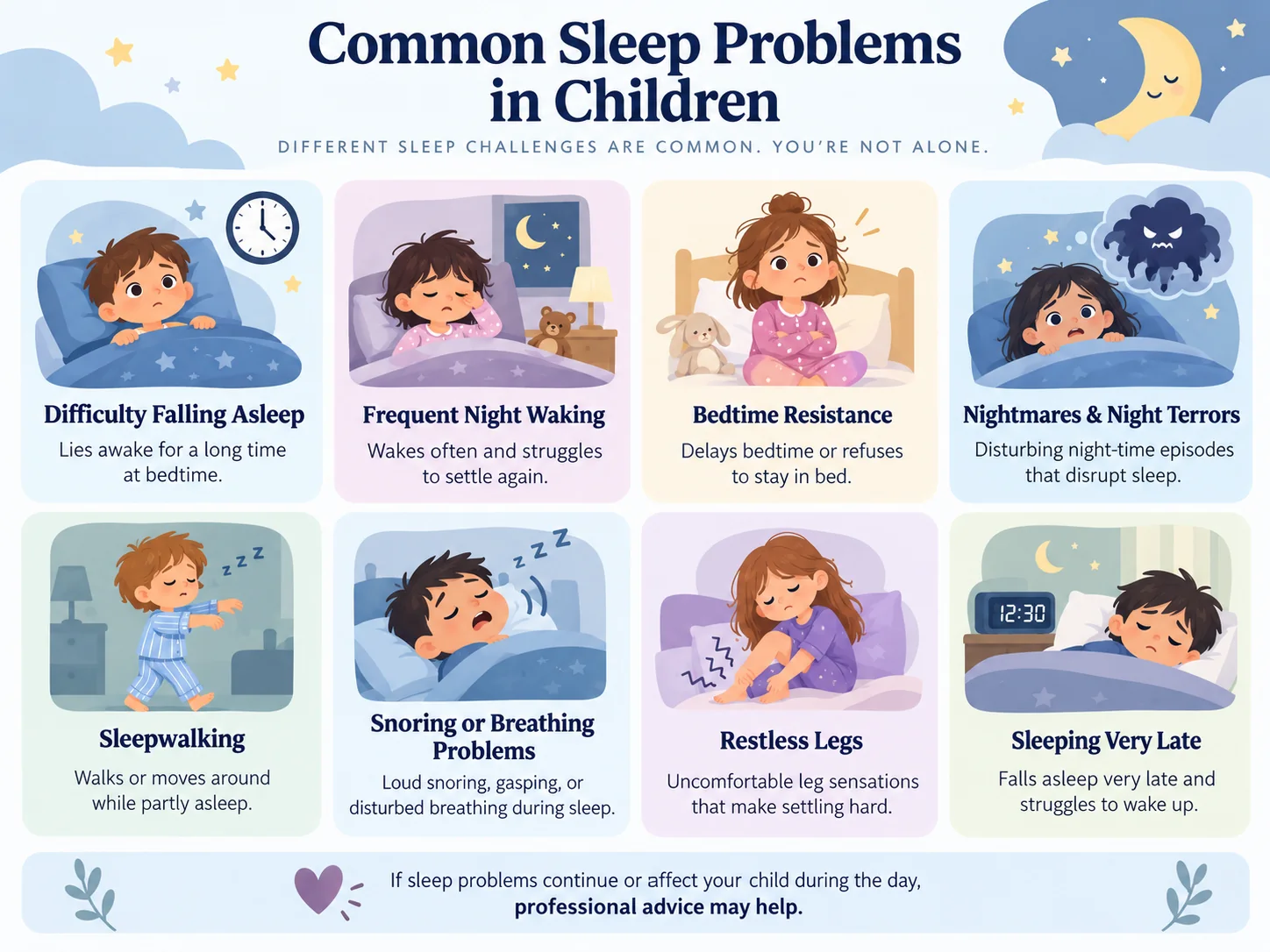
1. Difficulty Falling Asleep
Your child gets into bed at the usual time but remains awake for a long time. They may toss and turn, repeatedly leave their room or tell you they are not sleepy.
Sometimes bedtime is earlier than their body is ready for sleep. In other cases, worries, an irregular schedule or physical discomfort may interfere.
When difficulty falling asleep happens regularly despite enough opportunity for sleep and begins affecting everyday functioning, a clinician may assess for insomnia.
2. Frequent Night Waking
Your child falls asleep without much trouble but wakes at midnight, again at 2 am and perhaps once more before morning.
Brief awakenings between sleep cycles are normal. The concern is usually whether your child struggles to return to sleep, remains awake for long periods or becomes distressed.
For example, a child who falls asleep while a parent sits beside them may look for that same comfort after waking. However, waking can also be related to pain, anxiety or disturbed breathing.
3. Bedtime Resistance
Some children repeatedly ask for water, another story or one more hug. Others cry when a parent leaves or refuse to stay in bed.
It may seem like your child is deliberately delaying bedtime, but that is not always the case.
A child may be afraid of sleeping alone, uncomfortable in their bedroom or simply not ready for sleep. Understanding what is behind the resistance is more useful than treating every bedtime struggle as misbehaviour.
4. Nightmares and Night Terrors
If your child wakes frightened after a nightmare, they will usually recognise you and may remember what happened in the dream.
Night terrors look different. Your child may suddenly scream, cry, sweat or appear terrified while still partly asleep. They may not recognise you or respond when you try to comfort them.
Although frightening to witness, night terrors are often temporary, and many children outgrow them. They do not automatically mean a child has experienced trauma.
During an episode, focus on keeping your child safe rather than trying to force them awake. Seek medical advice if episodes are frequent, involve injuries or seem unusual.
5. Sleepwalking
You may find your child sitting up, walking around or speaking while appearing only partly awake.
They may respond poorly to you and remember nothing the following morning.
The immediate concern is preventing injury. Keep stairs, windows and dangerous objects secure. If sleepwalking becomes frequent or unsafe, discuss it with your child’s doctor.
6. Snoring and Breathing Difficulties
A child who snores occasionally during a cold may simply have temporary nasal congestion.
But loud, regular snoring, gasping or pauses in breathing during sleep need medical attention.
These symptoms can indicate sleep-disordered breathing, including obstructive sleep apnoea. Your child may appear to sleep for many hours but still experience disrupted sleep.
A paediatrician can determine whether further evaluation, including a sleep study, is needed.
7. Restless Legs or Uncomfortable Movements
Some children complain that their legs feel strange or uncomfortable when they lie down. They may repeatedly stretch, kick or move their legs because sitting still makes the sensation worse.
These complaints may suggest restless legs syndrome, particularly when they occur in the evening and interfere with falling asleep.
Low iron stores can be associated with this condition in some children. However, iron supplements should only be considered following appropriate medical assessment.
8. Sleeping Very Late and Struggling to Wake Up
This is especially relevant for teenagers.
Your teenager may feel completely awake at midnight, struggle to fall asleep until much later and find it extremely difficult to get up for school.
Adolescence naturally shifts sleep timing later. However, when the pattern becomes persistent and interferes with school or daily activities, a clinician may consider a circadian rhythm sleep-wake disorder.
Signs of Sleep Problems in Children
Some children tell their parents they cannot sleep. Others show the effects through their behaviour.
You may notice:
- Difficulty waking your child most mornings.
- Regular complaints of tiredness or falling asleep during the day.
- Increased irritability, frustration or emotional outbursts.
- Problems concentrating or remembering instructions.
- Changes in school performance.
- Less interest in activities they previously enjoyed.
- Persistent fear or distress around bedtime.
Poor sleep can sometimes make children unusually restless rather than sleepy. A child may appear distracted, impulsive or hyperactive during the day.
These behaviours can resemble ADHD symptoms, although they do not establish that sleep problems or ADHD are responsible.
If changes in sleep occur alongside persistent anxiety, withdrawal or emotional difficulties, it is worth considering your child’s broader emotional wellbeing.
How Much Sleep Do Children Need by Age?
A four-year-old needs considerably more sleep than a teenager. Knowing the recommended range can help you understand whether your child’s schedule is allowing enough rest.
According to the American Academy of Sleep Medicine:
| Child’s age | Recommended sleep in 24 hours |
|---|---|
| 4–12 months | 12–16 hours, including naps |
| 1–2 years | 11–14 hours, including naps |
| 3–5 years | 10–13 hours, including naps |
| 6–12 years | 9–12 hours |
| 13–18 years | 8–10 hours |
These are general recommendations rather than exact requirements for every child. Naps count towards the daily total in younger children.
For example, if your five-year-old sleeps nine hours at night and no longer naps, they may be getting less sleep than recommended. If they sleep for eleven hours but still seem unusually exhausted, sleep quality or another health issue may need consideration.
Normal Childhood Sleep Difficulties vs Concerning Symptoms
It can be difficult to know whether your child is going through a phase or needs help.
This comparison may help you decide what deserves closer attention.
| What you notice | How to interpret it |
|---|---|
| Your child occasionally takes longer to fall asleep | Often temporary, especially during routine changes |
| Your child regularly lies awake for hours and struggles the next day | May need assessment for insomnia or another cause |
| Your toddler wakes briefly and settles again | Can be normal for their developmental stage |
| Your child wakes repeatedly and remains awake for long periods | Worth assessing if persistent or disruptive |
| Your child occasionally has nightmares | Common during childhood |
| Night-time episodes cause injuries or substantial sleep disruption | Seek medical advice |
| Your child snores while recovering from a cold | May be related to temporary congestion |
| Your child snores loudly most nights, gasps or appears to stop breathing | Arrange paediatric assessment |
Pay particular attention when sleep difficulties affect your child’s mood, learning, school attendance or ability to manage ordinary activities.
Seek emergency medical care if your child has severe breathing difficulty, a prolonged breathing interruption, turns blue or grey, becomes unresponsive or cannot be awakened normally.
You do not need to wait for your child’s sleep to become severely disrupted before raising concerns with a paediatrician.
What Causes Sleep Problems in Children?
A child who struggles to sleep may have several contributing factors rather than one obvious cause.
Sleep Habits and Environment
Late naps, inconsistent waking times, evening caffeine, stimulating activities and bright light exposure can interfere with sleep.
Some children also become accustomed to particular conditions when falling asleep, such as having a parent beside them or listening to something specific.
These patterns can make settling harder when the same conditions are unavailable.
Anxiety and Emotional Stress
Bedtime may be the first quiet moment your child has had all day.
Worries about school, friendships, separation or family circumstances can become more noticeable when there are fewer distractions.
A child experiencing signs of anxiety in children may ask repeated questions, fear being alone or struggle to settle even when physically tired.
Physical Health Conditions
Pain, eczema-related itching, asthma symptoms, nasal obstruction, reflux and other health conditions can disturb sleep.
This is why it is important not to assume that bedtime resistance or repeated waking always has a behavioural explanation.
ADHD and Autism
Some children with ADHD struggle with bedtime transitions, irregular sleep schedules or difficulty settling. Certain prescribed medications may also affect sleep.
Autistic children may experience difficulties associated with sensory sensitivities, anxiety, sleep timing or other health concerns.
If your child has ADHD, their sleep patterns are worth discussing during child ADHD counselling or other professional assessment. Poor sleep should not automatically be attributed to ADHD.
Changes in Daily Life
Starting school, moving home, illness, family conflict or changes in routine may temporarily disturb sleep.
If your child’s difficulties began around a particular event, consider how they are coping with the change. However, avoid assuming that an emotional event is the only explanation if symptoms continue.
How Can Parents Help a Child With Sleep Problems?
You may already have tried earlier bedtimes, calming music, fewer screens and consistent routines.
If your child still struggles, repeating the same advice may not solve the problem. Try to identify what happens before, during and after their sleep difficulties.
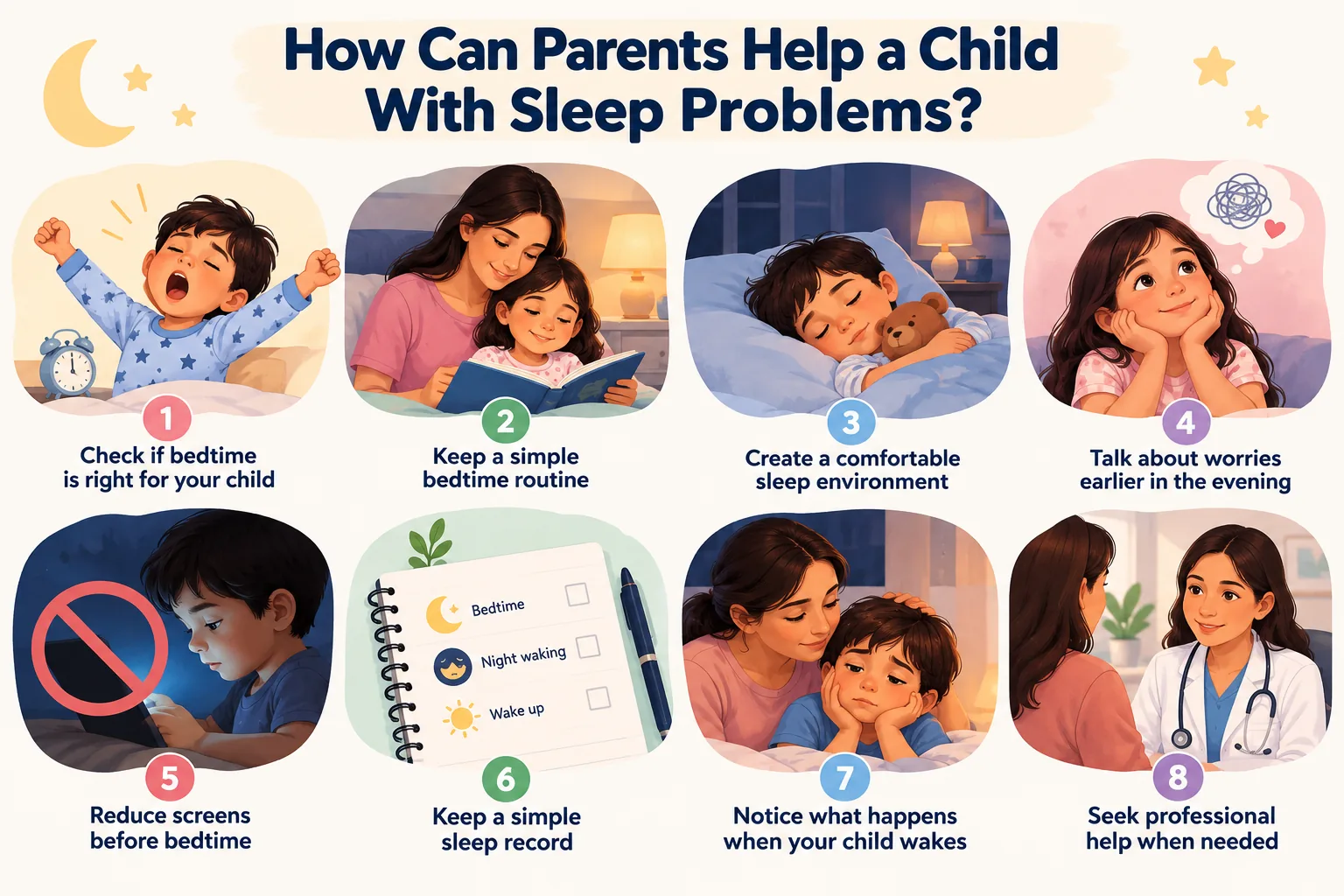
1. Check Whether Bedtime Is Too Early
If your child goes to bed at 8 pm but rarely falls asleep before 10 pm, consider whether their schedule matches their actual sleep needs.
Look at nap timing, morning waking and when they naturally become sleepy.
A bedtime that is too early can lead to a prolonged struggle, while one that is too late may leave your child without enough rest.
2. Keep the Routine Short and Predictable
A simple routine of washing, changing clothes, reading and settling down may help your child prepare for sleep.
You do not need an elaborate routine that takes an hour to complete.
What matters is that your child knows what to expect and has a reasonable opportunity to wind down.
3. Notice What Happens When Your Child Wakes
If your child repeatedly calls for you during the night, think about what helps them fall asleep initially.
For example, if they always fall asleep while you hold their hand, they may look for the same comfort when they wake.
Gradual changes to settling habits can help some children, but the approach should suit their age, emotional needs and development.
If your child is frightened, in pain or experiencing another difficulty, address that concern rather than focusing only on independent settling.
4. Discuss Worries Before Bedtime
Some children begin asking anxious questions as soon as the lights go out.
Instead of turning bedtime into a long discussion, try setting aside time earlier in the evening to hear what is troubling them.
Listen, respond calmly and help them identify what they can do about the concern.
If repeated questions become a nightly pattern, understanding why children constantly seek reassurance may help you respond without extending the bedtime struggle.
5. Check for Discomfort and Distractions
Consider whether your child’s bedroom is too warm, noisy or bright.
Younger children may be sensitive to clothing, bedding or unfamiliar sounds. Children with sensory sensitivities may need particular adjustments.
Also pay attention to late-day caffeine, stimulating activities and screen exposure.
6. Keep a Simple Sleep Record
For one or two weeks, note:
- When your child goes to bed and falls asleep.
- How often they wake and how long they remain awake.
- Their morning waking time and any daytime naps.
- Unusual breathing, movements or physical complaints.
- Changes in mood, behaviour or energy the following day.
You may notice a pattern that was difficult to recognise from memory alone.
A sleep record can also help a clinician understand the problem if you decide to seek advice.
7. Do Not Keep Trying the Same Strategy Without Results
If your child has struggled for weeks despite appropriate adjustments, consider whether something important has been missed.
A child who lies awake worrying about school may benefit from help managing anxiety. A child who snores loudly or wakes gasping needs medical assessment.
Understanding the cause matters more than finding another bedtime trick.
How Are Childhood Sleep Problems Assessed?
When you consult a paediatrician, they will usually begin by asking what your child’s sleep looks like on a typical night.
They may want to know how long the problem has continued, whether your child snores, how often they wake, whether they experience discomfort and how they manage during the day.
Your child’s age, medical history, medications, emotional wellbeing and developmental needs also help guide assessment.
Depending on the symptoms, the clinician may recommend a physical examination, relevant blood tests or referral to a specialist sleep service.
A sleep study may be necessary when breathing-related sleep problems are suspected.
Not every child requires testing. The assessment should match the difficulties you are describing.
What Treatments Can Help Childhood Sleep Problems?
Treatment depends on what is keeping your child from sleeping well.
For behavioural sleep difficulties, parent-guided strategies can help with bedtime resistance, settling and repeated waking.
For anxiety-related sleep difficulties, psychological support may help children manage bedtime fears, persistent worries and avoidance. Cognitive behavioural therapy (CBT) is an evidence-based treatment for childhood anxiety disorders.
For obstructive sleep apnoea, a paediatrician or relevant medical specialist may recommend further investigation and condition-specific treatment.
For restless legs syndrome, a clinician may assess symptoms and iron status before recommending treatment.
For circadian rhythm difficulties, treatment may involve carefully planned adjustments to sleep timing and light exposure.
Children with ADHD, autism or complex developmental needs may require individualised approaches that account for their sensory, behavioural and medical needs.
Should Parents Give Their Child Melatonin?
Melatonin is sometimes considered for particular sleep difficulties, but it is not a general solution for children who cannot sleep.
The American Academy of Pediatrics advises parents to discuss melatonin with a paediatrician before using it.
Some children with neurodevelopmental conditions may be offered melatonin under specialist guidance when appropriate sleep strategies have not resolved significant difficulties.
Do not begin melatonin, iron supplements or other sleep-related medications without professional advice.
When Can Psychological Support Help?
If your child’s sleep difficulties are closely connected to anxiety, emotional distress, bedtime fears or behavioural patterns, psychological support may be appropriate.
Through online child and teen counselling, LeapHope can help families address relevant emotional and behavioural concerns.
However, symptoms such as persistent loud snoring, breathing pauses or significant physical discomfort require medical assessment. Counselling is not a replacement for treatment of a medical sleep disorder.
Final Recap
If your child occasionally struggles to fall asleep, it may be related to a temporary change in routine or development. But when sleep difficulties continue, affect their everyday life or involve unusual physical symptoms, they deserve closer attention.
Notice whether your child struggles to fall asleep, wakes repeatedly or appears poorly rested despite spending enough time in bed.
You do not need to solve every sleep difficulty on your own. A professional assessment can help identify whether your child needs support with sleep habits, emotional wellbeing or a medical condition.
Clinical References
- Paruthi S, et al. Recommended Amount of Sleep for Pediatric Populations: A Consensus Statement of the American Academy of Sleep Medicine. Journal of Clinical Sleep Medicine. 2016.
- Common Sleep Disorders in Children. American Family Physician. 2022.
- American Academy of Pediatrics. Melatonin for Kids: What Parents Should Know About This Sleep Aid.
- National Institute for Health and Care Excellence. Autism Spectrum Disorder in Under 19s: Support and Management. Sleep recommendations.
- Royal Children’s Hospital Melbourne. Sleep Problems — Children and Teens.
This article provides general information and does not replace professional medical or psychological assessment.


