
Last Updated on November 2, 2026
Reviewed by Dr. Sachitra Chakravorty, Senior Counselling Psychologist · Ph.D., M.Phil., M.Sc.
Your child’s teacher says, “They understand the work, but hardly ever answer questions.”
At home, you see something different. Your child explains their homework, has opinions about everything and chats freely with people they know. You ask why they did not answer in class, and they shrug or say, “I just didn’t want to.”
Quietness in class can happen without any underlying disorder. Some children prefer listening or take longer to join a discussion. Others want to answer but worry about mistakes, struggle to find the words or become anxious when attention turns towards them.
Should you encourage them more? Would a speaking class help? Or are you worrying about something they will become comfortable with in time?
Start by finding out what happens when your child has a chance to answer and how they feel about it.
Why Does My Child Answer at Home but Stay Quiet in Class?
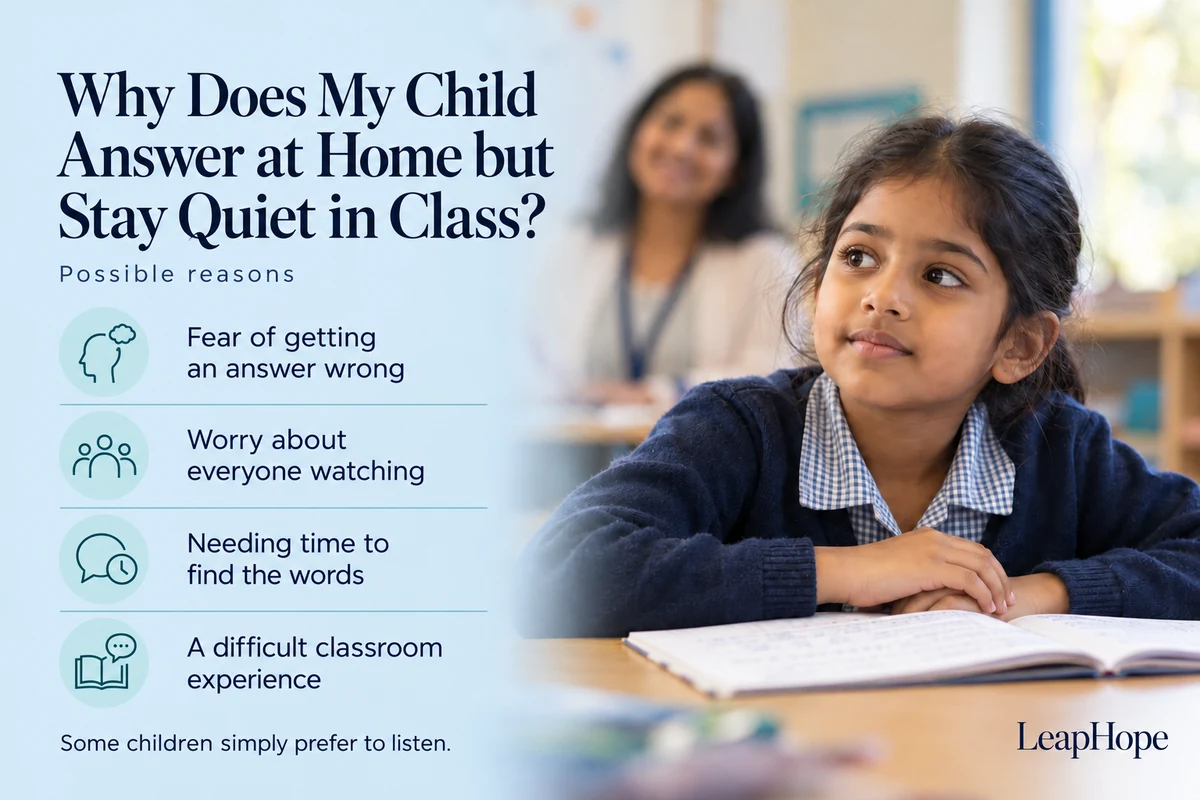
In class, your child may have less time to respond and more people listening. Knowing the answer is only part of what they need to manage.
They Worry About Getting It Wrong
Your child may wait until they are completely certain before raising their hand. They might worry that classmates will laugh, that the teacher will sound disappointed or that their answer will seem silly.
You may hear:
“What if everyone else knows it?”
“Someone will say it better.”
“I don’t want them looking at me.”
If mistakes also lead to repeated checking, giving up or harsh self-criticism at home, you may recognise some of the patterns described in perfectionism in children.
They Need Longer to Explain What They Know
A child might solve a calculation but need help explaining the steps. They may understand a story yet struggle to organise a longer answer.
The classroom language can matter too. Your child may explain an idea easily in Hindi but need longer to express it in English.
Notice whether they answer independently at home. Getting a multiple-choice question right on a learning app, or completing an answer after several hints, does not show you how easily they can explain it themselves.
Something About the Class Makes Them Uncomfortable
Think about when the hesitation started. Was there a change of teacher, a new class or an incident your child found embarrassing?
Perhaps another child laughed at their pronunciation. Perhaps they were interrupted or corrected in a way that upset them. These are possibilities to ask about, rather than conclusions to draw from silence.
If teasing or humiliating treatment is happening, the school needs to address it.
What Can I Ask My Child Without Making Them Feel Criticised?
Choose a relaxed moment. You could start with:
“Your teacher mentioned that you don’t often put your hand up. What’s that like for you?”
Then follow what your child tells you. A few useful questions are:
- “Do you sometimes want to answer and then change your mind?”
- “What do you think might happen if you get it wrong?”
- “Does the teacher move on before you’re ready?”
- “Would you like some help with this?”
Ask one question and listen. Running through the whole list can make the conversation feel like another test.
If your child says “I don’t know,” you can leave the door open: “Okay. If you notice what makes it difficult, you can tell me.”
Some children cannot explain their feelings clearly in the moment. Our article on why children say “I don’t know” about feelings explores this further.
A younger child may find it easier to describe one lesson or show you how the teacher asks questions. An older child may prefer to talk while walking or doing something together.
What Should I Ask Their Teacher?
Ask for examples of what happens. “They need more confidence” does not tell you enough to choose the right help.
Find out:
- Do they answer when the teacher speaks with them privately?
- Do they talk to classmates and contribute in a small group?
- When called on, do they answer quietly, say “I don’t know” or seem unable to respond?
- Is this happening across subjects or mainly during particular activities?
- Does their independent work show that they understand?
- Can they ask for help, explain a problem or ask to use the toilet?
Share what you have noticed at home. The teacher may be seeing a difficulty you do not see, and you may know something that helps explain it.
Before ending the conversation, agree on something to try. You could ask:
“Could we try one change, such as giving them time to prepare an answer, and compare notes after a few lessons?”
How Can Parents Help Their Child Speak Up in Class?
Choose a Manageable First Step
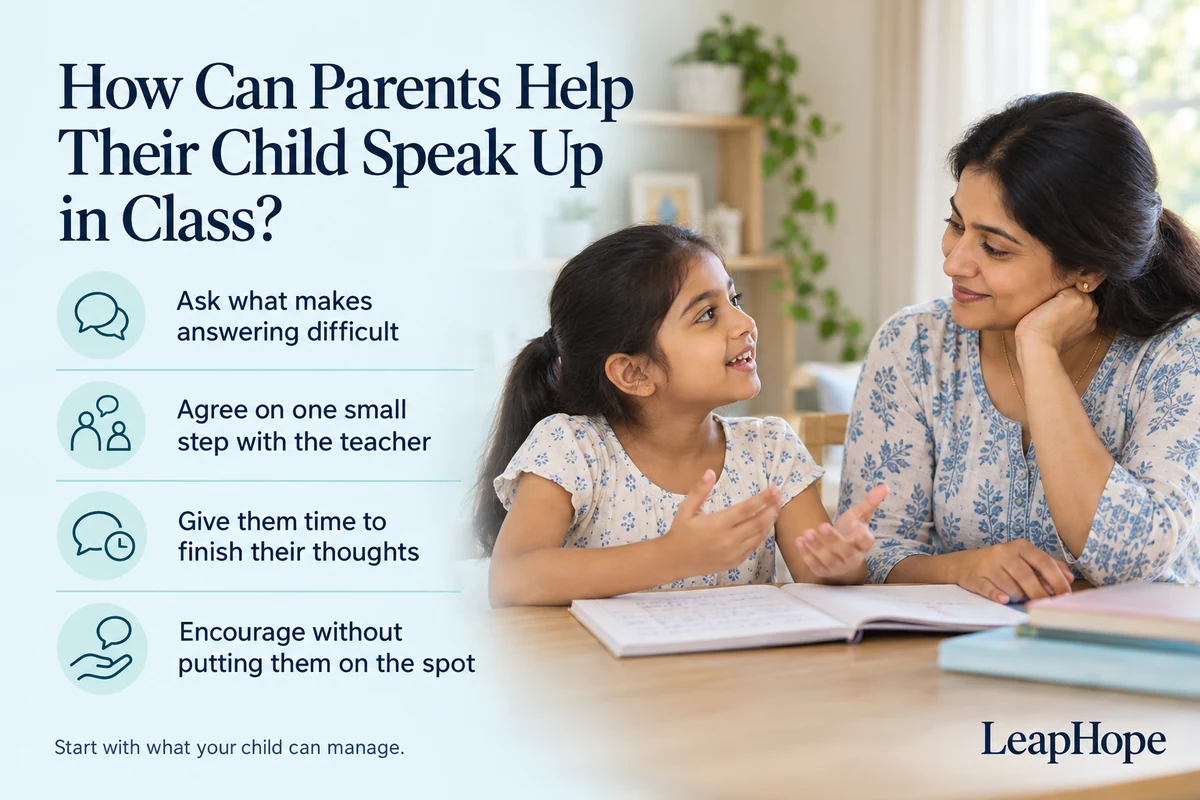
Use what the teacher has observed to choose a starting point with your child.
For example, a child who speaks comfortably with a partner might practise sharing one sentence from their discussion with a small group. A child who already contributes in groups may feel ready to answer a familiar question in front of the class.
Preparation helps some children. Others become more worried if they know they are about to be called on. Ask your child which feels easier rather than assuming advance warning will help.
Written responses, diagrams or classroom quizzes can help the teacher check understanding while spoken participation is being worked on.
At the review, ask whether your child feels more comfortable and can manage something that was difficult before.
Keep Home Practice Brief and Relevant
If your child wants to rehearse, practise something they actually need. They could explain one answer from the current lesson or try saying:
“Could you repeat the question?”
“I need a moment to think.”
“I’m not sure, but I think…”
Let them finish without immediately supplying the next word or correcting every sentence.
Ordinary conversations offer practice too. Your child could explain a game, describe a school project or tell you why they disagree with something. You do not need to turn these conversations into speaking exercises.
If they already express themselves easily at home, repeatedly practising answers there may add little. The changes may need to happen in the classroom.
Make Feedback Easier to Hear
When your child tells you they answered a question, show interest in the conversation: “What were you discussing?” A quiet acknowledgement may suit them better than a big celebration.
If an answer was wrong, keep your response specific. “You remembered the first part. Let’s check what happened next” gives them something to work with.
Notice whether your child hears a correction as “I’m stupid” or “You’re disappointed in me.” If this happens often, the article on children who take correction personally may help you understand their reaction.
Avoid making participation the first question after school each day. Your child should be able to tell you about a difficult lesson without expecting another conversation about why they did not raise their hand.
Would Drama or Public-Speaking Classes Help?
They can give a child opportunities to tell stories, organise ideas and practise with a group. Before enrolling, ask how the instructor supports hesitant children, handles mistakes and introduces speaking activities.
Let your child have a say. A small group they enjoy may be a better starting point than a performance they dread.
These classes do not address every reason a child stays quiet. If speaking causes marked distress or your child seems unable to get words out, get advice about that difficulty before adding more demands.
Can I Speak to a Psychologist About My Child’s Classroom Confidence?
Yes. You can book a parent consultation even if your child’s marks are good and you mainly want guidance.
You might want help deciding how much encouragement to give, what to ask the school or whether the behaviour needs further attention. Bring a few examples, including when it began and what the teacher has noticed.
A psychologist can help you explore whether the difficulty relates to temperament, anxiety, fear of mistakes or another concern. Depending on what emerges, they may suggest changes at home or school, meeting your child or further assessment.
Seek advice particularly when your child repeatedly wants to speak but cannot, struggles to communicate everyday needs or becomes distressed about attending lessons. A sudden change in a previously talkative child also deserves attention.
Persistent difficulty speaking in particular settings can occur with selective mutism. Speaking freely at home does not rule it out, and the cause needs an individual assessment.
Mention any difficulty hearing instructions, understanding questions, finding words or explaining ideas too. A hearing check or speech and language assessment may be appropriate.
LeapHope offers online school stress counselling for parents seeking guidance and children who need support with school-related worries. You can start by discussing what is happening and what help, if any, your child needs.
Clinical Resources and References
- NICE: Social anxiety disorder, recognition, assessment and treatment. Guidance on assessment, psychological treatment and working with families and schools.
- American Speech-Language-Hearing Association: Selective mutism. Guidance on communication across settings, assessment and coordinated support.
- American Speech-Language-Hearing Association: Spoken language disorders. Information on language assessment, hearing and multilingual considerations.
- Crozier WR, Hostettler K. The influence of shyness on children’s test performance. British Journal of Educational Psychology. 2003.
- Think and pair before share: Effects of collaboration on students’ in-class participation. Learning and Individual Differences. 2021.
- Betsi Cadwaladr University Health Board: Speech anxiety. Practical guidance for supporting children who find speaking difficult.
- Lebowitz ER and colleagues. Parent-based treatment as efficacious as cognitive-behavioral therapy for childhood anxiety. Journal of the American Academy of Child & Adolescent Psychiatry. 2020.