
Last Updated on November 2, 2026
Clinically reviewed by Mansi More Nopany, RCI-Registered Clinical Psychologist.
Your child sits down to do a few sums, but the evening soon becomes difficult. They get stuck on a calculation, become upset over a wrong answer or refuse to continue.
Maths anxiety in children can be hard to recognise when you are unsure whether your child is frightened, confused about the work or both.
You explain the question again. They say they still do not understand. Should you keep going, try another method or leave it until tomorrow?
Perhaps you have already arranged tuition or downloaded a learning app. Before adding more practice, it helps to understand what your child finds difficult and what happens when they try.
What Is Maths Anxiety?
Maths anxiety is fear, tension or worry around mathematical activities. Your child might feel nervous about mental arithmetic, answering a question in class, completing calculations or sitting a maths test.
It can affect children who understand the work as well as children who need more teaching. Some get good marks but spend considerable time worrying about mistakes or doubting their answers.
Feeling frustrated with a difficult sum occasionally is part of learning. Pay closer attention when the fear keeps returning or begins to affect your child’s willingness to attempt the work.
Signs Your Child May Be Anxious About Maths
Children do not always describe the feeling as anxiety. They may say they hate multiplication, refuse to open their maths book or insist that every question is too hard.
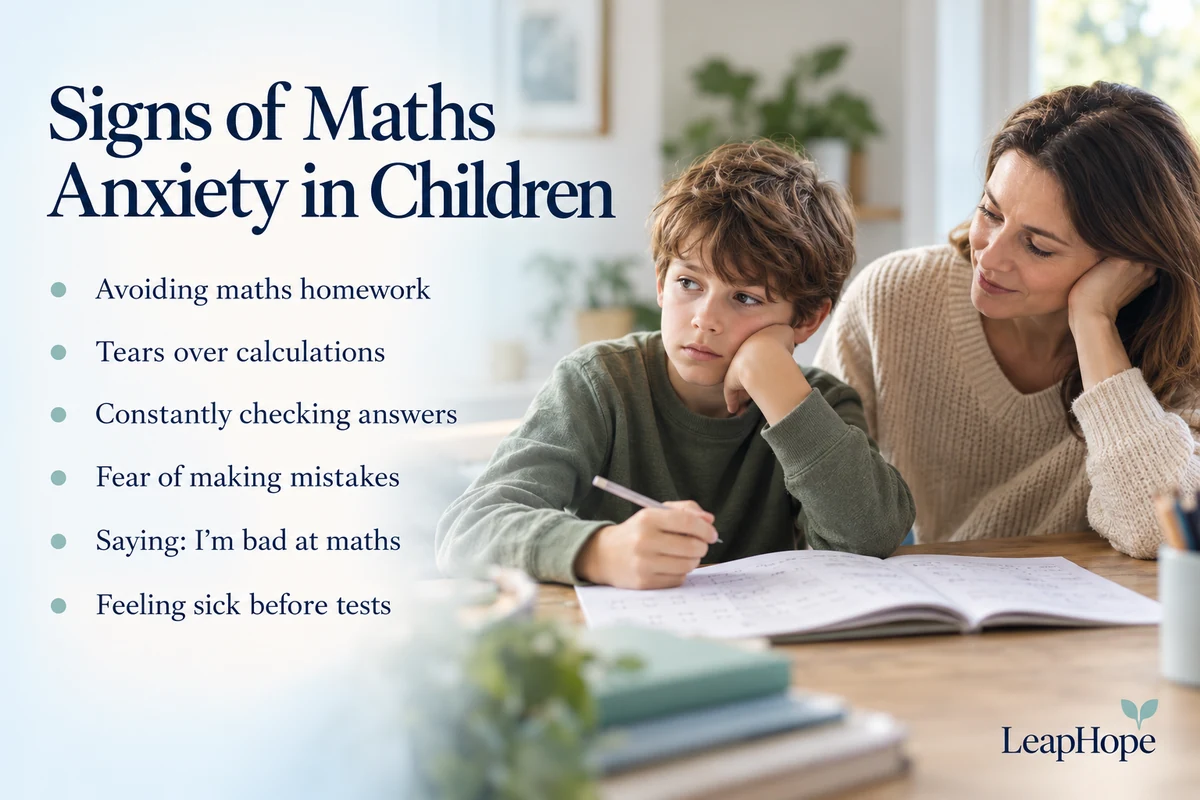
You might notice that your child:
- Delays starting a worksheet or repeatedly asks for a break.
- Becomes tearful or angry when a calculation goes wrong.
- Checks an answer several times but still wants your confirmation.
- Refuses to attempt unfamiliar problems.
- Makes harsh comments about their mathematical ability.
- Complains of stomachaches or feeling unwell before maths lessons or tests.
These behaviours can have different explanations. Look at when they happen rather than using them as a checklist to diagnose your child. Physical discomfort and avoidance can accompany anxiety, but they need to be understood alongside the child’s circumstances.
Ask about a recent example when you are both calm:
“When you got to that division question, what felt difficult?”
Your child might tell you they did not understand the method, could not remember a step or were afraid you would become annoyed. Each answer gives you a different starting point.
Persistent or concerning physical symptoms should also be discussed with your child’s doctor.
Why Does My Child Find Maths So Scary?
A missed concept can make later lessons confusing. A child who is unsure about place value may struggle with subtraction. Difficulty understanding fractions can make percentages and ratios harder.
After repeatedly getting stuck, your child may begin expecting the next question to go badly too.
Sometimes the worry centres on being watched. Answering at the board, recalling times tables aloud or hearing “You should know this” can make a child feel embarrassed about taking time to think.
For some children, a strong fear of mistakes makes it difficult to begin a question without knowing exactly how it will end.
Worry can also interfere with the thinking needed for a calculation. Your child has to remember numbers, follow a method and keep track of each step. Thoughts about getting the answer wrong can make this harder. Anxiety and difficulty learning maths can then reinforce each other.
This may explain why your child solves a problem comfortably at home but freezes over a similar one in class. The arithmetic may be familiar while the pressure feels different.
If most of the distress happens before or during maths tests, our article on exam anxiety may help you understand that part of the problem.
Is It Anxiety, or Does My Child Need More Help With Maths?
They may need help with both.
Ask the teacher which skills your child can use independently and where they get stuck. Be specific. “How are they managing subtraction with regrouping?” gives the teacher more to work with than “Are they bad at maths?”
Find out whether they understand during lessons, need repeated prompting or struggle mainly when answering under pressure. Bring examples of unfinished calculations or steps they frequently forget.
If tuition has not helped, ask what the sessions involve. Is the tutor checking earlier arithmetic skills, explaining current lessons differently or simply assigning more practice?
If your child keeps struggling with basic number skills, remembering number facts or carrying out calculations, ask about a learning assessment. This can help investigate difficulties such as dyscalculia. The assessment considers learning history, teaching opportunities and the child’s skills. A few untimed questions at home cannot confirm or rule it out.
You can discuss these concerns with a qualified professional while continuing to work with the school. You do not have to work out the explanation yourself first.
How Can Parents Help Their Child With Maths Anxiety?
What to Do When Your Child Becomes Upset
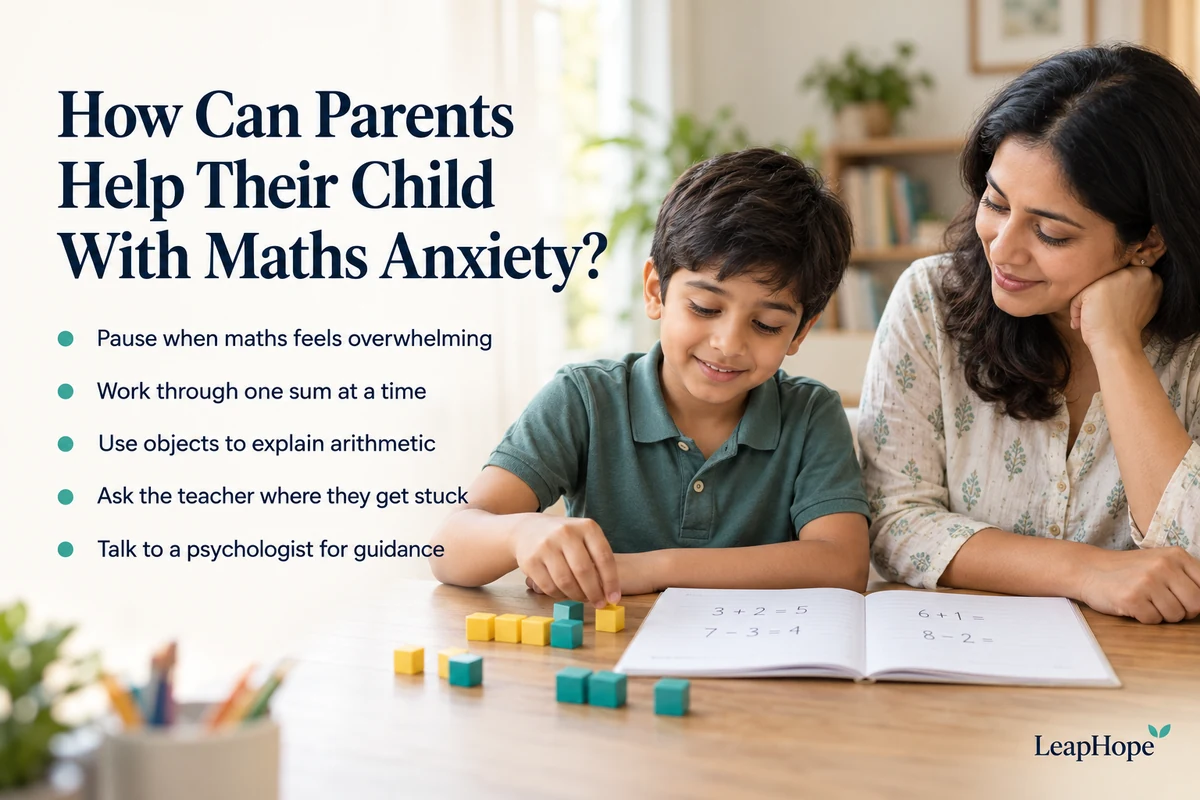
Pause the explanation. Repeating the same instructions more firmly is unlikely to help a child who is already overwhelmed.
You could say:
“This question is getting upsetting. Let’s take a short break, then look at the step that’s confusing.”
Agree when you will return. Afterwards, cover the rest of the worksheet and focus on one problem. Ask your child to show you the last part they understood.
If they cannot start, demonstrate a similar example, then let them attempt a manageable part themselves.
A pause should help your child return to the work. Gradually approaching a feared activity with encouragement is part of established childhood-anxiety guidance.
Try Another Way to Explain the Arithmetic
Your child may need to see or handle something before the written method makes sense.
For example:
- Use counters or coins to show addition, subtraction and equal groups.
- Draw arrays to explain multiplication instead of relying only on reciting tables.
- Fold paper into equal parts to compare fractions.
- Draw a number line for counting forwards, backwards or working with negative numbers.
- Sketch a word problem before choosing the calculation.
Ask your child to explain what they notice. “Can you show me three groups of four?” may reveal more about their understanding than asking them to recall the answer immediately.
Let them write down each step rather than expecting them to hold the whole calculation in their head.
There are also resources you can use together. The Math Learning Center provides free visual tools for place value, number lines and fractions. Khan Academy’s arithmetic lessons cover topics such as multiplication, division, decimals and fractions.
Choose something that addresses the point where your child is stuck. A visual fraction model serves a different purpose from a times-table practice game. Ask the teacher which resource would fit the current lesson.
What to Say When They Call Themselves Stupid
Your first reaction may be, “Don’t say that. You’re clever.”
Try acknowledging the disappointment first:
“You’re upset because you worked hard and the answer was wrong. Let’s see where it went off track.”
Give feedback they can use:
“You chose the right calculation. The subtraction in this line needs another look.”
If your explanation still is not helping, say:
“We need another way to explain this part. Let’s ask your teacher.”
Avoid comparing their speed or marks with another child’s. Keep the conversation about the calculation in front of them and the help they need to understand it.
How to Help Without Both of You Getting Frustrated
You might be worried about unfinished homework or how quickly the class is moving through the syllabus. Those worries can make you impatient even when you intend to be helpful.
If you have snapped, repair it directly:
“I was impatient earlier. I’m sorry I raised my voice.”
On a calmer day, agree on a realistic amount of maths practice and a stopping point. If the homework regularly takes much longer than expected, tell the teacher what happens rather than quietly extending the evening.
You can share the task with another caregiver, ask about school support or find a tutor who is patient and willing to revisit earlier concepts. You do not have to provide every explanation yourself.
What to Do When Your Method Differs From the Teacher’s
Your child may reject a method you learned at school because it differs from the one they are practising. They might worry that using it will be marked wrong.
Ask to see a worked example:
“I learned another way. Can you show me how your teacher starts it?”
If you are still unsure, ask the teacher which method is expected and what your child needs to show in their working.
Keep disagreements about teaching away from your child. They already have a problem to solve; they should not also have to decide which adult is right.
It is fine to say, “We don’t understand these instructions yet. We’ll ask.”
Can I Talk to a Psychologist About My Child’s Maths Worries?
Yes. You can book a routine consultation to discuss your child’s experience of maths. You do not need to wait for failing marks, severe anxiety or school refusal.
You can begin by speaking with a psychologist yourself about what happens during homework, how you respond and what the teacher has noticed. The conversation can cover practical questions, such as how much help to give, how to respond to repeated checking and whether meeting your child or arranging a learning assessment would be useful.
Through LeapHope’s online school stress counselling, you can speak with a psychologist about your child’s maths worries and how to help at home.
Clinical Resources and References
- Devine, A., et al. (2018). Cognitive and Emotional Math Problems Largely Dissociate: Prevalence of Developmental Dyscalculia and Mathematics Anxiety. Journal of Educational Psychology.
- Möhring, W., et al. (2024). Mathematics anxiety and math achievement in primary school children: Testing different theoretical accounts. Journal of Experimental Child Psychology.
- Codding, R. S., et al. (2023). Meta-analysis of skill-based and therapeutic interventions to address math anxiety. Journal of School Psychology.
- Shah, H. R., et al. (2019). Clinical Practice Guidelines on Assessment and Management of Specific Learning Disorders. Indian Journal of Psychiatry.
- Canadian Paediatric Society. Anxiety in children and youth: Part 2 – The management of anxiety disorders.
- Walter, H. J., et al. (2020). Clinical Practice Guideline for the Assessment and Treatment of Children and Adolescents With Anxiety Disorders. Journal of the American Academy of Child & Adolescent Psychiatry.


