Last Updated on October 14, 2026
Clinically Reviewed By: Mansi More Nopany, RCI Clinical Psychologist
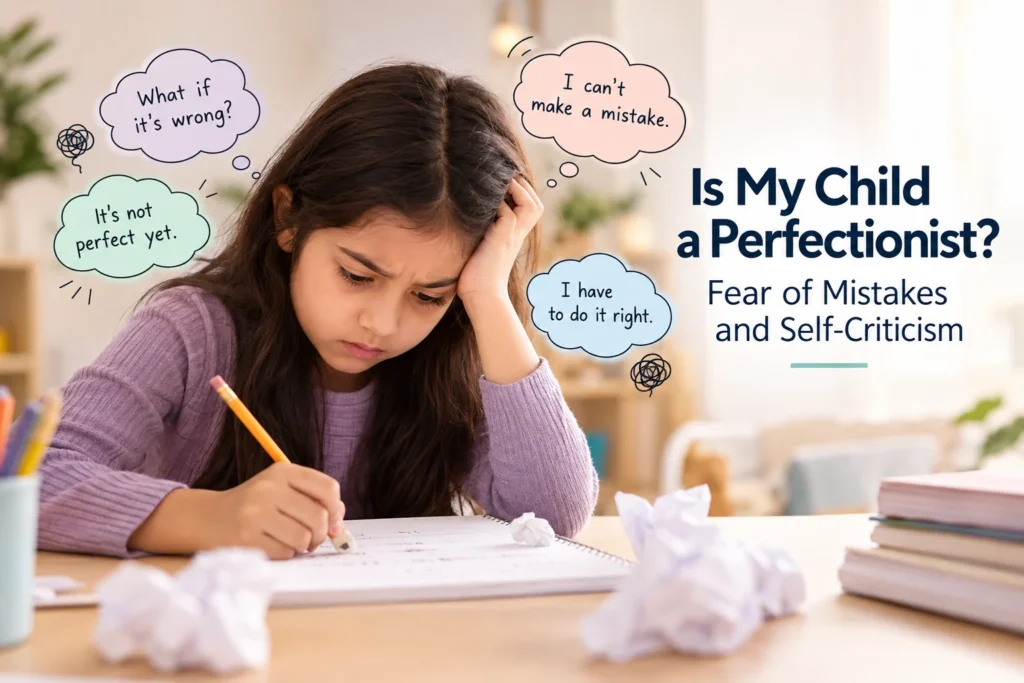
Your child may cry over one wrong answer, erase the same work repeatedly, refuse to try unless they know they can do it well, or say, “I’m stupid” after a small mistake.
Parents often describe this as perfectionism in children.
Being upset by mistakes or wanting to do very well does not mean your child has a perfectionism problem. Look at the wider pattern: whether mistakes repeatedly lead to distress, harsh self-criticism, checking, avoidance or difficulty moving on.
What Does Perfectionism Look Like in Children?
Perfectionism is not a childhood diagnosis.
Research distinguishes high standards or perfectionistic striving from perfectionistic concerns such as excessive worry about mistakes, doubts about performance and harsh self-evaluation.
A meta-analysis of 121 studies involving young people found much stronger links between perfectionistic concerns and anxiety, OCD symptoms and depression than between high standards alone and these difficulties.
So a child wanting excellent marks or practising hard is not enough to make the pattern concerning.
What matters more is whether not being perfect begins creating distress, avoidance, excessive checking or strong self-criticism.
What Are the Signs of Perfectionism in Children?
No single behaviour proves that a child is struggling with perfectionism.
Parents may want to look more closely when several of the following patterns occur repeatedly.
1. They Become Very Upset About Small Mistakes
A wrong answer, uneven drawing, missed goal or spelling error may trigger much more distress than parents expect.
The child might:
- cry
- become angry
- tear up the work
- erase repeatedly
- restart the whole task
- refuse to continue
- focus on one mistake despite doing everything else well
Disappointment after making a mistake is normal.
The concern is the intensity and repetition of the response, especially when minor errors regularly make it difficult for the child to continue.
2. They Are Very Hard on Themselves
Instead of seeing the mistake as something they did, a child may turn it into a judgement about themselves.
You may hear:
- “I’m stupid.”
- “I can’t do anything right.”
- “I’m terrible at this.”
- “I always mess everything up.”
- “Everyone else is better than me.”
There is an important difference between:
“I got this wrong.”
and:
“I’m a failure.”
When this type of self-criticism starts appearing more broadly, parents may also notice some of the patterns discussed in signs of low self-esteem in children.
3. They Avoid Things They Might Not Do Perfectly
Perfectionism does not always look like a child working harder.
Sometimes it looks like not trying at all.
A child may refuse to enter a competition, answer in class, try a new sport, start difficult homework or participate in an unfamiliar activity.
Avoidance can have many explanations. It becomes relevant to perfectionism when the child repeatedly avoids something because making a mistake or performing imperfectly feels too difficult to tolerate.
4. They Keep Redoing, Checking or Restarting
Some children struggle to decide when their work is finished.
They may:
- erase and rewrite ordinary answers
- repeatedly check schoolwork
- restart drawings or projects
- spend excessive time on simple tasks
- repeatedly ask whether something is correct
- struggle to submit work because it never feels good enough
Careful checking is not automatically concerning.
It becomes more important when checking or redoing creates distress, takes excessive time or prevents the child from completing ordinary tasks.
5. They Give Up When Success Is Not Guaranteed
A child who seems capable may suddenly quit when something becomes difficult.
For some children, the problem is not lack of motivation. Continuing means accepting the possibility of failure.
The pattern may look like:
“If I cannot do this perfectly, I would rather not do it.”
This becomes more significant when the child stops attempting activities they might otherwise enjoy or learn from.
6. They Doubt Whether Their Work Is Good Enough
Some children repeatedly seek certainty even after completing something successfully.
They may ask:
- “Is this definitely right?”
- “Is this good enough?”
- “Should I do it again?”
- “Are you sure?”
- “What if I made a mistake?”
Occasional reassurance is normal.
The pattern deserves more attention when the child rarely trusts their own judgement and repeatedly needs confirmation before moving on.
7. They Feel Other People Expect Them to Be Perfect
Some children believe that parents, teachers, coaches or other important adults expect flawless performance.
They may worry that:
- a parent will be disappointed by a lower mark
- a teacher will think they are not smart
- a coach will be unhappy if they lose
- other people will notice their mistakes
Importantly, the child’s perception of expectations is not necessarily the same as what adults have actually communicated.
Is Perfectionism the Same as Wanting to Do Well?
No.
A child can be ambitious, hardworking and disappointed by mistakes without having a concerning perfectionistic pattern.
The difference is whether high standards are accompanied by fear of mistakes, harsh self-criticism, avoidance, excessive checking or significant distress.
Why Does My Child Get So Upset When They Make a Mistake?
There is no single explanation.
For some children, mistakes become tied to how capable they believe they are. Others may fear disappointing someone, being judged or losing an identity built around doing well.
Anxiety can also make uncertainty and mistakes harder to tolerate.
The same reaction can have different causes, so it should be understood as part of the child’s wider pattern, not interpreted on its own.
What Can Contribute to Perfectionism in Children?
There is no single proven cause.
Possible influences include:
- Temperament — some children are more sensitive to evaluation or uncertainty.
- Perceived expectations — a child may believe adults expect very high performance.
- Achievement pressure — marks, sport or competitive environments may make performance feel unusually important.
- Modelling — children may observe adults being highly critical of their own mistakes.
- Repeated success — children accustomed to doing very well may find ordinary failure harder to tolerate.
- Performance-focused feedback — approval may begin feeling too closely connected with achievement.
- Anxiety — worry and difficulty tolerating uncertainty can overlap with perfectionistic concerns.
- School or social experiences — criticism, comparison or embarrassment around mistakes may affect some children.
These factors do not affect every child in the same way.
Perfectionism should not automatically be blamed on strict parenting, childhood trauma or one particular experience.
Can Anxiety, OCD, ADHD or Autism Look Like Perfectionism?
Yes, but similar behaviour does not mean your child has any of these conditions. Different difficulties can look alike from the outside, and one pattern cannot identify the cause.
- Anxiety: fear of mistakes, reassurance-seeking and avoidance can overlap with perfectionistic concerns. See child anxiety counselling.
- OCD: checking, repeating or needing something to feel “just right” can resemble perfectionism, but OCD involves a different obsessive-compulsive pattern. See OCD therapy and treatment.
- ADHD: frustration, unfinished work or repeated correction may coexist with perfectionistic behaviour, but perfectionism is not a core ADHD symptom. See child ADHD counselling.
- Autism: rigidity or a strong need for sameness can sometimes resemble perfectionism, but the underlying reason may be different.
Parents do not need to decide which explanation fits before asking for professional guidance.
How Can Parents Help a Child Who Struggles With Perfectionism?

The aim is not to stop the child caring about doing well. It is to help mistakes feel manageable rather than threatening.
Parents can:
- Keep mistakes separate from personal worth. A wrong answer should remain a problem with the task, not evidence that the child is incapable.
- Keep expectations clear and realistic. Help the child understand what actually needs to be completed.
- Avoid encouraging endless checking or redoing. Work that already meets the requirement does not always need further correction.
- Focus feedback on effort, strategy and progress. This keeps attention on learning rather than proving ability.
- Allow manageable mistakes to remain mistakes. Children need opportunities to experience getting something wrong and continuing anyway.
- Notice where the pattern appears. Is it mainly schoolwork, or does it also affect sport, hobbies, appearance, friendships or other activities?
Parents do not need to “treat” perfectionism themselves.
If the pattern is creating distress or you are unsure what is driving it, counselling can help you understand what is happening before deciding what support is needed.
When Should Parents Consider Child Counselling?
You do not need to know whether your child is actually struggling with perfectionism before speaking with a counsellor.
Parents can seek guidance simply because a pattern is worrying them, creating repeated distress or conflict, or becoming difficult to understand.
Professional support becomes particularly useful when several patterns persist or begin affecting:
- schoolwork
- willingness to try difficult things
- how long ordinary tasks take
- activities the child previously enjoyed
- anxiety or sleep
- family life
- mood
- harsh self-talk
- everyday functioning
A child psychologist or counsellor can help parents understand what is driving the behaviour.
Perfectionistic concerns may be part of the picture, but sessions may also identify anxiety, school pressure, learning difficulties or another explanation—or simply help the child cope better with mistakes and expectations.
Parents can explore LeapHope’s online child and teen counselling even if they are not sure what is behind the behaviour.
Families in India, the USA, the UAE and Canada can access LeapHope’s child counselling support online.
Final Thoughts
A child wanting high marks, disliking mistakes or caring about doing something well does not automatically mean they have a perfectionism problem.
What deserves closer attention is when fear of mistakes begins controlling what the child attempts, how harshly they judge themselves or how much distress ordinary tasks create.
You do not need to give the behaviour a label before asking for help. If something about your child’s response to mistakes is worrying you, professional guidance can help you understand the pattern and decide what support, if any, would be useful.