Last Updated on October 14, 2026
Clinically Reviewed By: Mansi More Nopany, RCI Clinical Psychologist
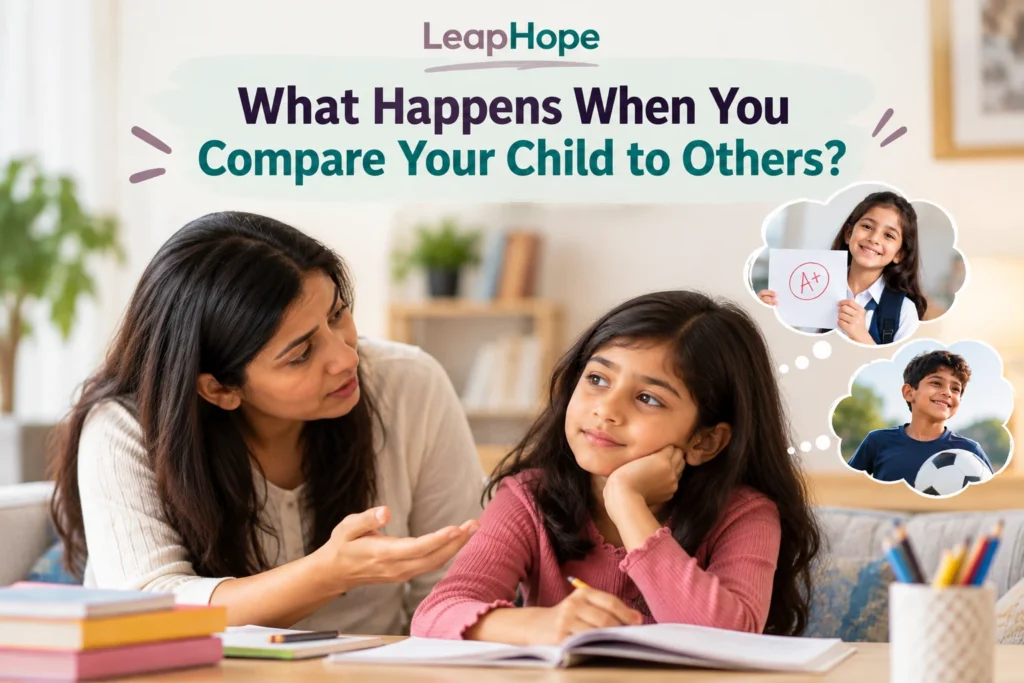
“Your sister never needs reminding.”
“Your cousin gets better marks.”
“Why can’t you behave like the other kids?”
Parents may use comparisons like these while trying to motivate, explain expectations or understand whether their child is falling behind.
Occasional comparison does not automatically harm a child. The concern is repeated comparison that makes another child the standard for how your child should perform, behave or see themselves.
What Are the Effects of Comparing Your Child to Others?
Children do not all respond to comparison in the same way.
One child may become more motivated. Another may feel discouraged, become highly competitive or decide they are simply “not good enough.”
What matters is how often comparison happens, what is being compared and how the child interprets it.
How They See Their Own Ability
Repeated comparison can gradually shape the way a child describes themselves.
They may begin thinking:
- “She is the smart one.”
- “I am bad at maths.”
- “He is better at everything.”
- “I am always the slow one.”
This is about more than confidence.
Children develop beliefs about their abilities in different areas, including school, sport, friendships and behaviour. When another child repeatedly becomes the reference point, those comparisons can become part of the child’s own self-evaluation.
Their Motivation
Comparison does not always reduce motivation.
Some children may think:
“I want to work harder so I can do that too.”
Others may experience the same comparison very differently:
“There is no point trying because I will never be as good.”
Research on social comparison in children shows that seeing someone perform better can sometimes motivate a child and sometimes discourage them, depending on how they interpret the comparison.
That means parents should avoid assuming that comparison is motivating simply because the intention behind it is positive.
How They Handle Mistakes and Failure
For some children, repeated comparison may make mistakes feel more evaluative, especially when performance is frequently discussed relative to another child.
A child may start thinking less about what went wrong and more about what the mistake says about them compared with someone else.
For example:
“My brother got this right and I didn’t.”
can become:
“He is smarter than me.”
When fear of mistakes, excessive checking or harsh self-criticism also become prominent, parents may notice patterns discussed in perfectionism in children.
Comparison is not the only explanation for perfectionistic behaviour, but it can become one part of a wider performance-focused pattern.
Their Self-Worth
Repeated comparison may also influence how children judge their own worth.
If another sibling, cousin or classmate is repeatedly described as more capable, responsible, successful or talented, the child may begin to see themselves through that contrast.
They may say:
- “I’m not as good as them.”
- “Everyone else is better.”
- “I never do anything right.”
These statements do not automatically mean a child has low self-esteem.
But when this kind of self-evaluation becomes frequent or spreads across different areas of life, parents may also want to look at signs of low self-esteem in children.
Their Relationship With Parents
Parents may intend comparison as encouragement.
The child may hear it as:
- criticism
- disappointment
- favouritism
- rejection
- proof that someone else is more valued
This gap between parent intention and child experience matters.
A 2024 study examining parental upward social comparison found that parents tended to view comparison as motivating, while children’s reports suggested that greater comparison was associated with poorer self-concept and lower mastery motivation. Read the study on PubMed.
This does not mean every comparison produces harm.
It does show why parents should pay attention to how the child is actually receiving the message.
Their Relationship With Siblings
Comparison can also affect sibling relationships.
If one child repeatedly hears that the other is:
- smarter
- calmer
- more responsible
- more successful
- better behaved
the comparison may contribute to jealousy, resentment or rivalry.
Repeated comparison can also reinforce family labels such as “the clever one,” “the responsible one” or “the difficult one.”
The issue is not simply that siblings are different.
It is when those differences repeatedly become a ranking system inside the family.
What Happens When Parents Compare Siblings?
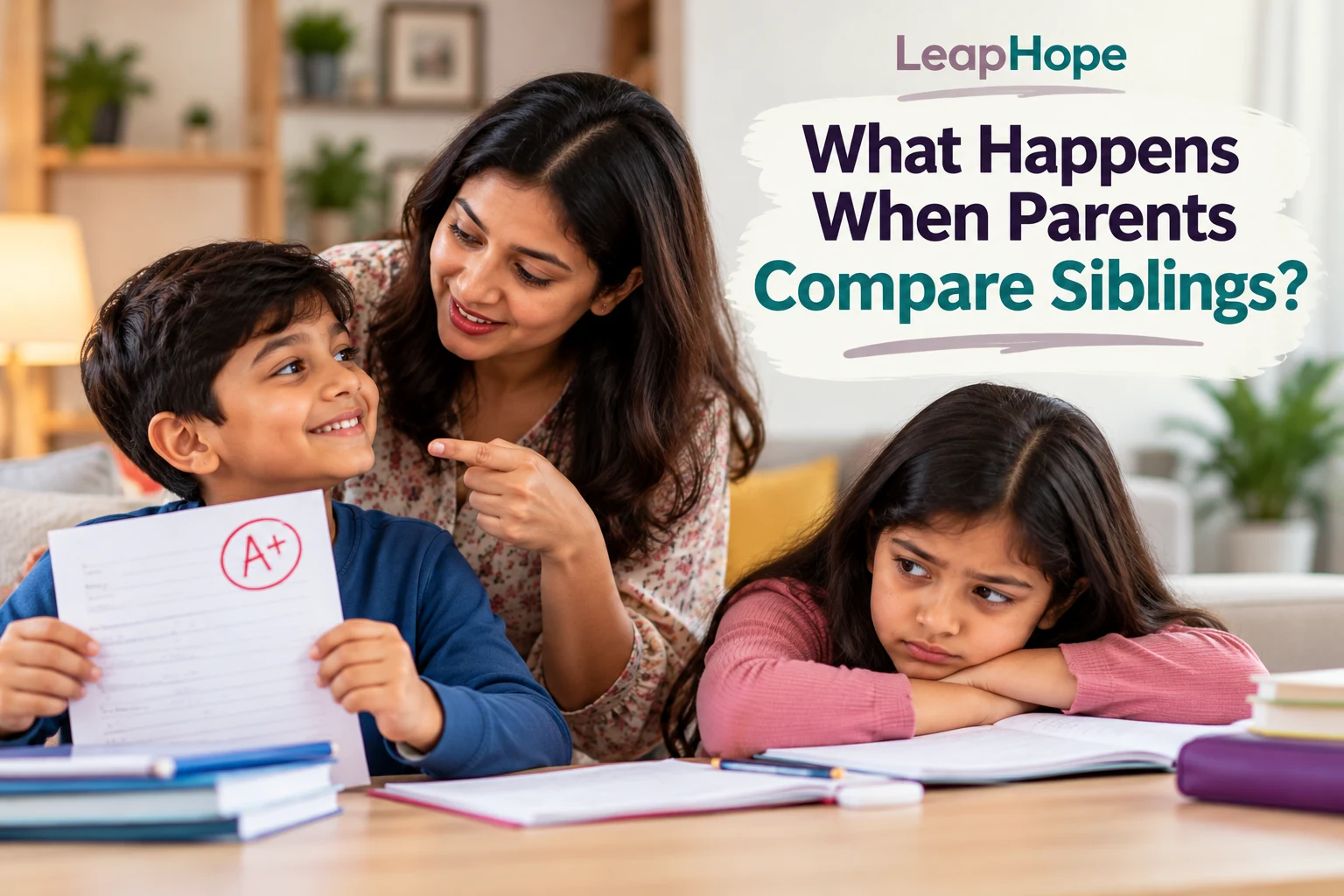
Sibling comparison can be particularly sensitive because siblings share the same family environment and naturally become easy reference points.
Parents may compare:
- marks
- behaviour
- responsibility
- appearance
- sport
- confidence
- independence
- friendships
Comparisons may become especially noticeable when siblings are close in age or attend the same school.
However, different treatment is not automatically unfair treatment.
A 16-year-old and a 10-year-old will reasonably have different rules, responsibilities and freedoms.
One child may also need more academic support, emotional support or structure than another.
Children do not always need identical treatment. What matters is whether differences are understandable and experienced as fair.
What About Comparing Your Child With Classmates?
Children naturally compare themselves with classmates.
School gives them constant information about:
- marks
- reading ability
- sport
- popularity
- behaviour
- appearance
- confidence
- speed of completing work
Parents are therefore not the only source of comparison.
A child may already be thinking:
“Everyone reads faster than me.”
or:
“She is better at football.”
Adding repeated adult comparison can make those differences feel even more important.
For example:
“Your classmates finished this already.”
may be intended as encouragement.
But a child who is already worried about keeping up may hear:
“I am behind everyone else.”
That is why context matters.
Why Do Parents Compare Their Children?
Parents usually do not compare children because they want to hurt them.
Common reasons include:
- trying to motivate
- checking whether development seems typical
- worrying the child is falling behind
- using siblings as an easy reference point
- uncertainty about what behaviour is age-appropriate
- repeating patterns from their own upbringing
Parents may also compare because they are trying to decide whether a child needs extra help.
That is understandable.
The important point is:
A parent may intend comparison as encouragement while the child experiences it as judgement.
Parents do not need to feel guilty for ever making a comparison.
What matters more is noticing when comparison has become a repeated way of discussing performance, behaviour or worth.
Is It Bad to Compare Your Child to Others?
Not every comparison is harmful.
Children naturally notice how they differ from siblings, classmates and friends. Comparison can sometimes provide useful information or even motivation.
It becomes more concerning when comparison is:
- frequent
- critical
- humiliating
- repeatedly centred on the same sibling or peer
- used to define personality or ability
- making the child feel less valued
- creating strong distress or conflict
- discouraging the child from trying
For example:
“Your brother completed this in twenty minutes”
is different from:
“Why can’t you be more like your brother?”
The first gives information.
The second makes another child the standard for how the child should be.
What Can Parents Do Instead of Comparing Their Child to Others?
Parents do not need to avoid every reference to other children.
The goal is to reduce comparison that turns another child into the benchmark for worth or ability.
Parents can:
- Compare progress with the child’s own past performance. Look at what has improved rather than who is ahead.
- Talk about the specific task or behaviour. Address homework, routines or effort directly instead of bringing another child into the conversation.
- Avoid fixed family labels. Phrases such as “the clever one,” “the difficult one” or “the sporty one” can become identities.
- Explain different expectations between siblings. Age, temperament and individual needs may justify different rules.
- Ask what made something difficult. A child who is struggling may need support rather than comparison.
- Notice when another child has become the main benchmark. If most conversations about performance involve someone else, the comparison may be taking up too much space.
Parents can start by noticing when another child has become the main reference point and bringing the conversation back to their own child’s needs, behaviour or progress.
When Can Counselling Help?
Parents do not need to prove that comparison has harmed their child before seeking counselling.
Support may be useful if a child begins to:
- repeatedly say they are worse than other children
- become highly distressed about marks or performance
- avoid activities because someone else performs better
- show strong sibling resentment
- become increasingly self-critical
- worry excessively about being judged
- lose motivation
- experience repeated parent-child conflict around achievement
A counsellor can help understand how the child is interpreting family, school or sibling comparisons.
Comparison may be part of the difficulty, but it may not be the whole explanation.
Anxiety, low self-esteem, perfectionistic concerns, school pressure, learning difficulties or another issue may also be relevant.
Parents can explore LeapHope’s online child and teen counselling even when they are not sure what is driving the behaviour.
Families in India, the USA, the UAE and Canada can access LeapHope child counselling online.
Final Thoughts
Children will naturally notice how they differ from siblings, classmates and friends.
The concern is not comparison itself.
It is when another child repeatedly becomes the standard by which your child feels judged, valued or defined.
If comparison is creating distress, family conflict or changes in how your child sees themselves, you do not need to decide whether it has “caused” a problem before asking for professional guidance.