Last Updated on October 22, 2026
Clinically Reviewed by Amritha H. | Counselling Psychologist & Certified CBT Practitioner
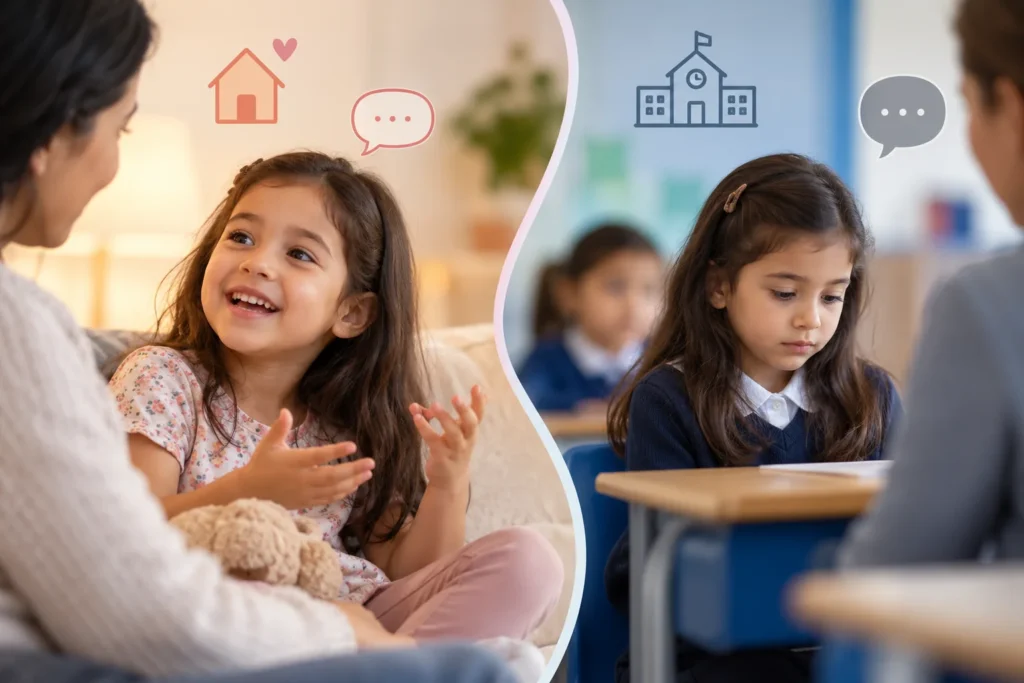
Your child’s teacher says they haven’t heard your daughter speak in class. But the moment she gets home, she’s talking about her friends, her homework and everything that happened at school.
Why can she speak so easily at home but not answer a simple question in the classroom?
This can be a sign of selective mutism, an anxiety disorder that makes speaking extremely difficult in certain situations, even when a child speaks comfortably elsewhere.
What Is Selective Mutism in Children?
Selective mutism is a condition in which a child consistently cannot speak in certain social situations where speaking is expected.
The child isn’t choosing to stay silent. They may know exactly what they want to say but feel unable to get the words out.
The difficulty often becomes noticeable when children start nursery or school. It can also affect conversations with relatives, medical appointments and other everyday situations.
Signs of Selective Mutism in Children
Not every child with selective mutism remains completely silent. Watch for patterns such as:
- Talkative at home, silent elsewhere: Your child speaks freely with family but cannot answer their teacher or unfamiliar adults.
- Freezing when asked a question: They know the answer but look down, become stiff or remain silent when someone expects them to speak.
- Whispering to selected people: They talk to one friend but stop when another person approaches.
- Using gestures instead of speech: They nod, point, write answers or rely on someone else to speak for them.
- Avoiding activities that require talking: Ordering food, greeting relatives, answering the phone or joining group conversations becomes difficult.
Some children complete their schoolwork, follow instructions and play happily without speaking. Their teachers may describe them as well-behaved rather than recognise a communication difficulty.
A child who cannot ask the teacher to explain something may fall behind. Another might stay quiet when they feel sick or need help.
One useful question to ask the teacher: Can my child communicate when they need something, or only when someone offers them a choice?
Selective Mutism vs Shyness: What’s the Difference?
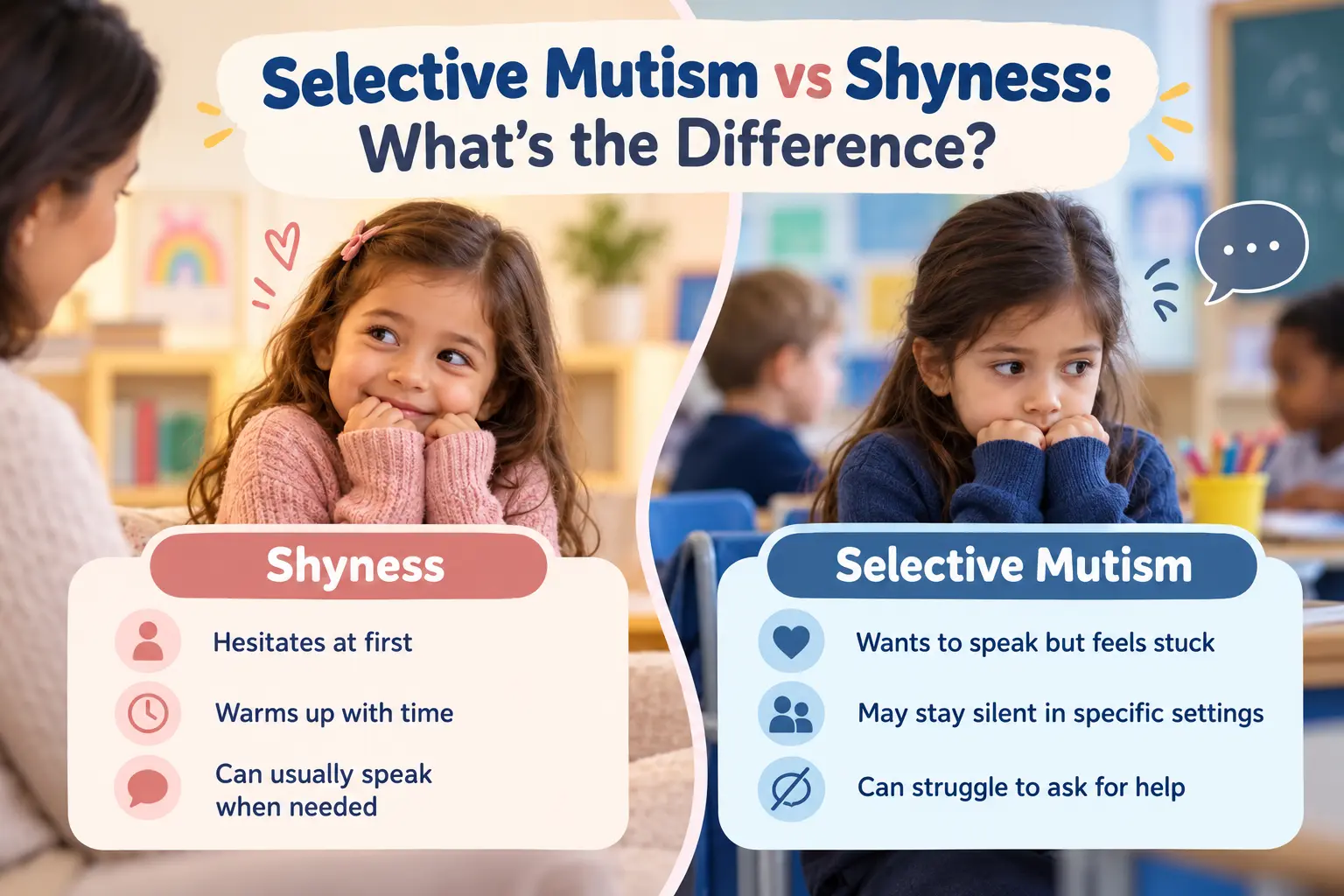
| Shyness | Selective mutism | |
|---|---|---|
| Speaking | The child may hesitate or speak softly. | Speaking becomes difficult or impossible in particular situations. |
| With familiar people | They may become more comfortable with time. | They may remain unable to speak even with familiar people in certain settings. |
| Everyday needs | They can often communicate despite feeling nervous. | They may struggle to ask for help or express basic needs. |
Social anxiety is closely related. It involves marked fear of judgement or embarrassment, while selective mutism is identified by a consistent inability to speak in particular situations. A child can experience both conditions.
Read more in LeapHope’s guide to shyness versus social anxiety in children.
What Causes Selective Mutism?
Selective mutism is strongly linked to anxiety. A child may feel overwhelmed when someone expects them to speak, particularly in unfamiliar or socially demanding situations.
A pattern can develop:
Teacher asks a question → child freezes → teacher moves on → child feels relieved.
That relief can make silence more likely the next time the child feels pressure to speak.
Temperament, family history of anxiety and speech or language difficulties may contribute. There is no single cause, and selective mutism does not require a history of trauma.
How Can Parents and Teachers Help a Child With Selective Mutism?
Children need a way to communicate their needs while they gradually become more comfortable speaking. Parents and teachers can help by changing how they respond and working towards the same goals.
Avoid Pressuring Your Child to Speak
A relative asks your child to say hello. Your child stays quiet, so the adult repeats the request while everyone waits.
That attention can make speaking harder.
Greet your child naturally and allow the interaction to continue. Don’t demand answers, insist on eye contact or withhold food, gifts or participation because they haven’t spoken.
Make Everyday Conversations Feel Easier
Children often communicate more comfortably when they’re doing something enjoyable.
Try drawing, playing a board game or building something together. Make comments about the activity instead of asking question after question.
Allow time for a response. If your child manages to speak, respond naturally rather than making it a big event.
Make Sure Your Child Can Ask for Help at School
Agree on a discreet communication card, hand signal or another reliable way for your child to request a toilet break.
They also need a way to report illness, injury, bullying or difficulties with schoolwork.
Teachers should never make access to basic needs depend on speaking aloud. These arrangements provide immediate safety and support while treatment develops communication skills.
Help Your Child Practise Speaking in Small Steps
A child who talks comfortably with a parent in an empty classroom might gradually practise with another trusted adult nearby.
The next step could involve communicating with that adult while the parent moves farther away.
This progression should follow an individual treatment plan developed with a professional experienced in selective mutism. Never surprise your child by bringing people into a room to catch them speaking.
Work With Teachers on a Consistent Plan
Ask who your child communicates with, when speech becomes difficult and what has helped so far.
Agree on manageable goals with the teacher and treating professional. Review progress without pressuring the child to meet an arbitrary deadline.
Prepare for classroom changes too. A child who becomes comfortable with one teacher may need time and support to communicate with another.
When Should Parents Seek Professional Help?
Arrange an assessment if your child consistently struggles to speak in particular settings, especially when it affects education, friendships or everyday needs.
For a diagnosis of selective mutism, the difficulty must generally last at least one month, excluding silence limited to the first month of school. Don’t delay seeking advice if your child cannot communicate important needs.
If your child also experiences persistent worries outside situations involving speech, LeapHope’s guide to the signs of anxiety in children explains those broader patterns.
What Happens During an Assessment?
A psychologist or another appropriately qualified professional will ask about your child’s communication at home, school and elsewhere.
Assessment may involve:
- Parents and teachers describing the child’s communication across settings.
- A psychologist or mental health professional evaluating anxiety, speaking patterns and development.
- A speech-language therapist assessing speech, language and hearing-related concerns where indicated.
For multilingual children, clinicians must consider communication in all relevant languages. A child learning English shouldn’t be diagnosed with selective mutism simply because they aren’t comfortable using English at school.
Autism and selective mutism can also occur together, so wider developmental concerns may need assessment.
Your child doesn’t have to speak during the appointment. Experienced clinicians can gather information through observation, nonverbal responses and reports from familiar settings.
Can Selective Mutism Be Treated?
Yes. Behavioural therapy and cognitive behavioural approaches adapted for selective mutism can help children speak more comfortably.
Treatment often uses two methods:
- Stimulus fading: Gradually introducing new people or settings where the child is already comfortable communicating.
- Shaping: Building towards speech through manageable communication steps.
A 2025 meta-analysis of 12 studies involving 472 participants found improvements in speaking behaviour following behavioural interventions, although the evidence has limitations. A 2026 review also highlighted the needs of adolescents and young adults whose speaking difficulties persist.
Families can contact LeapHope through online child anxiety counselling or seek support through parenting counselling.
Selective mutism treatment often requires a specialist working with the child’s school and family. Online support can contribute to that plan, but it doesn’t replace the communication practice needed in everyday settings.
Resources and Research
- ASHA — Selective Mutism: Clinical Practice Portal
- NHS — Selective Mutism
- Child Mind Institute — Parent’s Guide to Selective Mutism
- Iimura et al. (2025) — Meta-analysis of Behavioural Treatments
- de Jong et al. (2026) — Selective Mutism in Adolescence and Young Adulthood