
We work with clients from different countries and age groups, and one concern comes up again and again:
“I feel like my partner is cheating, but I don’t have proof.”
What follows is usually the same pattern: constant overthinking, fear of being betrayed, and feeling stuck in uncertainty. Something has changed in the relationship, but it’s not clear what it means.
At the same time, it’s important to understand this: suspicion does not always mean cheating. Changes in behaviour can come from stress, personal shifts, or emotional distance that has nothing to do with infidelity.
So the real question becomes:
Is something actually wrong, or are you overthinking it?
Signs That May Be Making You Suspect Cheating
Before you go through these signs, keep this in mind.
These behaviours can also happen for normal reasons like stress, routine changes, or personal shifts. Seeing one or two signs at a mild level does not mean cheating.
They matter only when they are consistent, stronger, and repeated over time, especially if they don’t improve after you’ve addressed them.
The goal is not to label, but to notice patterns that don’t add up.
More Secrecy Around Phone and Communication
You may start noticing small things that didn’t exist before. Your partner spends a lot more time calling or chatting when you’re busy, but the moment you come near, they put the phone down or switch the screen.
There are late-night calls or messages, and when you ask, it’s explained as “office work” or something vague. They might begin taking calls in another room, replying to messages privately, or suddenly become more protective of their phone.
Individually, these things can have normal explanations. But if this pattern feels new, repeated, and intentionally hidden from you, it’s something you shouldn’t ignore.
Routine or Schedule Not Adding Up
You may start hearing reasons that sound normal, but feel repetitive or unclear. It could be things like, “I have a late meeting,” “office party ran long,” “just catching up with friends,” or “last-minute work came up.” Sometimes there are sudden weekend plans or short trips that weren’t part of their routine before.
The issue is not going out or being busy. It’s when these reasons start showing up more often, plans come up last minute, and details stay vague when you ask simple questions.
On their own, these explanations can be genuine. But if the pattern is new, frequent, and doesn’t quite match what you usually know about their schedule, it’s something worth paying attention to.
Emotional Distance or Detachment
You may feel it in small, everyday moments. You’re talking, but they’re half-listening, scrolling, or just giving short replies. Conversations that used to flow now feel forced or limited to basic things like schedules, bills, or daily tasks.
Time together starts to feel routine rather than connected. They may avoid deeper conversations, show less interest in your day, or stop sharing what’s going on in their own life. Even when you’re sitting together, it can feel like you’re alone.
Irritation also shows up more easily. Simple questions like “Where were you?” or “What’s going on?” can lead to defensive or annoyed responses.
Yes, this has become common in busy relationships today. But there’s a difference between being tired and being emotionally unavailable. If the distance feels consistent, not temporary, and the connection keeps reducing instead of improving, it’s something you need to take seriously.
Inconsistencies in What They Say
You may start noticing small mismatches in what they tell you. A plan they mentioned earlier sounds slightly different later. Timings don’t match. Details change when you ask again.
When you try to clarify, the answers feel vague or incomplete. Instead of a clear explanation, you get general responses like “nothing important,” “just work stuff,” or “you’re overthinking.”
One or two mix-ups can happen. But if stories keep shifting, details don’t stay consistent, and you’re left more confused after asking, it’s something worth paying attention to.
Changes in Behaviour or Lifestyle
You may notice shifts that feel out of character. They start dressing differently, paying more attention to their appearance, or suddenly becoming more conscious about how they look before going out.
There may also be new habits or routines that weren’t there before, like going to the gym more often, changing their daily schedule, or picking up new interests that they don’t really share with you.
On its own, personal improvement is normal and even healthy. But if these changes come suddenly, feel disconnected from your relationship, and happen alongside secrecy or distance, it’s something to pay attention to.
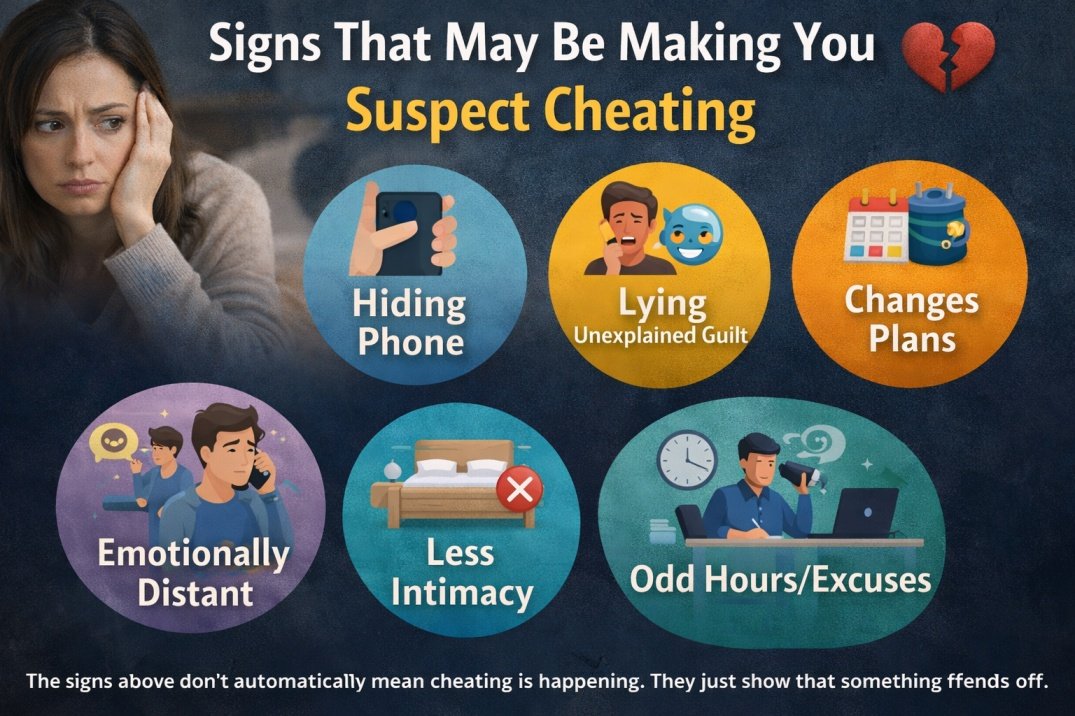
Avoidance of Sexual Intimacy
You may notice a clear shift in your physical connection. Intimacy becomes less frequent, feels forced, or is avoided with reasons like being tired, stressed, or not in the mood, more often than before.
There may also be a change in how they respond to closeness, less initiation, less engagement, or pulling away when you try to connect.
In some cases, the change can go the other way, sudden differences in behaviour that feel unfamiliar or disconnected from your usual dynamic.
Fluctuations in intimacy can happen in any relationship. But if the change is consistent, unexplained, and feels emotionally distant, it’s something worth paying attention to.
Sudden Mention of a New or “Safe” Person
You may notice your partner starting to mention a particular person more often, someone from work, a friend, or someone they’ve recently connected with. It’s usually introduced in a very casual, safe way, like “just a colleague” or “just a friend.”
Over time, this person comes up more frequently. There are mentions of meeting them, talking to them, or going out with them, sometimes in ways that weren’t part of their routine before.
When you ask, it’s explained simply and without detail, so it sounds normal on the surface.
On its own, this can be harmless. But if one person suddenly becomes a consistent part of their time, attention, and communication, especially along with other changes, it’s something to pay attention to.
Is Something Really Wrong Or Are You Overthinking It?
A few unusual behaviours do not mean your partner is cheating.
What matters is how often it’s happening and how different it feels from who your partner normally is. You know their routine, their habits, and how they usually communicate. If things start to feel out of character, that’s when it stands out.
For example, if they used to share details openly but now start brushing things off with “it’s just work,” “just friends,” or give very general answers, that shift matters more than the excuse itself.
At the same time, many changes can come from stress, work pressure, burnout, or personal phases, not necessarily cheating.
The key is to ask yourself:
- is this occasional, or happening frequently?
- does this match who they usually are, or feel out of character?
- are you getting clarity, or being left more confused?
You’re not trying to prove cheating. You’re trying to understand whether the pattern you’re seeing actually makes sense.
It’s Time to Reflect on Your Psychological State Too
Before you move to conclusions, take a step back and look at your own mental state.
Sometimes what you’re feeling is not just about your partner. Past experiences, like betrayal or trust issues, can make you more alert to signs of something going wrong.
What you consume daily also matters. Social media, reels, and shows often make cheating look very common. Normal situations like going out or meeting someone are shown as leading to affairs, which can affect how you interpret your partner’s behaviour.
In reality, cheating is not as common as it appears online.
Also, there’s a difference between anxiety and observation. Anxiety creates doubt without clear patterns. Observation is based on repeated behaviour that doesn’t add up.
Ask yourself:
- am I reacting to the present, or influenced by past experiences or what I’ve been seeing online?
- do I have clear patterns, or mostly thoughts?
This helps you respond with clarity, not fear.
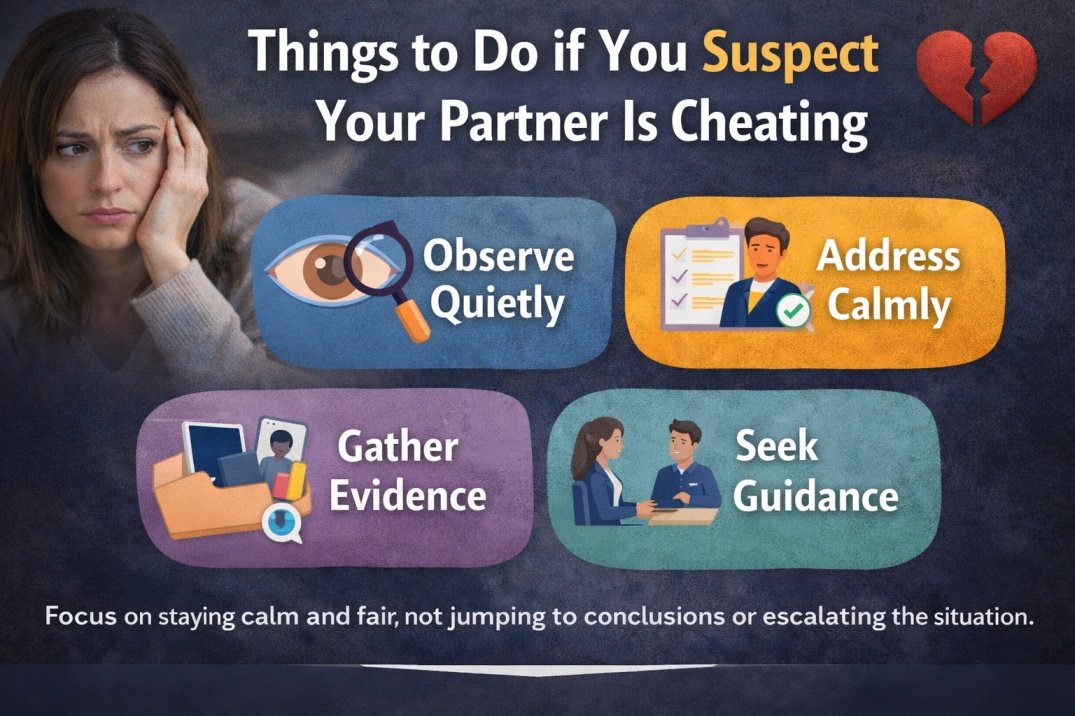
Things to Do if You Suspect Your Partner Is Cheating
Consider Speaking to a Professional
If your thoughts are constantly looping and you’re not able to think clearly, getting a neutral perspective helps. A therapist won’t tell you your partner is cheating, they help you separate what you’re actually observing from what you’re assuming. This prevents you from reacting emotionally and making the situation worse.
Calm Yourself Before Reacting
If you act while anxious or angry, the conversation will go wrong. You’ll either accuse, over-explain, or lose control of the situation. Take time to settle your thoughts first. The goal is not to confront, it’s to understand what’s happening.
Get Clear on What You’ve Actually Observed
Don’t go into this with “I feel something is wrong.” That leads nowhere.
Be clear:
- what exactly changed?
- how often is it happening?
- what doesn’t add up?
If you can’t explain it clearly, you’re not ready to address it yet.
Don’t Let Overthinking or Online Content Drive Your Thoughts
If you keep consuming cheating stories, reels, or advice online, your mind will start connecting everything to cheating. You’ll begin to see patterns that may not exist.
Stay focused on your actual situation, not what you’ve seen online.
Stick to Facts, Not Accusations
Avoid statements like:
- “You’re cheating”
- “I know something is going on”
Instead, say what you’ve noticed:
- “You’ve been coming home late frequently”
- “You’ve been more private with your phone”
Facts keep the conversation grounded. Accusations make the other person defensive.
Have One Honest and Calm Conversation
Don’t bring it up repeatedly or in frustration. Have one clear conversation.
Keep it simple and direct:
- say what you’ve noticed
- say how it’s affecting you
- ask for clarity
Don’t interrogate. Don’t jump between points. Stay focused.
Pay Attention to What Happens Next
The real clarity comes after the conversation.
Watch:
- do their actions match what they said?
- does anything actually change?
- do things become more open or stay the same?
Words can be controlled. Patterns over time are harder to fake.
How to Understand Their Response
What your partner says in the moment matters less than what happens after. Anyone can explain things once. What matters is whether their words and behaviour stay consistent over time.
If things are clear, you’ll notice it. They answer directly, don’t avoid simple questions, and their actions match what they’ve said. Even if you don’t like everything, it makes sense and doesn’t keep changing.
If something is being avoided, it shows up differently. You may get irritation instead of answers, vague explanations instead of clarity, or the conversation gets turned back on you. The focus shifts from your question to your reaction.
Sometimes, everything sounds fine in words, but nothing actually changes. The same patterns continue, the same confusion remains. This is where you need to pay attention. Behaviour matters more than explanations.
You may also notice your concerns being dismissed with things like “you’re overthinking” or “it’s all in your head.” If this keeps happening without real clarity, it only increases doubt.
Don’t try to analyse every word. Focus on what stays consistent over time.
Do things become clearer or more confusing?
Does behaviour improve or stay the same?
Do you feel more at ease or more uncertain?
One conversation won’t give you the answer.
Consistent behaviour over time will.
You May Not Get Proof
You may never get clear proof of cheating.
Most people don’t catch anything directly. There is no message, no incident, no clear moment that confirms it. If you keep waiting for that, you can stay stuck for months or even years.
Instead of waiting for proof, look at what is happening repeatedly.
- Are the same behaviours continuing?
- Are your questions still not getting clear answers?
- Is the situation improving or staying the same?
Your decision should come from what you consistently experience, not from one piece of evidence.
When to Seek Help
You should consider help when:
- you’re thinking about this constantly
- you keep checking or questioning but feel unsure
- conversations don’t give clear answers
- the same patterns continue
Trying to handle it alone often increases confusion.
If you need clarity, online marriage counselling at LeapHope can help you understand what’s happening and decide your next steps calmly.
The Bottom Line
You don’t need proof to see that something has changed in your partner’s behaviour.
Repeated patterns matter more than one incident or one explanation. If the same things keep happening and don’t make sense over time, you should take that seriously.
At the same time, don’t label it as cheating too quickly. Many changes have normal reasons, whether it’s a man or a woman, and reacting early can make things worse.
Your goal is not to catch your partner cheating.
Your goal is to understand what is actually happening and decide what to do with clarity.