
Last Updated on October 28, 2026
Clinically reviewed by Aradhana Gambhir, Senior Child Psychologist.
When your child studies but struggles in the exam, it can be difficult to know what they need. Should they revise differently? Are they frightened of making mistakes? Why can they explain an answer at home but struggle to write it on the paper?
More revision will not address every difficulty. Understanding where your child gets stuck helps you choose the right support.
How to Recognise Exam Anxiety in Your Child
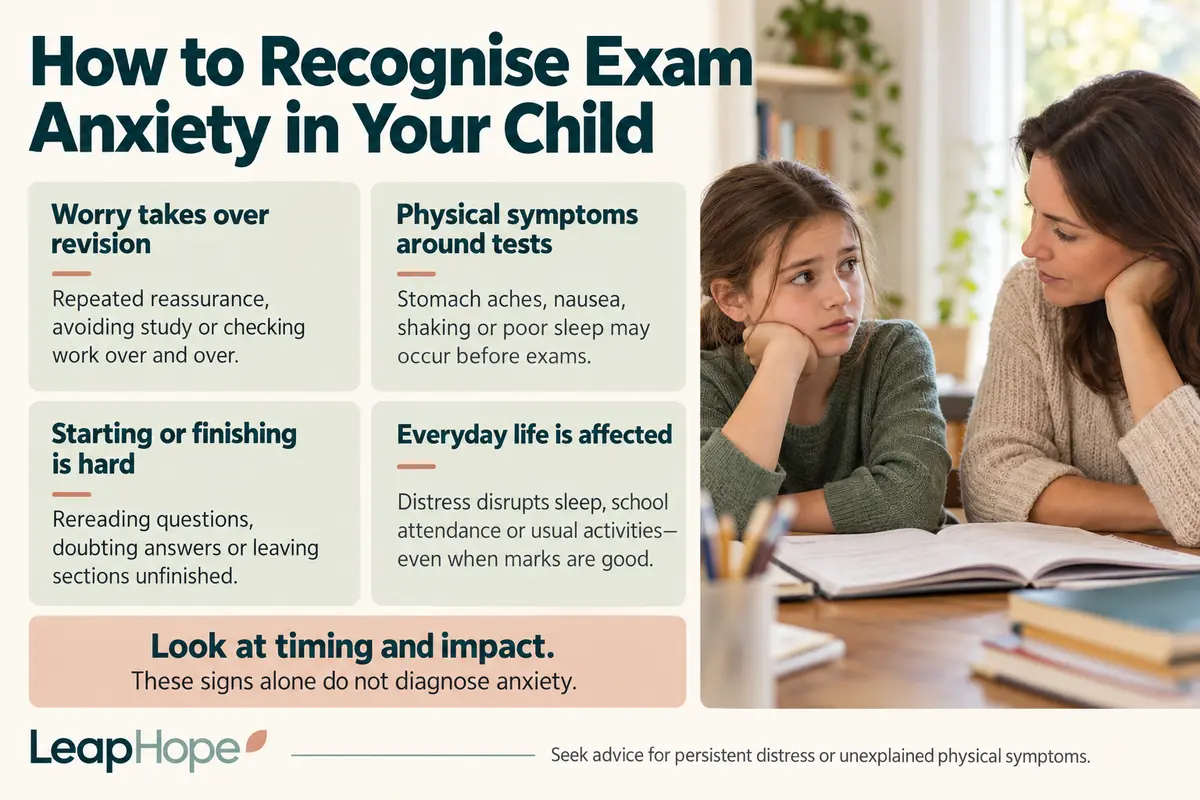
Exam anxiety, also called test anxiety, involves worry about taking a test or how the result will be judged. Look at how much it interferes with your child’s preparation, performance and everyday life.
Worry Takes Over Their Revision
Your child may repeatedly seek reassurance about passing, become very upset over mistakes or struggle to stop checking what they have learned.
Avoidance can also be a sign. Some children delay opening their books because studying brings up worries about what they cannot do. Others spend long periods revising but find it difficult to concentrate on the material.
Notice whether these changes build around assessments or are present throughout the school term.
Physical Symptoms Appear Around Tests
Stomach aches, nausea, headaches, a racing heart, sweating or shaking can accompany anxiety. Your child might struggle to sleep before an exam or feel unable to eat breakfast.
The timing matters, but physical symptoms alone cannot establish the cause. Tell your child’s doctor about recurrent or unexplained symptoms, including those that occur outside exam periods.
They Struggle to Begin or Finish the Paper
Your child might describe reading the same question repeatedly, forgetting information or doubting an answer they initially felt sure about.
Their paper may show long unanswered sections, unfinished responses or considerable time spent on one question. A low score tells you less than understanding how they used the time.
The Distress Matters Even When Their Marks Are Good
Some children achieve high scores while experiencing considerable fear beforehand. Others avoid school, lose sleep or become unusually withdrawn around tests.
Ordinary nerves can coexist with completing the task. Concern increases when distress is intense, repeatedly disrupts preparation or makes participating in assessments difficult. You do not need to wait for your child to fail before taking it seriously.
Why Does Your Child Know the Answers at Home but Go Blank in Exams?
Look closely at how your child answers at home and what becomes difficult in the exam. Several factors can contribute, and they can occur together.
Their Attention Keeps Returning to What Could Go Wrong
Some children describe thinking about failing, running out of time or disappointing someone while trying to answer a question. Others become preoccupied with physical sensations such as a pounding heart.
They can lose their place in an explanation, repeatedly restart or struggle to decide what to do next. Ask whether this happens immediately, after an unfamiliar question or as the end of the exam approaches. That detail helps identify what to practise.
Fear about the test itself may also differ from fear about telling you their marks afterwards.
Familiar Material Is Harder to Recall Without Help
Reading notes can make information feel familiar. Producing an answer with the book closed requires recall.
At home, hints, a parent’s questions or seeing part of the answer can help a child continue. Those supports are usually unavailable during an exam.
Check understanding through a few manageable questions rather than judging preparation by hours spent studying. Can your child explain an idea in their own words and use it in a question they have not seen before?
The Test Requires Skills They Find Difficult
Your child may understand a topic but struggle to interpret unfamiliar wording, organise a written response or complete several steps within the time available.
Compare ordinary work with exam work. Can they explain an answer aloud but struggle to write it? Do they answer accurately without a time limit but leave timed papers incomplete? Are difficulties concentrated in one subject?
Persistent problems with reading, writing or concentration deserve attention alongside anxiety. These observations are useful to discuss with the teacher; they do not establish a diagnosis.
Remembering answers after the exam is another detail worth sharing. It should be considered with the rest of your child’s experience.
How to Help Your Child With Exam Anxiety
Find Out What They Are Afraid Will Happen
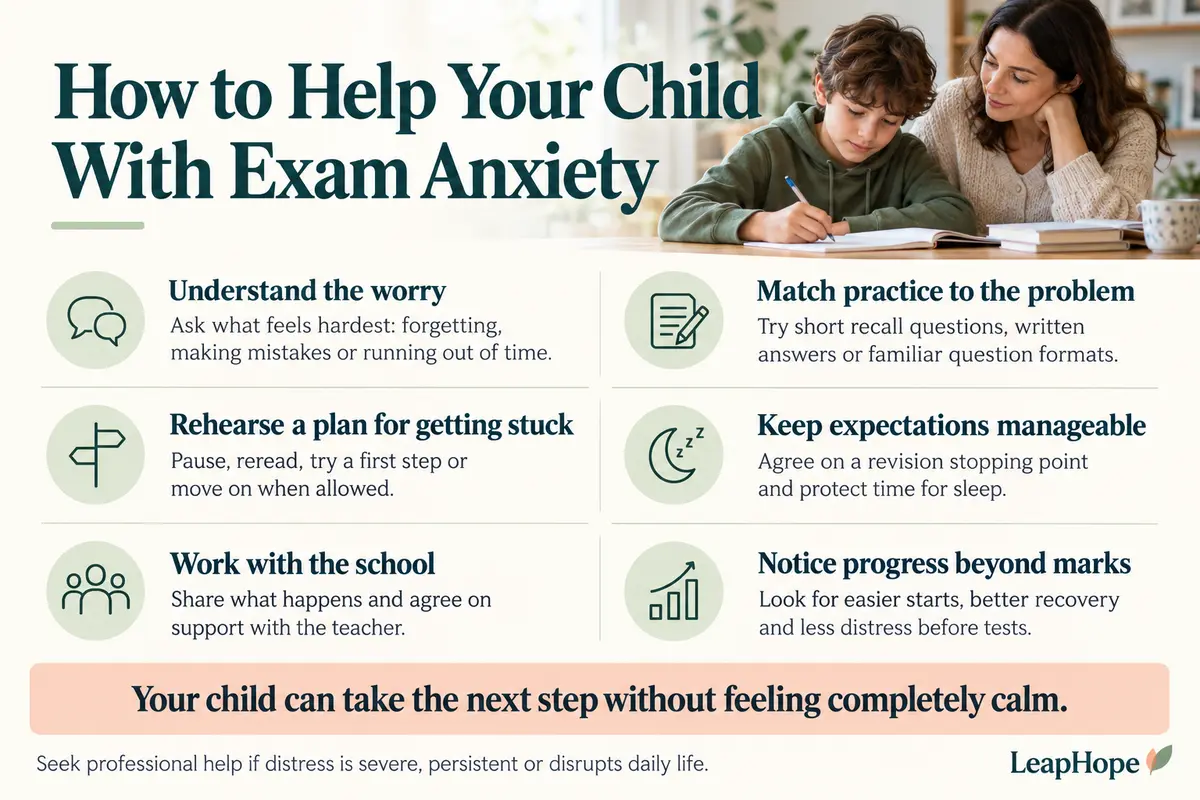
Ask about the worry rather than repeatedly assuring them that they will do well.
They might fear forgetting everything, being the last to finish or making a mistake that lowers their score. A child who struggles with perfectionism may find unanswered questions especially upsetting.
Listen to their explanation before deciding what they need. Reassurance about passing will have limited relevance if their main difficulty is understanding instructions or writing quickly enough.
Practise the Skill They Need
Match practice to the problem you have identified.
If recall is difficult, use short questions with the book closed, then check the answers together. If written explanations are the problem, ask the teacher how to help your child organise a response. If unfamiliar formats cause distress, introduce examples of the question types they will encounter.
Begin with manageable work and give useful feedback. Move towards more demanding conditions gradually, including timing where appropriate. Repeatedly setting difficult papers and focusing on the score can turn practice into another source of worry.
Agree on a stopping point for revision before exam day. Leave time for sleep rather than trying to cover every remaining gap late into the night.
Rehearse What to Do When They Get Stuck
Make a brief plan with your child and, where needed, their teacher. Depending on the assessment rules, it could include:
- Pause briefly and use a calming action they have practised, such as comfortable, slow breathing.
- Read the instruction again and identify what the question asks.
- Write a relevant first step or begin with a question they can attempt.
- Move on when permitted and return to the difficult question later.
- Tell the supervising adult if distress makes continuing difficult.
Practise using the plan during ordinary schoolwork. Being told to “calm down” in the moment gives a child little guidance about how to continue.
They do not need to eliminate every nervous feeling before attempting an answer.
Keep Your Expectations Clear
Tell your child what you expect them to do: prepare regularly, attempt the work honestly and ask for help when needed.
Avoid promises that they will get a particular score or repeated predictions about how important the result will be. If academic pressure is affecting family conversations throughout the year, that needs attention beyond the next exam.
On the morning of the test, keep reminders brief. Your child already has a task to manage.
Agree on Support With the School
Share the difficulty you have noticed and ask what the teacher sees during assessments.
Useful details include trouble starting, repeated reassurance-seeking, distress in one subject or a consistent difference between classwork and test performance.
Discuss what can be tried: clearer preparation for the format, help with instructions, test-taking strategies or assessment adjustments where appropriate. Changes to examination conditions depend on the child’s needs and the school or examination board’s requirements.
Agree on how you will review whether the support is helping.
Look for Progress Beyond the Score
After the exam, give your child time before discussing the paper. Ask what helped and where they became stuck.
Progress might include beginning more readily, returning to a question after a difficult moment, completing more of the paper or experiencing less disruption beforehand. Discuss these changes alongside marks.
Choose one useful adjustment for the next test. Replaying every mistake rarely produces a clearer plan.
When to Seek Professional Help
Speak with your child’s paediatrician or a qualified mental health professional when distress is severe, persists or affects sleep, eating, attendance or everyday activities. A single severe episode can also warrant help.
Further assessment may be useful when academic difficulties continue despite appropriate teaching and preparation, particularly when they also occur outside exams.
A child psychologist can explore the fears involved, help your child practise responding to anxious thoughts and build confidence through manageable assessment tasks. Cognitive behavioural approaches have evidence for reducing test anxiety, particularly in adolescents. Treatment should suit the child’s age and difficulties and may involve parents and school staff.
For online support with school stress and exam anxiety, explore LeapHope’s child counselling options in India, the UK, USA, Canada, UAE and Australia. Choose a professional experienced with your child’s age and concern, and check whether they can provide care where your child lives.
Let’s Recap
Find out where the exam becomes difficult, match practice to that difficulty and agree on a plan for getting stuck. Seek help when distress or learning difficulties continue despite support.
Clinical resources
- Test anxiety in primary school children: A 20-year systematic review and meta-analysis — Journal of School Psychology
- Test anxiety effects, predictors, and correlates: A 30-year meta-analytic review — Journal of Affective Disorders
- Do Practice Tests (Quizzes) Reduce or Provoke Test Anxiety? A Meta-Analytic Review — Educational Psychology Review
- Cognitive-behavioral intervention for test anxiety in adolescent students — Anxiety, Stress & Coping