

Last Updated on October 28, 2026
Clinically reviewed by Aradhana Gambhir, Senior Child Psychologist.
When your child hides their marks, you want to understand why they did not tell you the truth. You may be upset about the dishonesty and concerned about what is happening at school.
It can be especially confusing if you rarely scold them about results. Finding out what they were avoiding will help you decide what to do next.
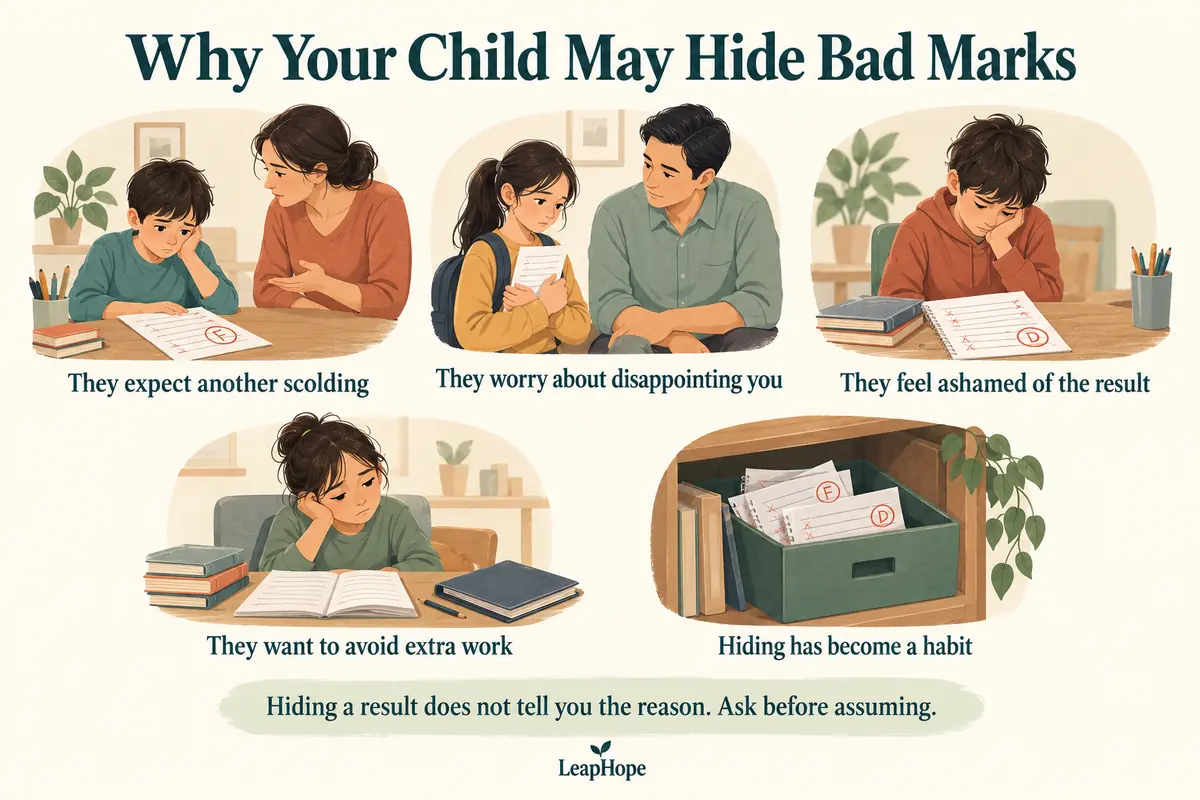
Why Your Child May Hide Bad Marks
Your child could be worried about your reaction, disappointed in themselves or reluctant to admit they did not prepare. Children can hide results even when their parents are understanding.
They Remember Earlier Scolding or Punishment
If poor results have repeatedly led to shouting, threats, insults or punishment, your child may expect the same response again. Becoming calmer recently does not necessarily change that expectation straight away.
The worry may concern one parent more than the other. Notice whether your child tells you their marks but asks you not to tell their mother or father.
Think about what happens after the first conversation, too. Bringing up a low score during later arguments, comparing them with siblings or discussing their marks with relatives can make the next result harder to share.
They Fear Disappointing You, Even When You Are Supportive
Your child may know that you believe they are doing well and feel uncomfortable correcting that impression.
Some children want to remain the academically successful child in the family. Others worry that a poor score means they have wasted their parents’ money or effort.
Check whether your child understands what you expect. Academic pressure can still be felt when they understand “do your best” to mean “always get a high score.”
For some, the fear is that doing badly will make them less loved or valued. Notice whether your warmth towards your child changes after disappointing results.
They Feel Ashamed of Their Own Performance
Some children set very high standards for themselves. A score you consider acceptable might feel deeply disappointing to your child, particularly if they usually perform well.
Others feel embarrassed because they cannot understand work their classmates seem to manage. Showing you the result would mean admitting that they are struggling.
Ask what happens at school when someone gets a low mark or gives a wrong answer. Does your child feel comfortable asking for help? Have classmates commented on their results? Their answers can help you identify concerns to discuss with the school.
They Want to Avoid Questions, Extra Work or Consequences
Your child may have skipped revision, left homework unfinished or ignored an agreed routine. Revealing the result could mean admitting those choices and facing extra practice, closer supervision or restrictions on activities they enjoy.
This possibility deserves attention alongside fear and embarrassment. A child can avoid studying and still be worried about your reaction afterwards.
Hiding Has Become Their Usual Response to Poor Results
If keeping a result secret has helped your child postpone an uncomfortable discussion before, they may try it again.
Are they hiding only marks, or lying about other things too? Delaying one result is different from repeatedly inventing scores, altering reports or misleading people in several situations.
Hiding marks needs attention, but it is not enough to conclude that your child is dishonest by nature. If the pattern extends beyond school results, our article on why children lie explains other reasons to consider.
Why Your Child May Keep Hiding Results Without Improving Their Marks
You may wonder why your child does not put more effort into getting better marks.
Hiding can put off a conversation immediately. Improving a score takes preparation, understanding and practice. A child who wants a better result may still be unsure how to achieve it.
Find out where the difficulty occurs:
- Preparation: Are assignments completed? Is revision regular enough to cover the material?
- Understanding: Can your child explain what they have studied and answer questions independently?
- During the exam: Do they struggle to recall information, understand instructions, manage time or finish?
- Across schoolwork: Are reading, writing, concentration or organisation causing persistent problems?
The answers help you decide whether your child needs a more consistent routine, additional teaching or further assessment. Time spent sitting with books does not tell you how well they understand the work.
What to Do When Your Child Hides Bad Marks

Check What Happened Before Making Accusations
Confirm the score, when the result became available and what your child told you.
A missing paper could have been misplaced. Delaying a conversation, reporting a false score and altering a school document are different actions. Be clear about what happened.
If you already know the facts, state them directly and give your child an opportunity to explain. Avoid repeatedly questioning them to catch another lie.
Ask What They Were Worried About
You can ask: “What were you worried I would do or say when I saw the result?”
Listen before explaining your intentions. If their answer surprises you, ask what happened previously that made them expect that response.
They might describe an earlier argument, the other parent’s reaction or a consequence you had not realised mattered to them.
Discuss the Dishonesty and the Schoolwork Separately
Explain what needs putting right. A false score needs correcting. An altered report may require contact with the school. Missed assignments need a completion plan.
Choose a reasonable consequence related to what happened. If your child repeatedly claims unfinished homework is complete, agree to check it together for a period.
Thank them when they correct their account, while following through on what still needs doing. Describe the action you are concerned about: “You told me the assignment was finished when it wasn’t.” Avoid labelling them a liar or lazy.
Acknowledge Past Reactions and Change How You Respond
If you have shouted, insulted or threatened your child over marks, acknowledge what you did. Avoid adding that they made you react that way.
Explain how you will handle future results. Then show them you can stay calm when another disappointing score arrives.
Where both parents are involved, agree on the response and discuss disagreements privately. Your child should not have to manage conflict between you.
If sharing a result could expose your child to violence or serious threats, seek prompt help to protect them before arranging a joint discussion.
Agree on How Results Will Be Shared and What Help Is Needed
Decide when your child will show you results and when you will discuss them. If you use a school portal, be open about checking it.
Speak with the teacher about any difficulty you have identified. Ask what they notice in class, what support has been tried and what improvement would look like.
Choose one problem to work on first. That could mean completing missed assignments, getting a topic explained or practising timed questions. Agree on who will help and when you will check progress.
When to Seek Professional Help
A teacher is a useful starting point for difficulties with a particular subject or classroom experience.
Speak with your child’s paediatrician if schoolwork remains difficult despite support, especially when attention, sleep, physical health or development may be involved. They can help decide whether further assessment is needed.
Consider a child psychologist when stress about school results repeatedly affects sleep, school attendance or mood, or when arguments at home continue despite changes. Serious, repeated lying across several areas of life also deserves assessment.
If you are considering online support, LeapHope has information for families in India, the UK, USA, Canada, UAE and Australia. Check the professional’s experience with your child’s age and concern, and whether they can provide care where your child lives.
Let’s Recap
Find out why your child hid the result, correct any false information and agree on what needs to happen next. Follow up before the next exam so the conversation leads to practical changes.
Clinical resources
- Open up or close down: How do parental reactions affect youth information management? — Journal of Adolescence
- Parental conditional regard: A meta-analysis — Journal of Adolescence
- Motivational dynamics of children’s academic help-seeking and concealment — Journal of Educational Psychology
- Parental support and adolescents’ coping with academic stressors: A longitudinal study of parents’ influence beyond academic pressure and achievement — Journal of Youth and Adolescence