
Last Updated on October 22, 2026
Clinically Reviewed by Mohit Yadav, RCI-Registered Clinical Psychologist (CRR A100623)
Have you noticed your child checking things repeatedly, asking the same question even after getting an answer, or becoming unusually upset when a routine changes? Perhaps they have started washing their hands more often, avoiding certain objects, or insisting that things must be done in a particular order.
These behaviours can leave parents wondering whether their child has OCD. But children also develop habits, fears and routines as they grow, and not every repetitive behaviour indicates a mental health condition.
This guide explains the early signs of OCD in children, how they differ from ordinary childhood habits, what research tells us about possible causes, and when a professional assessment may be useful.
What Is OCD in Children?
Obsessive-compulsive disorder (OCD) is a mental health condition involving obsessions, compulsions, or both.
- Obsessions are recurring, unwanted thoughts, images or urges that cause anxiety or distress.
- Compulsions are repetitive behaviours or mental acts a child feels driven to perform, often to relieve distress or prevent something feared from happening.
According to the CDC, OCD can become a significant concern when these experiences are frequent, distressing, time-consuming or interfere with everyday life.
Completing a compulsion may briefly ease the discomfort, but the urge often returns.
Early Signs and Symptoms of OCD in Children
Childhood OCD does not always look like excessive cleaning. Some symptoms are visible, while others involve thoughts or mental rituals that parents may never notice.
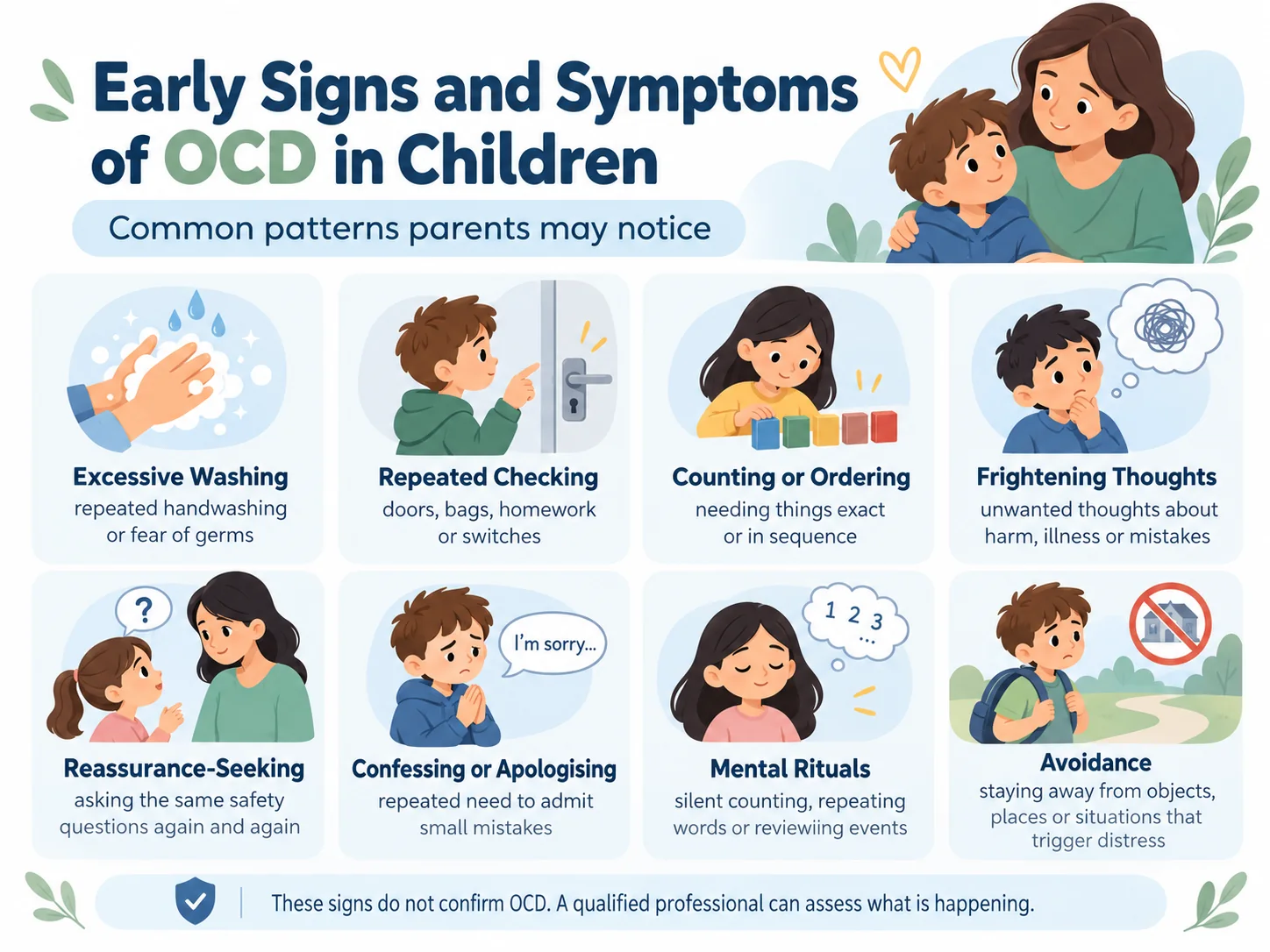
The following are recognised obsessive-compulsive symptom patterns, although their presence alone does not establish a diagnosis.
1. Fear of Germs and Excessive Washing
A child may repeatedly wash their hands, avoid touching everyday objects or become preoccupied with contamination and illness.
2. Repeated Checking
Checking doors, switches, schoolbags or homework several times, even after confirming that everything is in order.
3. Counting, Ordering and Repeating
Arranging objects until they look exactly right, counting in particular sequences or restarting actions because something feels incomplete.
4. Unwanted or Frightening Thoughts
Recurring thoughts about accidents, illness, harm, religion or doing something wrong. These thoughts may be upsetting enough that a child avoids discussing them.
Unwanted intrusive thoughts are not automatically intentions, although any genuine concern about a child’s safety requires appropriate professional evaluation.
5. Constant Reassurance-Seeking
Repeatedly asking whether something bad will happen, whether they made a mistake or whether a parent is safe.
While reassurance-seeking is also seen in other childhood worries, it may become a compulsion when the child repeatedly needs certainty to relieve obsessive doubt.
6. Repeated Confessing or Apologising
Feeling compelled to disclose minor mistakes, apologise repeatedly or ask whether they have done something morally wrong.
7. Hidden Mental Rituals
Silently counting, repeating words, mentally reviewing past events or performing other internal rituals to neutralise unwanted thoughts.
8. Avoiding Particular Situations
Avoiding objects, places or activities associated with intrusive fears or the urge to perform compulsions.
These examples are based on symptom dimensions described in clinical OCD literature, including the International OCD Foundation’s paediatric resources and the Indian Psychiatric Society’s clinical guidelines.
Normal Childhood Habits vs OCD: What’s the Difference?
Repetition is common in childhood. The more useful distinction is whether the behaviour remains flexible or becomes driven by distress and difficult-to-resist urges.
| What parents notice | Ordinary childhood habit | More concerning OCD-like pattern |
|---|---|---|
| Repeating activities | Enjoys the familiarity | Feels compelled to repeat |
| Changing a routine | Usually able to adjust | May experience marked distress |
| Reason for behaviour | Preference, comfort or play | Attempts to relieve fear, doubt or discomfort |
| Time involved | Fits into daily routines | Takes increasing amounts of time |
| Everyday functioning | Little interference | Disrupts sleep, school or other activities |
For example, wanting the same bedtime story is a common childhood preference. Insisting on repeating it numerous times because of a distressing belief that something bad will happen otherwise presents a different concern.
A clinician considers the behaviour alongside developmental expectations and the child’s overall functioning, rather than using one habit to determine whether OCD is present.
What Does OCD Look Like at Different Ages?
Clinical presentations can vary with a child’s development, particularly their ability to recognise and describe unwanted thoughts.
Preschool Children (Approximately 3–6 Years)
Younger children may show repetitive actions or strict rituals without being able to explain why they feel necessary. Since routines and ritualised play are also common at this age, developmental context is particularly important.
School-Age Children (Approximately 7–12 Years)
Checking, contamination concerns, repeating actions and obsessive doubts may become easier to recognise. Some children spend considerable time on homework or ordinary routines because of compulsions.
Adolescents (Approximately 13–17 Years)
Teenagers may describe more complex intrusive thoughts or carry out mental rituals privately. Shame or embarrassment can also lead them to conceal symptoms.
These are broad patterns rather than fixed age-specific symptoms. OCD can begin at different ages and does not follow an identical developmental course in every child.
What Causes OCD in Children?
No single cause explains childhood OCD. Research points towards several possible contributing influences:
- Genetics: Having biological relatives with OCD is associated with increased vulnerability.
- Brain processes: Research implicates circuits involved in habit learning, behavioural control and responses to uncertainty.
- Developmental and environmental factors: Individual experiences and stress may influence when symptoms appear or how severely they are experienced.
- Co-occurring conditions: Anxiety disorders and tic-related conditions are more common among children with OCD and can complicate its presentation.
These are research findings, not a formula for determining why a particular child develops OCD. Parenting style alone is not an established cause.
OCD vs Anxiety, Autism and ADHD in Children
Certain behaviours can appear in more than one condition, making the underlying reason for them important.
| Comparison | What clinicians consider |
|---|---|
| OCD and anxiety | Whether recurring fears involve compulsive responses, rather than worry or avoidance alone |
| OCD and autism | The child’s developmental history, sensory experiences, repetitive behaviours and associated distress |
| OCD and ADHD | Whether difficulties completing tasks are linked to obsessive checking or attention and executive-function difficulties |
| OCD and tic disorders | Whether repeated movements are associated with compulsive fears, sensory urges or both |
These conditions can coexist. Clinical assessment looks at the full pattern rather than relying on a single symptom to distinguish them.
How Does OCD Affect a Child’s Daily Life?
When symptoms become more persistent, their effects may extend into ordinary activities.
- Bedtime: Repeated checking, arranging or other rituals may delay sleep.
- School: Excessive rewriting, repeated checking or compulsive routines may interfere with assignments. These difficulties can sometimes resemble perfectionism.
- Home: Parents may become involved in rituals, repeated questions or avoiding particular situations.
- Daily activities: Distressing thoughts and compulsions can make previously manageable activities difficult.
Clinicians consider these effects when evaluating symptom severity and deciding whether intervention is needed.
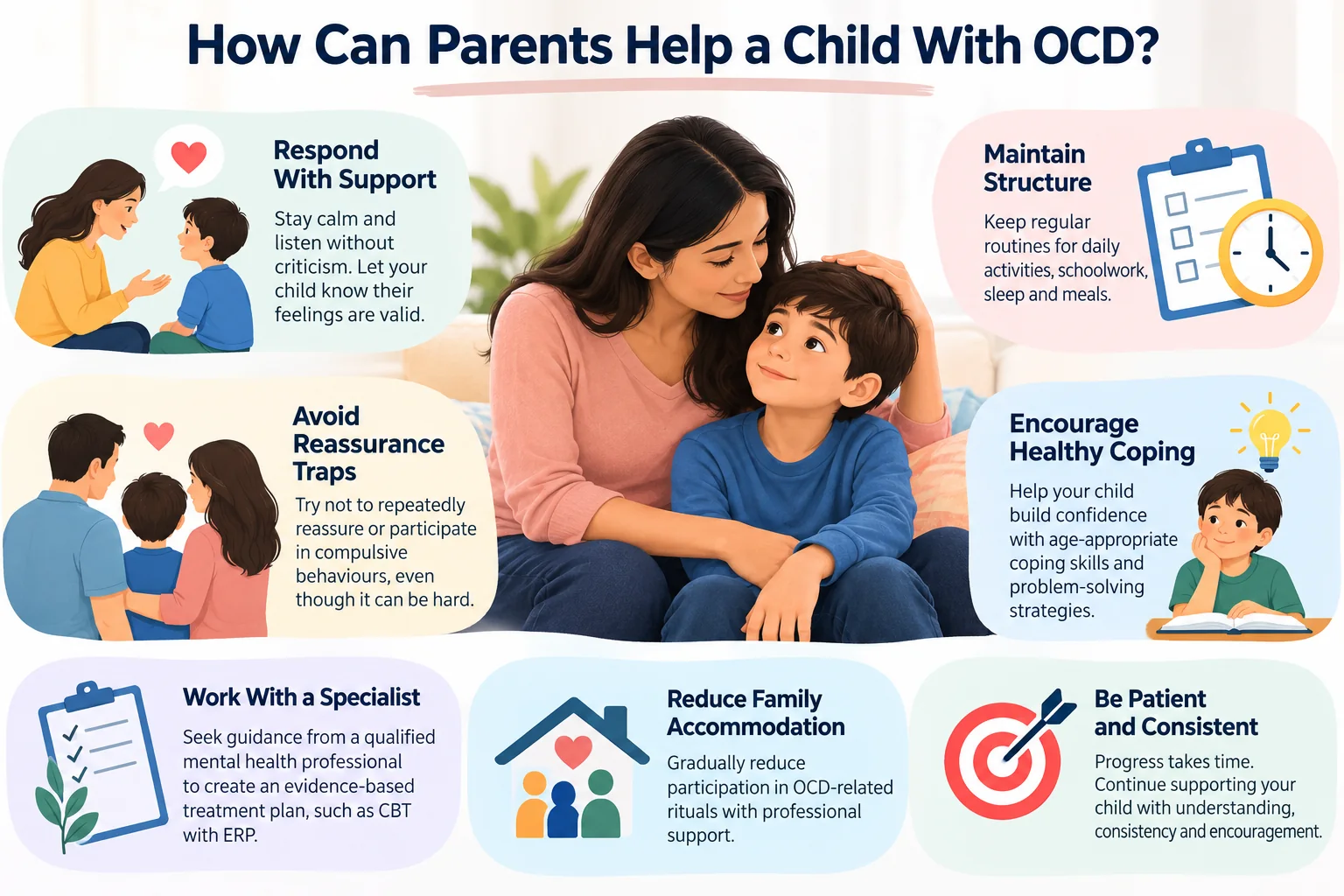
How Can Parents Help a Child With OCD?
Research on paediatric OCD supports family involvement, particularly when children rely on parents to complete compulsions or relieve obsessive fears.
Respond Without Criticism
Children may find compulsions difficult to resist, even when they recognise that a ritual is unnecessary. Punishment, ridicule or repeated arguments do not address the obsessive-compulsive process.
Recognise Family Accommodation
Family accommodation occurs when relatives participate in rituals, repeatedly provide OCD-driven reassurance or change routines to prevent distress.
Although usually well-intentioned, these responses can maintain symptoms. Evidence-based family interventions help parents change accommodation patterns gradually and supportively.
Avoid Forcing a Child to Stop Rituals
Abruptly preventing compulsions or attempting exposure exercises without professional guidance can create considerable distress.
In structured OCD treatment, reducing compulsions is planned according to the child’s age, symptoms and capacity to participate.
Participate in the Treatment Plan
When a child is receiving OCD-specific CBT, caregivers may learn how to respond consistently, support planned exercises and reduce behaviours that reinforce the disorder.
The International OCD Foundation provides additional guidance on family involvement in childhood OCD treatment.
When Should Parents Seek Professional Help?
Consider an evaluation if obsessive fears or compulsive behaviours:
- Cause significant distress or become difficult to resist.
- Consume substantial time or progressively increase.
- Affect schoolwork, sleep, eating or everyday routines.
- Lead to persistent avoidance or dependence on family participation.
Parents who are uncertain about their child’s behaviour can discuss their concerns with LeapHope’s child psychologists to understand whether further assessment is warranted.
An initial consultation may identify a developmental pattern, another psychological concern or the need for specialist OCD evaluation. Sudden, dramatic behavioural changes, particularly with additional medical symptoms, warrant prompt medical attention.
How Is OCD Diagnosed in Children?
OCD is diagnosed through clinical evaluation by an appropriately qualified professional.
The assessment considers:
- The nature and severity of obsessions and compulsions.
- Time spent on rituals and their effect on daily functioning.
- Developmental, medical and family history.
- Other mental health or developmental conditions that may explain or accompany the symptoms.
The Children’s Yale-Brown Obsessive Compulsive Scale (CY-BOCS) is one established clinician-rated tool for measuring symptom severity. It supports clinical evaluation but does not independently confirm OCD.
A formal psychological assessment may be appropriate when symptoms require further investigation. In India, clinical psychological assessment should be conducted by an appropriately qualified and registered Clinical Psychologist working within their scope.
How Is OCD Treated in Children?
Treatment recommendations depend on symptom severity, age and clinical needs.
Cognitive Behavioural Therapy With ERP
Cognitive behavioural therapy (CBT) with exposure and response prevention (ERP) is a first-line psychological treatment for childhood OCD.
ERP involves carefully planned, gradual exposure to situations that trigger obsessive distress while helping the child resist compulsive responses. It should be delivered by a clinician trained in paediatric OCD treatment.
Family-Based CBT
For younger children especially, parents may be actively involved in treatment. This can include learning how to reduce accommodation and support the child’s work between sessions.
Medication
Selective serotonin reuptake inhibitors (SSRIs) may be considered for moderate-to-severe OCD or when psychological treatment alone is insufficient. Decisions about medication require assessment, prescribing and monitoring by a qualified medical professional.
Online Treatment
Research supports remote delivery of ERP for some children and adolescents, provided treatment is appropriately structured and delivered by a suitably trained professional.
Can OCD in Children Go Away?
Many children improve substantially with appropriate treatment, although the course of OCD varies.
Some experience lasting symptom reduction, while others have periods when symptoms return or change. Continued use of treatment skills and specialist review when needed can help maintain improvements.
The aim is not simply to eliminate visible rituals, but to reduce obsessive distress and help the child function comfortably in everyday life.
Frequently Asked Questions About OCD in Children
What are the earliest signs of OCD in a child?
Early signs may include unusual checking, repetitive washing, counting, reassurance-seeking or distressing intrusive thoughts. A professional considers their persistence, severity and impact before determining whether they reflect OCD.
Can a 5-year-old have OCD?
Yes. OCD can occur in very young children, although ordinary developmental rituals are also common. Specialist assessment is important when concerns arise at this age.
Can a child have OCD without visible compulsions?
Yes. Some compulsions are mental, such as silently counting, repeating phrases or reviewing events. They may not be apparent to parents.
Does every child with OCD need medication?
No. CBT with ERP is an established first-line treatment. Medication may be recommended depending on symptom severity, clinical circumstances and response to psychological treatment.
Can OCD in children be cured?
Many children achieve substantial improvement, and some experience remission. Long-term outcomes vary, so no treatment can guarantee that symptoms will never return.
Final Recap
If your child is repeatedly checking, washing, seeking reassurance or following increasingly rigid rituals, pay attention to the distress and disruption surrounding those behaviours rather than assuming they indicate OCD.
An online article can explain recognised symptom patterns, but it cannot determine what is happening with an individual child. When concerns persist or affect daily life, a qualified assessment can help establish whether OCD or another explanation is involved.
Childhood OCD has well-established treatment options, and many children experience meaningful improvement with appropriate care.
Clinical References
- Centers for Disease Control and Prevention — Obsessive-Compulsive Disorder in Children
- NICE — Obsessive-Compulsive Disorder and Body Dysmorphic Disorder: Treatment (CG31)
- International OCD Foundation — Pediatric OCD Resources
- Indian Psychiatric Society — Clinical Practice Guidelines for OCD, 2025 Update