

Last Updated on September 5, 2026
Divorce is rarely caused by one argument or one difficult period. Usually, several problems have continued for months or years.
A partner may stop trying. Arguments may never get resolved. Trust may be broken by cheating, hidden debt or repeated lies. Eventually, one or both partners may no longer want to continue the marriage.
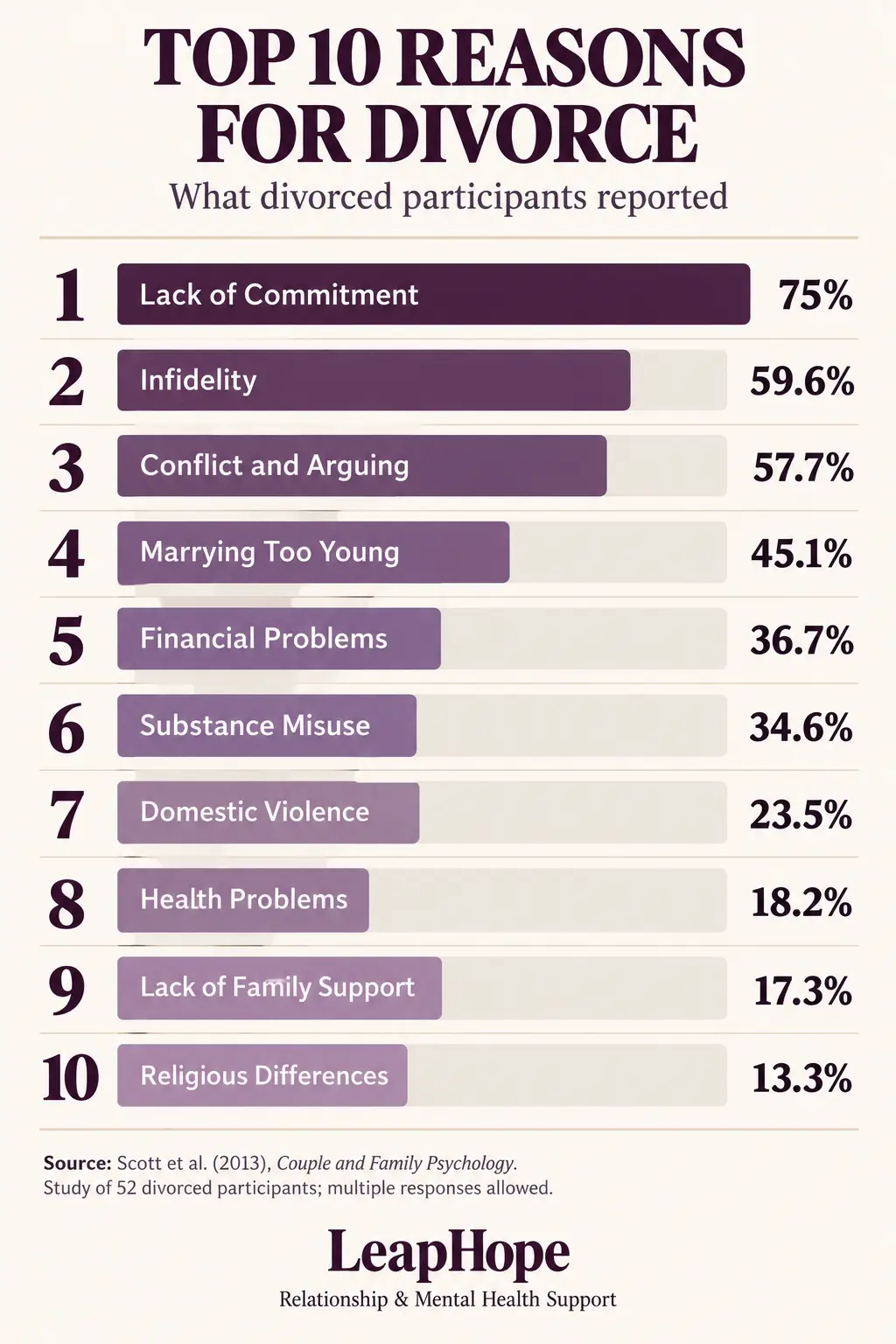
The percentages below come from a peer-reviewed US study of 52 divorced people. Participants could choose more than one reason, so the figures do not total 100%.
Top 10 Reasons for Divorce
1. Lack of Commitment — 75%
One partner stops putting effort into the marriage. They avoid serious conversations, dismiss concerns or promise to change without doing anything differently.
The other partner feels they are keeping the marriage alive alone. Relationship counselling may help establish whether both people still want to work on it.
2. Infidelity — 59.6%
Infidelity may be sexual, emotional or online. For many couples, the continued lying and hiding hurt as much as the affair.
Some marriages recover when the affair ends and the partner who cheated takes responsibility. Others end because the secrecy continues or trust cannot be restored.
Marriage counselling for infidelity can help both partners decide whether rebuilding trust is possible.
3. Too Much Conflict and Arguing — 57.7%
The same arguments happen again without any solution. Conversations turn into shouting, insults, blame, silent treatment or threats.
After some time, even small issues start another fight. The couple may stop talking about important matters because they already know how the conversation will end.
4. Marrying Too Young — 45.1%
People’s goals, beliefs and expectations can change as they grow older. A couple may later disagree about careers, money, children, religion or where they want to live.
Marrying young does not mean a marriage will fail. It was simply a factor reported by 45.1% of participants in this study.
5. Financial Problems — 36.7%
Financial problems include debt, unemployment, hidden spending, unequal control over money and arguments about supporting relatives.
Money problems often become trust problems. A secret loan, hidden account or repeated overspending can leave the other partner feeling deceived.
Couples dealing with this pattern can consider marriage counselling for money problems.
6. Substance Misuse — 34.6%
Alcohol or drug misuse can affect money, trust, parenting and safety. The partner may repeatedly promise to stop but return to the same behaviour.
Addiction usually needs its own treatment. Relationship support alone cannot treat substance dependence.
7. Domestic Violence — 23.5%
Domestic violence can include hitting, threats, forced sex, stalking, humiliation, isolation and control over money or movement.
This is not a normal marriage disagreement. If one partner is afraid to speak freely, couples therapy may not be safe. Individual support or emotional abuse counselling may be more appropriate.
8. Health Problems — 18.2%
Chronic illness, pain, disability, mental health concerns and sexual health problems can change daily married life.
The illness itself is not the reason to blame. Problems grow when treatment is avoided, care becomes completely one-sided or the couple stops talking honestly about the strain.
9. Lack of Family Support — 17.3%
Some families reject the marriage or refuse to support the couple during difficult periods. In other cases, relatives interfere so much that the couple cannot make their own decisions.
The issue may involve money, children, living arrangements or loyalty to parents. Family counselling can help when the conflict involves the wider family.
10. Religious Differences — 13.3%
Religious differences can affect marriage when partners disagree about children, food, celebrations, clothing, worship or family traditions.
Different beliefs are not automatically a problem. They become one when neither partner can accept the other’s choices or agree on how the family will live.
The complete findings are available in the peer-reviewed divorce study by Scott and colleagues.

Do the Main Reasons for Divorce Differ by Country?
Yes. Some reasons appear across countries, but their order changes. The available studies also use different questions, samples and definitions, so their percentages should not be compared directly.
Common Reasons for Divorce in the United States
US participants most often reported:
- Lack of commitment
- Infidelity
- Conflict and arguing
- Marrying too young
- Financial problems
- Substance misuse
Another US study found communication problems and one partner’s unwillingness to work on the relationship were each reported by 70% of divorced participants.
Couples living in the country can access online marriage counselling in the USA.
Common Reasons for Relationship Breakdown in Britain
A British national survey included 706 men and 1,254 women who had recently experienced the end of a marriage or live-in relationship.
| Reason | Men | Women |
|---|---|---|
| Grew apart | 39% | 36% |
| Arguments | 27% | 30% |
| Infidelity | 18% | 24% |
| Lack of respect or appreciation | 17% | 25% |
| Domestic violence | 4% | 16% |
Money, housework, sexual difficulties and alcohol, drug or gambling problems were also reported.
The figures come from Britain’s National Survey of Sexual Attitudes and Lifestyles, published in PLOS ONE.
LeapHope provides online marriage counselling in the UK.
Common Reasons for Divorce in Australia
Australian research found these common reasons:
- Communication problems
- Incompatibility or growing apart
- Infidelity
- Alcohol or drug misuse
- Physical or emotional abuse
- Financial problems
- Work pressure
- Family interference
- Health problems
The findings come from the Australian Institute of Family Studies. The research is older, so it should not be presented as a current national ranking.
LeapHope also offers online marriage counselling in Australia.
Common Reasons for Divorce in India
India does not have a recent national survey ranking the personal reasons for divorce. Indian research and counselling cases commonly involve:
- Infidelity and lost trust
- Repeated arguments
- Parental or in-law interference
- Unequal household responsibilities
- Financial conflict or dependence
- Domestic violence and control
- Loss of emotional or sexual connection
- Different expectations from marriage
Family involvement can support a marriage, but repeated interference can stop a couple from making their own decisions.
Couples can access online marriage counselling in India. When depression, anxiety or another psychological concern is affecting the relationship, separate mental health counselling in India may also help.
Do Couples Usually Divorce for One Reason?
Usually, more than one problem is involved.
- An affair may follow years of emotional distance.
- Hidden spending may create both financial and trust problems.
- Frequent arguments may reduce affection and sex.
- Addiction may affect money, parenting and safety.
- Family interference may expose weak boundaries between partners.
The final event may end the marriage, but it is not always where the problem began.
Which Marriage Problems Can Be Repaired?
Repair is possible when both partners:
- Accept that the problem exists
- Take responsibility for their actions
- Stop lying or hiding information
- Respect agreed boundaries
- Make changes that continue over time
- Remain willing to work on the marriage
Apologies and short-term improvement are not enough when the same behaviour keeps returning.
Violence, coercive control and fear need a different response. Safety comes before repairing the relationship.
When Can Marriage Counselling Help?
Marriage counselling may help with:
- Repeated arguments
- Infidelity and broken trust
- Financial conflict
- Loss of emotional or sexual connection
- Parenting disagreements
- Family interference
- Different expectations from marriage
Counselling cannot guarantee that a marriage will continue. It can show whether both partners are willing to make real changes.
If you are unsure whether to stay, separate or divorce, separation and divorce counselling can help you examine the decision without pressure.
Final Thoughts
The most common reasons for divorce include lack of commitment, infidelity, conflict, money problems, substance misuse, abuse and differences in family or personal expectations.
One problem does not always end a marriage. The bigger concern is when it continues, trust keeps falling and only one partner is trying to fix it.
FAQs
What is the number one reason for divorce?
Lack of commitment was the most reported reason in one US study, cited by 75% of participants. Other studies place growing apart, conflict or communication problems first.
What are the top 10 reasons for divorce?
The study reported lack of commitment, infidelity, excessive conflict, marrying young, financial problems, substance misuse, domestic violence, health problems, lack of family support and religious differences.
Is infidelity the most common reason for divorce?
Infidelity is one of the leading reported reasons, but it is not first in every study. Lack of commitment, growing apart and repeated conflict may rank higher.
Can poor communication cause divorce?
Yes. Poor communication becomes serious when important problems cannot be discussed or every discussion ends in blame, withdrawal or another unresolved argument.
Can a marriage survive without intimacy?
Yes, if both partners accept the arrangement. It becomes a problem when one feels rejected or lonely and the issue cannot be discussed. Sexless marriage counselling may help identify what changed.
Do financial problems cause divorce?
Financial problems were reported by 36.7% of participants in the US study. Debt, hidden spending and financial control can create conflict and damage trust.
Can in-laws cause divorce?
In-laws can contribute when they repeatedly interfere and the couple cannot set boundaries. The marriage may suffer when one partner continually places family pressure above decisions made with their spouse.
Can marriage counselling prevent divorce?
Marriage counselling may help when both partners are honest and willing to change. It cannot repair a marriage when only one person participates or serious harmful behaviour continues.