Last Updated on October 26, 2026
You ask your child to get dressed, but ten minutes later, they’re still playing with something they found on the floor. During conversations, they seem to lose track of what you’re saying. At school, their teacher mentions unfinished work or difficulty following instructions.
Yet when they’re doing something they enjoy, they seem perfectly capable of concentrating.
So why can’t your child concentrate when it matters?
Sometimes, the explanation is as simple as boredom, tiredness, or expectations that don’t match their age. In other cases, emotional difficulties, learning needs, or a health condition may be involved. Understanding the cause can help you respond in a way that actually works.
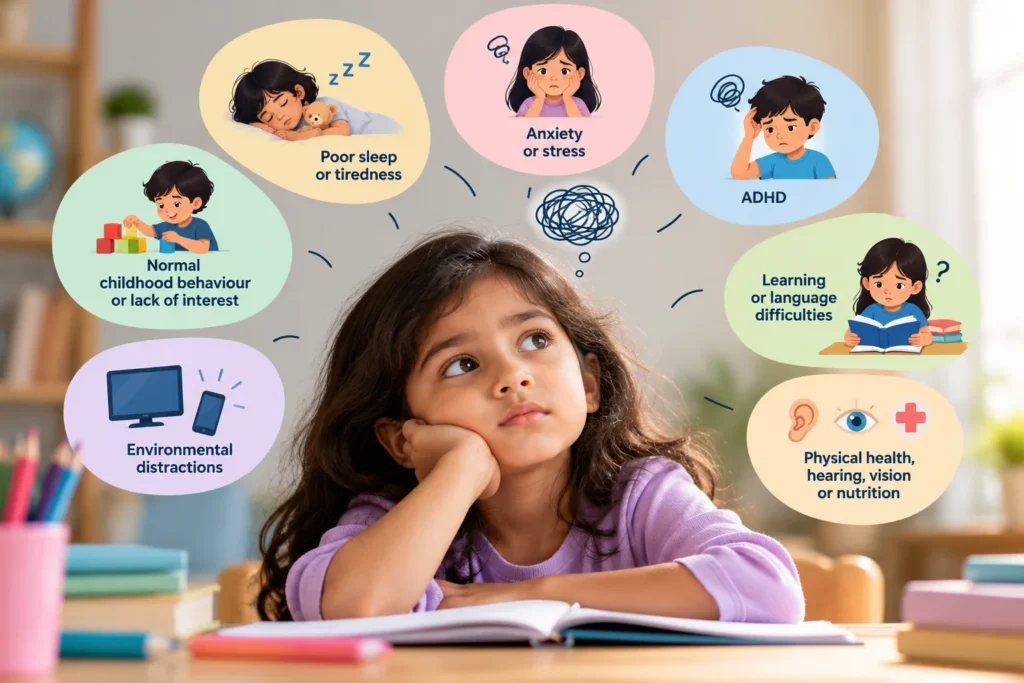
Why Can’t Your Child Concentrate? 7 Possible Reasons
1. Normal Childhood Behaviour, Boredom, or Lack of Interest
Children develop attention skills gradually. A five-year-old cannot be expected to manage lengthy activities or follow complicated instructions as independently as an older child.
Interest and task difficulty also matter. A repetitive worksheet, an activity that’s too challenging, or something a child doesn’t understand may quickly lose their attention.
For example, a six-year-old might abandon a board game halfway through because the rules are confusing, not because they have an attention problem.
Occasional distraction is common, especially during activities that are too long or poorly suited to a child’s developmental stage. What matters is whether the difficulties persist and interfere with everyday functioning.
2. Poor Sleep or Physical Tiredness
Sleep deprivation affects memory, attention, learning, and emotional regulation. Children who aren’t getting enough rest may become restless, forgetful, or irritable rather than appearing sleepy.
Recommended sleep duration depends on age.
| Age | Recommended Sleep per 24 Hours |
|---|---|
| 3–5 years | 10–13 hours, including naps |
| 6–12 years | 9–12 hours |
| 13–17 years | 8–10 hours |
Late bedtimes, interrupted sleep, and inconsistent schedules can contribute to daytime difficulties. Persistent snoring, breathing pauses, or excessive sleepiness deserve medical attention.
Read more about how lack of sleep affects children’s mood and behaviour.
3. Environmental Distractions or Mental Fatigue
Children may struggle to concentrate when several things compete for their attention.
A television playing nearby, frequent interruptions, noisy surroundings, or easily accessible devices can make it harder to complete activities that require sustained effort.
Mental fatigue is another possibility. After a busy school day, extracurricular activities, or a long period of demanding tasks, a child may find it harder to stay engaged.
Screen-based entertainment can compete with other activities for attention, but it should not automatically be blamed for persistent concentration difficulties.
4. Anxiety, Stress, or Emotional Difficulties
A child who appears inattentive may actually be concentrating intensely on something worrying them.
They might be thinking about an upcoming examination, a disagreement with a friend, bullying, or tension at home. From the outside, this can look like daydreaming or ignoring instructions.
Anxiety may also make children repeatedly check their work or hesitate because they’re afraid of making mistakes.
Depression can affect concentration too, particularly when accompanied by persistent low mood, irritability, tiredness, or loss of interest.
If your child’s attention has changed alongside their emotional wellbeing, our guide to the signs of anxiety in children may help you understand what else to look for.
5. ADHD (Attention-Deficit/Hyperactivity Disorder)
ADHD is a neurodevelopmental condition that affects attention regulation, activity levels, and impulse control.
Some children are noticeably restless or impulsive. Others appear quiet but frequently forget instructions, misplace belongings, struggle to organise activities, or fail to finish tasks despite trying.
ADHD may also affect executive functions such as planning, working memory, and getting started on tasks.
For diagnosis, clinicians consider whether symptoms have lasted at least six months, whether several were present before age 12, and whether they cause meaningful difficulties in more than one setting. They also assess whether another condition could better explain the symptoms.
ADHD and other difficulties, such as anxiety or learning disorders, can occur together.
6. Learning or Language Difficulties
Sometimes, a child appears distracted because they’re struggling to understand the activity.
Specific learning disorders can affect reading, writing, or mathematics. For example, a child with reading difficulties may lose track during written activities but follow an orally explained story comfortably.
Language difficulties can create a different problem. A child who struggles to understand spoken sentences may miss important details even when they’re trying to listen.
These are distinct difficulties and may require different types of assessment.
If problems consistently arise during particular subjects or when instructions become complicated, consider whether the child needs learning or language-related support.
7. Physical Health, Hearing, Vision, or Nutritional Concerns
Physical discomfort or an undetected health problem can interfere with a child’s ability to pay attention.
A child with hearing difficulties may miss spoken information. Someone with poor vision may struggle to follow activities requiring them to see distant objects or written material.
Headaches, persistent pain, illness, medication effects, and fatigue may also contribute.
Hunger or inadequate nutrition can affect a child’s comfort and daily functioning, although there’s no reason to assume that a particular food is responsible for an attention disorder.
A paediatrician can assess possible medical causes and recommend hearing, vision, or other checks when needed.
Why Can Your Child Focus on Games but Not Homework?
Games usually offer immediate rewards, interesting challenges, and frequent feedback. Homework often requires more effort, organisation, and patience before a child sees a result.
This difference is common and doesn’t, on its own, confirm or rule out ADHD.
If homework is particularly difficult, check whether your child understands the material, feels overwhelmed by the task, or struggles to begin.
How Can Parents Help Their Child Concentrate Better?
Start with the particular difficulty you’ve noticed. If your child forgets instructions, simplify them. If they’re distracted by noise, change the environment. If they struggle to begin an activity, help them complete the first step.

The following strategies reflect approaches used in behavioural and educational support, including evidence-based interventions for children with ADHD. Their usefulness will depend on the child’s needs.
1. Give One Clear Instruction at a Time
Instead of giving several directions together, break them into manageable steps.
For example, say, “Put your books in your schoolbag,” rather than listing five things your child needs to do before leaving home.
A written or visual checklist can support children who frequently lose track of routines.
2. Use Specific Praise and Positive Reinforcement
Acknowledge the behaviour you want to encourage.
Instead of saying, “Good job,” try, “You finished putting away your toys before starting another activity.”
Specific praise helps children understand exactly what they did well. For some children, a structured reward system developed with professional or school support may also be useful.
3. Establish Predictable Daily Routines
A consistent sequence for regular activities can reduce the need to remember and plan everything from scratch.
For example, keeping school materials in one place and following a familiar morning routine may help a child become more independent.
Keep expectations realistic and adapt routines to the child’s age and abilities.
4. Reduce Distractions and Include Appropriate Breaks
Choose an environment that supports the activity.
For reading or schoolwork, turn off background television and minimise unnecessary interruptions. During longer activities, allow short breaks or movement when needed.
There’s no single concentration time limit that works for every child. The demands should match their developmental abilities and the task.
5. Coordinate With Teachers When Needed
If attention difficulties affect classroom participation, discuss which situations are most challenging.
Teachers may be able to offer shorter instructions, organisational reminders, regular feedback, or adjustments to classroom activities.
For children diagnosed with ADHD, behavioural classroom management and organisational-skills training are recognised support approaches. Evidence-based parent training in behaviour management is particularly important for younger children with ADHD.
When Should You Seek Expert Help for Your Child’s Concentration Problems?
You don’t have to wait for your child’s concentration problems to become serious before seeking professional advice. Parents can consult a child psychologist at any time, even if they simply want to understand their child’s behaviour or learn better ways to support their attention and learning.
Professional help becomes particularly important when difficulties persist, interfere with school or daily activities, or appear alongside anxiety, emotional distress, or noticeable behavioural changes. An appropriately qualified professional can explore possible causes and recommend a formal assessment for ADHD, learning difficulties, or other conditions when needed. Sudden confusion, seizures, or serious neurological symptoms require urgent medical care.
At LeapHope, parents can connect with professionals through online child and teen counselling. Whether you’re raising a child in India, the USA, the UK, Canada, or the UAE, you can explore counselling options and seek guidance suited to your child’s needs.
Let’s Recap
Difficulty concentrating doesn’t always indicate a disorder. Your child’s age, surroundings, emotional wellbeing, learning needs, and physical health may all influence their ability to focus.
Understanding what makes attention difficult is the starting point for finding support that fits your child.
Clinical Resources
- CDC — Diagnosing ADHD — ADHD diagnostic criteria and assessment considerations.
- CDC — ADHD in the Classroom — Behavioural classroom management and organisational interventions.
- CDC — Parent Training in Behaviour Management — Evidence-based behavioural support for children with ADHD.
- NICE — ADHD: Diagnosis and Management — Clinical recommendations for assessment and treatment.
- CDC — About Sleep — Age-specific sleep recommendations.