
Last Updated on September 9, 2026
Clinically reviewed by Mamta Mehrotra, Senior Mental Health and Family Counsellor with 35+ years of experience.
A marriage can look fine from outside while the couple inside it has stopped talking, touching or trusting each other.
Sometimes the warning signs are obvious. Sometimes they appear in small moments: a phone turned face down, another late-night work call, a purchase kept secret or two people scrolling in bed without saying goodnight.
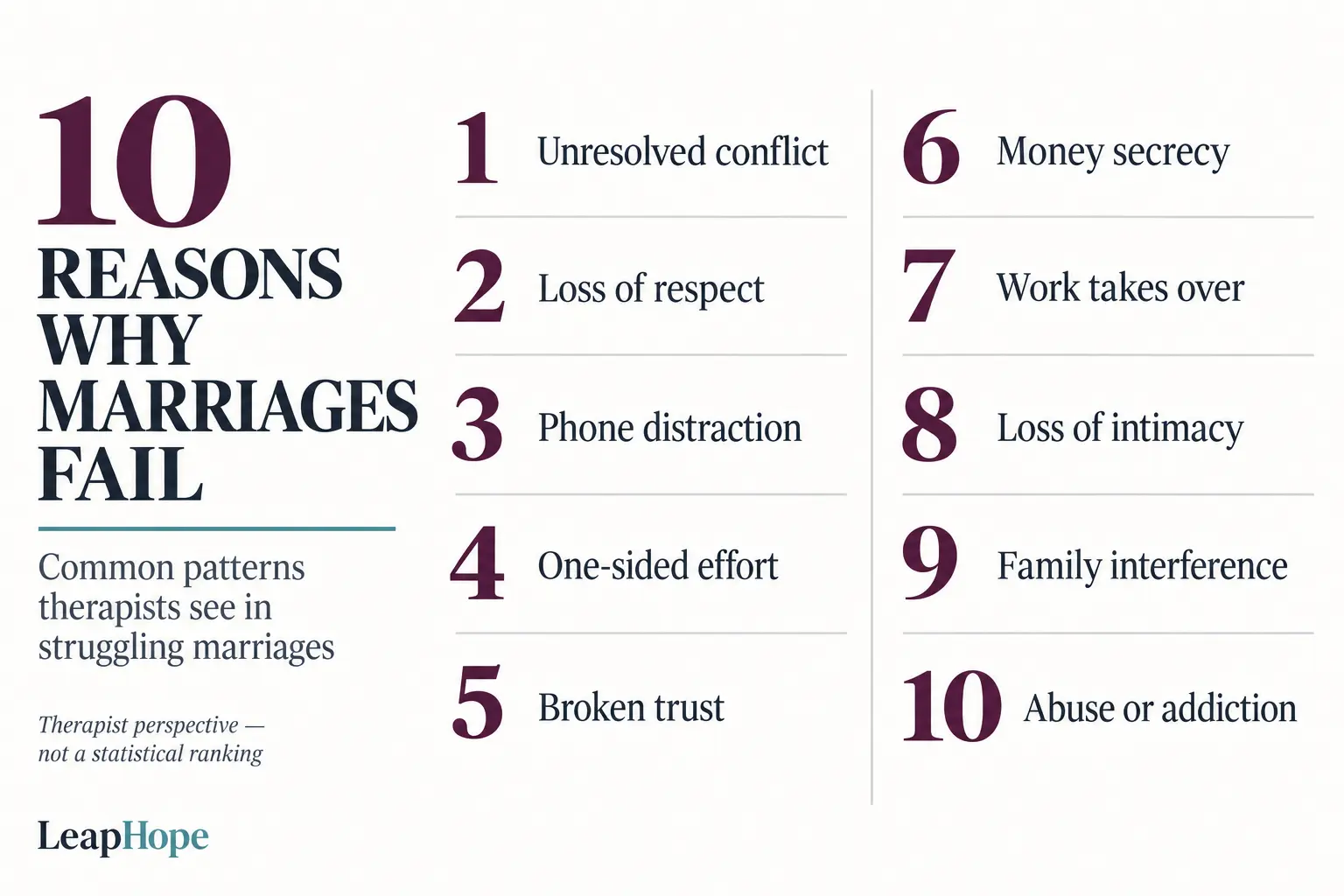
These are 10 common reasons why marriages fail. They are not a statistical ranking. They are patterns therapists often see when couples describe how their relationship gradually changed.
1. Problems Are Discussed but Never Resolved
Some couples have the same argument for years.
The subject may be money, housework, children, sex or in-laws. They argue, stop speaking, calm down and return to normal—but nothing changes.
Texting can make this worse. A serious disagreement begins on WhatsApp during work, continues through angry voice notes and ends when one person stops replying.
Arguments do not usually destroy a marriage by themselves. Repeated problems without repair do. Couples who recognise this pattern may find it helpful to understand why they cannot stop fighting in their marriage.
2. Respect Slowly Disappears
Respect can disappear before love does.
It starts with eye-rolling, sarcasm, personal insults or jokes made at a partner’s expense. One person may correct the other in front of friends, criticise them in a family group chat or share private marriage problems online.
After a while, the couple no longer argues about an issue. They attack each other’s character.
Relationship researcher John Gottman describes criticism, contempt, defensiveness and stonewalling as four destructive communication patterns in relationships. His explanation of the Four Horsemen and their antidotes offers practical alternatives.
3. Phones Get More Attention Than the Marriage
Phones are part of work, banking, shopping, entertainment and family life. The problem begins when there is no time left in which the couple is actually present with each other.
One partner talks while the other scrolls. Dinner happens beside a screen. A film is playing, but both people are checking separate feeds. Even bedtime becomes another hour of reels, messages and emails.
This is not only a problem for young couples. Older couples also use smartphones, social media and messaging apps throughout the day.
A marriage needs some undivided attention. Ten honest minutes can matter more than an entire evening spent in the same room on separate phones.
4. One Person Stops Making an Effort
Many marriages go through periods when one partner has less energy because of work, illness, pregnancy, parenting or grief. That is different from leaving the entire relationship to one person.
One partner keeps starting conversations, planning time together and asking for change. The other dismisses the problem or promises to deal with it later.
Eventually, the person trying may stop—not because everything is better, but because they are tired of asking.
Relationship counselling can help clarify whether both people are still willing to work on the marriage.
5. Trust Is Broken Online or Offline
Infidelity is no longer limited to physical affairs.
It may involve secret messages, dating apps, intimate video calls, contact with an ex or an emotional relationship kept hidden from a spouse. Couples can also disagree about what counts as cheating. One person may see private flirting as harmless while the other experiences it as betrayal.
The damage often grows through repeated lying: deleted chats, changed passwords, hidden accounts and explanations that do not add up.
Trust can sometimes be rebuilt, but not while secrecy continues. Marriage counselling for infidelity may help a couple decide what honesty and repair would require.
6. Money Becomes Secretive or Controlling
Couples now manage money through cards, payment apps, subscriptions, online loans and buy-now-pay-later services. It has become easier to spend and easier to hide spending.
One partner may discover debt, a second account or months of unmentioned purchases. Another may be expected to justify every payment while their spouse spends freely.
Money arguments are rarely only about the amount. They are also about fairness, security and control.
Shared planning helps. Both people should know what is coming in, what is being spent and which financial decisions must be made together. Couples struggling with this can read more about money problems in marriage.
7. Work and Responsibilities Take Over
Remote work and smartphones have made it difficult to know when the working day has ended. Emails arrive during dinner. Messages are answered from bed. Weekends become catch-up time.
Add children, housework, caring for parents and everyday administration, and the marriage can become another task waiting to be completed.
This can happen to newly married couples as well as couples who have been together for decades. The details change, but the result is similar: they become efficient partners in running a household and strangers in everything else.
A marriage needs time that is not about bills, schedules or children.
8. Affection and Intimacy Are Avoided
Intimacy can change because of stress, health problems, medication, childbirth, menopause, ageing, resentment or unresolved hurt.
The difficulty becomes greater when the couple cannot discuss it. One person feels repeatedly rejected. The other feels pressured or criticised. Both begin avoiding the subject.
Intimacy is not only sex. It includes affection, warmth, playfulness and feeling wanted. No one owes a partner sex, but both people should be able to speak honestly about what has changed.
Sexless marriage counselling can provide a private place to begin that conversation.
9. Other People Start Running the Marriage
Parents and relatives can offer valuable support. Problems begin when they are involved in every disagreement or allowed to make decisions for the couple.
Constant family calls and group chats can bring relatives into an argument before the couple has spoken privately. A parent may influence where they live, how they spend, how they raise a child or whether one partner should continue working.
Friends and social media can also create pressure. Comparing a real marriage with carefully selected holiday photos, anniversary posts and expensive gifts can make ordinary married life feel inadequate.
When family involvement has become part of the conflict, family counselling may help establish clearer boundaries.
10. Abuse or Addiction Makes Home Unsafe
Abuse is not a communication problem.
It may involve physical violence, threats, sexual coercion, humiliation, location tracking, checking a partner’s phone, restricting access to money or isolating them from friends and family.
Alcohol, drugs or gambling can also bring fear, debt, aggression and repeated broken promises into the home.
Couples counselling may be unsafe when one person fears punishment for speaking honestly. Individual support and immediate safety come first. Someone experiencing control or abuse may consider confidential emotional abuse counselling and appropriate local support.
Signs of Marriage Failure to Take Seriously
The signs of marriage failure are not limited to frequent arguments. A couple may need to pay attention when:
- Important conversations are repeatedly avoided.
- Phones feel more private or important than the relationship.
- One partner has stopped trying to repair problems.
- Affection has disappeared and neither person discusses it.
- Money, messages or online activity are being hidden.
- Disagreements regularly become insulting or frightening.
- The couple talks only about work, children and household tasks.
- One or both partners feel lonely while living together.
One bad week does not define a marriage. A pattern that continues for months deserves attention.
Can Marriage Counselling Help?
Marriage counselling can help when both partners are willing to speak honestly and make changes outside the session.
The aim is not to prove who is right. It is to identify the pattern the couple keeps repeating and decide what each person must do differently.
One person can also begin counselling alone if their spouse refuses to attend. However, counselling cannot make an unwilling partner participate, and it should not be used to pressure someone to remain in an abusive relationship.
Couples can explore online marriage counselling when recurring conflict, broken trust or emotional distance has become difficult to manage alone.
Final Thoughts
Most marriages do not fail in one dramatic moment. Distance usually grows through repeated choices: avoiding another conversation, hiding another payment, sending another secret message or spending another evening together without connecting.
Small choices can also move a marriage in the other direction.
Speak before resentment hardens. Put the phone down when your partner is trying to reach you. Be honest about money, messages and intimacy. Most importantly, notice whether both people are still willing to take part in the marriage.
FAQs
What are the main reasons why marriages fail?
The main reasons why marriages fail include unresolved conflict, loss of respect, emotional distance, broken trust, money secrecy, unequal effort, intimacy problems, family interference, abuse and addiction. Several of these problems often occur together.
What is the number one reason for marriage failure?
There is no single number one reason for marriage failure in every relationship. Therapists often find that unresolved problems become especially damaging because they create resentment, distance and loss of trust over time.
What are the early signs of marriage failure?
The early signs of marriage failure include avoiding important conversations, spending little meaningful time together, hiding messages or money, losing affection and repeating the same arguments without change.
Can social media cause marriage failure?
Social media can contribute to marriage failure when it leads to secret conversations, comparison, public disrespect, jealousy or less attention between partners. Social media itself is not the problem; secrecy and the couple’s pattern of using it are what matter.
Can a failing marriage be repaired?
A failing marriage can sometimes be repaired when both partners acknowledge the problem, stop harmful behaviour and follow through on agreed changes. One person cannot repair a marriage alone.
Can marriage counselling prevent marriage failure?
Marriage counselling may help prevent marriage failure by addressing recurring conflict, broken trust and emotional distance before these patterns become fixed. It cannot guarantee that a couple will remain together, especially when only one person is willing to participate.
When is marriage counselling not appropriate?
Marriage counselling may not be appropriate when there is ongoing violence, coercive control, intimidation or fear of retaliation. In these situations, individual safety and specialist support should come before joint counselling.