Clinically reviewed by Dr. Mansi More Nopany, RCI Licensed Clinical Psychologist & Marriage Therapist · 10+ years of experience
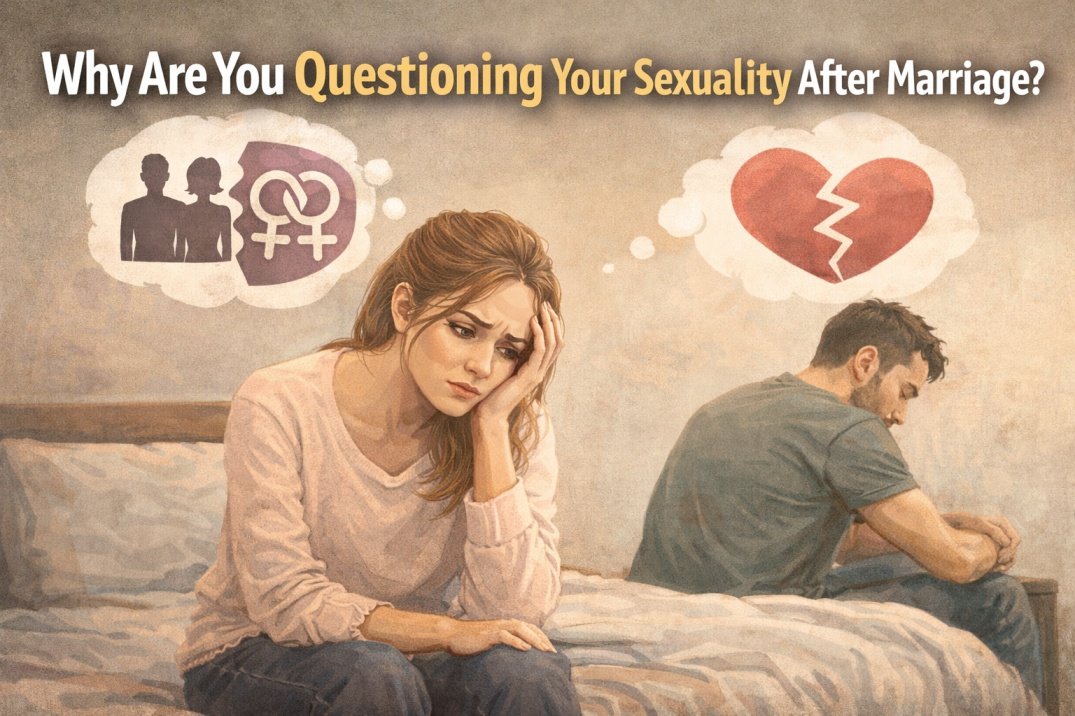
You are married, but something about your sexuality has started feeling less certain than it did before.
Maybe you have noticed attraction toward someone of the same gender. Maybe you love your husband or wife but wonder whether bisexual, gay, lesbian or queer describes you better. Or perhaps your attraction has not clearly changed, but your mind keeps asking, “What if I have misunderstood my sexuality?”
Many people who are married and questioning their sexuality struggle because the question seems connected to much more than identity. You may immediately think about your spouse, children, parents, in-laws and the life you have already built.
Start by separating three questions:
- What am I actually feeling?
- What, if anything, does it mean about my sexual orientation?
- What do I want to do about my marriage?
You do not have to answer all three at the same time.
Can I Love My Spouse and Still Question My Sexuality?
Yes.
Love, emotional attachment, sexual attraction and sexual orientation are related, but they are not the same thing.
A woman can genuinely love her husband and notice attraction toward women. A man can care deeply about his wife and begin recognising attraction toward men. A bisexual person can be committed to one partner without needing relationships with every gender they are attracted to.
Experiencing same-sex attraction after marriage does not, by itself, tell you whether you are bisexual, gay, lesbian or how your marriage should change.
Do not jump directly from:
“I felt attracted to someone.”
to:
“My entire marriage must be false.”
First understand the attraction itself.
Why Am I Only Questioning My Sexuality After Marriage?
Sometimes the feelings are new.
Sometimes they are not new, but marriage gives you a context in which they become harder to ignore.
This can be especially relevant in India if:
- dating was discouraged;
- you had little relationship experience before marriage;
- heterosexual marriage was always assumed;
- sexuality was rarely discussed openly;
- family expectations strongly influenced your relationship choices;
- or you entered an arranged marriage without having much private space to explore attraction beforehand.
Marriage does not cause a sexual orientation.
But real intimacy can bring questions into focus that were previously theoretical.
You may discover that emotional closeness feels good but sexual intimacy does not. You may notice attraction toward another gender more clearly. Or you may simply begin questioning beliefs about yourself that you never had a reason—or permission—to examine earlier.
Am I Bisexual, Gay, Lesbian or Just Questioning?
If you are questioning your sexual orientation after marriage, it is understandable to want an answer quickly because the answer seems connected to your spouse and future.
But a label should describe your experience. It should not be something you force yourself into because uncertainty feels uncomfortable.
You might eventually identify as:
- bisexual;
- gay;
- lesbian;
- queer;
- asexual or somewhere on the asexual spectrum;
- another identity;
- or no label at all.
Bisexuality is also not automatically a temporary stage between straight and gay.
Some people genuinely experience romantic or sexual attraction to more than one gender.
Instead of asking:
“Which label must I choose?”
start with:
“What pattern of attraction do I actually notice over time?”
One fantasy, one crush or one period of low desire does not necessarily define an entire orientation.
Do I Need to Experiment With Someone Else to Know?
No.
You do not need to have sex with someone of a particular gender to know that you are attracted to them.
If you are in a monogamous marriage, having an affair or secretly experimenting can create a second problem—betrayal—that is separate from the sexuality question.
You can explore your orientation without breaking your relationship agreement.
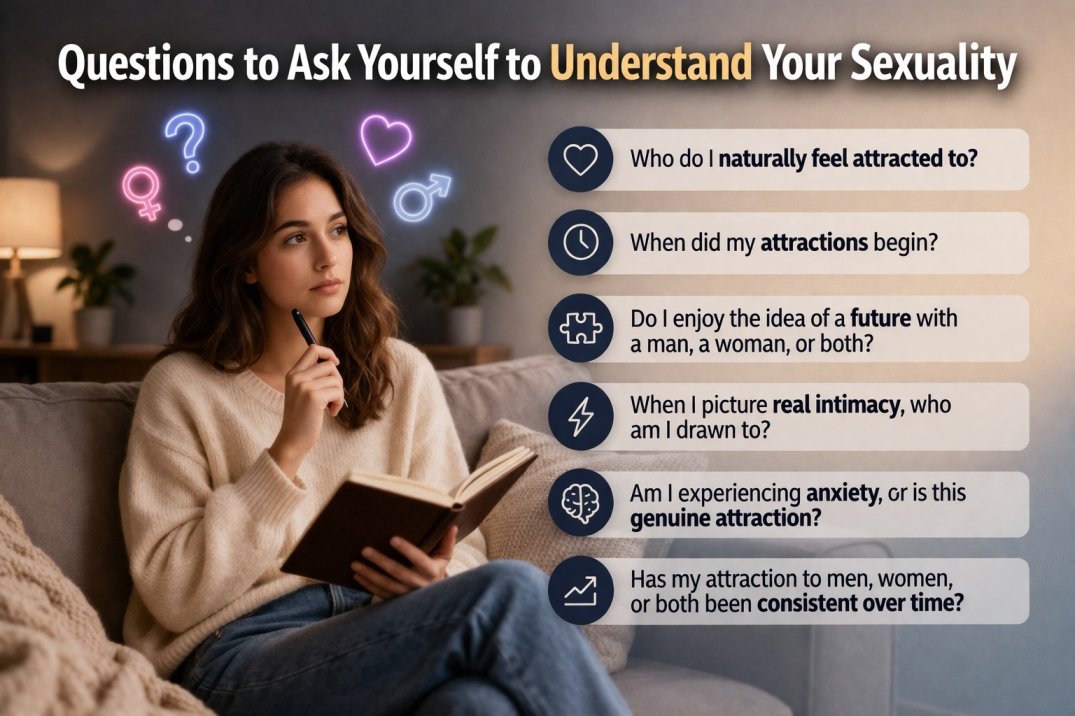
You can reflect on:
- who you have naturally felt drawn to;
- whether attraction has appeared repeatedly over time;
- whether it feels romantic, sexual, emotional or some combination;
- what past crushes meant to you;
- and what kinds of relationships you imagine when you are not trying to please anyone else.
The goal is not to “test” yourself.
It is to understand yourself.
Could Low Desire for My Spouse Mean My Orientation Is Different?
It can be one clue, but it is not enough by itself.
Low desire toward a spouse can happen because of:
- unresolved conflict;
- resentment;
- depression or anxiety;
- stress and exhaustion;
- medication;
- hormonal or physical health issues;
- painful sex;
- body-image concerns;
- relationship routine;
- performance pressure;
- or loss of emotional connection.
That is different from noticing a broader pattern of attraction toward another gender.
Compare these two experiences:
“I no longer feel much desire toward my husband.”
and:
“Across different periods of my life, I have repeatedly felt romantic and sexual attraction toward women.”
Those are not the same question.
Sometimes both may be true.
That is why it helps to look at your broader pattern of attraction and the condition of your marriage separately.
What If I Love My Spouse but Feel Attracted to the Same Sex?
Do not treat those feelings as mutually exclusive.
You may still love your spouse.
You may still value the marriage.
You may also be discovering something important about your sexuality.
What you need to understand next is not simply whether attraction exists, but what it means to you.
Ask:
- Is this attraction occasional or recurring?
- Have I felt something similar before?
- Is it romantic, sexual or both?
- Does recognising it feel clarifying or does it trigger panic and compulsive doubt?
- Do I feel that my current identity no longer describes me?
- Am I unhappy with my spouse specifically, or am I discovering attraction that exists independently of the marriage?
Do not force these questions into one conclusion.
What If I Feel Straight but Keep Worrying That I Might Be Gay?
This needs a different approach.
Some people are not mainly exploring attraction. They are trying to achieve absolute certainty about their sexual orientation.
You might:
- repeatedly check whether you find men or women attractive;
- scan your body’s reaction around people;
- analyse old friendships and crushes;
- search online for signs that you are secretly gay or bisexual;
- compare every attraction with how you feel about your spouse;
- ask others to reassure you;
- test yourself with images, fantasies or pornography;
- feel temporarily relieved, then start doubting again.
This pattern can occur in sexual-orientation OCD (SO-OCD), although only a qualified clinician can assess whether OCD is actually present.
The important distinction is this:
Sexuality exploration asks, “What do I genuinely feel?”
An obsessive loop often asks, “How can I become 100% certain right now?”
Those require different responses.
Repeatedly checking your attraction may feel like research, but for someone caught in an OCD cycle it can become another compulsion.
The International OCD Foundation’s guidance on sexual-orientation obsessions explains how checking, testing and reassurance-seeking can maintain this cycle.
If you spend hours trying to prove your orientation rather than simply noticing attraction, speak with a psychologist who understands OCD.
Questioning Sexuality in an Arranged Marriage
Questioning sexuality in an arranged marriage can feel especially complicated when attraction, family expectations and the future of two families seem tied together.
You may worry about:
- what your parents will think;
- what your spouse’s family will say;
- whether you will be blamed for the marriage struggling;
- whether the information will remain private;
- what happens if children are involved;
- financial dependence;
- housing;
- family reputation;
- or pressure to remain married regardless of what you discover.
These are important practical concerns.
But they should not be used as evidence for or against your sexual orientation.
For example:
“My family would never accept me being bisexual”
does not mean you are not bisexual.
And:
“My marriage is difficult”
does not automatically mean you are gay or lesbian.
Try to separate what you feel from what you fear may happen if other people know.
Should I Tell My Husband or Wife?
There is no universal point at which every questioning person must disclose.
But secrecy can become difficult if the questioning starts affecting intimacy, emotional closeness or decisions inside the marriage.
Before telling your spouse, be clear about what you actually know.
Compare:
“I have realised I am gay and I know what I want to do.”
with:
“I have started questioning some things about my attraction. I don’t fully understand what they mean yet, and I don’t want to make assumptions.”
These conversations will affect a spouse very differently.
If you are still uncertain, say that.
Do not present uncertainty as a final conclusion because you feel pressured to give your spouse an answer.
Your partner may react with fear:
- “Do you still love me?”
- “Do you want to leave?”
- “Were you pretending?”
- “Do you want to be with someone else?”
- “Does this mean I am not enough?”
Those reactions deserve space too.
If the conversation feels too difficult to manage alone, relationship counselling can provide a neutral setting where both of you can speak without requiring an immediate decision about the marriage.
Do I Have to Tell My Parents or In-Laws?
No.
Your spouse and your wider family do not automatically have the same right to private information about your sexuality.
In Indian marriages, relatives may be deeply involved in decisions, but that does not mean disclosure to everyone is automatically helpful.
Before telling parents or in-laws, ask:
- Why am I telling them?
- Do I need practical support from them?
- Are they likely to respect confidentiality?
- Will disclosure make the situation safer?
- Could it expose me or my spouse to humiliation, coercion or pressure?
- Have my spouse and I discussed what we want shared?
Do not involve a larger family group simply because you feel panicked and need an immediate answer.
More people do not necessarily create more clarity.
Does Questioning My Sexuality Mean My Marriage Has to End?
No.
Questioning is information.
It is not automatically a relationship decision.
Some people discover they are bisexual and remain happily married and monogamous.
Some discover that their orientation and current relationship are no longer compatible.
Some realise that their main problem was anxiety or compulsive doubt.
Some discover that sexual dissatisfaction was related more to the relationship than to orientation.
Others remain uncertain for a while.
No friend, family member, Reddit commenter, psychologist or marriage counsellor knows enough about your relationship to make the decision for you.
Therapy can help you understand:
- what you are attracted to;
- whether anxiety is distorting the process;
- how you feel about your spouse;
- whether relationship problems exist independently;
- what values matter to you;
- what disclosure might mean;
- and what choices you could realistically live with.
But therapy should not tell you what your orientation must be or whether you must stay married or leave.
If the questioning is creating significant strain between you and your spouse, online marriage counselling in India can help you work through the relationship consequences while you continue understanding your own experience.
What If I Want to Stay Married and Monogamous?
That is also a valid possibility.
Recognising attraction to more than one gender does not create an obligation to have multiple partners.
A bisexual person can choose monogamy in the same way a heterosexual person chooses one partner despite being capable of attraction to other people.
What matters is whether the relationship you are in is one you genuinely want.
You may need to discuss:
- what your identity means to you;
- whether you want your spouse to know;
- whether anything in the marriage needs to change;
- how you want to handle attraction outside the marriage;
- and whether your current relationship still feels emotionally and sexually workable.
Identity and behaviour are not the same thing.
What Should I Avoid Doing While I Figure This Out?
Avoid turning every feeling into evidence.
Do not repeatedly test your attraction during sex.
Do not use pornography, strangers or fantasies as a constant diagnostic test.
Do not cheat simply to “find out.”
Do not assume one same-sex crush proves you are gay.
Do not assume loving your opposite-sex spouse proves you cannot be bisexual.
Do not let anonymous people online decide your identity from a few paragraphs of your life.
Do not choose a label simply because uncertainty feels unbearable.
And do not make a major marriage decision during a period of intense panic purely to stop the anxiety.
Your goal is not perfect certainty.
Your goal is enough understanding to make thoughtful decisions.
When Should I Speak With a Psychologist?
Consider professional support when the questioning is causing significant distress or affecting everyday life.
For example, when:
- you spend hours thinking about your orientation;
- you repeatedly check attraction;
- intimacy has become stressful;
- you cannot stop seeking reassurance;
- you feel strong shame because of family or cultural expectations;
- you want to talk to your spouse but do not know how;
- you feel emotionally connected to your spouse but confused about attraction;
- you are considering major relationship decisions while overwhelmed;
- or you need a private place to explore feelings you cannot discuss elsewhere.
If compulsive doubt, checking and reassurance-seeking are dominant, anxiety or OCD-focused support may be important. LeapHope’s anxiety counselling can help you explore whether anxiety itself has become part of the problem.
If the central issue is sexuality and identity, look for a psychologist who can explore sexuality without treating same-sex attraction as something to cure or trying to push you into a particular identity.
Final Thoughts
Questioning your sexuality after marriage can feel frightening because the question seems connected to your entire life.
It does not have to be solved that way.
Start smaller.
Ask what you are genuinely feeling.
Separate attraction from anxiety.
Separate your sexual orientation from the current health of your marriage.
Separate what you feel from what your family expects you to feel.
And remember that recognising something about yourself does not automatically dictate what you must do next.
Understanding your sexuality is one process.
Deciding what you want for your marriage is another.
Give each question the space it deserves.