

In our work at LeapHope, our marriage therapists often see this situation with husbands, wives, boyfriends, and girlfriends across their 20s, 30s, and 40s. You found clear evidence such as messages, apps, photos, behaviour, or transactions that did not match what you were told. This is not a doubt anymore, you have already seen something concrete.
You confronted your partner with what you found, expecting a clear explanation. Instead, the response was immediate denial, “it’s not what you think” or “nothing happened.” Now you’re stuck between what you saw clearly and what your partner is confidently denying.
- “I found messages and screenshots, I showed everything clearly, but he still said it’s not what it looks like.”
- “There were dating apps with her photos and chats, but she said someone else made them.”
- “I saw repeated calls, texts, even photos, but he kept denying everything and said I’m overthinking.”
This is where the confusion actually starts. Not because the evidence is unclear, but because your partner denying cheating even after you showed proof creates a direct conflict between reality and explanation.
Denial does not change what you saw. It only makes you question what you should believe next.
Why Your Partner Is Denying Cheating Even After You Showed Proof
When your partner denies cheating after clear evidence, it is a common defensive response driven by self-protection, avoidance of consequences, and control of the situation. This denial is often immediate and confident because it is meant to reduce accountability, manage guilt, and protect their self-image.
In many cases, the denial is not about proving innocence but about avoiding outcomes such as relationship loss, conflict, or exposure. Some partners may also justify their behaviour internally or rely on a different definition of cheating, especially in situations involving emotional involvement rather than physical actions.
For both men and women, the underlying reasons for denial are largely the same, fear of consequences, shame, and protecting identity. The difference is usually in how it is expressed. One partner may minimise the behaviour (“it didn’t mean anything”), while another may reframe it or justify it emotionally (“you’re misunderstanding it” or “it wasn’t serious”). These patterns can vary by person, not just gender.
The key point is clear: denial is a reaction, not validation of truth. If your partner is denying cheating even after you showed proof, it does not make your evidence incorrect.
7 Real Reasons Your Partner Is Denying Cheating As Per Relationship Experts
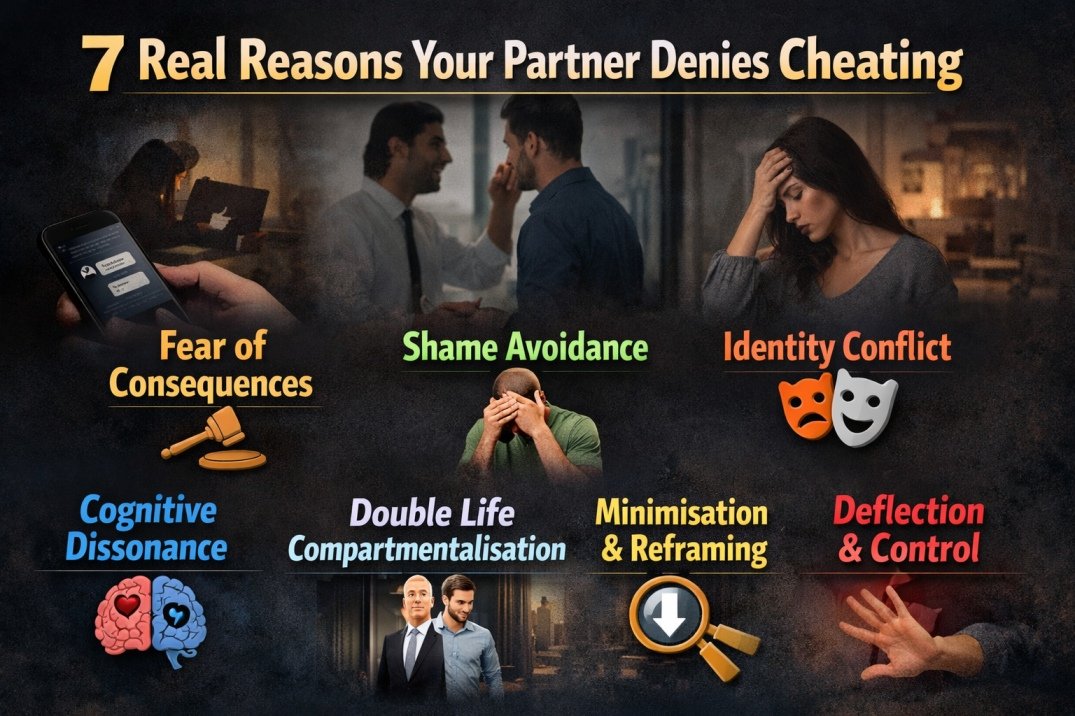
1. Fear of Immediate Consequences
When a partner is confronted with clear proof of cheating, denial is often a way to avoid immediate consequences. Admitting it can lead to arguments, loss of the relationship, or a major shift in how things work between you. Denial helps them avoid dealing with that in the moment.
For married people, this can mean fear of separation, impact on children, financial changes, or damage to family image. For those who are dating, it can mean losing the relationship, emotional security, or future plans. The situations are different, but the reaction is similar.
Across both men and women, denial is used to delay what comes next. By refusing to accept the truth, they try to hold the situation as it is, even if it cannot last.
2. Shame Avoidance and Self-Protection
After being confronted with clear proof of infidelity, many people avoid admitting it because of the emotional weight attached to it. Accepting the truth means facing guilt, embarrassment, and the reality of hurting their partner, whether it’s a husband, wife, boyfriend, or girlfriend. Denial helps them avoid that discomfort in the moment.
This is not just about the relationship, it is also about self-image. Admitting cheating forces a person to see themselves as someone who broke trust, which can be difficult to accept. Instead of facing that internal conflict, they reject the accusation and distance themselves from it.
Across both men and women, denial works as emotional self-protection. It reduces guilt temporarily and allows them to avoid dealing with the impact of their actions, even when the evidence is clear.
3. Threat to Self-Identity
When confronted with clear proof of cheating, many people resist admitting it because it directly challenges how they have presented themselves in the relationship. Accepting it means acknowledging that they have been dishonest, that their actions did not match their words, and that the trust they built was not real.
For a husband or wife, this can mean facing that they failed the role they claimed to hold in the marriage. For a boyfriend or girlfriend, it can mean accepting that they were not as genuine or loyal as they appeared. This creates a strong internal conflict because it questions their character and moral standing.
Across both men and women, denial becomes a way to avoid that reality. By rejecting the truth, they avoid seeing themselves as someone who acted falsely or broke trust at a fundamental level, even when the evidence clearly shows it.
4. Cognitive Dissonance
When confronted with clear proof of cheating, a person may still care about their partner and know they have done something wrong. Admitting it means accepting that they broke trust and caused real harm. That creates strong internal discomfort because their actions do not match how they feel about the relationship.
To reduce this conflict, they start changing the meaning of what happened. A husband or wife may say “it didn’t mean anything,” while a boyfriend or girlfriend may call it a misunderstanding or say “it just happened.” These statements are not about explaining the situation clearly, they are attempts to make it feel less serious.
Across both men and women, denial and justification work together. Instead of fully admitting cheating, they minimise it so they do not have to face the full impact of their actions.
5. Compartmentalisation of Double Life
Some people are able to separate their relationship from their outside behaviour. They act like a committed partner at home, while keeping the cheating completely separate in their mind. This allows them to continue the relationship without feeling the full weight of what they are doing.
A husband or wife may still behave normally in the marriage, showing care and responsibility, while hiding what is happening outside. A boyfriend or girlfriend may continue the relationship as usual, as if both realities do not connect. Because of this split, they do not fully process the cheating as part of the relationship.
When confronted, denial comes from this separation. Since they have mentally kept both sides apart, they can reject the cheating as if it does not define the relationship, even when the evidence clearly shows it.
6. Minimisation and Reframing
When confronted with clear proof of cheating, some people do not deny everything. Instead, they try to reduce the seriousness of what happened. This is done by changing how the situation is described rather than accepting it fully.
A husband or wife may say “it didn’t mean anything” or “it was just physical.” A boyfriend or girlfriend may say “you’re making it bigger than it is” or “it was just a mistake.” The goal is to make the behaviour seem smaller than it actually is.
Across both men and women, this shifts the focus from the act to its meaning. By reframing it as something minor, they try to avoid full accountability and reduce the emotional impact of being caught cheating.
7. Deflection and Control Strategy
When clear proof is presented, some partners shift the focus away from their actions and onto you. The pattern is often consistent, denial first, then deflection, followed by blame shifting. This changes the conversation from what they did to how you are reacting.
A husband or wife may say “you’re overreacting” or “you’re imagining things.” A boyfriend or girlfriend may say “you’re insecure” or “you don’t trust me.” These responses are not explanations, they are attempts to move attention away from the cheating.
Across both men and women, this creates confusion and self-doubt. By making you question your reaction, they reduce pressure on themselves and regain control of the situation, even when the evidence is clear.
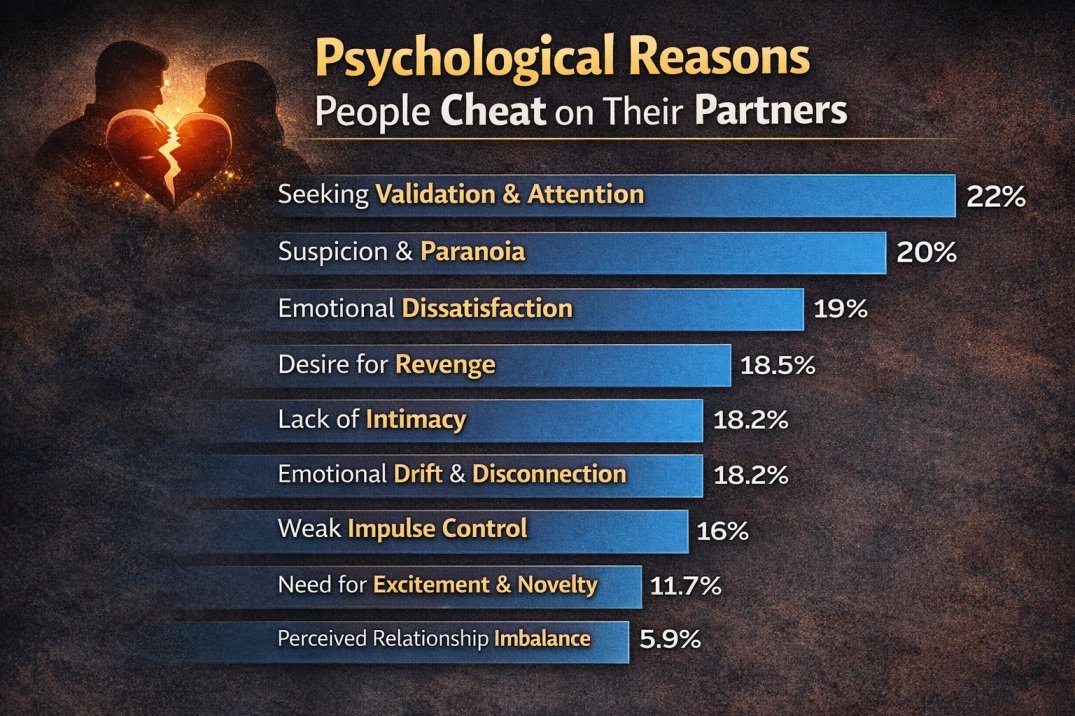
Note: Cheating does not always mean there was no love. Some partners may care deeply but still cross boundaries due to poor decisions or other factors. At the same time, love does not reduce the impact of cheating. You are in the best position to judge whether this reflects a pattern or a one-time failure, based on their behaviour over time.
When You Start Questioning Yourself Instead of Them
You are already hurt from finding out about the cheating. You expected at least some honesty after confronting it. When your partner denies it to your face, that hurt turns into something deeper, confusion about what is real.
Now it is not just about what they did. You start questioning your own experience, your memory, and even the reality of your relationship. Thoughts like “was I being used for money, convenience, or sex,” “was I not enough,” or “did I trust too easily” begin to take over.
You may start experiencing:
- Conflict between what you saw and what your partner is saying
- Self-doubt about your judgment and memory
- Replaying events to check if you missed something
- Questions about your self-worth and value in the relationship
- Anxiety and emotional instability
- Mental exhaustion from trying to make sense of it
- Hyper-awareness of your partner’s behaviour
- Reduced emotional safety
- Loss of trust in your own perception
The situation shifts from their actions to your identity and self-worth. This is why denial can feel more damaging than the cheating itself, it makes you question not just them, but yourself and the relationship you believed in.
What To Do If Your Partner Is Denying Cheating Even After Solid Proofs

Talk to a Relationship Counsellor
When you are dealing with clear evidence but ongoing denial, it becomes hard to think clearly. A relationship counsellor gives you a neutral space to step out of arguments and understand the situation without emotional pressure.
They help you break things down with direct questions, what exactly did you find, how consistent is the behaviour, and how your partner is responding. At the same time, they help you process the emotional impact, such as confusion, self-doubt, and loss of trust.
They also guide you in looking at what is at stake, your relationship, marriage, children, finances, and future plans. Most importantly, they help you think through both outcomes, staying or leaving, so your decision is based on clarity, not denial or emotional overwhelm.
Stabilise Your Own Reality First
Before reacting or making any decision, come back to what you actually observed. Write down the evidence clearly, messages, apps, photos, behaviour, without adding explanations or assumptions. This helps you separate what is real from what is being denied.
In this situation, denial creates confusion by mixing facts with explanations. Your focus should be to keep them separate. What you saw is one thing, what your partner is saying about it is another.
This step is important because repeated denial can slowly affect your memory and confidence. Staying anchored in clear facts helps you avoid second-guessing yourself and keeps your thinking grounded.
Evaluate the Strength of the Evidence
Look at what you found with clarity, not just emotion. Strong evidence is usually clear and consistent over time, such as repeated messages, apps, photos, or behaviour patterns, rather than a single unclear incident.
Avoid relying on one moment without context, but also don’t ignore consistent patterns just because your partner is denying them. The strength of evidence comes from consistency, not intensity.
Also be aware of confirmation bias. Once you believe something, it is easy to only notice things that support it. Focus on what is actually there, not just what you expect to find.
Integrate Gut Feeling With Observable Patterns
Your gut feeling is often based on subtle changes you’ve noticed over time, behaviour shifts, inconsistencies, or things that don’t add up. It can point you toward something being wrong, but it is not proof on its own.
Use your gut as a signal, not a conclusion. It should be checked against clear, observable evidence such as messages, actions, and repeated patterns. This helps you avoid acting only on emotion or dismissing something important.
The goal is to combine both. When your gut feeling aligns with consistent evidence, it becomes more reliable. When it doesn’t, take a step back and reassess instead of jumping to conclusions.
Note What Is at Stake
Before making any decision, clearly look at what is involved in your situation. This may include your relationship or marriage, children, finances, living arrangements, and shared responsibilities. Each of these can be affected depending on what you decide next.
Also consider the emotional impact. This includes your mental wellbeing, sense of safety, and how the situation is affecting your daily life. These factors are just as important as practical concerns.
This step helps you move from reaction to clarity. Instead of acting only on emotion, you are able to see the full picture and understand what each choice may realistically involve.
Initiate a Calm, Non-Accusatory Conversation
When you bring this up, your tone matters. Strong emotional reactions often lead to defensiveness, which makes the conversation go in circles. A calm approach does not mean ignoring what happened, it means keeping the focus on clarity.
Speak about what you observed without adding accusations or labels. This reduces immediate resistance and increases the chances of getting a clearer response. The goal is not to force a confession, but to understand how your partner responds when faced with the situation.
Pay attention to their response patterns:
- Consistency in what they say over time
- Defensiveness or attempts to avoid the topic
- Empathy for your feelings vs dismissal or blame
These patterns often give you more clarity than the words themselves.
Recognise Common Denial Patterns During Conversation
During confrontation, denial often follows predictable patterns. The goal is not to clarify the situation, but to avoid it. Recognising these patterns helps you stay focused on what actually matters.
Look for:
- Immediate denial without engaging with the evidence
- Sarcasm or overconfidence to make you doubt yourself
- Blame shifting (“you’re insecure” or “you don’t trust me”)
- Minimising the situation (“it’s not a big deal” or “it meant nothing”)
- Gaslighting (“you’re crazy” or “you’re overthinking”)
These responses are not explanations. They are ways to deflect, confuse, or control the conversation.
Do Not Depend on Confession
A clear admission may never come, even when the evidence is strong. Waiting for your partner to accept it can keep you stuck in the same cycle of confrontation and denial.
Your clarity should not depend on their willingness to admit it. Focus on what you have already seen and what is consistently happening, rather than waiting for words that may never come.
Look at Patterns Over Time
Focus on what your partner does consistently, not just what they say in one moment. Words can change, but behaviour over time is more reliable.
If the same patterns keep repeating, it carries more weight than any single explanation. Consistency matters more than what is said during confrontation.
Set Personal Boundaries
Be clear about what you can and cannot accept in the relationship. This is not about controlling your partner, but about protecting your own limits.
Your boundaries should be based on behaviour, not promises. What matters is what they do next, not what they say they will do.
Avoid Impulsive Decisions
This situation can trigger strong emotional reactions. Acting immediately, especially in anger or hurt, can lead to decisions you may later question.
Take time to process what happened and understand the full situation. Clarity comes with time, not in the moment of confrontation.
Make Decisions Based on Your Reality
Do not base your decision only on what your partner says in the moment. Words can change, especially when there is denial. Focus on what you have consistently experienced, what you saw, how they behaved, and what patterns have repeated over time.
If you are married, the decision is more complex. Separation involves emotional, legal, financial, and family consequences, especially if children are involved. If there is no repeated cheating, abuse, or ongoing dishonesty, many couples consider trying to repair the relationship first before making a final decision.
If you are in a dating relationship, the decision is more personal and based on your tolerance and future expectations. Ask yourself if you can genuinely accept what happened, rebuild trust, and see a future with this person. If not, continuing the relationship may lead to ongoing doubt and dissatisfaction.
Your decision should reflect your reality, not just their explanation. It should be based on patterns, impact, and whether rebuilding trust is realistically possible for you.
When to Seek Professional Help
If you feel stuck between what you saw and what your partner keeps denying, and you cannot decide what to believe, it may be time to seek professional help. This situation often starts affecting your thinking, emotions, and ability to make decisions.
You should consider support if you are experiencing:
- Ongoing confusion about what is real
- Repeated denial, shutdown, or gaslighting
- Emotional exhaustion and anxiety
- Loss of trust in your own judgment
- Wanting to repair the relationship but not knowing how
At this stage, structured support helps. At LeapHope, an online clinical psychologist can help you process the psychological impact, while an online marriage counsellor can guide trust rebuilding in both marriage and dating relationships.
💡 The Bottom Line
When your partner denies cheating even after you found clear evidence, the confusion is not about what you saw, it is about what you are being told. Denial can make you question your own judgment, but it does not change the reality of your experience.
You may not get a clear admission. Waiting for it can keep you stuck. Clarity comes from looking at consistent behaviour, patterns over time, and how your partner responds when confronted.
Your decision should not be based on their words alone. It should be based on what you have experienced, what is at stake, and whether trust can realistically be rebuilt.
FAQs
Why does my husband deny cheating even after I showed proof?
When your husband denies cheating after clear proof, it is typically a defensive response to avoid consequences, guilt, and loss of control. The denial is meant to reduce immediate pressure, not to verify truth. You should assess consistency between his behaviour and his explanation, not rely on the denial itself.
Why is my wife denying cheating even after I found clear evidence?
When your wife denies cheating despite clear evidence, it is often linked to shame avoidance, self-image protection, and fear of relationship damage. Denial in this context functions as emotional self-protection, not as confirmation of innocence. The focus should remain on observable behaviour and repeated patterns.
My boyfriend cheated but keeps denying it, what should I believe?
If your boyfriend denies cheating after evidence is present, you should rely on verifiable facts and behavioural patterns. Denial is a reaction and can coexist with contradictory evidence. Decision-making should be based on consistency of actions, not on verbal reassurance.
My girlfriend is cheating but denies everything, what should I do next?
If your girlfriend denies cheating despite evidence, avoid depending on admission to move forward. Continued denial shifts the situation into a pattern of avoidance or deflection. Your next step should be based on whether trust can be rebuilt through behaviour, not whether she verbally accepts it.