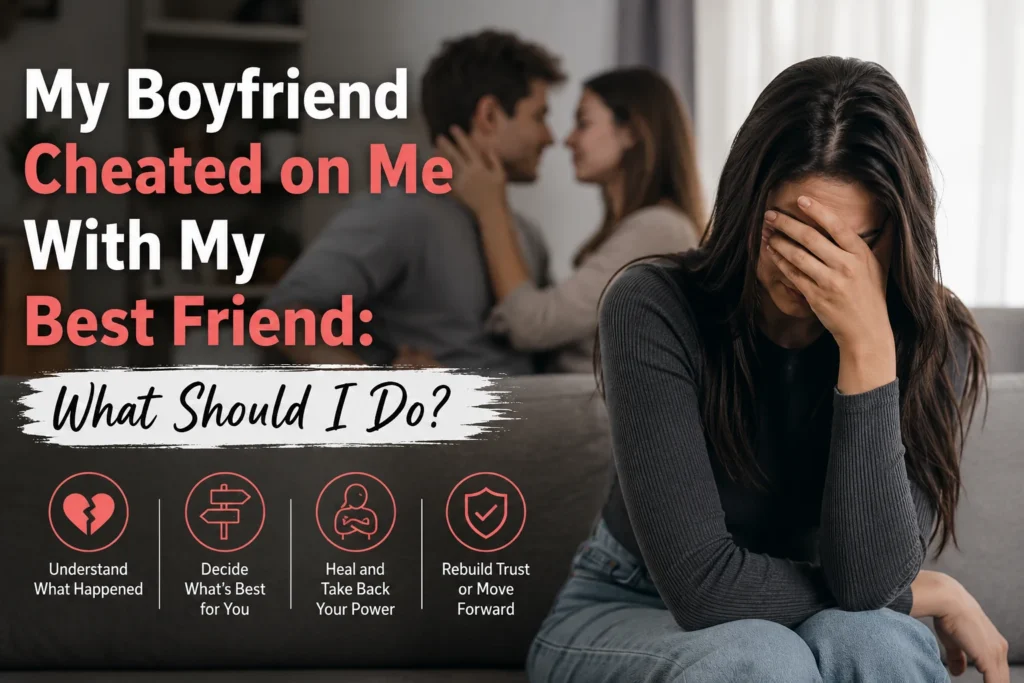

We work with men and women who have found their husband, wife, boyfriend, or girlfriend cheating and feel scared to confront them.
They usually come to us saying they have found clear proof, they are in shock, hurt, and angry, and they don’t know how to bring it up without the conversation getting out of control.
We see this across people in their 20s, 30s, and 40s, from different countries and different types of relationships. This is not limited to one age group or one kind of couple.
What stops them is not whether they should confront, but what could happen when they do.
They think about how their partner will react, whether there will be denial or blame, whether the conversation will turn into a fight, and what it could affect, their relationship, children, home, and overall stability.
In this article, our marriage therapists at LeapHope explain exactly how to confront your partner after finding proof of cheating, how to stay in control of the conversation, and how to avoid making decisions in anger that could affect your relationship, children, or future.
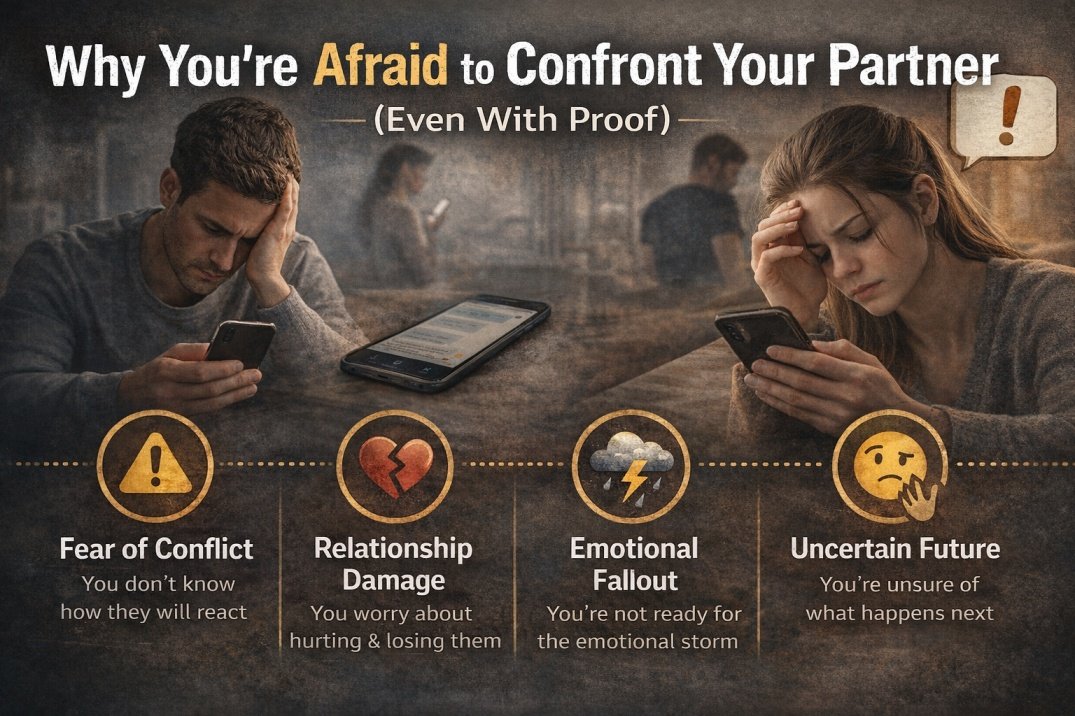
Why You’re Afraid to Confront Your Partner (Even With Proof)
When you find a partner cheating, even with clear proof, most people don’t confront immediately. Not because they don’t know what they saw, but because they know what this could turn into.
If you are married:
- Confrontation can affect children immediately, their routine, schooling, and emotional stability
- It can trigger financial disruption, separation of income, shared assets, and housing decisions
- Legal issues may follow, divorce, custody, and long-term responsibilities
- It makes the situation real, after this, you cannot go back to normal or ignore it
- There is a risk your partner denies or shifts blame, putting you in a defensive position
- You may have to involve families, which can escalate the situation beyond your control
👉 The fear here is:
“If I confront this, it can immediately affect my children, finances, and home, and push everything into a situation I cannot easily control or reverse.”
If you are with a boyfriend or girlfriend:
- Confrontation can immediately affect your living situation and shared finances
- You may lose the person and everything you’ve invested in the relationship
- It can leave you feeling used, misled, or that the relationship was not real
- There is a real risk of emotional breakdown, where you cannot think or act clearly
- You may still hesitate: what if I’m wrong, or I misunderstood something
👉 The fear here is:
“If I confront this, I could lose the person, my current setup, and everything I’ve invested, and I may not be able to handle what follows.”
Are You Seeing Real Proof of Cheating Or Signs That Can Be Misread?
Not everyone who comes here has the same type of evidence. Some have clear proof of cheating, others have strong signs that feel like cheating but are not fully confirmed.
What counts as real proof?
- Messages where your partner is clearly engaging in sexual or romantic conversations with another person
- Photos or videos showing physical intimacy (kissing, sexual activity, or clear couple behaviour)
- Catching your partner in person with someone in a clearly intimate or sexual situation
- Ongoing recent chats or calls that show an active emotional or physical relationship outside your relationship
👉 This is real proof of cheating by a partner. There is no guesswork.
What can be misleading?
- Seeing your partner with someone without clear intimacy or context
- Older chats that show closeness or cheating
- Hearing from a friend or third person without seeing proof yourself
- Suspicious behaviour (hiding phone, deleting chats, acting distant) without actual messages or evidence
- Work changes, gifts, or schedule changes that feel wrong but are not proof of cheating
👉 These are signs of possible cheating, but not confirmed proof.
If you have clear proof of cheating, you need to prepare yourself mentally, financially, and psychologically before confronting. You don’t know how your partner will react or what the outcome will be, even if you want to save the relationship.
If you don’t have clear proof and it’s based on lying, hiding, or suspicious behaviour, this needs a grounded conversation. You cannot directly accuse your partner of cheating, but you can ask for a clear explanation of what you’ve seen.
What NOT to Do When You Find Your Partner Is Cheating
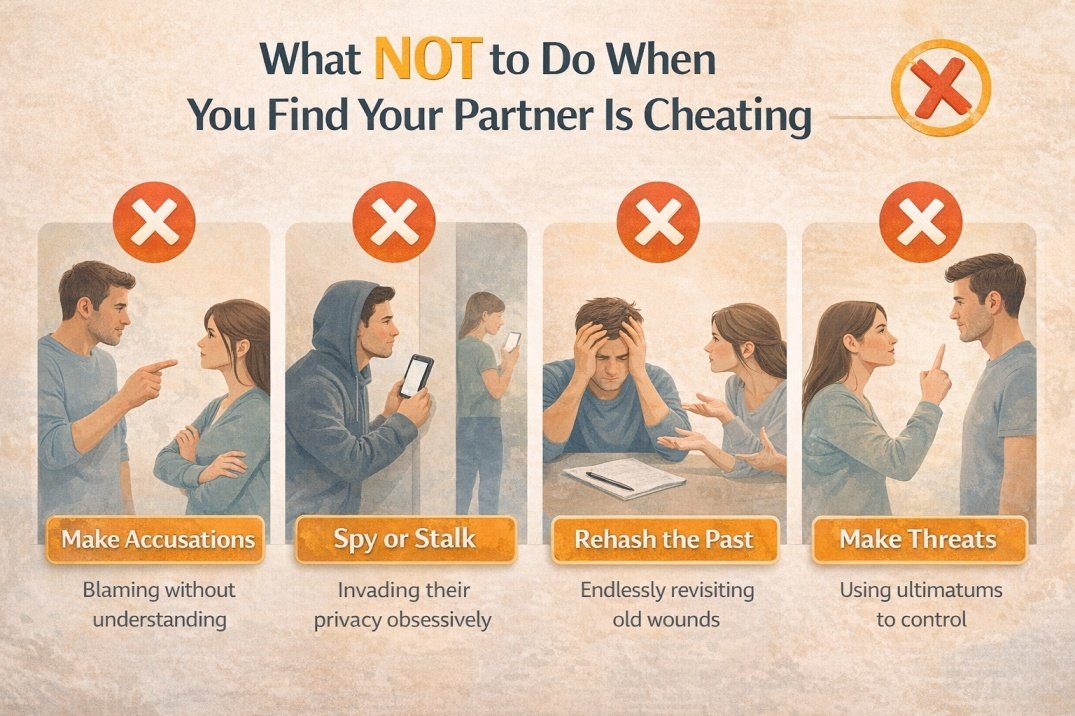
- Don’t confront in anger (shouting, accusing, threatening)
This usually turns into a fight, they deny everything, and the conversation goes out of control. - Don’t expose everything at once (show all chats, screenshots immediately)
They become defensive, start explaining or twisting things, and you lose control of how the conversation unfolds. - Don’t keep checking their phone, social media, or tracking them repeatedly
It increases anxiety, affects your mental state, and you still don’t get clarity. - Don’t call or message the other person directly
This often escalates the situation, creates more conflict, and can complicate things further. - Don’t involve friends, family, or colleagues immediately
Once others are involved, it becomes public, more emotional, and harder to handle privately. - Don’t make instant decisions (breakup, divorce, leaving the house on the spot)
These decisions are often made in shock or anger and can create long-term consequences you didn’t plan for.
Before You Confront Your Partner About Cheating – Ask Yourself These Questions
- What exactly do I want from this conversation, truth, explanation, or clarity?
- Am I ready to hear denial, blame, or confirmation without reacting immediately?
- What will I do right after this conversation if it goes badly?
- Do I have my facts clear, or will I get confused while explaining them?
- Can I stay steady if they try to turn this back on me?
- Am I mentally prepared for the emotional impact this conversation will have on me?
How to Confront a Cheating Partner Without Making It Worse
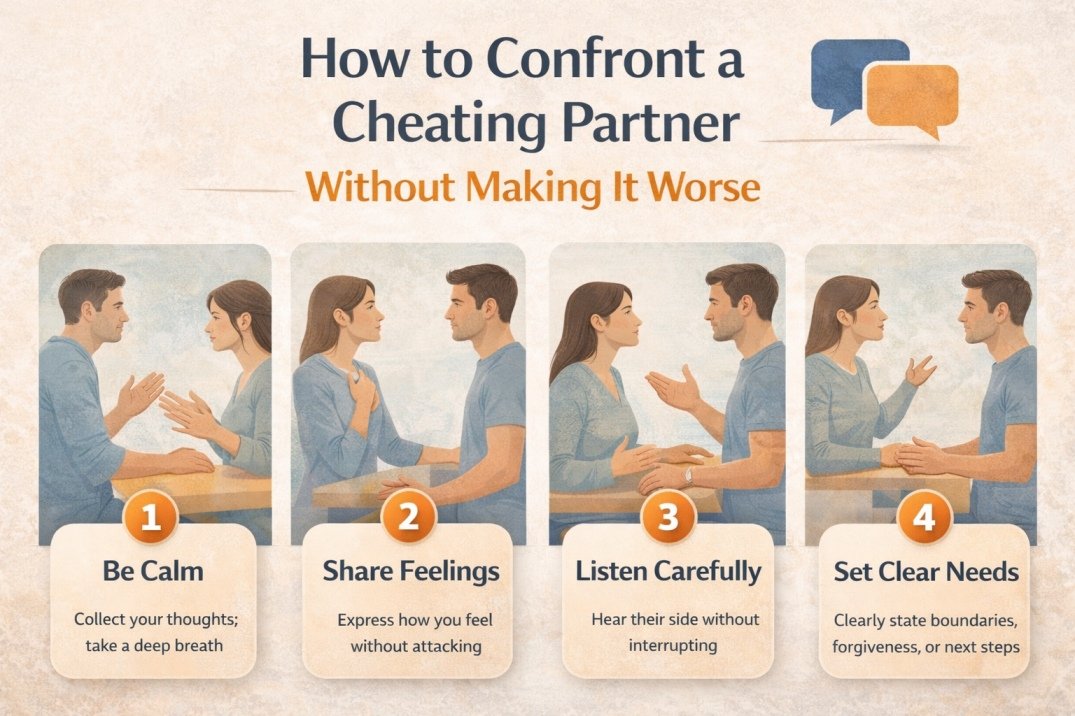
Choose the Right Time and Setting
Have this conversation in a private place where you won’t be interrupted. Avoid public settings, late-night arguments, or moments when either of you is already stressed or rushing. You need space where the conversation can happen without distraction or escalation.
Start Directly, Without Accusation
Start clearly so there is no confusion about the topic.
You can say:
“I need to talk about something I found. It’s about you cheating. I want a clear and honest explanation.”
Avoid shouting, sarcasm, or indirect hints.
A clear, direct start keeps the conversation focused and reduces immediate defensiveness.
Present What You Found Clearly
Do not start this conversation without evidence. If you don’t have proof, it will turn into denial or argument.
Come with what you have clearly found, such as messages, chats, photos, videos, or something you directly saw. State it directly and show it. For example, say, “I saw these messages,” or “I found these photos,” or “I saw you with this person.”
Do not add assumptions, emotional statements, or bring up past issues. Stick only to what you can clearly show. This keeps the conversation focused and prevents it from being dismissed.
Stay in Control of Your Reactions
Don’t start crying, shouting, or blaming as soon as the conversation begins. Once it turns into an emotional reaction, the focus shifts away from the truth.
You may not get this conversation again in a clear way. If it turns into a fight, they can shut down, walk away, or avoid answering properly.
Keep reminding yourself:
“I will listen to everything first. I can react later. I can argue later. Right now, I need the truth.”
Your goal in this moment is not to win or release emotion.
Your goal is to understand what is actually happening.
Don’t Let Them Shift the Blame
Most of the time, a cheating partner will try to shift the blame onto you. They may say you were not giving enough attention, love, sex, care, support, or emotional validation. They may say they felt lonely or that the relationship had too many fights.
Do not get pulled into defending each of these points in that moment. These are relationship issues, and they require communication, not betrayal.
Understand what is happening here. Blame is often used to reduce their guilt or take pressure off themselves.
Keep the focus clear:
“If there were issues, we should have addressed them directly. Cheating is not a solution.”
You can acknowledge that relationships have problems, but don’t accept cheating as a justified outcome. Cheating is a conscious decision, not a mistake or emotional accident.
Don’t Reveal Everything at Once
Don’t show all your evidence at once or start asking for explanations for every detail. You will not get clear answers for everything, there is no clear explanation for infidelity.
Start with what you know and let them speak. Listen to what they say, how they say it, and whether it is consistent.
If you put everything out immediately, they will focus on defending each point instead of telling the truth. Let them explain first, then decide what to bring up next.
Know When to Pause the Conversation
If the conversation turns into shouting, constant denial, or emotional overload, don’t keep pushing it in that moment.
You don’t need to force answers in one sitting. When things go out of control, you stop getting clarity and start reacting.
Pause it clearly:
“This is not going anywhere right now. We will continue this later.”
Take space, think clearly, and come back when you can handle it better.
What Usually Happens When You Confront a Cheating Partner
When you confront, don’t expect a straight answer immediately. Most people react in predictable ways.
- Denial
They may say nothing happened, even when there is clear proof. - Defensiveness
They may get angry, raise their voice, or try to shut the conversation down. - Blame shifting
They may say you didn’t give enough attention, love, sex, or support, and try to justify their actions. - Partial truth
They may admit small parts but hide the full extent of what happened. - Confession
In some cases, they admit it directly, but this usually comes after denial or pressure.
Be prepared for these reactions. If you expect them, you are less likely to lose control or get pulled into arguments.
If Your Partner Confirms Cheating – What Happens Next
If your partner confirms cheating, it will hurt. You may feel shock, anger, and emotional breakdown.
Don’t make immediate decisions. You don’t need to end everything in that moment. You can stay in the same situation and take time to think.
Now you need to decide whether to stay or leave.
Both are valid. Staying is not wrong if it was a one-time incident and both of you are willing to fix the relationship. Leaving is also valid if trust is broken.
Most people are not thinking clearly at this stage. You can speak to an online marriage counsellor at LeapHope to understand what is at stake and what each decision means.
They can help you get clarity, but the final decision will always be yours.
The Bottom Line
If you have found proof of cheating, you will confront. The question is not whether you should, but how you handle it.
Go in with clarity, control, and preparation. Don’t let anger, shock, or fear take over the conversation.
Focus on understanding the truth first. Decisions about staying or leaving can come later.
How you handle this moment will affect what happens next.
FAQs
Should I confront my partner if I suspect cheating?
If you only suspect cheating without clear proof, don’t directly accuse. Have a grounded conversation based on what you’ve observed and ask for a clear explanation.
How do I know if I have enough proof of cheating?
You have enough proof when there is direct evidence like messages, photos, videos, or clear ongoing communication showing emotional or physical involvement. Suspicious behaviour alone is not proof.
What if I’m scared to confront my partner?
Fear is normal because confrontation can affect your relationship, stability, and future. Prepare yourself mentally and practically before confronting so you can stay in control of the conversation.
Can I be wrong about cheating signs?
Yes. Behaviour changes, secrecy, or third-party information can be misleading. Without direct proof, there is a chance of misinterpretation.
What is the best way to catch a cheating partner?
The focus should not be on catching your partner but on understanding what you already know. If you have proof, prepare for a clear conversation. If not, focus on clarity instead of investigation.