

Clinically reviewed by Mansi More Nopany, RCI-Registered Clinical Psychologist
You weren’t planning to check your partner’s phone.
It just happened.
Maybe a notification appeared. Maybe something had been feeling off for a while. Maybe it was a moment of curiosity, or a quiet need for reassurance.
And then you saw it.
A message. A name. A conversation that didn’t sit right with you.
Since then, your mind hasn’t slowed down. You keep going back to what you saw, trying to understand it, questioning whether it means something serious or if you might be misreading the situation.
In counselling, this is a moment many people, men and women, find themselves in. Not because they want to create problems, but because something inside them no longer feels settled.
Now you’re in a difficult emotional space.
If you confront your partner, it could lead to answers, but also conflict.
If you stay quiet, the doubt doesn’t disappear, it grows.
And somewhere underneath all of this is a deeper question:
Is this about what you found… or about what it’s making you feel about your relationship?
Before you decide what to do next, it’s important to understand both.
What You May Have Found on Your Partner’s Phone
What people find on a partner’s phone is often not subtle. It can be direct, uncomfortable, and hard to ignore. And once you see it, it’s difficult to convince yourself it means nothing.
Sexual Messages, Sexting, or Explicit Conversations
This is one of the most common and most painful discoveries.
You might come across messages that are clearly sexual, exchanging photos, videos, or talking in ways that cross a clear boundary. There’s usually no confusion here. It feels like a betrayal the moment you see it.
What makes it worse is knowing this wasn’t accidental. It was ongoing, intentional, and hidden from you.
Romantic or “Love-Type” Messages With Someone Else
Sometimes it’s not sexual, but it feels just as intense.
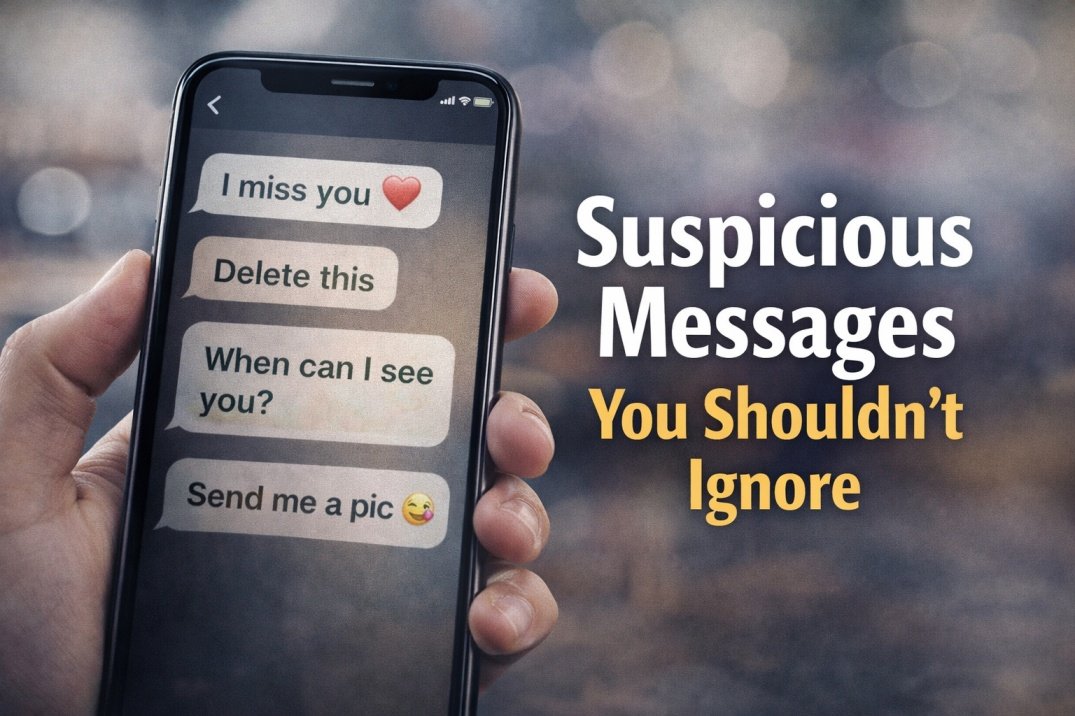
Messages like “I miss you,” “I wish you were here,” or constant emotional check-ins with someone else can feel like your partner is building a connection outside the relationship.
Even if they say “it’s just talking,” the emotional intimacy can feel like something that no longer belongs only to your relationship.
Deleted Chats, Hidden Conversations, or Secret Accounts
You may notice conversations missing, chats archived, or apps/accounts you didn’t know existed.
Even if you don’t see the full picture, the act of hiding itself creates doubt. It raises a simple question in your mind: why would this need to be hidden at all?
And that question is often enough to disturb your sense of trust.
Dating Apps or Multiple Social Profiles
Finding apps like Tinder or Bumble, or discovering extra social media accounts, can feel like a direct sign that your partner is open to connecting with others.
Even if they say they were “just looking” or “not using it seriously,” it still creates discomfort. Because being there at all suggests intention.
Photos, Videos, or Patterns That Don’t Add Up
You might find saved images of someone, screenshots of chats, or repeated searches for a specific person.
Sometimes it’s not one thing, but a pattern that starts to form. And that pattern is what makes it hard to ignore or dismiss.
At the end of it, what you saw may be different in detail, but the feeling is often the same.
It’s not just about the content.
It’s about what it means for trust, honesty, and the reality of your relationship.
Why What You Found Feels Disturbing
What you saw on the phone might be clear, or it might be confusing. But the feeling it leaves behind is usually the same, something doesn’t sit right anymore.
It Suggests Secrecy or Hidden Behaviour
The biggest discomfort often comes from the sense that something was being kept from you.
Whether it’s deleted chats, private conversations, or things your partner never mentioned, it creates a feeling that there is a part of their life you’re not being allowed to see. And in a close relationship, that kind of secrecy doesn’t feel neutral, it feels intentional.
Even if you don’t have the full story, the idea that something was hidden is enough to shake your sense of security.
It Creates Doubt About Honesty in the Relationship
Once you see something that doesn’t match what you believed, your mind starts questioning everything.
You begin to wonder:
- Have they been honest with me?
- Is this the first time, or has it happened before?
- What else don’t I know?
It’s not just about that one discovery. It starts to affect how you see past conversations, past behaviour, and even the way they talk to you now.
It Raises Questions About Loyalty and Boundaries
Every relationship has certain unspoken boundaries, what is okay and what is not.
When you see sexual messages, emotional closeness with someone else, or secret interactions, it forces you to question whether those boundaries have been crossed.
Even if your partner doesn’t see it as “cheating,” it may still feel like a violation to you.
And that’s where the real discomfort lies, not just in what they did, but in the gap between what you believed was acceptable and what actually happened.
How This Affects You Emotionally and Mentally
What you saw doesn’t stay limited to that moment. It starts affecting how you think, how you feel, and how you behave with your partner.
Immediate Shock and Physical Stress Response
The reaction is usually instant.
You might feel:
- a sudden drop in your stomach
- your heart beating faster
- your body becoming tense
This happens the moment you read a message or see something unexpected. Your brain treats it like a serious relationship threat, not a small issue.
Repeated Overthinking and Analysing the Situation
After that, your mind keeps going back to it.
You may:
- replay the exact message or image in your head
- think about the tone, words, or timing
- connect it with past situations
For example:
- “Why were they texting at that time?”
- “Is this the first time or something ongoing?”
- “Have I missed signs before?”
Even when you try to focus on something else, your mind keeps returning to it.
Confusion Between Doubt and Denial
You are trying to decide between two explanations.
- One side: “This clearly looks wrong.”
- Other side: “Maybe I misunderstood it.”
For example, a message like “I miss you” can feel serious, but you may still try to explain it as friendly or harmless.
Because you don’t have full context, your mind keeps switching between these two views.
Fear of Confronting and Being Wrong
You may hesitate to bring it up because:
- you are not sure what the message or content actually means
- you don’t have full proof of anything serious
- you are worried your partner may deny it or turn it into an argument
So you hold back, even though the thought is bothering you.
Change in How You See Your Partner and the Relationship
After this, your behaviour often changes without you realising it.
You may:
- pay more attention to their phone use
- notice when they hide their screen or turn away
- feel uneasy when they are texting someone
Earlier, these things may not have mattered. Now, they stand out.
This is how trust starts shifting, from automatic trust to active checking and questioning.

Why You May Be Hesitating to Confront Your Partner
Even if something feels wrong, it’s not easy to bring it up immediately. Most people pause because they are trying to understand what they saw and what it could mean for the relationship.
- What if this is actually cheating?
- What if it’s just casual or not serious from their side?
- What if I misunderstood and I’m overreacting?
- Should I ignore this or talk about it now?
- What if confronting them leads to a breakup or loss?
- Can the relationship continue after this?
This hesitation usually comes from uncertainty, not weakness. You are trying to protect yourself while figuring out what is really going on.
Should You Confront Your Partner or Wait
The decision becomes clearer when you look at exactly what you saw, not just how it felt.
Situations Where Confrontation Is Necessary
- You saw sexting, nude photos, or sexual conversations with someone else
- You found messages planning to meet or already meeting in person
- There are ongoing chats with the same person, not just a one-time interaction
- You discovered active use of dating apps like Tinder, Bumble, etc.
- You saw deleted chats, hidden accounts, or apps used secretly to talk to others
- You found your partner saying “I love you,” “I miss you,” or similar romantic messages to someone else
- You saw your partner complaining about you, mocking you, or sharing private relationship details with another person
Situations Where Waiting May Help
- You saw one message that could be taken in different ways (e.g., friendly vs flirty)
- The chat looked old or inactive, not something currently happening
- You don’t know who the other person is or the full context of the conversation
- You checked their phone in a moment of suspicion or insecurity and feel emotionally charged
- You are not yet clear on what exactly you want to ask or say
The key is simple:
If what you saw is clear and ongoing, it needs to be addressed.
If it’s unclear or incomplete, take time to understand it before reacting.
How to Talk to Your Partner About What You Found
Once you decide to bring it up, how you handle the conversation matters. The goal is to get clarity, not turn it into a fight where nothing gets resolved.
Choose the Right Time and Stay Calm
Don’t start the conversation immediately after seeing something.
Wait until:
- you are not angry or shaking
- you can speak without shouting or breaking down
Pick a private, quiet moment where both of you can talk without interruption.
Be Honest About What You Saw and How It Affected You
Say clearly what you came across.
For example:
“I saw messages between you and this person that looked sexual”
“I noticed you were using a dating app”
Then add how it impacted you:
“It made me uncomfortable and confused”
“I felt like something was being hidden from me”
Avoid Blaming, Accusing, or Interrogating
Don’t start with:
- “You are cheating”
- “You always do this”
This usually leads to denial or defensiveness.
Instead, stick to:
- what you saw
- what you felt
- what you want to understand
Ask Direct but Clear Questions
Don’t hint or go in circles.
Ask clearly:
- “What is this conversation about?”
- “Is this something ongoing?”
- “Have you met or planned to meet this person?”
Clear questions lead to clearer answers.
Observe Their Response and Behaviour
Pay attention to how they respond, not just their words.
Notice:
- do they answer directly or avoid questions
- do they take responsibility or shift blame
- do they stay calm or become defensive
Their reaction will help you understand the situation better than explanations alone.
This conversation is not about proving something.
It’s about getting clarity on what is actually happening and where your relationship stands.
When to Seek Professional Help
Some situations don’t resolve on their own and need support.
- You found cheating, sexting, or ongoing involvement and feel stuck
- Your partner denies clear evidence or avoids the issue
- Conversations turn into arguments or silence without resolution
- You feel constant anxiety, overthinking, or urge to check again
- Trust is broken and you don’t know how to move forward
For emotional stress, speak to an online clinical psychologist.
For relationship issues, online marriage counselling at LeapHope can help you both address trust and communication clearly.
The Bottom Line
What you found matters, but what matters more is how you respond to it.
Don’t ignore clear signs like cheating, sexting, or hidden behaviour. At the same time, don’t react impulsively to something you don’t fully understand.
Take a step back, be clear about what you saw, and decide what you need, clarity, honesty, or a serious conversation.
Because in the end, this is not just about your partner’s phone.
It’s about trust, respect, and whether this relationship still feels right for you.
FAQs
Should I confront my partner after seeing suspicious messages on WhatsApp?
Yes, you should confront your partner after seeing suspicious messages on WhatsApp if the messages are clearly flirty, sexual, or repeated with the same person. Waiting usually increases doubt, so it is better to choose a calm moment and ask directly instead of assuming.
What should I do if I found inappropriate chats on Instagram but don’t have full proof of cheating?
If you found inappropriate chats on Instagram but don’t have full proof of cheating, you should not ignore it or jump to conclusions. Take time to understand what you saw, then discuss it with your partner calmly to get clarity rather than trying to prove something.
Is it wrong to check my partner’s Snapchat without their permission?
Yes, checking your partner’s Snapchat without their permission crosses a privacy boundary. However, this usually happens when trust is already affected, so it is important to address both the checking and the underlying trust issue.
How can I talk to my partner about messages I saw on their phone without starting an argument?
You can talk to your partner about messages you saw on their phone without starting an argument by being direct and specific. Clearly mention what you saw and how it affected you, avoid blaming language, and ask clear questions instead of accusing.
Can a relationship recover after finding sexual or emotional chats on WhatsApp?
Yes, a relationship can recover after finding sexual or emotional chats on WhatsApp, but only if both partners are willing to address the issue honestly. The partner involved must take responsibility, and both need to rebuild trust through consistent actions and clear communication.