
“Why do I feel such a strong urge to check my partner’s phone?”
“I checked my partner’s phone and now I feel guilty… did I cross a line?”
“Why can’t I trust her, especially when it comes to her phone or social media?”
These questions come up in both dating and marriage, usually when something feels slightly off but hard to explain. The mind looks for certainty, and checking the phone becomes a quick way to reduce that discomfort.
But it rarely brings clarity. If nothing is found, the feeling often stays. If something is seen, it is incomplete and easy to misinterpret.
That’s because digital interactions lack context. Without tone, timing, or intent, the brain fills gaps using past experiences, current emotions, or underlying insecurity.
The guilt that follows reflects an internal conflict. One part of you wanted reassurance, while another recognises that a boundary may have been crossed.
More importantly, if the urge keeps returning, it points to a deeper pattern. This article focuses on understanding that urge, not just judging the action.
Why You Felt the Urge to Check Their Phone in the First Place
The urge to check your partner’s phone usually comes from feeling uncertain or emotionally unsafe, not random curiosity. The mind tries to reduce doubt and gain certainty quickly.
It can be triggered by a gut feeling something is off, emotional distance or reduced communication, or perceived secrecy. Even small changes can create internal discomfort.
Past betrayal or trust issues can make you more alert to possible risks. At the same time, anxiety increases the need for reassurance, pushing you to look for answers externally.
In simple terms, people check phones when something feels unclear, unresolved, or unsafe, and they want immediate clarity.
I Checked My Partner’s Phone and Feel Guilty – Did I Cross a Line?
Yes, checking your partner’s phone can cross a privacy boundary.
Reading messages without consent often goes beyond what most people consider acceptable, especially when it’s done secretly. That’s why guilt tends to show up quickly.
But context matters.
There is a difference between a one-time reaction to feeling uncertain and a pattern of control or surveillance. The intent behind the action, and what led you to that moment, is important to understand.
Feeling guilty does not mean you are a bad partner.
Guilt is a sign of awareness, it reflects that your actions and your values may not fully align. It’s not proof of wrongdoing, but it is a signal to pause and look at what led you there.
What Your Guilt Is Actually Telling You (Psychologically)
Guilt after checking your partner’s phone usually reflects an internal conflict. One part of you wanted certainty or reassurance, while another part recognises that your action did not align with your values.
There is often a fear of becoming “that person” – someone who checks, doubts, or crosses boundaries. This creates discomfort because it challenges how you see yourself in the relationship.
At a deeper level, the behaviour is linked to a need for emotional safety. When something feels unclear or unstable, the mind looks for ways to reduce that feeling, even if the method is not ideal.
It can also point to a shift in trust, either within the relationship or within your own sense of security. The action is less about the phone itself and more about how safe or certain things feel to you.
The key point is that the guilt is not just about checking the phone, it’s about what led you to do it in the first place.
Why Checking Your Partner’s Phone Often Creates More Problems
1. It reflects underlying trust issues
The urge to check usually signals that something doesn’t feel stable or clear. Instead of resolving that feeling, the act itself can deepen doubt.
2. It leaves you with guilt
Even if you had a reason, the action can create discomfort afterwards. This internal conflict can stay longer than the original doubt.
3. You may see things without full context
Messages, chats, or interactions can be easily misread. Without tone or intent, small details can feel bigger than they actually are.
4. It crosses personal boundaries
A phone contains private thoughts and conversations. Accessing it without consent can affect how safe and respected your partner feels.
5. It can turn into a pattern
What starts as a one-time check can become a repeated behaviour. The mind begins to rely on checking as a way to manage uncertainty.
6. It creates emotional distance
Instead of bringing clarity, it often increases tension. This can reduce openness and make communication more guarded.
7. It introduces control dynamics
Checking can shift the balance in the relationship. One person starts monitoring, while the other may feel watched or restricted.
8. It shifts focus to finding problems
Rather than addressing concerns directly, attention moves toward searching for evidence. This can make the relationship feel more investigative than supportive.
What Matters More: Privacy or Trust?
This is often framed as a choice, but in reality, both serve different roles in a relationship.
Privacy is about personal boundaries. It allows each person to have individual space, thoughts, and interactions without feeling constantly observed.
Trust is about emotional safety. It creates a sense of security in the relationship, where you don’t feel the need to verify everything.
When privacy is ignored, a partner may feel exposed or controlled. When trust is weak, the need to check or seek reassurance increases.
A healthy relationship is not built on choosing one over the other. It requires both – personal space and emotional security – working together.
Should You Tell Your Partner You Checked Their Phone?
It depends on what happened and what you’re trying to resolve.
If you found something serious, it’s better to address it directly. Bring it up calmly and focus on what you saw and how it affected you, rather than starting with how you found it.
If you found nothing, sharing it is not always necessary. It depends on the level of openness in your relationship and whether telling them will help or create unnecessary tension.
If the action came from anxiety, the focus should be on the feeling, not just the act. Instead of reacting out of guilt, have a conversation about what made you feel uncertain and what you need to feel more secure.
When Checking Their Phone Becomes a Bigger Problem
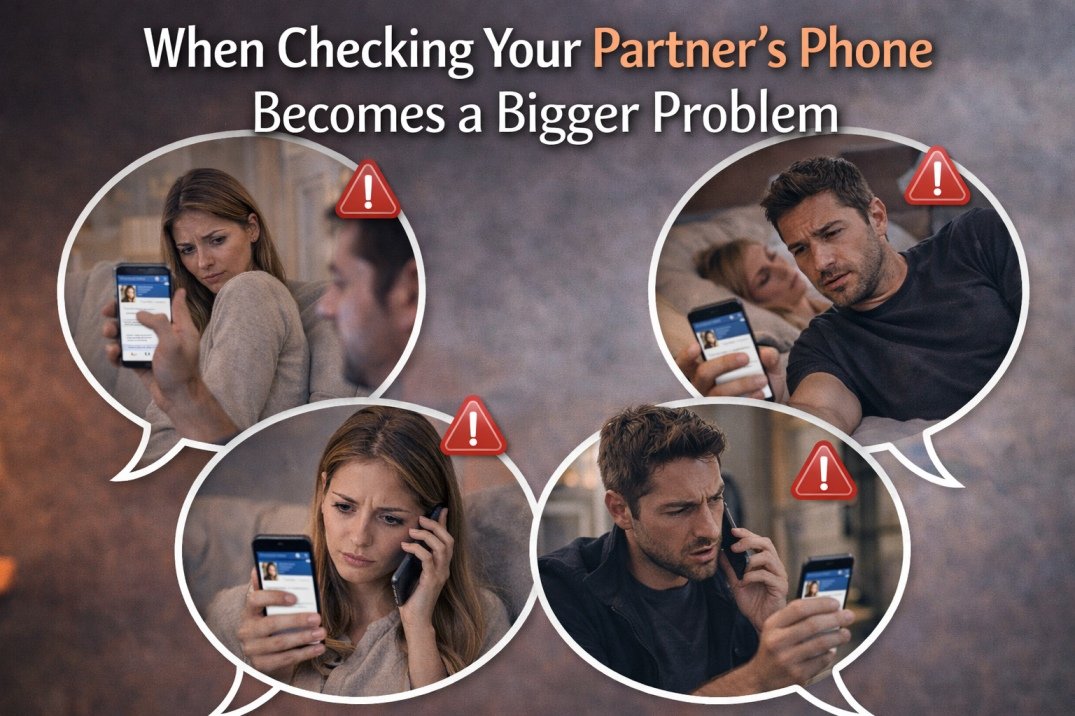
It becomes a concern when the behaviour is no longer a one-time reaction, but a repeated pattern.
If you feel the urge to check again and again, even without new reasons, it suggests the mind is trying to manage ongoing uncertainty.
If you don’t feel reassured even after checking, it indicates that the issue is not being resolved at the surface level. The doubt continues despite the action.
If you start relying on finding evidence instead of having direct conversations, communication begins to weaken and mistrust can increase.
These patterns usually point to deeper insecurity in the relationship or within your own sense of safety, rather than the phone itself being the problem.
The Real Question You Should Be Asking
Focusing only on “Was I wrong to check?” keeps the attention on the action, not the reason behind it. That question often leads to self-judgment, not clarity.
A more useful approach is to step back and understand what led to that moment, especially in everyday situations like checking WhatsApp chats, Instagram DMs, last seen, or notifications.
Ask yourself:
- Why did I feel the need to check?
Was it something I noticed, like hidden chats, unusual activity, or just a feeling I couldn’t ignore? - What exactly felt off to me?
Was it delayed replies, secretive behaviour with the phone, or changes in how they communicate online? - What feels missing in this relationship right now?
Is it reassurance, transparency, or consistent communication? - Do I feel emotionally safe without checking?
Or do I depend on seeing messages, activity, or online behaviour to feel secure? - Am I reacting to this situation or something from the past?
Is this about what’s happening now, or past experiences shaping how I interpret things?
These questions bring the focus back to what actually matters, not just the phone, but what your reactions to it are trying to tell you.
When to Seek Help
Sometimes this doesn’t settle on its own. If the same thoughts and urges keep coming back, it usually means something deeper needs attention.
You may need support if you notice:
- persistent suspicion, even without clear reasons
- anxiety affecting your daily life or focus
- repeated trust breakdown, where reassurance doesn’t last
At this point, it’s less about the phone and more about how you’re experiencing the relationship.
At LeapHope, online marriage counselling focuses on understanding what’s driving these patterns and helping you work through trust and communication issues in a practical way.
The Bottom Line
Checking your partner’s phone can give a moment of clarity, but it rarely resolves the underlying feeling. In many cases, it creates more doubt, confusion, or guilt than answers.
The urge itself is more important than the action. It usually comes from uncertainty, emotional discomfort, or something in the relationship that doesn’t feel fully clear or secure.
If it happens once, it’s a moment to reflect. If it keeps happening, it points to a pattern that needs attention.
Instead of focusing only on whether it was right or wrong, focus on what led you there. Talking to a therapist can help you understand these patterns more clearly and figure out what needs to change, in yourself or in the relationship.
People Also Ask
Why do I feel a strong urge to check my partner’s phone?
You feel a strong urge to check your partner’s phone when your mind is trying to reduce uncertainty and regain a sense of control. The urge to check your partner’s phone often comes from subtle discomfort, where something feels off but not clear enough to address directly. Instead of tolerating that uncertainty, the brain looks for immediate evidence to settle the feeling.
Is it normal to check your partner’s phone?
It is normal to feel the urge to check your partner’s phone, especially during moments of doubt or emotional disconnection. However, acting on that urge repeatedly can train your mind to depend on checking your partner’s phone for reassurance, which can gradually weaken trust and increase anxiety.
Why do I feel guilty after checking my partner’s phone?
You feel guilty after checking your partner’s phone because your action conflicts with your internal values around trust and respect. This guilt is not just about checking your partner’s phone, but about recognising that you acted from fear or doubt rather than security.
Can checking my partner’s phone make things worse?
Checking your partner’s phone can make things worse because it gives you fragmented information without emotional context. Your brain then tries to interpret those fragments, often amplifying fear or suspicion, which can increase overthinking and emotional distance.
What if I found something on my partner’s phone?
If you found something on your partner’s phone, your immediate reaction may be influenced more by emotion than clarity. What you found on your partner’s phone may not represent the full situation, so reacting without processing can escalate the issue rather than resolve it.
Why can’t I trust my partner when it comes to their phone?
Not trusting your partner when it comes to their phone often reflects a deeper issue with emotional safety. You may not trust your partner’s phone because your mind is scanning for potential threats, especially if past experiences or current uncertainty have reduced your sense of security.
Should couples have access to each other’s phones?
Couples may choose to have access to each other’s phones, but access does not automatically create trust. If the need to check your partner’s phone remains, it suggests that the underlying need for reassurance is still unresolved.
How do I stop overthinking about my partner’s phone activity?
To stop overthinking about your partner’s phone activity, you need to address the discomfort driving those thoughts. Overthinking about your partner’s phone activity usually comes from an inability to tolerate uncertainty, so building emotional clarity and direct communication becomes important.
Does checking a partner’s phone mean the relationship is unhealthy?
Checking a partner’s phone once does not necessarily mean the relationship is unhealthy. However, if checking your partner’s phone becomes a repeated way to manage doubt, it can indicate deeper patterns of insecurity or communication breakdown.
What should I do if I keep wanting to check my partner’s phone?
If you keep wanting to check your partner’s phone, it is important to understand what is driving that urge. The need to keep checking your partner’s phone usually comes from unresolved anxiety or emotional discomfort, and addressing that directly is more effective than continuing the behaviour.