
Last Updated on October 26, 2026
Clinically Reviewed by Mohit Yadav, RCI-Registered Clinical Psychologist
Your daughter gets good grades, rarely gets into trouble at school, and her teachers describe her as well-behaved. But at home, things look different.
Homework takes hours. She forgets instructions you’ve repeated several times, loses her belongings, or becomes frustrated when ordinary tasks don’t go as planned.
You’ve probably wondered whether she’s distracted, anxious, overwhelmed or simply needs to try harder. ADHD may not have crossed your mind, especially if she isn’t particularly hyperactive.
So, what are the signs of ADHD in girls that parents often miss, and why can they go unnoticed for years?
What Are the Signs of ADHD in Girls That Parents Often Miss?
Girls can have any of the three recognised ADHD presentations: predominantly inattentive, predominantly hyperactive-impulsive or combined. Some girls have symptoms that are less disruptive and therefore attract less attention.
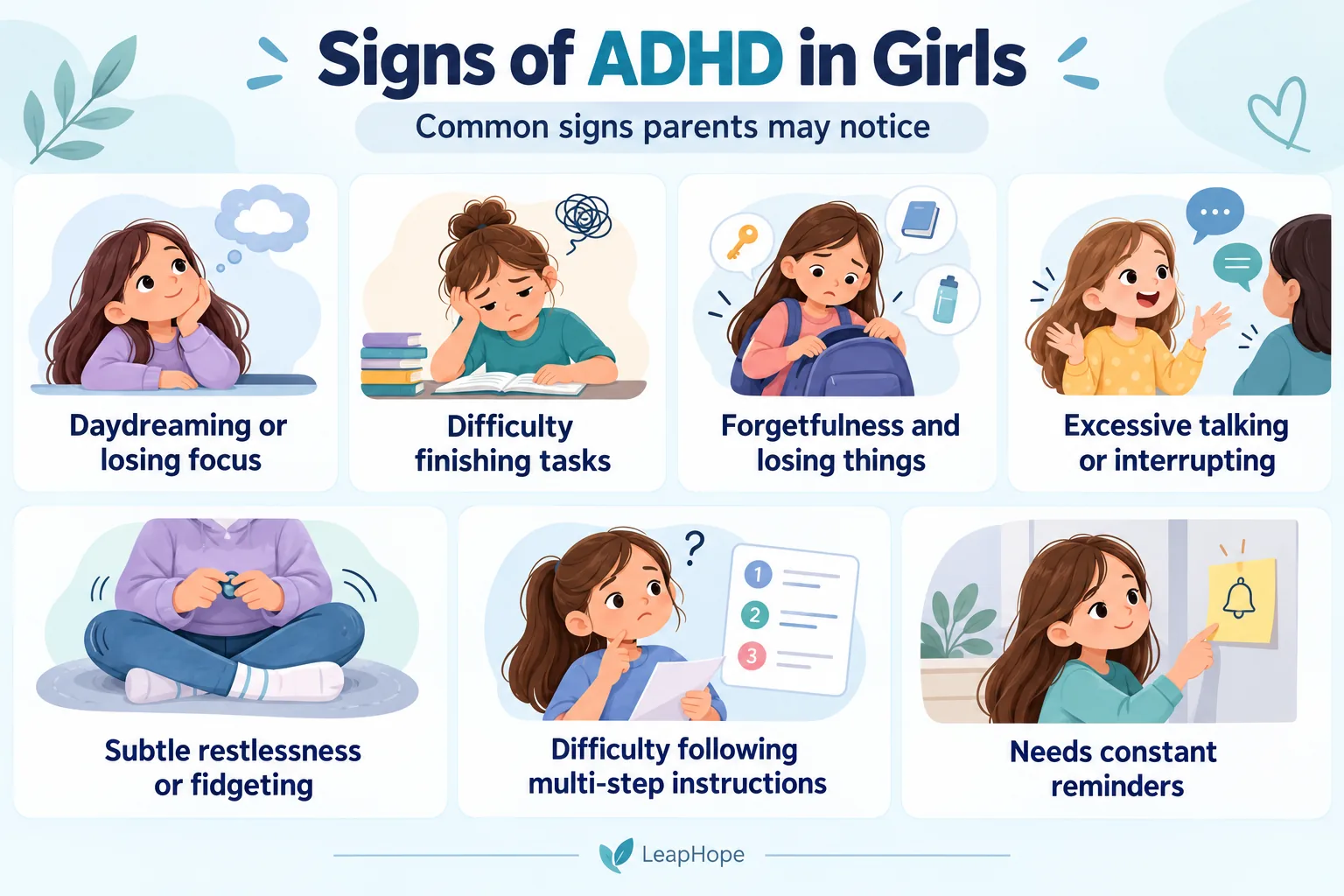
These seven behaviours may be worth discussing with a professional when they are persistent and affect daily life.
1. Frequent Daydreaming or Losing Track of Conversations
Your daughter looks towards the teacher but misses parts of the lesson. At home, she sometimes forgets what you were discussing halfway through a conversation.
Difficulty sustaining attention can be mistaken for daydreaming or a lack of interest.
2. Difficulty Finishing Tasks
She understands her homework but repeatedly loses her place, skips questions or leaves assignments unfinished when working independently.
You may notice that even familiar activities require considerably more supervision than expected for her age.
3. Forgetting Instructions and Losing Belongings
Schoolbooks disappear, assignments get left behind, or she forgets what you asked her to do minutes earlier.
You might describe her as careless, but persistent forgetfulness and difficulties organising tasks are recognised ADHD symptoms.
4. Excessive Talking or Interrupting
Not every girl with ADHD is quiet.
Your daughter may talk continuously, interrupt others, answer before a question is finished or struggle to wait her turn.
These behaviours can reflect hyperactive-impulsive symptoms even when she isn’t physically restless.
5. Subtle Restlessness
She remains seated during lessons but frequently taps her feet, fidgets with objects or struggles to stay still.
Restlessness doesn’t always involve running around or leaving a seat.
6. Difficulty Following Several Instructions
You ask your daughter to change clothes, put away her schoolbag and get ready for dinner.
Ten minutes later, she’s completed one task and forgotten the others.
This may involve difficulties following through on instructions or organising activities.
7. Needing Constant Reminders to Manage Daily Activities
You check her homework, organise her schoolbag and remind her about assignments because otherwise important things are forgotten.
The concern isn’t that she needs help. It’s whether she requires significantly more support than expected for her developmental level.
For a detailed explanation of inattention symptoms, see LeapHope’s guide to inattentive ADHD in children.
What Does ADHD Look Like in Girls at Home and School?
Your daughter may seem to manage well in the classroom while having considerable difficulties at home.
A teacher might see completed assignments and cooperative behaviour. You might see the extra time, reminders and supervision required to achieve those results.
| What adults notice | What may need attention |
|---|---|
| She sits quietly in class | Is she following instructions and completing activities? |
| She submits her homework | How much help does she need to finish it? |
| Teachers report no behaviour problems | Are attention difficulties affecting her without disrupting others? |
| She’s upset or exhausted after school | Is she dealing with stress, anxiety or demands she finds difficult? |
Differences between home and school can occur for several reasons. They don’t automatically indicate ADHD, but they are useful information for a clinical assessment.
Why Is ADHD Often Missed or Diagnosed Late in Girls?
Research identifies several possible reasons girls with ADHD may be recognised later than boys.
- Less disruptive symptoms: Adults may notice obvious hyperactivity more readily than persistent inattention or organisational difficulties.
- Masking or compensation: Some girls try to conceal their struggles by copying classmates, relying on reminders or putting extra effort into schoolwork.
- Other explanations: Difficulties may be attributed to anxiety, shyness or lack of effort without ADHD being considered.
ADHD masking describes attempts to hide or compensate for difficulties so they are less apparent to others. It isn’t a separate diagnostic symptom, and not every girl with ADHD masks.
Research published in 2026 exploring parents’ and professionals’ experiences found that some girls’ difficulties were more apparent at home than at school. The findings help explain possible recognition problems but cannot be used to diagnose an individual child.
The Duke Center for Girls & Women with ADHD also discusses how presentation and recognition can affect diagnosis.
Can Girls Have ADHD and Still Get Good Grades?
Yes. Good grades do not rule out ADHD in girls.
Your daughter might perform well in exams but spend far longer than expected on homework, forget deadlines or depend heavily on your assistance to stay organised.
Academic results don’t always reveal the effort or support required.
Some girls manage these challenges without their grades being affected, while others struggle academically. Clinicians consider the wider impact of symptoms on daily functioning rather than relying on school marks alone.
How Can ADHD Affect a Girl’s Emotions and Friendships?
A girl with ADHD might interrupt friends, forget arrangements or lose track of conversations. These difficulties can sometimes lead to misunderstandings or arguments.
Some children with ADHD also struggle with emotional regulation. Your daughter may become unusually frustrated when plans change, activities feel overwhelming or something goes wrong.
Repeated criticism or difficulties keeping up with expectations may affect her confidence.
However, emotional outbursts, friendship problems and sensitivity to criticism are not specific diagnostic signs of ADHD. They can have several explanations.
Anxiety may also occur alongside ADHD. If your daughter worries frequently about school, mistakes or friendships, our guide to ADHD vs anxiety in children explains how the conditions can overlap.
What Are the Signs of ADHD in Teenage Girls?
Some girls are first recognised as having ADHD during adolescence, when school and everyday responsibilities become more demanding.
Parents may notice:
- Difficulty planning longer assignments and meeting deadlines.
- Forgetting responsibilities across several subjects or activities.
- Struggling to manage independent study without reminders.
- Problems organising increasingly complicated schedules.
- Greater difficulty coping with everyday demands that previously required less independence.
These changes may expose difficulties that were present earlier but less noticeable.
Puberty can coincide with changes in mood, sleep and concentration, but it doesn’t cause ADHD. A sudden change in your teenager’s attention or behaviour also deserves consideration of stress, sleep problems and other health concerns.
How Is ADHD Diagnosed in Girls?
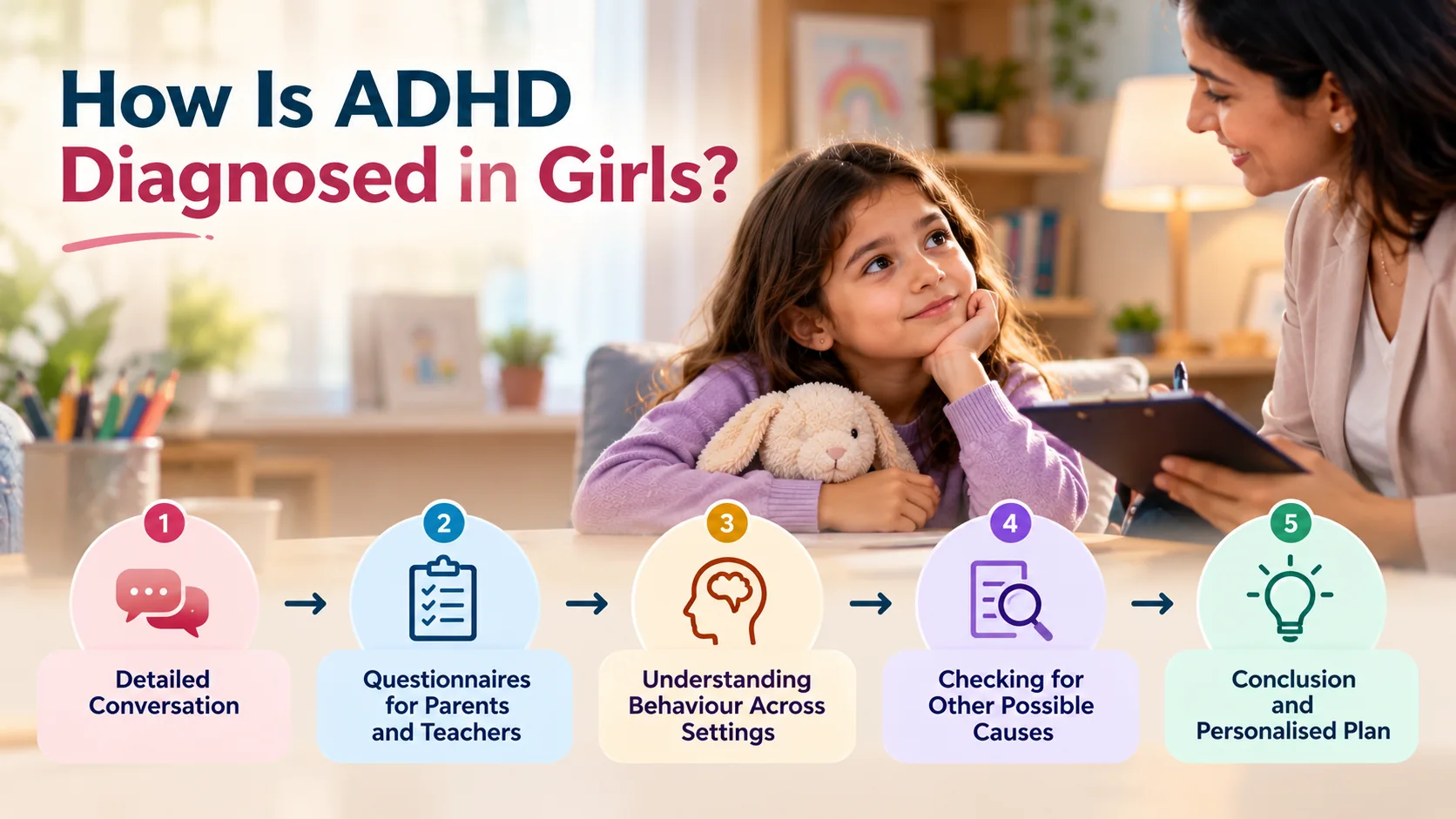
ADHD is diagnosed using the same clinical criteria for girls and boys. There is no separate diagnostic test for girls.
Under DSM-5-TR criteria, clinicians assess whether:
- A child up to age 16 has at least six symptoms of inattention and/or six symptoms of hyperactivity-impulsivity. From age 17, the threshold is five.
- Symptoms have persisted for at least six months and are inconsistent with developmental expectations.
- Several symptoms were present before age 12.
- Symptoms occur in at least two settings, such as home and school.
- They clearly interfere with functioning or development.
- Another mental disorder does not better explain them.
The assessment considers your daughter’s developmental history, school functioning, daily activities and emotional wellbeing. Clinicians may also use standardised questionnaires and gather information from parents, teachers and the child herself.
If teachers haven’t noticed the same difficulties you see at home, share both perspectives with the clinician. They can investigate whether symptoms occur across settings and how they affect your daughter.
An online ADHD checklist or free quiz cannot confirm or exclude a diagnosis.
The CDC’s ADHD diagnosis guidance explains the recognised assessment process.
For help distinguishing persistent ADHD-related difficulties from developmentally typical behaviour, read ADHD vs normal child behaviour.
What Should Parents Do if They Suspect ADHD in Their Daughter?
If you’re concerned about your daughter’s attention, organisation or behaviour, start with three steps.
- Talk to your daughter. Ask what she finds difficult during lessons, homework or friendships. For example, “Do you sometimes lose track of what your teacher is explaining?”
- Gather specific examples. Note recurring difficulties, how long activities take and how much assistance she needs. Ask her teacher for observations about attention and independent work.
- Seek professional advice. Discuss your concerns with a paediatrician or appropriately qualified child ADHD assessment professional.
At LeapHope, parents can explore child ADHD counselling for guidance with attention-related concerns, behaviour and parenting challenges. Counselling may support a child’s care, while formal ADHD diagnosis requires a professional qualified to conduct the assessment.
When seeking advice, explain both what your daughter manages successfully and what she finds difficult. That gives the professional a more complete picture than school grades or behaviour reports alone.
Clinical Resources
- CDC — Diagnosing ADHD — Recognised diagnostic criteria and assessment.
- Duke Center for Girls & Women with ADHD — ADHD presentation and recognition in females.
- Cardiff University — ADHD in Girls May Be Masked at School — Research on recognising difficulties across home and school.
- Child Mind Institute — How to Tell if Your Daughter Has ADHD — Parent-focused information about ADHD symptoms in girls.