Last Updated on October 26, 2026
Clinical Reviewer: Mohit Yadav, RCI-Registered Clinical Psychologist
Your child runs around the house, interrupts conversations, and struggles to sit through homework. But they can spend a long time playing their favourite game or building something with blocks.
Is this normal childhood energy, or could it be ADHD?
Being energetic, distracted, or impatient doesn’t automatically mean a child has ADHD. The main concern is whether these behaviours are unusually frequent for their developmental stage, continue over time, and interfere with everyday life.
Here’s how parents can tell when a closer look may be useful.
ADHD vs Normal Child Behaviour: What’s the Difference?
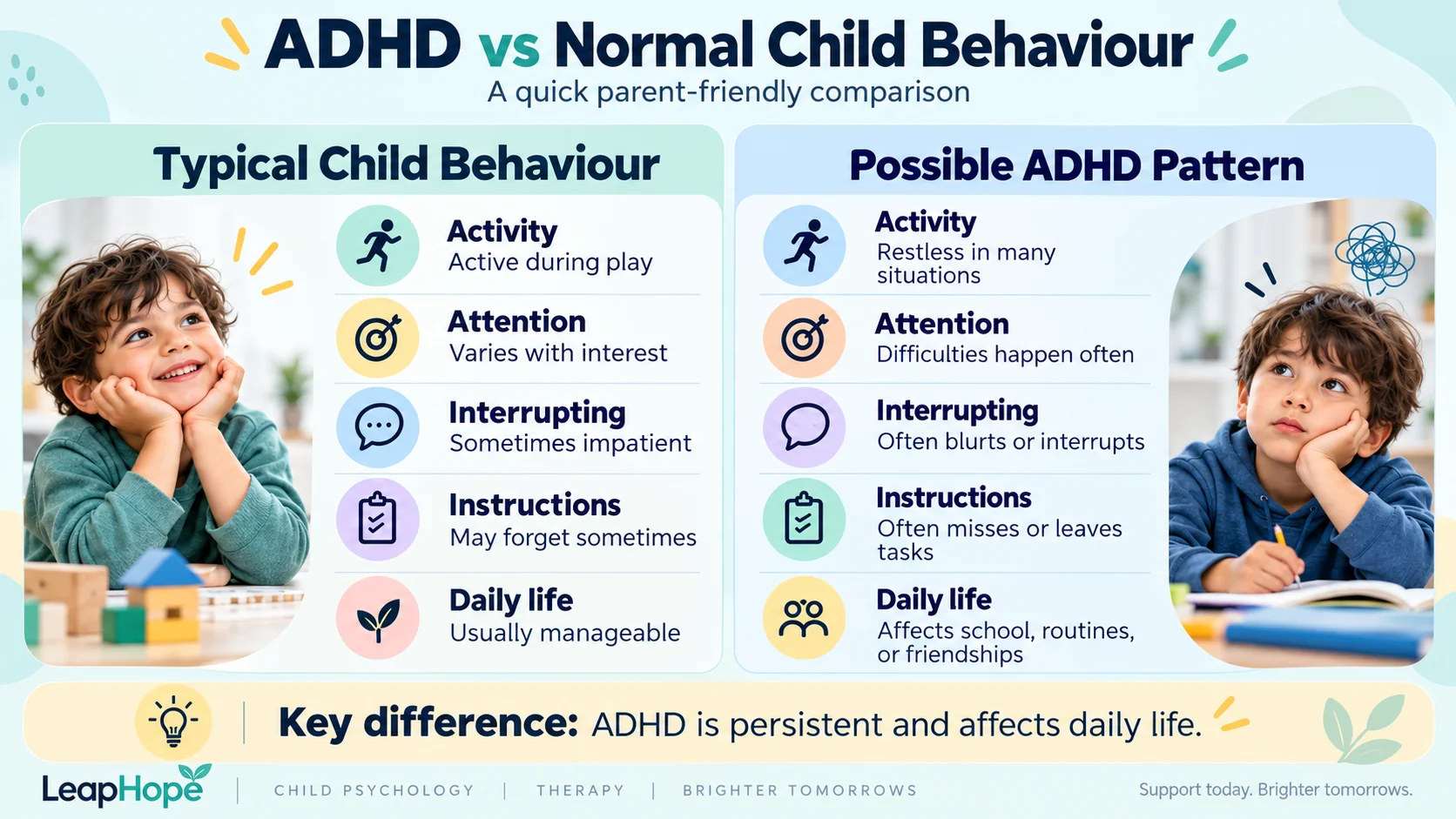
| Behaviour | Often typical in children | When it may be concerning |
|---|---|---|
| Running and moving around | Active during play, excitement, or after sitting for a long time | Excessive restlessness repeatedly disrupts age-appropriate activities |
| Losing concentration | Gets distracted when tired, bored, or overwhelmed | Persistent attention difficulties interfere with learning or daily tasks |
| Interrupting | Occasionally speaks out of turn | Frequently struggles to wait or stop an immediate response |
| Forgetting instructions | Sometimes forgets what was requested | Repeated difficulty following familiar instructions affects daily routines |
| Struggling at school | Occasional difficulty with lessons or classroom expectations | Ongoing attention, organisation, or impulse-control difficulties affect school functioning |
These patterns are not diagnostic rules. Children develop at different rates, and behaviour can change with the situation.
You can also read LeapHope’s article on 9 signs of ADHD in children that parents often miss.
When Should Parents Be Concerned About ADHD?
Four things are particularly important.
1. The Behaviour Seems Unusual for Their Age
A four-year-old may struggle to sit through a long family gathering. An older child may generally be expected to manage more time sitting, waiting, and following instructions.
There isn’t one attention span or activity level that applies to every child.
What matters: Whether the behaviour is substantially different from what is expected for the child’s developmental stage.
2. The Difficulties Keep Happening
Temporary changes can occur during stressful periods, after poor sleep, or when children are excited.
A repeated pattern over several months deserves more attention than an occasional difficult day.
What matters: How often the difficulties occur and whether they continue over time.
3. Difficulties Are Noticeable in Different Settings
A teacher may notice unfinished classroom activities, while parents observe problems with daily routines.
ADHD symptoms need to be evident in at least two settings, but they don’t have to look identical everywhere.
What matters: Whether difficulties extend beyond one particular activity or situation.
4. Everyday Life Is Being Affected
This is often the clearest reason to seek advice.
Consider whether your child is:
- Regularly struggling with age-appropriate schoolwork.
- Having repeated difficulties with friendships because of impulsive behaviour.
- Finding everyday routines unusually difficult to manage.
- Becoming frustrated or distressed by these problems.
According to the CDC’s ADHD diagnostic guidance, diagnosis involves symptoms lasting at least six months, several symptoms before age 12, and difficulties that interfere with functioning. The required number of symptoms also depends on age.
Parents don’t need to wait six months to ask for help. Those are diagnostic criteria, not a waiting period.
Can a Child With ADHD Concentrate on Favourite Activities?
Yes. A child with ADHD may concentrate well on activities they find interesting.
For example, they might spend a long time drawing or playing a favourite game but struggle with homework.
This doesn’t prove they’re deliberately avoiding schoolwork. Interest, motivation, distractions, and task demands can affect attention.
However, focusing well on preferred activities neither confirms nor rules out ADHD. Consider how the child manages a range of everyday responsibilities.
What Else Can Look Like ADHD?
ADHD isn’t the only possible explanation for restlessness or poor attention.
- Poor sleep: Can affect attention, energy, and behaviour.
- Anxiety or stress: Worries can make concentration difficult.
- Learning difficulties: A child may avoid work they find difficult to understand.
- Hearing or language difficulties: Instructions may be missed or misunderstood.
These conditions can also occur alongside ADHD.
For more detail, see LeapHope’s article on why children struggle to concentrate.
What Should Parents Do If They’re Unsure?
You don’t need to determine whether your child has ADHD yourself.
Start with three simple steps:
- Notice the pattern. Write down two or three examples of the behaviour, how often it happens, and what it affects.
- Speak with the teacher. Ask about attention, classroom activities, organisation, and friendships rather than simply asking whether your child behaves well.
- Seek professional guidance. If the difficulties concern you or are affecting your child’s life, consult a paediatrician or appropriately qualified child psychologist.
A formal ADHD assessment considers developmental history, symptoms, functioning, and observations from relevant settings. Under the NICE ADHD guideline, diagnosis must be made through a comprehensive clinical assessment by an appropriately trained professional, not from a questionnaire alone.
LeapHope offers online child and teen counselling and child ADHD counselling for families seeking professional support.
The most useful question isn’t simply whether your child is more energetic than other children. It’s whether attention, activity level, or impulse-control difficulties are making everyday life harder for them.
Clinical Resources
- CDC — Diagnosing ADHD
- American Academy of Pediatrics — Diagnosing ADHD in Children
- NICE — ADHD: Diagnosis and Management