

After an affair, the problem isn’t just what your partner did. It’s how your mind keeps going back over it.
You find yourself replaying what they said, going over calls, messages, social media behaviour, and moments you trusted without questioning. Your mind keeps pulling up what you ignored, what you believed, and what you now feel you should have seen.
We hear this from husbands, wives, boyfriends, and girlfriends in their 20s, 30s, 40s and beyond. Even months later, these thoughts can show up while working, trying to sleep, or even when you’re sitting next to your partner.
In online sessions, people say things like:
“Was I not good enough?”
“Was I being stupid this whole time?”
“Did they take me for granted?”
“How could they do this to me?”
The same details come back again and again, along with one question:
“Why does my brain keep thinking about my partner cheating even when I don’t want to think about it?”
As marriage therapists, we see this pattern often. In this article, we’ll explain why this happens and what actually helps reduce these thoughts over time.
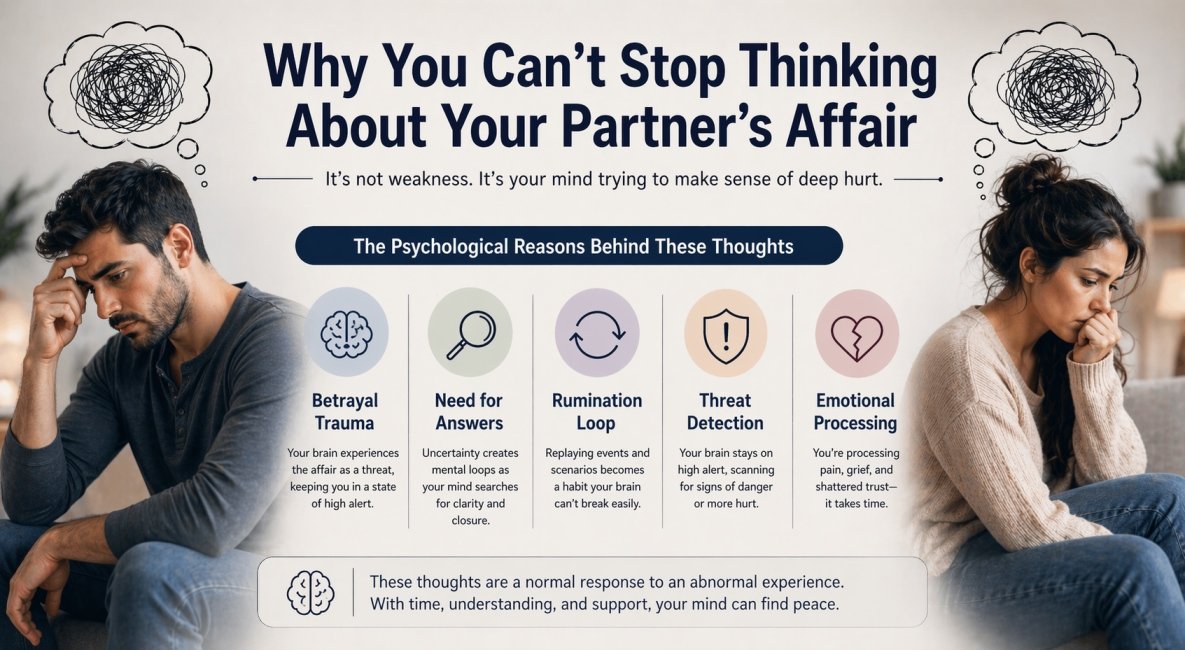
Why You Can’t Stop Thinking About Your Partner’s Affair
Your Mind Is Trying to Make Sense of What Feels Unfinished
After your partner’s affair, what keeps your mind active is not just what happened, but everything around the cheating that doesn’t fully add up.
There are gaps, things that feel unclear, behaviours that don’t match what you believed. Your brain keeps going back, trying to connect these pieces and understand what actually happened.
“When did this actually start?”
“Was anything they said real?”
“How did I not see this?”
Psychologically, this pattern is known as rumination, where the mind keeps returning to the same event to make sense of something that still feels incomplete.
Because there isn’t one clear, complete explanation, the thinking doesn’t settle, and the loop continues.
You Lost Emotional Safety, So Your Brain Keeps Going Back
After your partner’s cheating, something deeper than trust gets shaken, your sense of emotional safety. What once felt stable and predictable now feels uncertain.
The mind reacts to this loss of safety by trying to regain control. It becomes more alert, keeps scanning for signs, and goes back over past moments to check what was missed.
This is why you may notice:
- a constant need to mentally “check” things
- going back to conversations, behaviour, or timelines
- difficulty feeling settled, even when nothing is happening
When something feels unpredictable, the brain doesn’t relax easily. It keeps returning to the same details, trying to prevent the same hurt from happening again.
Your Heart Is Still Attached, Even When You Feel Hurt
After your partner’s cheating, the emotional bond doesn’t just switch off. You can feel hurt, angry, and still emotionally connected at the same time.
This creates a conflict inside. One part of you reacts to the betrayal, while another part is still attached to the person. That push–pull shows up as going back and forth between closeness and distance, understanding and anger.
For some people, this feels even stronger because of their attachment style. If you already lean towards anxious attachment, your mind may hold on tighter, trying to understand, fix, or regain closeness. If there has been childhood emotional instability or past betrayal trauma, this situation can feel more intense, because it connects with earlier experiences of hurt or unpredictability.
So even when you want to move on mentally, the emotional system is still engaged, which is why the thoughts keep coming back.
Your Brain Is Trying to Protect You From Being Hurt Again
After your partner’s cheating, your brain shifts into a protective mode. It’s not just thinking about what happened, it’s trying to make sure it doesn’t happen again.
That’s why you may find yourself constantly scanning for red flags, noticing small changes in behaviour, tone, or patterns that you might have ignored before. Your mind also goes back over the past, replaying events to “learn the lesson” and figure out what was missed.
This creates a kind of hyper-awareness. You become more alert to your partner’s actions, messages, and reactions, even when there’s no clear issue in the present moment.
From a psychological point of view, this is part of a threat-detection response. The brain is trying to reduce future risk, but instead of bringing relief, it keeps you mentally tied to the same situation.
Intrusive Thoughts Are Not Under Voluntary Control
After your partner’s cheating, many of the thoughts you’re having don’t feel like a choice, and that’s because they aren’t.
These thoughts often show up automatically, without you deciding to think about them. They can appear in the middle of normal activities and feel difficult to control or switch off.
Because they’re intrusive, trying to suppress or push them away usually has the opposite effect. The more you try not to think about it, the more your mind brings it back.
This is a common psychological pattern with intrusive thoughts. The goal isn’t to force them away, but to change how you respond to them so they lose intensity over time.
Thoughts Turn Into Repetitive Loops Without Resolution
After your partner’s cheating, your mind doesn’t just think about it, it gets stuck in a loop of thinking.
Each time you go over the same details, your brain treats it as important and keeps bringing it back. Instead of reducing the thoughts, repeated thinking actually reinforces the cycle.
This is how rumination works psychologically. The more attention you give to a thought, the more your brain flags it as something that needs to be revisited.
At the same time, thinking stays at a mental level. It doesn’t fully process the emotional impact, so there’s no sense of relief or completion.
So the loop continues, not because the situation isn’t understood, but because the mind has learned to keep returning to it.
Mental and Emotional Exhaustion Makes It Harder to Stop
After your partner’s cheating, the constant thinking itself becomes draining. Over time, this leads to mental and emotional exhaustion, which actually makes it harder to step out of the thought loop.
When your mind is tired, it has less control over attention. This is why thoughts start to feel more persistent or “sticky,” they stay longer and are harder to shift away from.
At the same time, emotional overload slows down processing. Instead of settling, the thoughts keep circulating because your system is overwhelmed.
For some people, this effect is stronger when anxiety levels are already high, or if there are patterns like intrusive thinking or OCD tendencies. In those cases, the brain is more likely to hold on to certain thoughts and repeat them, even when you don’t want to engage with them.
This creates a cycle: the more exhausted and overwhelmed you feel, the harder it is to step out of the loop, and the more the loop continues.
Is This Just Overthinking Or a Deeper Response to Infidelity?
You’re not just overthinking about your partner’s cheating.
What you’re experiencing is a deeper psychological response to infidelity, where intrusive thoughts, rumination, betrayal trauma (infidelity trauma), anxiety, and patterns like anxious attachment or relationship-focused OCD (ROCD) can all show up together.
That’s why the thoughts feel automatic, repetitive, and hard to control. Your mind keeps going back to your partner’s cheating, replaying details, imagining scenarios, questioning things, and looking for answers, even when you don’t want to engage with it.
At the same time, your brain stays in an alert state after betrayal, scanning for meaning, trying to reduce uncertainty, and prevent future hurt.
That’s why it feels like your mind won’t listen to you. This isn’t just thinking more, it’s your emotional and psychological system reacting all at once, which is why the loop is so hard to stop.
How Men and Women Experience Intrusive Thoughts and Mental Loops After Infidelity
How Men Experience Thoughts and Emotions After Being Cheated On
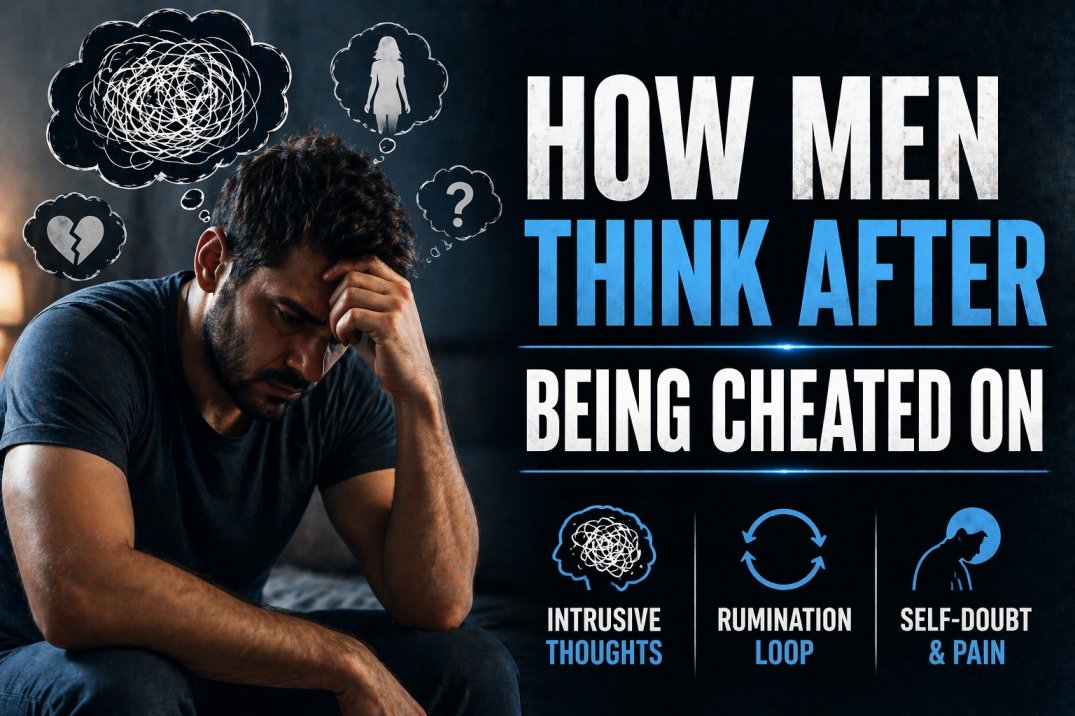
In many men, it starts with sudden mental images, not long thinking. The mind goes straight to what happened, often picturing the cheating without warning.
“Why do I keep picturing this?”
The reaction is usually anger, irritation, or silence. Instead of talking, many men push it away or stay busy. It may look like they’ve moved on, but the thoughts are still active.
At the same time, there’s comparison and self-worth in the background.
“Was I not enough?”
“Was the other person better than me?”
This connects to looks, money, status, and how they showed up in the relationship. For many men, it’s not just betrayal, it feels like a hit to their identity and respect.
They may want to understand it, but instead pull back, which keeps the thoughts internal. Even though the focus is often on the physical side, the deeper pain is about being replaced and not valued.
So it shows as anger or distance, but inside it’s images, comparison, and hurt repeating.
How Women Experience Thoughts and Emotions After Being Cheated On

In many women, the thoughts don’t come as quick flashes. They stay.
The mind keeps going over what was said, how things changed, what felt off, and what it all meant.
“When did this start?”
“Did they feel something for that person?”
“Was I not enough?”
It’s not just one thought. It turns into a continuous loop, going back to conversations, tone, small moments, trying to understand where things shifted.
At the same time, it hits emotionally.
Not just anger, but hurt, rejection, and confusion.
“Why would they do this to me?”
“Was everything real or was I just trusting blindly?”
The focus is often not just on the physical act, but on the emotional connection behind it. Whether there were feelings, attachment, or something deeper.
There’s also a strong pull to fix or understand. Thinking more, asking more, going deeper, trying to make sense of it or regain emotional stability.
This is where self-worth and attachment come in. The mind connects it to value, love, and security.
“If they loved me, how could they do this?”
So it may look like overthinking, but internally it’s emotional pain, questioning, and searching for meaning, repeating again and again.
How to Stop the Thought Loop About Your Partner’s Affair (Without Forcing Yourself to Move On)
Stop Trying to Force the Thoughts Away
When thoughts about your partner’s cheating show up, most people try to shut them down. That usually makes them come back stronger.
Instead of fighting it, notice it for what it is:
“This is that thought again.”
Not a fact, not something you need to solve right now, just a thought your mind is repeating.
Break the Cycle of Checking and Reassurance
A big part of the loop is what you do after the thought.
Checking their phone, reading old chats, watching their behaviour closely, asking the same questions again and again, it feels like you’re getting clarity, but it actually feeds the cycle.
Each time you check or seek reassurance, your brain learns:
👉 this thought is important, come back to it
Stopping these habits, even slowly, is what starts to weaken the loop.
Gently Interrupt the Loop Instead of Letting It Run
Once the thought starts, it tries to pull you into a full replay.
Instead of following it, pause and shift your attention slightly, your breath, your body, what you’re doing right now. Not to escape, but to stop the loop from building momentum.
Don’t Try to Solve It by Overthinking
It often feels like if you think about it enough, you’ll finally get an answer.
But this isn’t a puzzle that thinking will solve.
Going over it again and again doesn’t bring closure, it keeps your mind stuck in the same place.
Give Your Mind Space to Process, Not Just Analyse
There’s a difference between analysing what happened and actually processing how it felt.
Processing is slower. It doesn’t come from forcing answers, but from allowing the emotional impact to settle without constantly going back into the story.

Get the Right Kind of Support if It Feels Unmanageable
If the thoughts feel constant, intense, or tied to anxiety or OCD patterns, it may need more than self-control.
Approaches like Cognitive Behavioural Therapy (CBT) or Exposure and Response Prevention (ERP) are specifically designed to help with intrusive thoughts and compulsive patterns.
You don’t have to keep trying to manage this alone if it’s not reducing.
How Long Does It Take to Stop Thinking About an Affair?
There’s no fixed time frame.
Some people feel relief after a few months, others after 6 months or more, and for some it can take a year or longer. It’s usually not a clean break. The thoughts reduce gradually, not disappear completely. You may notice fewer loops, but sudden thoughts can still come up at times.
Over time, your mind stops going back to the affair constantly. But some people may still feel hurt, betrayal, or anxiety, even years later, sometimes even in a new relationship.
What matters is not the exact timeline, but whether the intensity and frequency are reducing. That’s what shows your mind is slowly processing it.
When You Might Need Extra Support
If thoughts about your partner’s cheating are not reducing over time, it may need more than self-effort.
You might notice:
- thoughts staying constant
- ongoing emotional distress
- difficulty feeling present or stable
- getting stuck in the same loop
When this continues, structured support can help. An online clinical psychologist can work on intrusive thoughts, anxiety, or OCD patterns, while online marriage counselling at LeapHope can support couples trying to repair the relationship in a safe space.
The Bottom Line
What you’re going through is a response to your partner’s cheating, not a personal failure.
The thoughts, the replaying, the questioning, all of it is your mind trying to process something that felt shocking, confusing, and hurtful.
This doesn’t mean you’re weak or stuck. It means your mind hasn’t fully settled yet.
As the emotional impact reduces and the thinking pattern changes, the thoughts about the cheating become less frequent and less intense. They may still come up sometimes, but they won’t take over your mind the same way.
You don’t have to force yourself to move on. You need to give your mind the space and the right support to process it properly.
FAQs
How can I stop intrusive thoughts about my partner cheating?
To stop intrusive thoughts about your partner cheating, don’t try to force them away. Pushing them usually makes them stronger. Instead, change how you respond, don’t engage with every thought, reduce checking or reassurance habits, and interrupt the loop early. Over time, this reduces their intensity.
Why do I keep thinking about my partner’s affair even when I want to move on?
You keep thinking about your partner’s affair because your mind is still processing what happened. After cheating, the brain stays alert, replays details, and looks for answers. This isn’t a choice, it’s a natural psychological response to something that felt unresolved.
Is it normal to have intrusive thoughts after being cheated on?
Yes, it is normal to have intrusive thoughts after being cheated on. Many people experience repeated thoughts, mental images, and emotional triggers after infidelity. It’s part of how the mind reacts to broken trust.
How long do intrusive thoughts last after infidelity?
Intrusive thoughts after infidelity don’t follow a fixed timeline. For some, they reduce in a few months, while for others it takes longer. Usually, they become less frequent and less intense over time rather than stopping suddenly.
Will I ever stop thinking about my partner’s affair?
You will stop thinking about your partner’s affair as the intensity reduces. The thoughts may still come occasionally, but they won’t take over your mind the same way as your mind processes the experience.