

Many men come to counselling asking the same question: my wife wants a child but I don’t.
This is not limited to one stage of life. Some are in their early 30s, some in their late 30s or 40s, and still unsure or clear that they don’t want a child.
Not because they don’t care about the relationship, but because they’re unsure what this decision actually means in practical terms.
In most cases, the hesitation is not random. It usually comes down to things like financial pressure, the shift in daily life, long-term responsibility, or simply not feeling ready to take that on. Sometimes it’s about timing. Sometimes it’s about not being clear what their role would realistically look like after a child.
In this article, our marriage therapist explains what needs to be discussed clearly before making this decision and how to approach it without confusion or pressure.
Why Many Men Today Hesitate to Have Children
Hesitation around having a child is not always about not wanting a family. In many cases, it is about understanding what comes with it and not being fully ready to take that on.
For some, this is about having their first child. In other cases, it can also come up when there are already children and the question is about having another, especially when existing responsibilities are already significant.
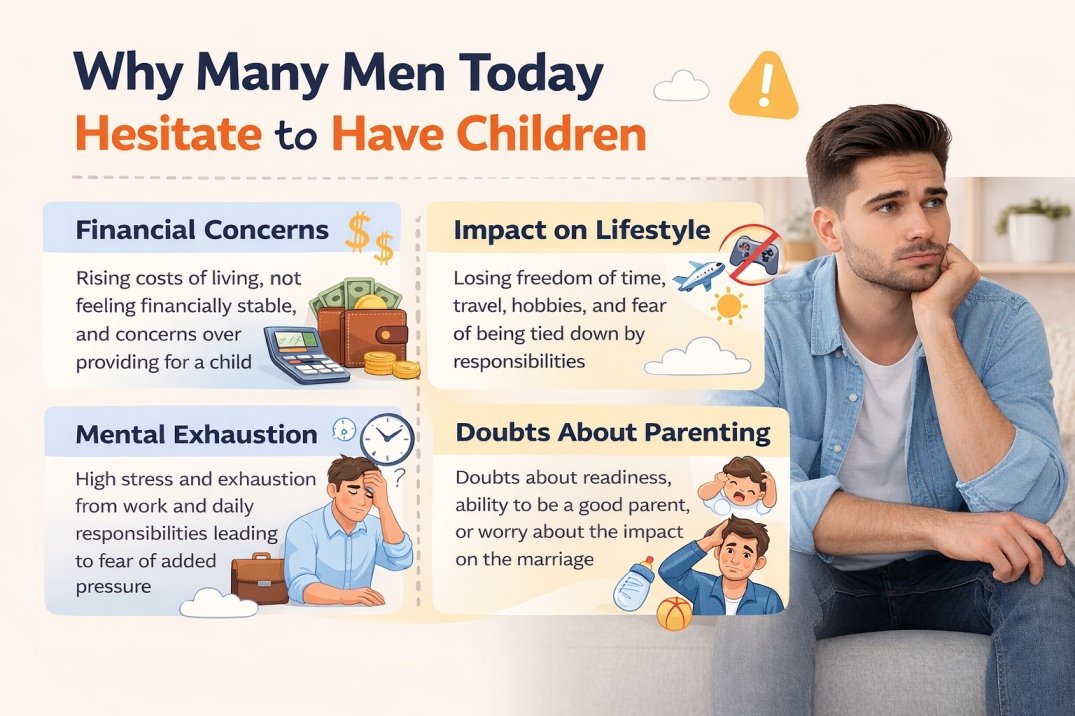
Some of the common reasons this hesitation comes up include:
- Financial responsibility and long-term costs
- Change in daily life, including sleep and routine
- Long-term commitment that does not reduce over time
- Work pressure and career stability concerns
- Not feeling ready to take on the responsibility
- Lack of clarity on who will handle daily care
- Current life not feeling stable enough
- Loss of personal time and flexibility
- Managing existing responsibilities, including current children
- Decisions being influenced by family or social pressure
Is Having a Child Something You Can Compromise On?
This is where many couples get confused.
Some decisions can be adjusted or negotiated. Having a child is not one of them.
It is not a middle-ground decision. You cannot “partly” have a child or revisit it later. It changes daily life and long-term parenting responsibility in a way that cannot be reversed.
This is why it is often understood as a “two yes or one no” decision.
In simple terms, both partners need to clearly say yes. If even one person is unsure or not ready, it is effectively a no for now.
Sometimes one partner agrees just to avoid conflict or keep things stable. But if it’s not a clear yes, it usually shows later through imbalance in responsibility or repeated arguments.
Delaying it without clarity does not solve it either. It only postpones the same issue.
So this is not about compromise. It’s about clear agreement from both sides.
How Do You Talk About This Without It Turning Into an Argument?
This conversation often turns into an argument because it is approached as a debate, not a discussion.
Instead of trying to convince each other, the focus should be on understanding what each person is actually saying.
A few things help keep this conversation clear:
- Have this discussion at a fixed time, not in the middle of an argument
- Keep the focus on the decision, not past issues or unrelated topics
- Speak in clear terms, not vague statements like “maybe later”
- Avoid trying to push for an immediate answer
It also helps to ask direct questions instead of making assumptions:
- What concerns you most about having a child?
- What would need to change for you to consider it?
- What are you not willing to take on?
The goal here is not to reach a quick decision, but to make sure both sides are clearly understood.
Without that clarity, the same conversation will keep repeating without progress.
Should You Wait and See If One of You Changes Your Mind?
This is a common approach, but it often creates more uncertainty than clarity.
Waiting can make sense if both partners agree on a clear timeline and are open to revisiting the discussion. But in many cases, waiting becomes a way to avoid making a decision.
One person may assume the other will eventually agree. The other may assume the topic will fade over time. In reality, neither usually happens.
Time on its own does not resolve this. It only delays the same question.
If you choose to wait, it should be structured:
- decide when you will revisit the discussion
- be clear on what needs to change during that time
- avoid open-ended delays
Without that, waiting tends to extend the uncertainty rather than reduce it.
What Needs to Be Discussed Clearly Before Deciding
Before making this decision, certain things need to be clearly understood and agreed, not assumed.
This is where most couples stay vague, and that’s what creates problems later.
Focus on specifics:
- Who will handle day-to-day care, including night routine and daily responsibilities
- How financial responsibility will be managed, including short-term and long-term costs
- What changes are expected in work schedules or career plans
- How responsibilities will be shared in practical terms, not “we’ll manage somehow”
- What support system is available, if any
- What each person is not willing to take on
One more thing needs to be clear upfront:
- This cannot be used later as “you wanted this” during arguments
Once the decision is made, it has to be treated as shared. Without that clarity, the issue usually shows up later through imbalance or conflict.
When Should You Consider Marriage Counselling for This?
If the conversation keeps repeating without clarity, or starts turning into arguments, it may help to involve a neutral third person.
This is not about being convinced or pushed in a particular direction. It is about having a structured discussion where both sides are clearly heard.
Counselling can help to:
- bring structure to the conversation
- identify what is actually causing hesitation or pressure
- clarify expectations around responsibility
- avoid miscommunication or assumptions
At LeapHope, we offer online marriage counselling and work with couples across the United States, United Kingdom, Canada, Australia, Germany, UAE, and India, with experience handling different cultural expectations around having children.
The goal is not to decide for you, but to help you reach a decision that is clear and understood from both sides.
Bottom Line
This decision does not need to be rushed, but it cannot stay unclear.
It is not about convincing each other or finding a middle ground. It is about being clear on what both of you are willing, and not willing, to take on.
Before deciding, make sure:
- expectations are clearly discussed
- responsibilities are understood
- the decision is not made under pressure
Once decided, it should not be treated as “your choice” or “my choice.” It has to be a shared decision.
Clarity now prevents confusion and conflict later.