
In counselling, we hear this more often than people realise.
“I’m having sexual intrusive thoughts about friends… family… sometimes even people I should never think about that way. I don’t want these thoughts. I feel disgusted. I feel ashamed. How do I get rid of them?”
If you’ve been sitting with something like this, quietly, without telling anyone, you’re not the only one.
And if you’re in your 40s, the shame can feel even heavier.
At this stage of life, you’ve built values, relationships, a sense of identity. So when these thoughts appear, it doesn’t just feel strange; it feels like it’s attacking everything you believe about yourself.
But this isn’t only limited to your age.
People in their 20s, 30s, 50s – men and women – experience the same kind of intrusive sexual thoughts and the same cycle of fear, guilt, and confusion.
The problem is, no one talks about it openly. So it starts to feel like something is uniquely wrong with you.
In this article, we will understand what these thoughts actually are, why they feel so disturbing, and how to break the cycle of obsession and shame without trying to control your mind.
What is Sexual Intrusive Thoughts OCD?
Sexual intrusive thoughts in OCD refer to unwanted, repetitive sexual thoughts, images, or doubts that cause distress and feel out of character. These thoughts are not chosen, and they do not reflect what you want. They persist because your mind keeps reacting to them with fear, analysis, and the need for certainty.
In clinical practice, these thoughts are described as ego-dystonic, meaning they go against your values, identity, and intentions. This is why they feel disturbing and hard to ignore.
The problem is not the presence of the thought. The problem is the loop that follows.
A typical pattern looks like this:
- A thought appears suddenly
- You feel discomfort, fear, or shame
- You try to understand or analyse it
- You check your reaction (“Did I feel something?”)
- You seek reassurance internally or externally
- The thought returns stronger
This cycle is what maintains intrusive sexual thoughts and OCD.
Trying to “figure out” the meaning of the thought or trying to push it away usually increases its intensity. The mind starts treating the thought as important, and that keeps it active.
Understanding this pattern is important, because it shifts the focus from what the thought means to how the mind is responding to it.
Real Examples People in Their 40s Struggle With Sexual intrusive thoughts
- A thought about someone inappropriate comes once, and then doesn’t leave. It keeps replaying, even when you try to distract yourself, and you start questioning, “Why is my mind stuck on this?”
- You keep getting the same sexual thought about a specific person you should not think about, and the mind keeps bringing it back again and again, even when you don’t want it.
- You try to push the thought away, but it comes back stronger, and at some point it feels like, “Why does it feel like my mind is forcing me to think this?”
- The thought becomes so repetitive that you start wondering, “If it keeps coming, does that mean I actually want this?”
- You begin to feel an urge or pull, not because you want to act, but because the thought has been repeated so many times that it starts feeling real and confusing.
- You sit with the thought for long periods, going in circles, trying to understand it, but it only makes the thought more intense and harder to ignore.
- Even after the moment passes, your mind brings it back later, during quiet time, at night, or when you’re alone and the same cycle starts again.
- You feel disturbed by your own mind, thinking, “What is wrong with me for thinking like this?”
- You feel strong shame, not because of anything you’ve done, but because of what keeps coming into your head.
- You start seeing yourself differently, as if these thoughts say something about who you are, even though you don’t agree with them.
Common Symptoms & Compulsions of Sexual OCD
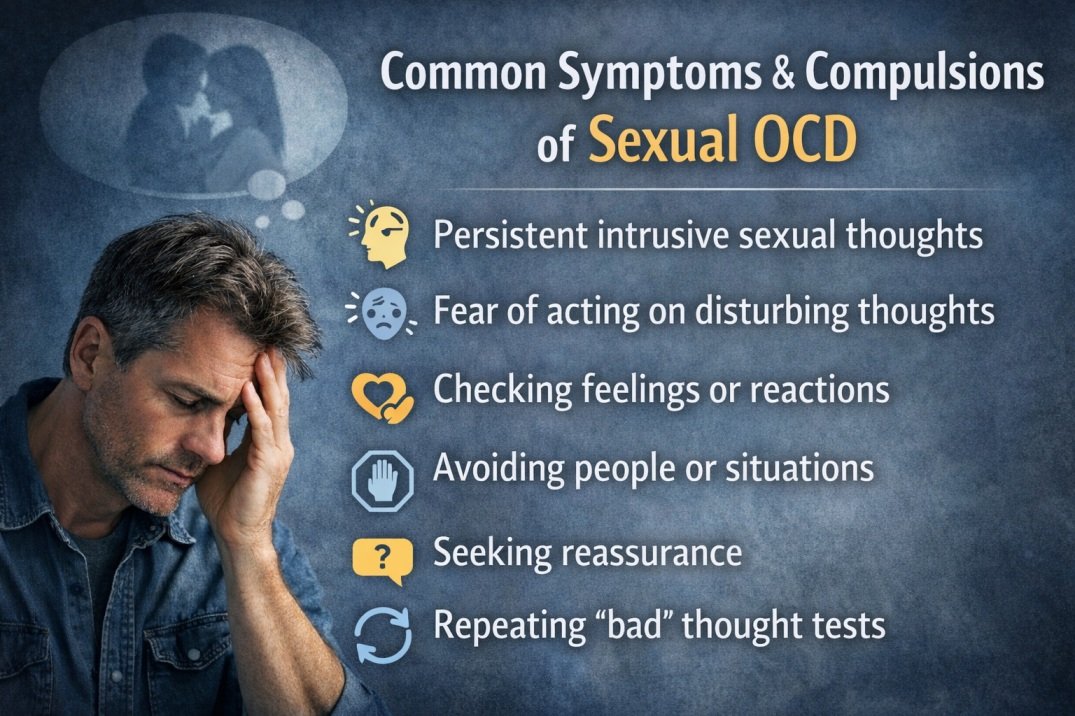
In intrusive sexual thoughts and OCD, the difficulty comes from two different layers:
- Symptoms = what shows up in your mind
- Compulsions = what you start doing to deal with it
These need to be clearly separated, because most people confuse the two.
Symptoms
- The same unwanted sexual thought or image repeats, even when you don’t engage with it
- The thought feels stuck, not passing like a normal random thought
- It creates immediate discomfort, not curiosity or interest
- The mind keeps throwing “what if” doubts without giving a clear answer
- The thought feels important or meaningful, even when you don’t want it to be
Compulsions
- Mental checking
Going back to the thought again and again
“Did I feel anything?” “Was there intention?” - Reassurance seeking
Trying to convince yourself repeatedly
“This is not me” “I would never do this” - Avoidance
Staying away from people or situations that trigger thoughts - Guilt loop / overthinking
Analysing the thought again and again
Feeling guilty → thinking more → feeling worse
The Psychological Reasons Behind Intrusive Sexual Thoughts and OCD
Intrusive sexual thoughts and OCD happen due to a few key psychological factors.
One is thought–action fusion, where the mind treats a thought as if it is the same as doing it, or fears it might lead to action.
These thoughts are also ego-dystonic, meaning they go against your values, which is why they feel disturbing.
There is misinterpretation of thoughts, where a random thought is taken as a sign of something deeper, instead of being seen as mental noise.
People may also have inflated responsibility, feeling they must control every thought to be a “good” person, leading to guilt when they cannot.
There is often intolerance of uncertainty, where the mind keeps asking what the thought means and cannot accept not knowing.
In some cases, trying to suppress thoughts can make them come back stronger.
How to Stop Sexual OCD and Intrusive Thoughts
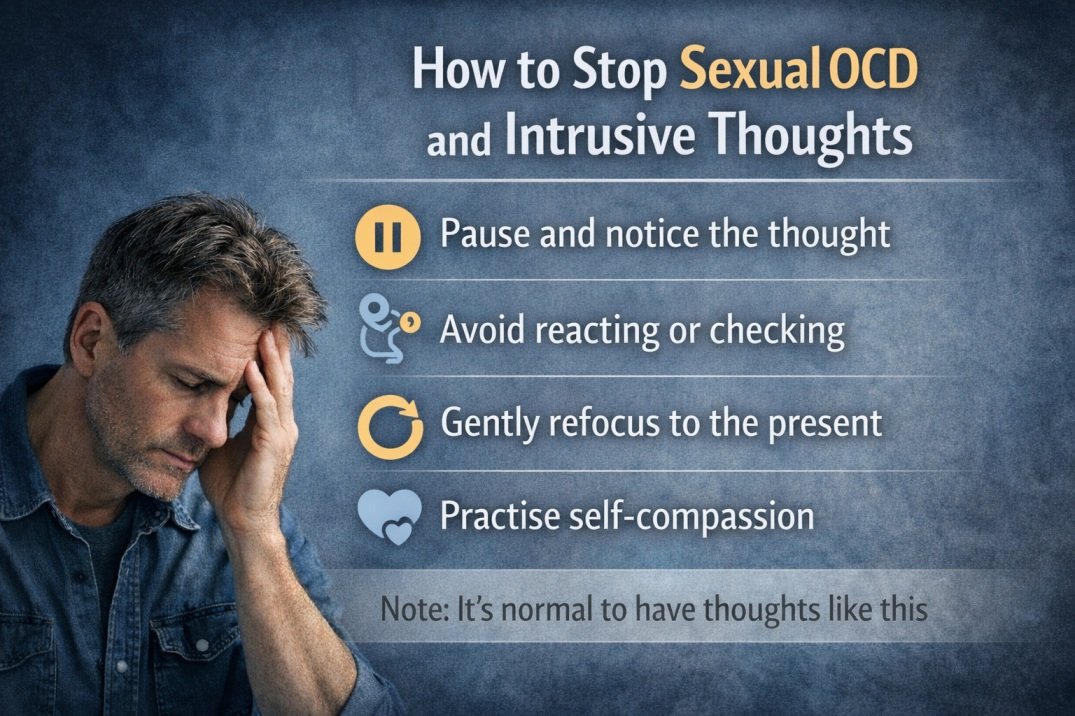
Stop analysing the thought
When the thought comes, do not try to understand why it appeared or what it means about you. In intrusive sexual thoughts and OCD, analysing the thought keeps it active. The more you try to figure it out, the more your mind returns to it. Treat it as a passing mental event and bring your focus back to what you were doing.
Label the thought and move on
Acknowledge it once: “this is an intrusive thought” or “this is OCD.” The purpose is recognition, not solving. Do not repeat it or argue with the thought. After labelling, shift your attention without engaging further.
Stop mental checking and reassurance
Do not go back to check your reaction, feelings, or intention. Questions like “did I feel something?” or “what does this say about me?” restart the cycle. Similarly, trying to reassure yourself that you are not that kind of person only gives short-term relief and keeps the doubt alive.
Do not avoid situations
Avoiding people, places, or interactions because of the thought strengthens the fear. It teaches your mind that the thought is dangerous. Instead, continue normal behaviour even if the thought is present. This reduces the importance your brain gives to it.
Allow the discomfort (ERP approach)
You may feel anxiety, guilt, or uneasiness when the thought appears. Do not try to remove these feelings. Allow them to be there without reacting. When you stop responding, the intensity naturally reduces over time. This is the core of Exposure and Response Prevention (ERP).
Use CBT, mindfulness, and acceptance
Cognitive Behavioral Therapy (CBT) helps you change your response pattern rather than the thought itself. Mindfulness helps you stay in the present instead of getting pulled into the thought. Acceptance means allowing the thought to exist without judging yourself or trying to control it.
What These Thoughts Do NOT Mean About You
In intrusive sexual thoughts and OCD, the mind tries to attach meaning to the thought and turn it into a judgment about who you are. That meaning is not accurate.
- You are not your thoughts
- You are not dangerous
- You are not secretly your fear
- These thoughts do not reflect your desires
- These thoughts do not mean you will act on them
- These thoughts do not define your character or identity
- These thoughts are not evidence of anything about you
When to Seek Professional Help
If these thoughts feel constant, take up a lot of your time, or are affecting your daily life, it may help to speak to a professional. You don’t have to wait for things to get worse.
You may consider help if:
- the thoughts are hard to manage
- you keep analysing or checking
- you are avoiding people or situations
- the shame or anxiety is affecting your life
Working with a therapist trained in OCD (CBT and ERP) can help you break this cycle.
You can explore:
Both options offer a safe, non-judgmental space to work through these thoughts.
Final Thoughts
If you’re in your 40s, these thoughts can feel more serious because they clash with how you see yourself and the life you’ve built. That’s why the shame feels stronger.
But this is not a sign of who you are. It’s a pattern your mind has fallen into.
You don’t need to figure out every thought or get complete certainty about what it means. That is what keeps you stuck.
Focus on changing how you respond, not what the thought is. That’s where the shift happens.
FAQs
Why do I have sexual thoughts I don’t want?
Sexual thoughts you don’t want happen because your mind produces random thoughts, and in intrusive sexual thoughts and OCD, these thoughts get stuck due to fear and overthinking. They feel disturbing because they go against your values, not because you want them.
Does having intrusive sexual thoughts mean I will act on them?
No, having intrusive sexual thoughts does not mean you will act on them. The fear and discomfort you feel show the thoughts are unwanted and not aligned with your intentions.
Why do intrusive sexual thoughts keep coming back again and again?
Intrusive sexual thoughts keep returning because you react by analysing, checking, or resisting them. This makes your mind treat them as important, increasing their frequency and making them harder to ignore.
How do I stop overthinking and checking intrusive sexual thoughts?
To stop overthinking and checking intrusive sexual thoughts, avoid analysing or checking them. Let the thought exist without reacting and gently shift your attention back to your current activity.
Why do I feel guilty or ashamed about intrusive sexual thoughts?
You feel guilty because you treat the thought as meaningful or as a reflection of your character. In reality, unwanted thoughts do not define you or your intentions.