
You want intimacy. You may even feel excited at first.
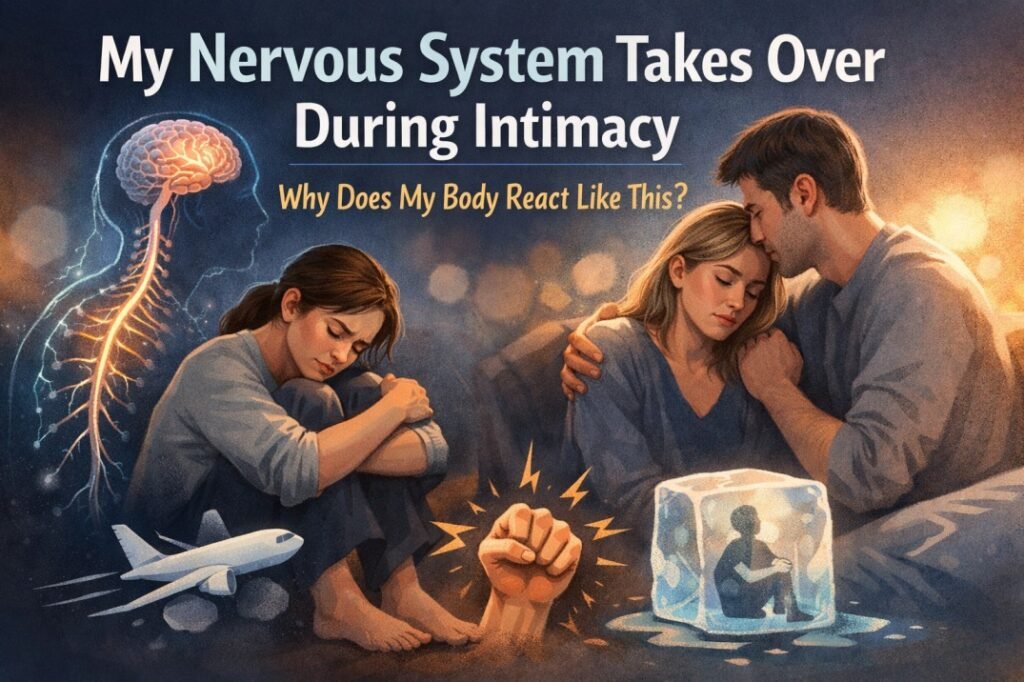
Then somewhere in the middle, something changes.
Instead of feeling your partner’s touch, you start thinking about yourself. Am I responding properly? Does my partner notice that I am tense? Am I taking too long? Why am I suddenly not as turned on?
Your body follows. You tighten up. Arousal drops. An erection may become difficult to maintain, lubrication may decrease, or kissing and touching suddenly start feeling like too much.
You may continue, but mentally you are no longer fully in the experience.
This is one of the most confusing parts: you wanted intimacy, so why did your body seem to pull away from it?
The answer is not always that you secretly do not want your partner or that something is wrong with your sexuality. Sexual response is sensitive to attention, pressure, stress, expectations, previous experiences and what is happening in your body in that moment.
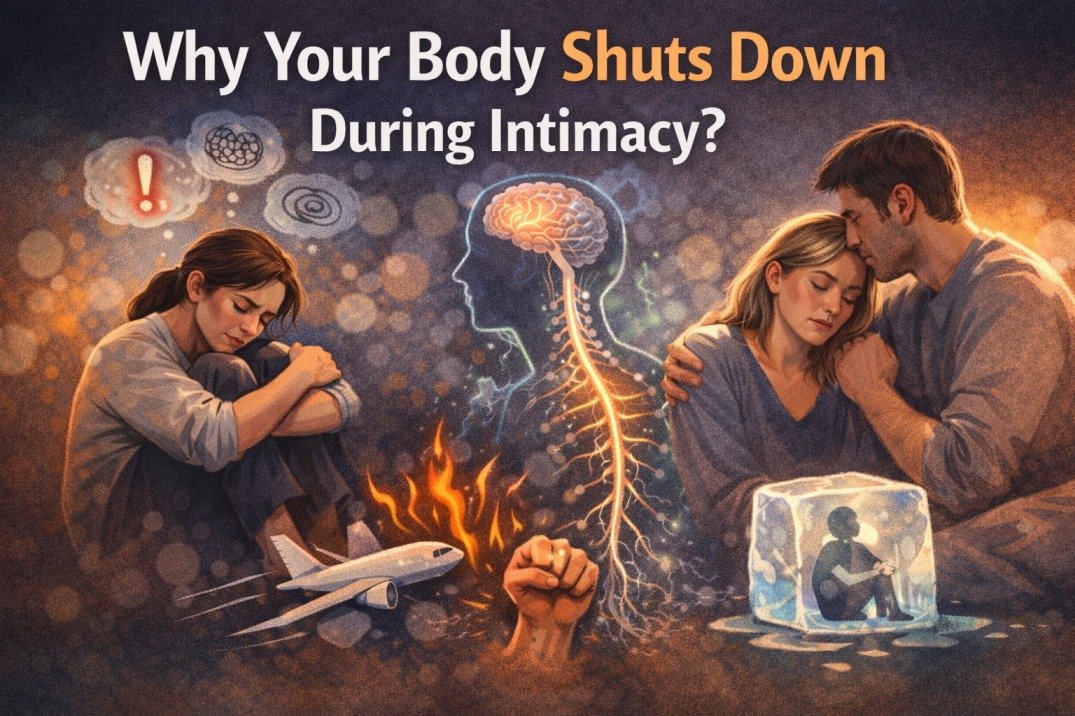
What Does It Mean When Your Body “Shuts Down” During Intimacy?
People describe this experience differently.
You might notice:
- sudden tension in your body
- your mind becoming unusually active
- losing an erection or lubrication
- wanting your partner to slow down
- feeling disconnected from what is happening
- finding it difficult to enjoy touch that felt good a few minutes earlier
- becoming very aware of how you are performing
- feeling an urge to pause or move away
Some people experience obvious anxiety. Their heart races, they feel panicky or they immediately know they are uncomfortable.
For others, it is much quieter.
They simply notice that pleasure has disappeared and their body is no longer responding naturally.
That distinction matters because not every sexual shutdown is a dramatic fight-or-flight reaction.
Sometimes the sexual response is simply being inhibited by pressure, self-monitoring, discomfort or stress.
How Can You Want Sex and Still Lose Arousal?
Sexual desire and sexual arousal are connected, but they are not identical.
You can want intimacy while something else in the situation is simultaneously putting the brakes on your sexual response.
Think of sexual response as having both an accelerator and brakes.
Attraction, touch, fantasy, connection and desire may be pushing the accelerator.
At the same time, thoughts such as these may be pressing the brakes:
- I need to stay hard.
- I should be more turned on by now.
- My partner expects sex.
- What if I cannot orgasm?
- What if this happens again?
- Do I look attractive?
- Am I satisfying them?
- Why isn’t my body responding?
The more important it becomes to make your body respond correctly, the harder it can become to remain absorbed in pleasure.
This is why telling yourself to “just relax” often does not solve it.
Now relaxing has become another thing you are trying to perform correctly.
When You Stop Experiencing Intimacy and Start Watching Yourself
This is one of the most common patterns we see when people describe their mind taking over during sex.
Instead of experiencing the moment from inside your body, you begin observing yourself.
You notice your erection.
You check whether you are lubricated enough.
You wonder whether your partner thinks you are enjoying yourself.
You evaluate whether the sex is going well.
In sex therapy, this kind of self-monitoring is sometimes described as spectatoring.
The problem is not that you had one distracting thought. Everyone does.
The problem begins when your attention repeatedly moves away from touch, pleasure, and connection and toward checking whether you are performing correctly.
Sexual performance anxiety can create this exact cycle. Cleveland Clinic notes that worries about pleasing a partner, erections, appearance or sexual performance can pull attention away from the experience and interfere with sexual interest and pleasure.
If erection anxiety is the main problem for you, our guide to performance anxiety and erectile difficulties explains that specific cycle in more detail.
Why Even Kissing Can Eventually Start Feeling Like Pressure
This is something people often find difficult to explain.
Kissing itself may feel good.
But once your mind starts treating kissing as the beginning of a sequence that must eventually lead to sex, the experience changes.
The body is no longer responding only to the kiss.
It may also be responding to everything you expect will happen next.
Kissing becomes:
kissing → more touching → sex → I need to become aroused → I need my body to work → I need to satisfy my partner.
That expectation can make even affectionate touch feel loaded.
You may begin pulling away much earlier than you used to because your mind is already anticipating the point at which you normally struggle.
This is one reason separating physical affection from the expectation of intercourse can sometimes be very helpful.
Touch does not always have to lead somewhere.
What Can Put the Sexual “Brakes” On?
There is rarely one universal reason.
Performance pressure
The more you believe you must achieve an erection, lubrication, penetration, orgasm or a particular level of desire, the more closely you may monitor whether it is happening.
Stress outside the bedroom
Your sexual response does not exist separately from the rest of your life.
Mental overload, work pressure, poor sleep, conflict or chronic stress can make it harder to become absorbed in intimacy.
Feeling that things are moving too quickly
You may want sex but still need more time to become comfortable, physically aroused or emotionally present.
Wanting intimacy does not mean every pace will feel right.
Previous difficult sexual experiences
An embarrassing, pressured, painful or frightening experience can make similar situations more anxiety-provoking later.
That does not automatically mean you have sexual trauma.
But if a past sexual experience was traumatic and intimacy now triggers strong fear, freezing or dissociation, therapy for the effects of sexual trauma may be more appropriate than treating the problem as simple performance anxiety.
Shame or body-consciousness
Sex can make people feel unusually exposed.
Thoughts about appearance, sexual experience, desire, erections, orgasm or being judged can quickly pull attention away from pleasure.
Pain or physical discomfort
If penetration, touch or another sexual activity is painful, your body may begin anticipating that discomfort before it happens.
Pain should not simply be treated as a psychological problem.
Persistent pain, dryness, erection changes or other physical symptoms deserve appropriate medical assessment.
How to Stop the Cycle During Intimacy
The goal is not to force your nervous system to calm down.
It is to reduce the things that keep turning intimacy into a test.
Slow down before your body shuts down
Most people wait until they have completely lost arousal before changing anything.
Notice the earlier signs.
Maybe your breathing changes.
You suddenly start thinking instead of feeling.
Touch becomes less enjoyable.
You notice yourself checking your erection or arousal.
That is the point to slow down.
You do not have to wait until the experience becomes uncomfortable.
Remove the expectation that touch must lead to sex
Spend time kissing, touching, hugging or lying together without automatically progressing toward intercourse.
This can be surprisingly important when your body has learned that every affectionate moment will eventually become a performance situation.
Knowing that you can stop at any point can make it easier to remain present.
If sexual intimacy has started feeling like pressure rather than pleasure, our guide to being sexually satisfied without pressure or stress explores this shift in more detail.
Stop testing whether you are aroused enough
Repeatedly checking your body keeps attention on the problem.
Instead of asking:
Am I hard enough?
Am I wet enough?
Am I turned on enough?
bring your attention back to what you can actually feel.
Warmth.
Pressure.
Breathing.
Touch.
Movement.
Pleasure does not have to be measured every few seconds.
Tell your partner what is happening
You do not need to give a psychological explanation during sex.
Simple communication is enough.
Ask to slow down.
Change what you are doing.
Pause.
Move back to something that feels easier.
Knowing that you do not have to hide the change in your body can itself reduce pressure.
Do not push through just to prove you can
Continuing when you already feel tense, disconnected or uncomfortable can make the next experience more difficult.
Pausing does not mean the sexual encounter has failed.
Sometimes stopping the performance goal is exactly what allows intimacy to start feeling safe and enjoyable again.
What If It Keeps Happening?
One difficult sexual experience is not necessarily a problem.
It becomes more important to look at the pattern when:
- it happens repeatedly
- you become anxious before intimacy even begins
- kissing or physical affection starts triggering anticipatory pressure
- you increasingly avoid sex
- you cannot stop monitoring your body’s response
- your partner begins interpreting the shutdown as rejection
- you feel ashamed or frightened about the next sexual experience
- it is affecting erections, lubrication, orgasm or enjoyment consistently
At that point, trying harder usually does not help.
The pattern itself needs attention.
Do Not Assume It Is Always Psychological
This is important.
Changes in sexual response can also have physical causes.
Medication, hormonal changes, fatigue, pain, pelvic-floor difficulties, vaginal dryness, erectile difficulties and other health conditions can affect sexual functioning.
If the change is persistent, appeared suddenly, involves pain, or happens even when you feel relaxed and comfortable, consider discussing it with an appropriate medical professional.
Psychological and physical factors can also exist together.
You do not have to decide that it is either “in your mind” or “in your body.”
When Sex Therapy Can Help
If you repeatedly want intimacy but your mind starts monitoring, your body tightens, arousal disappears or you increasingly avoid sexual situations because you expect the same thing to happen again, this is a concern worth bringing to a sex therapist.
This is precisely the type of pattern online sex therapy at LeapHope can work with.
Sex therapy may focus on:
- reducing performance monitoring
- understanding what triggers the shutdown
- separating touch from performance expectations
- rebuilding comfort with physical intimacy
- managing anticipatory anxiety
- communicating with your partner without embarrassment
- gradually returning attention to pleasure instead of performance
The aim is not to make you “perform better.”
It is to help intimacy stop feeling like something your body has to pass.
If a medical issue, significant pain or another physical concern appears to be contributing, a therapist may also recommend getting the appropriate medical assessment rather than treating everything as anxiety.
Final Thoughts
When your body shuts down during intimacy, it does not automatically mean you do not want sex, are no longer attracted to your partner, or have something seriously wrong with you.
Sometimes desire is present while pressure, self-monitoring, stress, discomfort or previous experiences are simultaneously putting the brakes on arousal.
The more you try to force your body to respond correctly, the easier it is to become trapped in the same cycle.
Instead of asking only, “Why won’t my body cooperate?”, pay attention to what happens immediately before the shift.
When do you stop feeling and start thinking?
When does touch begin feeling like an expectation?
When do you start checking whether your body is working?
Those moments often tell you far more about the pattern than the shutdown itself.
FAQs
Why does my body shut down during intimacy even when I want sex?
Wanting sex does not guarantee that arousal will continue automatically. Performance pressure, self-monitoring, stress, discomfort, anticipation or previous negative experiences can inhibit sexual response even when desire is present.
Can overthinking make you lose sexual arousal?
Yes. Constantly checking how you are performing or whether your body is responding can shift attention away from pleasurable sensations. This can make erection, lubrication, orgasm or enjoyment more difficult.
Why do I suddenly feel disconnected during sex?
Some people become disconnected when they feel overwhelmed, anxious, pressured or highly self-conscious during intimacy. If the disconnection is intense, happens repeatedly or is connected with past trauma, professional support may help identify the pattern.
Should I keep going if my body suddenly stops responding?
You do not need to push through. Slowing down, pausing or changing the activity can reduce pressure and help prevent the experience from becoming another stressful sexual memory.
Can sex therapy help if my body shuts down during intimacy?
Yes. Sex therapy can help when performance monitoring, anxiety, pressure, avoidance or difficult past experiences repeatedly interfere with intimacy. The work usually focuses on understanding the pattern and rebuilding comfortable, pleasure-focused sexual experiences.