
Last Updated on September 11, 2026
Reviewed by Aradhana Gambhir, Senior Psychologist, 25+ Years of Experience, with experience supporting relationship and intimacy concerns.
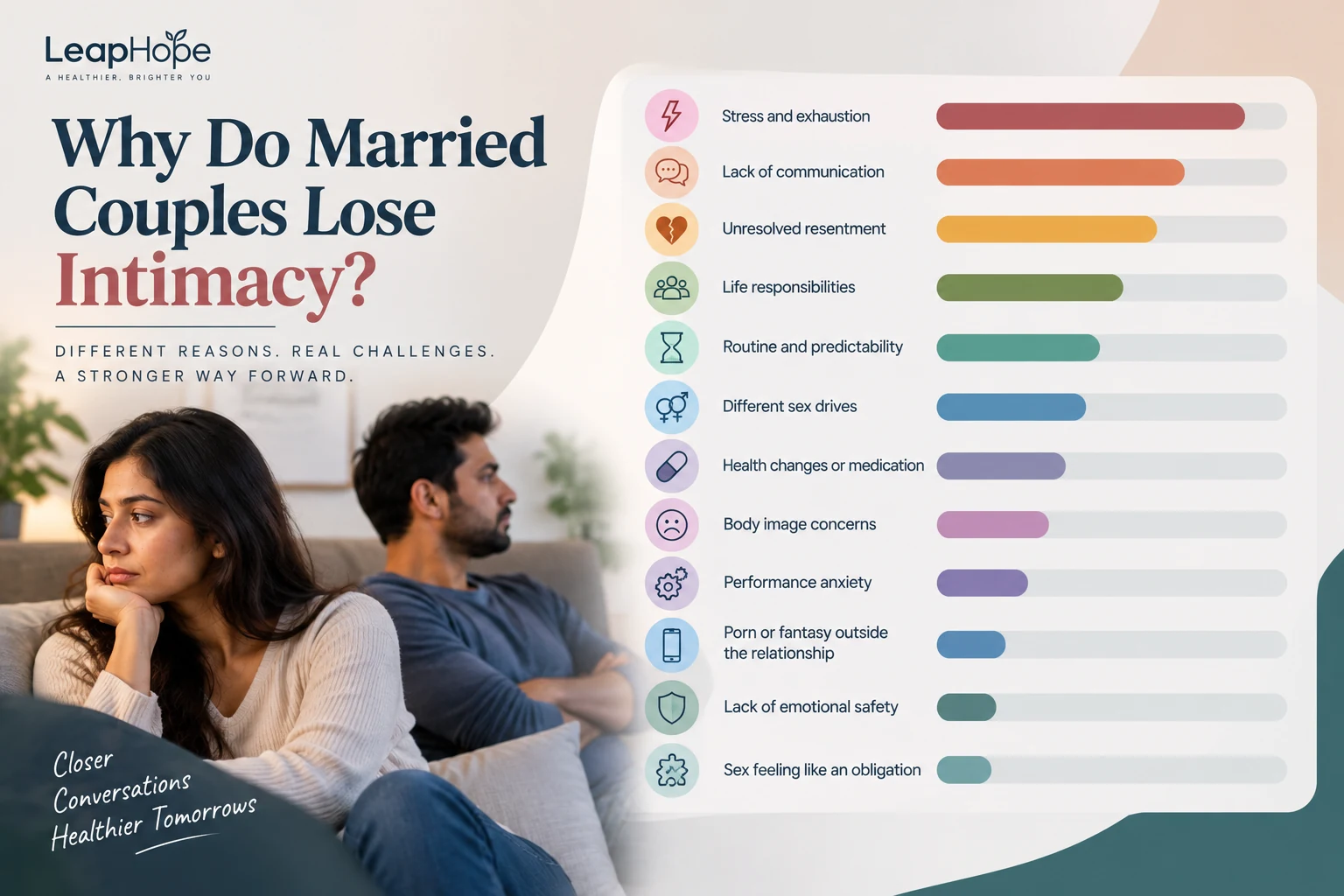
Most married couples do not wake up one morning and suddenly lose intimacy.
It usually changes slowly.
You kiss less. Sex becomes less frequent. One person stops initiating. Touch becomes practical rather than affectionate. You still love each other, but the sexual closeness that once felt natural starts requiring effort.
This article focuses mainly on sexual and physical intimacy in marriage: why desire, initiation, affection, attraction, and sexual connection can gradually fade even when the relationship itself continues.
1. Your Marriage Became More About Managing Life Than Being Lovers
In the beginning, you mainly knew each other as romantic partners.
Years later, you may also be:
- parents
- bill payers
- caregivers
- household managers
- problem solvers
- drivers
- planners
Most conversations become:
“Who is picking up the kids?”
“Did you pay the electricity bill?”
“What time are your parents coming?”
Nothing is wrong with those conversations. They are part of married life.
The problem starts when almost every interaction becomes functional.
You may still love your spouse deeply while gradually seeing them more as the person you manage life with than the person you flirt with, desire, or anticipate being close to.
Maintaining physical intimacy in marriage often requires preserving some room for affection and couplehood outside responsibilities.
2. Stress and Mental Load Leave Little Space for Desire
A stressful day can follow you into the bedroom.
Work deadlines, children, finances, caregiving, poor sleep, household responsibilities, and constant decision-making can leave very little mental space for sexual interest.
You may love your spouse and still think:
“Please don’t touch me. I just want to sleep.”
This does not automatically mean attraction has disappeared.
Sometimes desire is competing with exhaustion.
This is especially noticeable when one partner can mentally switch out of work or parenting mode quickly while the other needs time to relax before sexual interest appears.
3. Unresolved Resentment Changed How Closeness Feels
Sexual distance sometimes begins outside the bedroom.
You may be carrying resentment because your spouse:
- rarely helps with something important
- dismissed a concern repeatedly
- broke your trust
- criticised you
- made you feel taken for granted
- repeatedly ignored an agreement
You might still function well together.
But when resentment sits underneath daily life, being physically vulnerable with that person can become harder.
A partner may say:
“Why don’t you ever want to be close anymore?”
while the other is thinking:
“I’m still angry about things we never really resolved.”
Intimacy can fade when emotional repair keeps getting postponed.
4. You Became Emotionally Distant Without Having a Major Fight
Not every intimacy problem comes from obvious conflict.
Some couples stop sharing gradually.
You still discuss children, work, groceries, appointments, and family plans, but rarely talk about:
- fears
- disappointments
- hopes
- attraction
- loneliness
- sex
- what has changed between you
The marriage may look peaceful from the outside.
Inside, both people may feel slightly disconnected.
When emotional closeness becomes mostly practical, sexual intimacy can start feeling disconnected too.
If communication itself has become thin or purely functional, read more about lack of communication in marriage.

5. Repeated Rejection Made One Partner Stop Initiating
Sex requires somebody to make the first move.
If one partner repeatedly initiates and frequently hears:
“Not tonight.”
“I’m too tired.”
“Maybe tomorrow.”
they may eventually stop trying.
Not necessarily because they stopped wanting sex.
Initiating may simply have started feeling too vulnerable.
Meanwhile, the other partner may notice:
“They never touch me anymore.”
Now both people can wrongly assume the other has lost interest.
If the main problem in your relationship is that one person has become tired of always initiating intimacy, that deserves its own conversation rather than being treated only as low libido.
6. Sex Started Feeling Expected Instead of Wanted
Desire changes when sex starts feeling like an obligation.
Comments such as:
“It’s been two weeks.”
“You never initiate.”
“Other couples have more sex than us.”
“We should be doing it more often.”
may come from genuine frustration.
But repeated frequency discussions can make sex feel measured.
One partner starts anticipating disappointment or another conversation about how often they have sex.
Now initiation creates pressure rather than excitement.
The more pressured someone feels to become interested, the harder spontaneous interest may become.
That does not mean sexual needs should never be discussed. It means the discussion needs to be about both partners’ experience, not only achieving a target number.
7. Your Sex Drives Became More Different Over Time
Couples do not always want sex at the same frequency.
One spouse may think about sex several times a week.
The other may be perfectly content with much less.
That difference may have been easy to overlook when the relationship was new and sexual novelty was high.
Later, the underlying mismatch becomes clearer.
Life changes can widen it further.
One partner’s desire may stay relatively stable while the other’s drops with stress, medication, pregnancy, parenting, ageing, health changes, or relationship difficulties.
A persistent difference does not automatically mean you are incompatible. But it does need to be understood.
Read more about low sex drive in marriage and sexual incompatibility in relationships if desire difference is the main issue.
8. Flirting, Anticipation and Variety Gradually Disappeared
Sexual intimacy does not always begin in bed.
Earlier in your relationship, there may have been:
- teasing
- flirting
- long kisses
- private jokes
- sexual messages
- anticipation before meeting
- affectionate touch during the day
- curiosity about each other
Years later, sex may start suddenly at 11 PM after both people have finished chores and looked at their phones for an hour.
That is a very different context for desire.
Sex may also follow the same sequence every time.
Same initiation. Same timing. Same touch. Same ending.
Predictability is not inherently bad, but some couples lose curiosity when intimacy becomes heavily scripted.
If the relationship is still loving but sex has become repetitive, the issue may be less about “having more sex” and more about improving your sex life as a couple.
9. Health, Hormones, Medication or Pain Changed Desire
Not every loss of intimacy is a relationship problem.
Sexual desire and function can change because of:
- antidepressants and other medications
- menopause or perimenopause
- pregnancy and postpartum changes
- breastfeeding
- low testosterone
- erectile difficulties
- vaginal dryness
- painful sex
- chronic illness
- depression or anxiety
- poor sleep
- fatigue
Cleveland Clinic notes that libido can be affected by physical health, mental health, ageing, relationship factors, stress, medications, hormonal changes, pregnancy, menopause, pain, and sexual-function concerns. Read Cleveland Clinic’s medically reviewed guide to low libido.
If desire changed suddenly or sex has become painful or physically difficult, do not assume the explanation is simply boredom or relationship dissatisfaction.
A medical assessment may be appropriate.
10. Body Confidence or Sexual Performance Anxiety Got in the Way
Sometimes desire is present, but sex itself has become stressful.
A person may be thinking:
“Will I be able to perform?”
“Do they still find my body attractive?”
“What if I can’t stay aroused?”
“What if I don’t orgasm?”
“What if they notice I’ve gained weight?”
Now attention moves away from pleasure and into self-monitoring.
Sex starts feeling like something you can fail at.
That can lead to avoiding initiation even when attraction remains.
If performance concerns are part of the pattern, LeapHope’s guide to sexual performance anxiety and erectile difficulties goes deeper into that issue.
11. Sexual Attention Shifted Toward Fantasy, Porn or Somewhere Else
Fantasy itself is normal.
Masturbation itself does not mean something is wrong with a marriage.
Porn use also does not automatically explain a loss of partnered desire.
The pattern matters.
It becomes relevant when private sexual stimulation consistently feels easier or more appealing than navigating intimacy with a spouse.
For example, solo sexual activity may involve:
- no risk of rejection
- no need to discuss preferences
- no performance pressure from another person
- total control over timing
- immediate access to novelty
Sexual attention can also sometimes shift toward another person.
That does not mean every loss of marital desire indicates infidelity.
But if someone is investing romantic or sexual energy outside the marriage, intimacy at home can change.
The question is not simply, “Do you use porn?” or “Do you fantasise?”
It is:
“Has sexual energy moved away from the relationship in a way that is affecting intimacy between us?”
12. Sex No Longer Feels Emotionally or Physically Safe
Sexual intimacy requires vulnerability.
That becomes difficult when sex is connected with:
- criticism
- humiliation
- repeated pressure
- painful experiences
- betrayal
- body shaming
- fear of rejection
- coercion
- unresolved sexual trauma
Someone may still love their spouse but become guarded during sexual situations.
They may avoid initiation, feel numb during sex, or struggle to relax enough for desire to develop.
Past experiences can matter too. Sexual trauma does not disappear simply because someone is now in a loving marriage.
LeapHope’s resource on healing from sexual trauma explains this more carefully.
Why Can Someone New Feel Exciting When Your Spouse Doesn’t?
This can be one of the most confusing parts of fading intimacy.
You may have little sexual interest at home but suddenly notice attraction toward somebody new.
That does not automatically mean the stranger is a better partner or that your marriage is over.
A new person carries very little history.
You have not:
- argued about money with them
- divided household chores
- experienced sexual rejection with them
- raised children together
- seen them through illness and exhaustion
- repeated the same sexual routine for years
There is much more unknown.
And where information is missing, imagination can fill in the rest.
Your spouse represents a real relationship with history, responsibility, imperfections, and emotional consequences.
Someone new can remain largely fantasy.
That contrast can make novelty feel unusually intense.
Before treating attraction to somebody else as proof that your spouse is no longer attractive, look at what has changed inside the marriage itself.
Is It Normal for Intimacy to Change After Marriage?
Yes, sexual intimacy can change across a long relationship.
Your sex life at 35 may not look like your sex life at 25.
Pregnancy, children, work, health, ageing, grief, medication, stress, and changing priorities can all affect intimacy.
But “change” and “complete disappearance” are not the same thing.
A period of less frequent sex may be completely manageable for one couple and deeply distressing for another.
There is no universal number that defines a healthy marriage.
The more useful questions are:
- Are both of you comfortable with the current level of intimacy?
- Does either person feel repeatedly rejected or pressured?
- Can you talk about sex without fighting?
- Has affection disappeared too?
- Has desire changed suddenly?
- Does sex feel safe and mutually wanted?
When Fading Intimacy Becomes a Sexless Marriage
Intimacy can gradually decrease until sex becomes very rare or stops almost completely.
At that point, repeating the same question – “Why aren’t we having sex?” – often does not help.
The couple may need to look at what created the distance:
- desire mismatch
- unresolved resentment
- health changes
- repeated rejection
- sexual dissatisfaction
- emotional disconnection
- pressure around sex
If that is already where your relationship is, read LeapHope’s guide on how to fix a sexless marriage.
For couples who want professional help specifically around long-term sexual disconnection, LeapHope also offers sexless marriage counselling.
When Can Sex Therapy Help With Fading Intimacy?
Sex therapy can be useful when you both know intimacy has changed but cannot understand why or keep getting stuck in the same conversations.
Common reasons couples seek help include:
- mismatched sexual desire
- one-sided initiation
- repeated rejection
- performance anxiety
- sexual boredom
- difficulty discussing sex
- low desire
- sex becoming pressured
- loss of emotional or physical closeness
LeapHope provides online sex therapy for adults and couples worldwide.
For people specifically seeking support in India, online sex therapy in India is available for concerns involving desire, intimacy, sexual communication, performance, and mismatched sexual needs.
If fading intimacy is closely connected with broader relationship conflict, resentment, trust concerns, or communication difficulties, online marriage counselling may be the more appropriate starting point.
Final Thoughts
Married couples can lose intimacy for very different reasons.
Sometimes life became too practical.
Sometimes stress overwhelmed desire.
Sometimes resentment remained unresolved.
Sometimes one partner became tired of rejection.
Sometimes sex became pressured or repetitive.
And sometimes the explanation is medical rather than relational.
The important point is not to reduce every intimacy problem to:
“We aren’t attracted to each other anymore.”
That may be true for some couples, but it is far from the only explanation.
A better question is:
“What changed between the time intimacy felt natural and the way it feels now?”
That is usually where the useful conversation begins.
Frequently Asked Questions
Why do married couples lose intimacy?
Married couples can lose intimacy because of stress, exhaustion, resentment, emotional distance, different sex drives, repeated rejection, sexual pressure, predictable routines, health changes, medication, pain, performance anxiety, or unresolved relationship concerns.
Why does intimacy stop in a marriage?
Intimacy may stop when several smaller issues build over time. One partner may stop initiating, sex may become pressured or unsatisfying, resentment may remain unresolved, or physical and mental health changes may reduce desire.
Is it normal to lose intimacy in a marriage?
Some change in sexual frequency is common across long relationships. It becomes more important to address when one or both partners feel distressed, repeatedly rejected, pressured, disconnected, or unable to discuss the change openly.
Why does physical intimacy decrease after marriage?
Physical intimacy may decrease as responsibilities increase, affection becomes less intentional, stress rises, and partners spend more time managing daily life. Health changes, desire differences, relationship tension, and repeated rejection can also contribute.
Can intimacy come back after it fades?
Yes. Fading intimacy does not automatically mean attraction or the marriage is finished. Improvement depends on understanding what caused the change and addressing the relevant relationship, sexual, psychological, or medical factors.
Why am I attracted to other people but not my spouse?
A new person may feel exciting because there is novelty, fantasy, and no shared history of responsibilities or rejection. Attraction elsewhere does not automatically mean your marriage is over, but it may reveal something worth examining.
Can stress cause loss of intimacy in marriage?
Yes. Stress can reduce mental space, energy, sexual interest, and emotional availability. It can also affect partners differently, with one person seeking more closeness while the other needs rest or space.
When should we seek help for lack of intimacy in marriage?
Consider professional help when intimacy loss causes ongoing distress, arguments, rejection, pressure, avoidance, emotional distance, or a near-complete loss of sexual connection that you have been unable to address together.