Last Updated on October 21, 2026
Clinical Reviewer: Amritha H., Counselling Psychologist & Certified CBT Practitioner
Your child was excited about a friend’s birthday party until they remembered there’s a dog at the house. You’ve explained that the dog will stay in another room. Your child still begs you not to go.
Should you cancel, encourage them to attend or seek help? Parents face this question about dogs, bugs, pools, storms and many other fears.
Fear is a normal part of childhood. But when a fear starts to shape where your child goes, what they try and how the family plans its day, it’s time to look more closely.
What Are Common Childhood Fears?
As children grow, they learn about new kinds of danger. Young children fear strangers, loud sounds and things they imagine. Older children begin to worry about illness, injury and harm outside the home.
Common Childhood Fears by Age
| Age | Fears children often experience |
|---|---|
| Babies and toddlers | Unfamiliar people, separation from parents and sudden sounds such as a vacuum cleaner or hand dryer. |
| Preschoolers (3–5 years) | Darkness, monsters, animals, loud noises and unfamiliar experiences. |
| School-age children (6–9 years) | Thunderstorms, getting lost, injuries, illness and death. |
| Older children and teenagers | Accidents, serious illness, personal safety and harm coming to family members. |
These age ranges are guides. A ten-year-old can still fear the dark, and a toddler can have a strong fear of an animal they’ve met before.
Childhood Fear vs Specific Phobia: What’s the Difference?
A specific phobia is a marked fear of a particular object or situation that is out of proportion to the actual danger. The child usually avoids the trigger or endures it with intense distress. For a diagnosis, the fear must last and cause real distress or disrupt daily life.
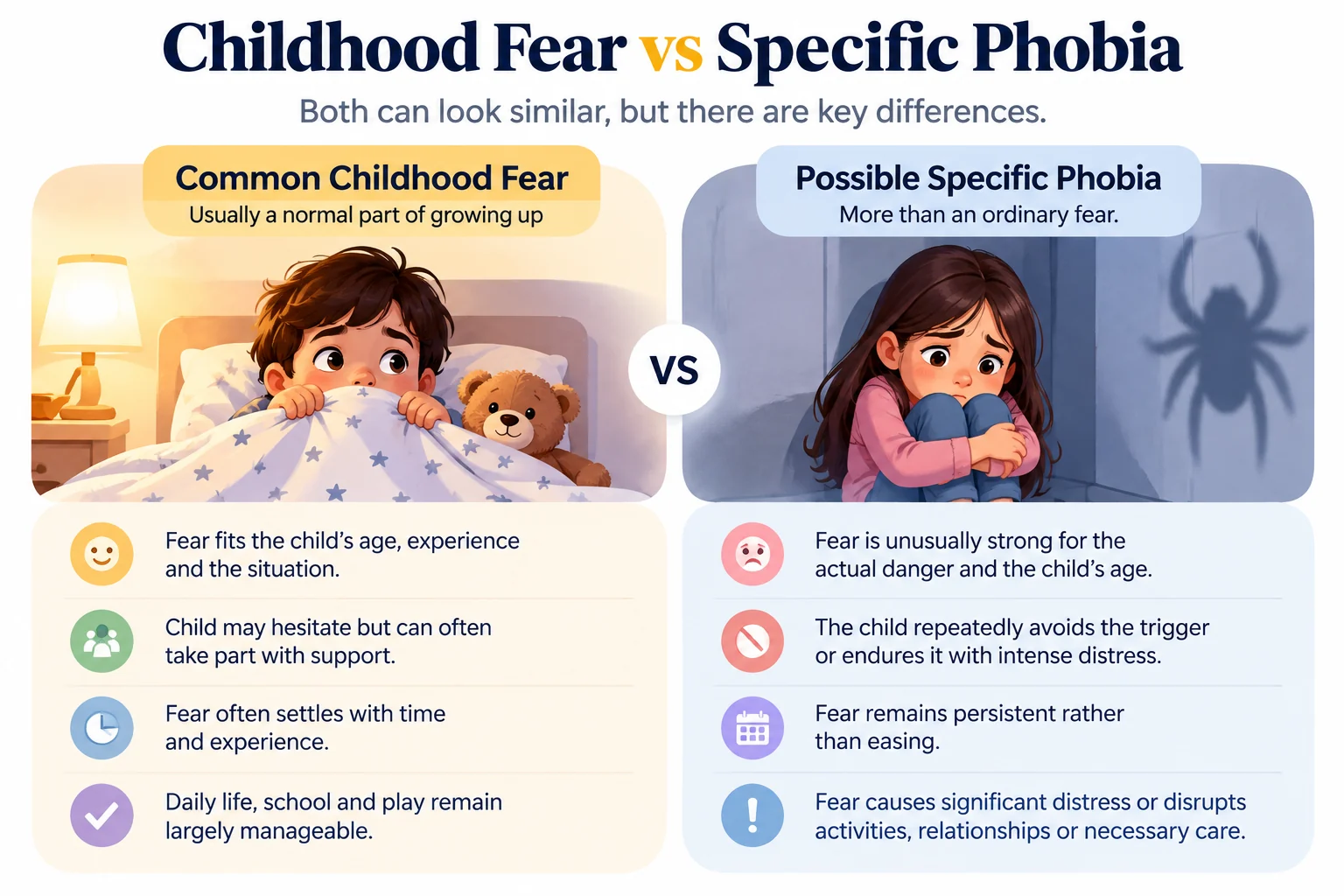
A child can cry, freeze or cling to a parent during an ordinary fright. How loudly they cry tells us little on its own. Watch what happens before, during and after the event.
| What parents notice | Common childhood fear | Possible specific phobia |
|---|---|---|
| Response | Fear fits the child’s age, experience and the situation. | Fear is unusually strong for the actual danger and the child’s developmental stage. |
| Trigger | Fear arises in an upsetting or unfamiliar situation. | The same object or situation almost always brings on immediate fear. |
| Avoidance | The child may hesitate but can often take part with support. | The child repeatedly avoids the trigger or endures it with intense distress. |
| Persistence | The fear often settles with time and experience. | The fear remains persistent rather than easing. |
| Daily impact | School, play and family routines remain largely manageable. | Fear causes significant distress or disrupts activities, relationships or necessary care. |
Why Has My Child Suddenly Become Afraid of Something?
A child who once used the bathroom alone may refuse after a loud toilet flush scares them. Another may refuse a swimming lesson after swallowing water in the pool.
One bad experience can start a fear. Children also learn about danger from adults, the news and their own thoughts. Sometimes there is no clear cause.
Can Scary YouTube Videos, Reels and Games Affect a Child’s Fears?
Yes. Scary images can linger long after a child turns off the screen. The American Academy of Pediatrics notes that disturbing films and videos can leave some children upset for days and contribute to nightmares.
A fake horror clip can look real to a young child. A jump scare in a game can catch them off guard. Later, the child asks whether someone could enter through the window or whether a frightening character is real.
Ask what they saw and what they believe might happen. Watch with them when you can. Explain what’s made up, and review age ratings, suggested videos and autoplay. Don’t punish a child for telling you what scared them.
Pain, sensitivity to noise or problems at school can also change how a child acts. If a daily task suddenly scares your child, ask what has changed and check for physical discomfort.
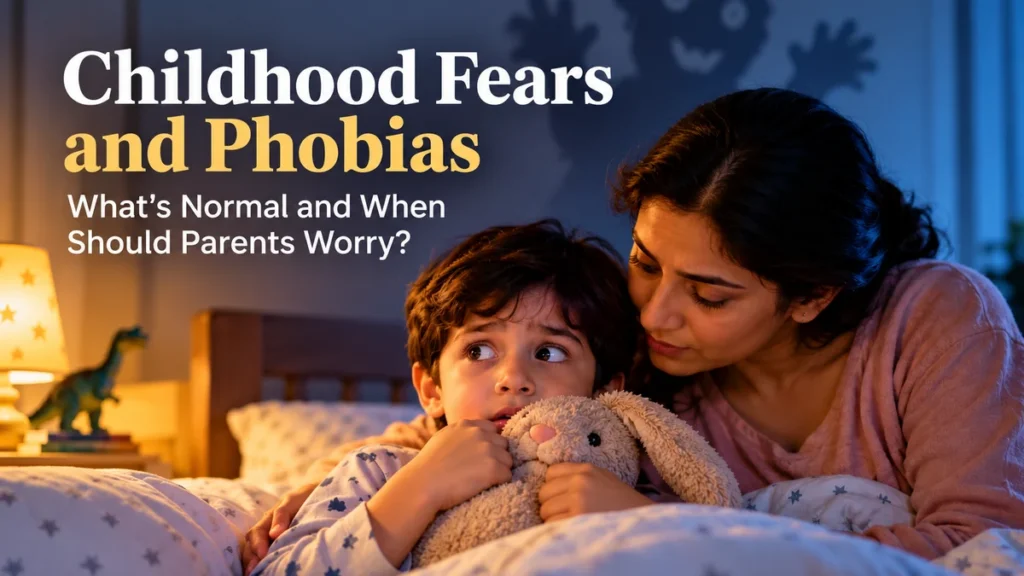
My Child Is Scared at Night or Screams in Their Sleep. Is That a Phobia?
These three problems can look alike:
Fear while awake: Your child refuses to enter a dark room, asks you to check behind the door or wants someone beside them. They can tell you what scares them. A steady bedtime routine, a small nightlight and calm support can help.
Nightmare: Your child wakes from a frightening dream, recognises you and may remember the dream. Comfort them and help them settle back to sleep.
Night terror: Your child screams, thrashes or looks terrified but remains asleep. They may not know you’re there and often recall nothing the next day. Night terrors are sleep events, not evidence of a specific phobia.
During a night terror, stay close, keep them safe and don’t try to force them awake. Speak to a paediatrician if these spells happen often, cause injury, involve odd movements or breathing problems, or leave you worried.
When Should Parents Worry About Childhood Fears?
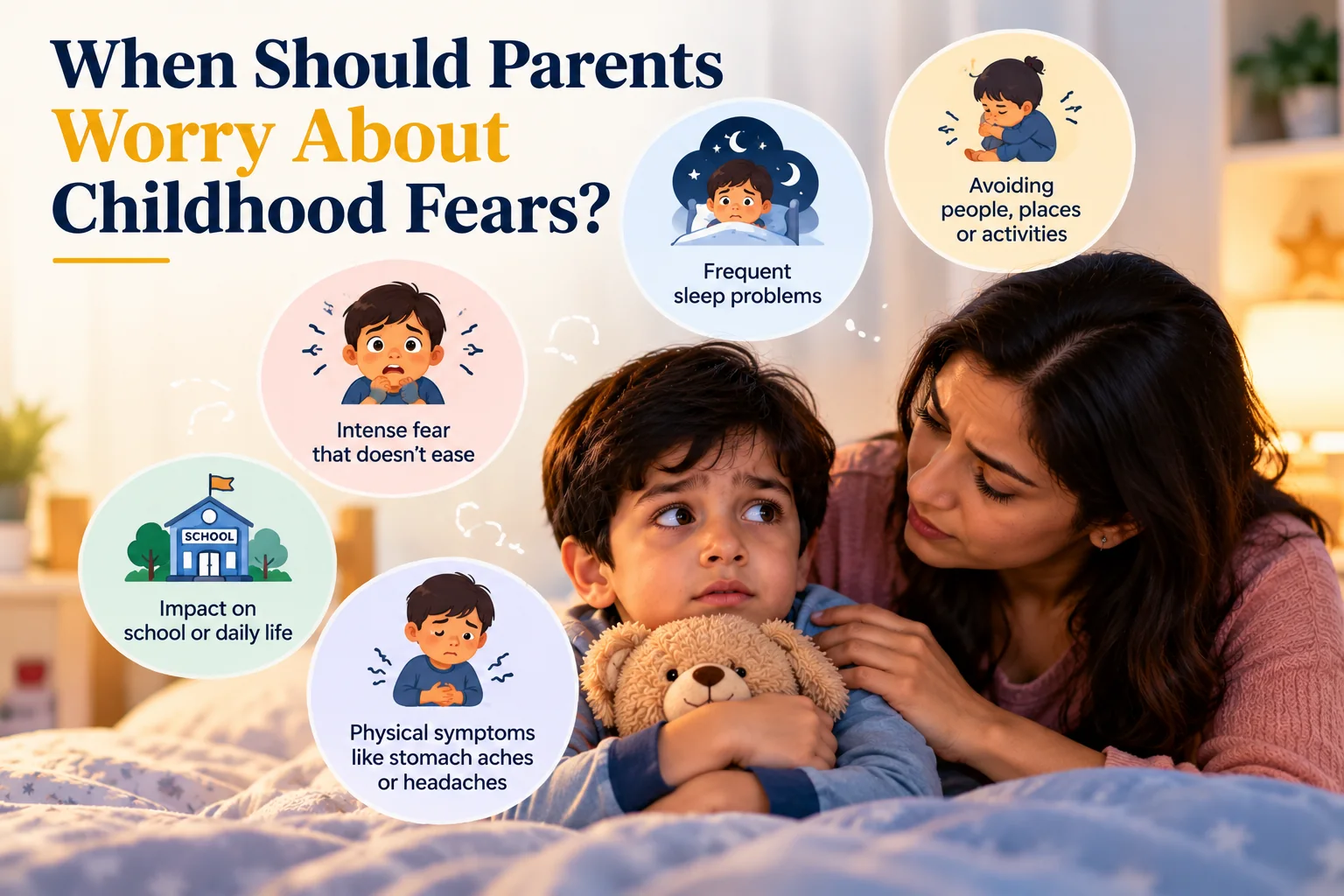
Watch for these five signs.
1. Your Child Stops Doing Things They Want to Do
Your daughter watches her siblings play in the garden but refuses to join them because she might see a bee. She feels left out, but staying indoors brings quick relief. That relief can make it harder to go outside next time.
2. The Worry Starts Long Before the Event
Your child is afraid of thunderstorms. Now they check the forecast each morning, become upset at the sight of dark clouds and plead to cancel plans even when no storm has begun.
This is anticipatory anxiety: fear driven by what the child expects to happen.
3. The Reaction Is Intense and Hard to Recover From
Some children shake, freeze, cry uncontrollably or try to escape. Others complain of nausea or a racing heart. The body’s fear response is real, but these signs alone don’t prove a phobia.
Note how often this happens and how long your child takes to calm down. A doctor should check new or lasting physical symptoms.
4. Fear Gets in the Way of Necessary Healthcare
A child who fears needles may become too distressed to complete a needed blood test or vaccination. Tell the healthcare team beforehand. Ask about preparing your child, reducing pain and making the visit easier. Mention any history of dizziness or fainting around needles.
Shame won’t help a child get through a painful or feared procedure.
5. The Fear Persists or Intensifies
A brief fear can grow into months of distress, even with support at home. Note the trigger, how your child reacts and whether things get better or worse. A clinician can use these details during an assessment.
How long does fear have to last to be a phobia? Diagnostic criteria for specific phobia generally require at least six months of symptoms, along with disproportionate fear and significant distress or impairment. Six months is not a waiting period for getting help. Seek advice earlier when distress is severe or daily life is being disrupted.
If your child worries about many different things, read LeapHope’s guide to the signs of anxiety in children.
How Can Parents Help a Child Who Is Frightened?
Ask what exactly scares them. A child refusing swimming lessons may fear putting their face underwater, not the pool itself. Ask, “Which part scares you?” instead of trying to reassure them again and again.
Show you understand the fear without treating a made-up threat as real. “That sound startled you. Let’s see where it came from” is more helpful than ridicule or a long debate about whether the fear makes sense.
Practise small steps without forcing contact. A child afraid of balloons popping might first watch a quiet game from a distance. Give them time to get used to each step. For severe phobias, a trained clinician should plan each step. Forcing a child into the feared event can make fear worse.
Coordinate with other adults. If the fear affects school, lessons or visits with relatives, explain which responses help. Agree on a plan so one adult isn’t pushing while another lets the child avoid it all.
Do not practise exposure around real hazards. A child still needs safety rules around roads, animals, water and severe weather.
When Should You Consult a Child Psychologist?
See a child psychologist if fear keeps your child from activities, causes severe distress or blocks needed care. An assessment looks at what starts the fear, what the child avoids and whether pain, sound sensitivity or another concern is involved.
Cognitive behavioural therapy (CBT) with planned exposure is an effective treatment for specific phobias. The ASPECT trial studied 268 children and teenagers aged 7–16. A structured one-session treatment was no less effective than multisession CBT on the main measure of fear-related avoidance at six months. Therapy uses planned steps with support, not a surprise test of bravery.
LeapHope offers online child anxiety counselling for children with strong, lasting fears and online parenting counselling for parents who want help responding to those fears at home.
Resources and Research
- American Academy of Pediatrics. Fears & Phobias in Children: How Parents Can Help.
- American Academy of Pediatrics. Nightmares, Night Terrors & Sleepwalking in Children.
- American Academy of Pediatrics. Should I Let My Child Watch Scary Movies?.
- Merck Manual Professional Edition. Specific Phobias. Clinical review updated April 2026.
- Wright, B., et al. (2023). One session treatment (OST) is equivalent to multi-session cognitive behavioral therapy (CBT) in children with specific phobias (ASPECT): results from a national non-inferiority randomized controlled trial. Journal of Child Psychology and Psychiatry, 64(1), 39–49. Read the study.