Last Updated on October 21, 2026
Clinically Reviewed by Amritha H., Counselling Psychologist
Your child asks, “Are you sure everything will be okay?” You reassure them, and they seem satisfied. But a few minutes later, they’re asking again.
Perhaps they keep checking whether you’re upset with them, whether their homework is correct, or whether something bad might happen. You’ve already explained everything, sometimes more than once. Yet your child still wants another answer.
You may wonder whether they don’t believe you, haven’t understood what you’ve said, or need more comfort.
Your child may constantly seek reassurance because they’re uncomfortable with uncertainty, afraid of making mistakes, or worried about your feelings towards them. Sometimes, repeated questions are also connected to anxiety or obsessive-compulsive symptoms.
The important thing is understanding why your child needs another answer and how you can help without making them feel dismissed.
What Is Excessive Reassurance-Seeking in Children?
Excessive reassurance-seeking happens when your child repeatedly asks for confirmation about the same concern, even after receiving a reasonable answer, and the pattern becomes distressing or interferes with everyday life.
You might notice your child:
- Asking whether you’re angry, even after you’ve explained that you’re not.
- Checking the same homework answers several times.
- Wanting you to promise that nothing bad will happen.
- Repeatedly asking whether they’re a good child or whether you still love them.
- Needing you to confirm that something is safe before continuing.
These behaviours aren’t automatically excessive. Your child’s age, circumstances and reasons for asking matter. They may genuinely need more information or comfort, particularly after something upsetting.
Why Does My Child Need So Much Reassurance?
Your child may be seeking certainty, approval or emotional connection. Sometimes, the repeated questions are related to anxiety or compulsive checking.
1. Your Child Wants Certainty About Something They’re Worried About
Your child might ask, “What if I get sick tomorrow?” or “How do you know you’ll be safe?”
You explain that there’s no immediate reason to worry, but they think of another possibility.
Your child may be trying to find an answer that removes every doubt. Because the future can’t always be predicted, they may struggle to feel completely satisfied with what you’ve told them.
This difficulty tolerating uncertainty can occur with anxiety, although repeated questions alone don’t establish an anxiety disorder.
2. Your Child Is Afraid of Making Mistakes or Disappointing You
You check your child’s homework and tell them it’s correct. A few minutes later, they bring it back for another look.
Perhaps they ask, “Are you disappointed in me?” after making a small mistake.
Your child may find it difficult to trust their own judgement or accept that something they’ve done might not be perfect. They look to you for confirmation because deciding for themselves feels uncomfortable.
If their reassurance-seeking mainly involves schoolwork, mistakes or high expectations, our article on perfectionism in children explores those concerns in greater detail.
3. Your Child May Need Emotional Security or Reconnection
After an argument, your child may ask whether you still love them or whether you’re upset about something they did.
If your family has recently experienced stress or change, they may also need more reassurance about your availability.
This isn’t necessarily excessive reassurance-seeking. Your child may need a genuine conversation, an apology where appropriate, or comfort that helps repair the connection between you.
The important difference is whether they need emotional support for something that has happened or are repeatedly trying to settle a worry that keeps returning.
4. Repeated Reassurance May Be Part of an OCD Pattern
Your child may repeatedly ask whether their hands are clean, whether a door is locked, or whether they’ve accidentally harmed someone.
In obsessive-compulsive disorder (OCD), such questions can function as compulsions when they’re used to reduce distress caused by intrusive thoughts.
You may notice that your child insists on hearing a particular answer or asks you to repeat the same words.
Repetitive questioning alone doesn’t mean your child has OCD. A qualified child mental health professional would assess the wider pattern of intrusive thoughts, compulsions and difficulties in daily functioning.
Why Does My Child Keep Asking the Same Question After I’ve Answered?
Sometimes, your child isn’t looking for new information. They’re asking because your answer temporarily makes an uncomfortable feeling go away.
Suppose your child is worried about tomorrow’s test.
“What if I fail?”
You remind them how much they’ve studied, and they feel better.
Ten minutes later, they ask, “But what if the questions are different?”
You explain again. Soon another question follows: “What if I forget everything?”
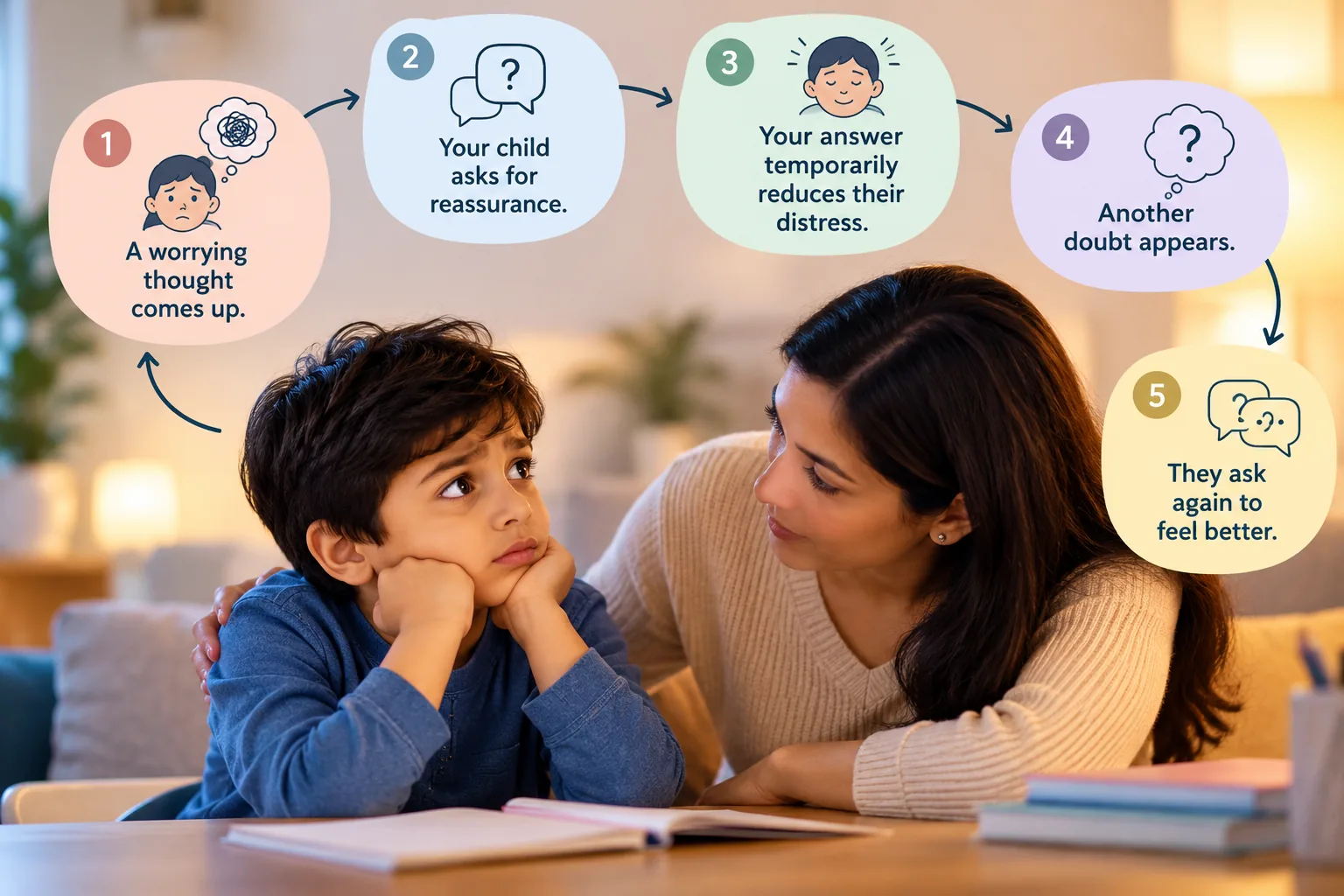
This is the reassurance cycle:
- Your child experiences a worrying thought.
- They ask you for reassurance.
- Your answer temporarily reduces their distress.
- Another doubt appears.
- They ask again to feel better.
When this happens repeatedly, your child may begin relying on your answers whenever uncertainty feels uncomfortable, rather than developing other ways to cope with the feeling.
Psychologists call it family accommodation when relatives change their behaviour to reduce a child’s anxiety, such as repeatedly answering checking questions, participating in rituals or changing routines around fears.
You reassure your child because you want to help. The difficulty is that more detailed explanations may not resolve a worry that keeps returning.
When Is Reassurance Helpful, and When Can It Become Unhelpful?
Reassurance is helpful when your child needs genuine information, safety guidance or emotional comfort. It can become unhelpful when they’re repeatedly seeking certainty about something you’ve already explained.
For example, answering your child’s question about who will pick them up from school is appropriate. If they’ve understood the plan but keep asking for guarantees because they’re afraid something might go wrong, the question may be part of an anxiety-related pattern.
Likewise, comforting your child after a frightening experience is different from repeatedly checking something to settle an intrusive doubt.
The aim isn’t to stop reassuring your child. It’s to recognise when they need support and when they may need help managing uncertainty.
How Should You Respond When Your Child Keeps Asking for Reassurance?
You can support your child without trying to answer every possible “what if.” These approaches can help you respond according to what they’re experiencing.
1. Answer genuine questions and offer comfort when needed.
If your child doesn’t understand something, explain it. If you’ve had an argument, repair the relationship. If there’s a real safety concern, address it.
Don’t treat every repeated question as a behaviour that needs correcting.
2. Acknowledge the fear without making impossible promises.
If your child asks whether something bad could happen tomorrow, you might say:
“I know you’re worried about tomorrow. You’ve prepared, and if something difficult happens, we’ll work through it.”
This offers support without guaranteeing an outcome you cannot control.
3. Help your child recognise the returning worry.
When your child asks the same question again, you could gently say:
“It sounds like that worry has come back. We talked about it earlier.”
Some children find it helpful to call these recurring doubts “what-if thoughts.” Naming the pattern may help them notice what they’re experiencing without starting another lengthy discussion about every possibility.
4. Encourage your child to take the next manageable step.
Your child may worry that their homework isn’t perfect, even after checking it.
You can help them review the instructions and decide whether it’s ready to submit instead of repeatedly checking every answer for them.
The goal is to help your child continue with ordinary activities without always needing complete certainty.
5. Discuss repeated reassurance when your child is calm.
If the same checking pattern happens frequently, talk about it outside the moment of distress.
Explain that you’re available when they need you, but you also want to help them become more comfortable managing worries.
For severe anxiety or suspected OCD, seek professional guidance before abruptly changing established reassurance routines or attempting exposure-based exercises.
When Should Parents Seek Help From a Child Psychologist?
Consider consulting a child psychologist if your child’s reassurance-seeking causes significant distress or disrupts school, sleep, relationships or everyday activities. Repeated checking, intrusive thoughts or a strong need for particular answers may also warrant assessment.
A psychologist can help identify whether the behaviour relates to anxiety, perfectionism, emotional difficulties or possible OCD. Treatment may involve cognitive behavioural therapy (CBT), exposure and response prevention (ERP) for OCD, or parent-focused strategies, depending on the assessment.
At LeapHope, parents can explore online child anxiety counselling or parenting counselling. Families can also find location-specific child counselling information for India, the USA, the UK, Canada, Australia, the UAE and Singapore, subject to professional suitability and local practice requirements.
Let’s Recap
Your child may repeatedly ask for reassurance because they’re struggling with uncertainty, worried about making mistakes or looking for emotional security. When your answers provide only brief relief, the questions may become part of a recurring anxiety-related pattern.
You can help by offering genuine comfort, recognising when the same worry returns and encouraging manageable steps towards coping with uncertainty. If the behaviour significantly affects daily life, a child psychologist can help identify the underlying difficulty.
Resources and Research
- AnxietyBC. How to Address Excessive Reassurance Seeking. Parent guidance hosted by the University of Reading. Read the guide.
- International OCD Foundation. Raising Resilience: 25 Tips for Parenting Your Child with Anxiety or OCD.
- International OCD Foundation. Talking to Kids about Distressing Times.
- Lebowitz, E. R., Marin, C., Martino, A., Shimshoni, Y., & Silverman, W. K. (2020). Parent-Based Treatment as Efficacious as Cognitive-Behavioral Therapy for Childhood Anxiety: A Randomized Noninferiority Study of Supportive Parenting for Anxious Childhood Emotions. Journal of the American Academy of Child & Adolescent Psychiatry, 59(3), 362–372.