Last Updated on October 15, 2026
Clinically Reviewed By: Mansi More Nopany, RCI Clinical Psychologist
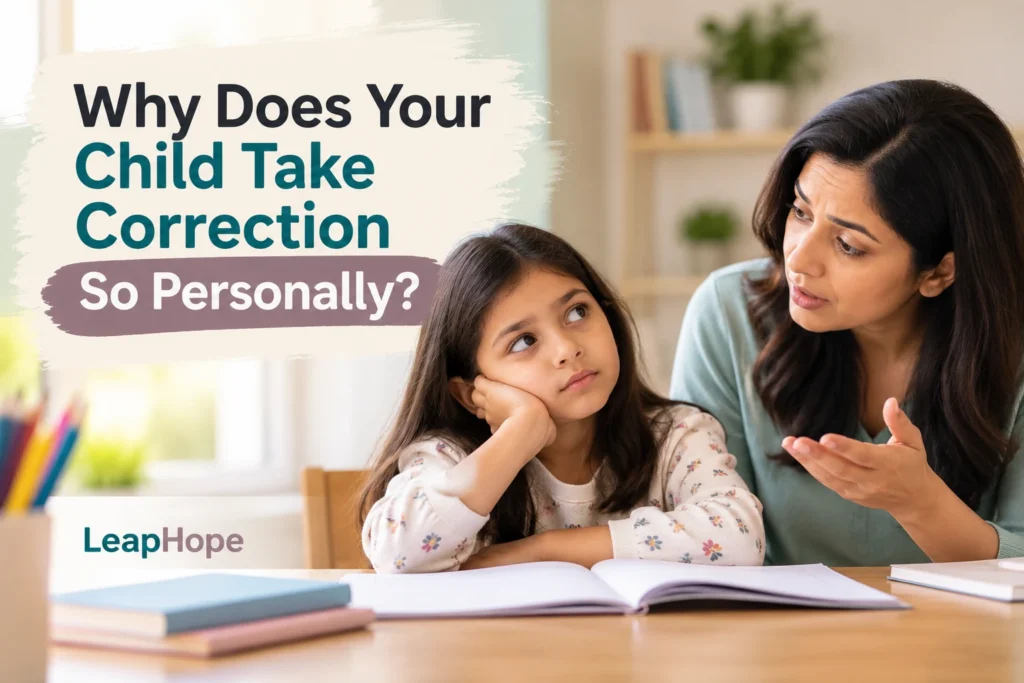
You point out a small mistake, ask your child to change a behaviour or suggest doing something differently.
Instead of simply accepting it, they become upset, defensive, quiet or frustrated.
One child may hear, “Please check this again,” and move on. Another may hear the same words and feel embarrassed or disappointed.
Every child is different. Temperament, emotional sensitivity, confidence, stress and what else is happening that day can all affect how a child responds to correction.
A strong reaction does not automatically mean something is clinically wrong.
Reasons Some Children Take Correction Personally
There is rarely one explanation. The same child may even react differently depending on the situation, who is correcting them and how they are feeling at the time.
They May Be More Sensitive to Disapproval
Some children notice changes in tone, facial expression or mood very quickly.
A parent may simply be correcting a behaviour, while the child also notices:
“Dad sounds disappointed.”
“Mum looks annoyed.”
“My teacher thinks I did badly.”
This does not necessarily mean the child is emotionally immature. Children naturally differ in how strongly they respond to social and emotional cues.
They May Already Be Tired, Frustrated or Overwhelmed
A child who normally accepts feedback may react very differently after a difficult school day, poor sleep or an already frustrating situation.
Sometimes the correction itself is small.
It simply arrives when the child is already carrying other emotions.
They May Care a Lot About Getting Things Right
Some children place a lot of importance on doing well.
A correction may therefore feel more disappointing than a parent expects.
Instead of thinking:
“I made one mistake.”
the child may think:
“I got it wrong again.”
When fear of mistakes and harsh self-criticism become a wider pattern, parents may also notice signs discussed in perfectionism in children.
But being upset after correction alone does not mean a child is a perfectionist.
They May Hear Something Different From What You Intended
Parents and children do not always understand the same conversation in the same way.
A parent may mean:
“This behaviour needs to change.”
The child may hear:
“You think I am bad.”
A parent may mean:
“Try this again.”
The child may understand:
“You think I cannot do it properly.”
Children can react to what they believe the correction means, not only to the exact words that were spoken.
The Way Correction Is Given Can Matter
There is an important difference between correcting what happened and describing the child.
Compare:
“You’re so careless.”
with:
“You missed this part. Check it once more.”
The first turns the mistake into a description of the child. The second keeps the feedback focused on the task.
In a study of 5- to 6-year-olds, children who received person-focused criticism showed more self-blame and helpless responses after setbacks than children who received process-focused criticism. Read the research on PubMed.
The lesson is not to stop correcting children.
It is to correct what happened without turning it into a description of who the child is.
They May Already Have Heard a Lot of Correction
A strong response may also happen when the child has already received several reminders or corrections that day.
They may have heard:
“Finish your homework.”
“Stop interrupting.”
“Put your things away.”
“Please listen.”
By the next correction, frustration may already be high.
This does not mean parents should stop setting limits. Frequency and timing can simply change how feedback is received.

Does This Mean Something Is Clinically Wrong With Your Child?
Not necessarily.
Children differ in temperament, sensitivity, confidence and how they respond to mistakes or feedback.
Getting upset after correction by itself does not mean a child has a psychological condition.
It becomes more worth paying attention to when the pattern is frequent, intense or starts affecting confidence, learning, relationships or everyday life.
Sensitivity to correction can sometimes appear alongside anxiety, perfectionistic concerns or low self-esteem, but this behaviour alone cannot tell parents what the cause is.
If negative self-talk and self-doubt are becoming more general, parents may also want to read about signs of low self-esteem in children.
When Should You Talk to a Child Psychologist?
You do not need to wait until you think your child has a psychological problem.
If you are worried about how strongly your child reacts to correction, you can speak with a child psychologist for guidance, support and help understanding what may be happening.
It may be particularly useful when these reactions are happening often, affecting confidence, creating conflict at home or school, or making your child afraid to try because they may make a mistake.
A psychologist can help parents understand the pattern and decide whether any further support is needed.
LeapHope offers online child and teen counselling for families looking for professional guidance or support.
Families can also access LeapHope child counselling in India, the USA, the UAE and Canada.
Final Thoughts
Children respond to correction differently because children themselves are different.
One child may accept feedback quickly. Another may feel embarrassed, frustrated or disappointed even when the correction was reasonable.
That does not automatically mean something is wrong.
What matters is whether the reaction becomes frequent, intense or starts affecting everyday life.
Children still need boundaries, guidance and correction. The goal is to keep feedback focused on what happened, rather than turning one mistake or behaviour into a judgement about who the child is.